

Geophonic Music
Air Date: Week of June 8, 2007
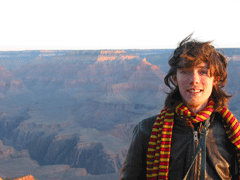
Arvid Tomayko-Peters in front of the Grand Canyon (Courtesy of Arvid Tomayko-Peters)
We've heard a lot about climate change in the news over the past few years, but how many of us have actually heard climate change itself? Composer Arvid Tomayako-Peters takes listeners on a musical voyage back through five million years of Earth's climate history.
Transcript
GELLERMAN: Well, twenty years from now Gleicians might be hearing this:
MUSIC: Arvid Tomayko-Peters “Vostok Blues”
GELLERMAN: This duet is composed from climate change records: data about carbon dioxide and ice temperatures put to music. Arvid Tomayko-Peters transforms geological data into sound using a computer program he created.
TOMAYKO-PETERS: In Geology, you have these layers stacked, one on top of the other and each one of them is a little bit different, so I approach this sort of like a score in music.
GELLERMAN: Arvid Tomayko-Peters just graduated from Brown University with a dual degree in computer music and geology. As part of his senior thesis he created the geo-music software. Living on Earth’s Ian Gray visited Arvid’s studio and produced this audio portrait.
[MUSIC PLAYING]
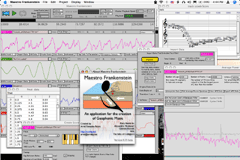
Maestro Frankenstein: the software program that Arvid Tomayko-Peters' created to write his music.
(Courtesy of Arvid Tomayko-Peters)
TOMAYKO-PETERS: Then I started to write this meistrofranksnstein software, which is a multi track sequencer for scientific data instead of music.
[MUSIC: POND CORE METAL]
TOMAYKO-PETERS: What we’re listening to is abundances of different elements then a column of mud from the bottom of a pond in Rhode Island. There’s twelve metals that we found in this mud that we’re concerned about such as chromium, arsenic and lead. Each metal is like a finger on a piano key. So in this case we have twelve fingers. You can see sort of at the end of the piece that a lot of the pitches get lower. That is an indication of less pollution because of less industry back 150 years ago when that sediment was laid down.
[KEYBOARD TAPPING]
Arvid Tomayko-Peters in front of the Grand Canyon(Courtesy of Arvid Tomayko-Peters)
[MUSIC: VOSTOK BLUES]
TOMAYKO-PETERS: So the string instrument that you’re hearing is the amount of carbon dioxide. And the tinkly xylophone-like synthesized instrument is the amount of ice. So the two instruments play opposite one another. When one is going down the other is going up through several ice ages. The time period that I’m going to play is the time that Homo sapiens has been in existence, the last about 195,000 years.
[MUSIC: VOSTOK BLUES CONTINUES]
TOMAYKO-PETERS: Now when the stringed instrument, carbon dioxide increases, there’s not very much ice. And when the pitch of this xylophone-like instrument is higher, there’s more ice on the poles. The data that I’m using here shows this really tight correlation between the amount of carbon dioxide and the amount of ice at the poles on the earth.
The latest piece I’ve been putting a lot of work into was an interactive installation, where visitors would come in and hear eight deep ocean cores being played back as sound. And it’s a very sort of ethereal piece. You come in, you listen and there’s no notes. Everything is continuous tone and just constantly changing pitch.
[MUSIC: CLIMATE CONTROL EXHIBIT]
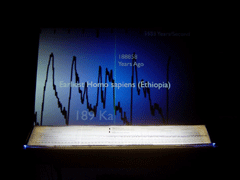
Arvid Tomayko-Peters most recent project turned data from eight deep-ocean sediment cores into an experimental geo-music exhibition. A giant screen tracked data going back 5.3 millions years and flashed events from Earth's history that corresponded to the chronology of the data--like the birth of Homo Sapiens 188,858 years ago.
(Courtesy of Arvid Tomayko-Peters)
[CLIMATE CONTROL CONTINUES]
TOMAYKO-PETERS: One of the wonderful things I think this music gives a listener a chance to do is relate to and experience this inconceivably long amount of geologic time that there have been. I mean a million years, you can’t even imagine that. And that’s just a tiny portion of the earth’s history going back 4.5 billion years. So, if you condense it down to something where you can experience that time in thirty seconds or five minutes it just sort of brings that time frame home, and makes you realize how absolutely short your existence is.
[MORE GEOLOGIC SOUNDS]
GELLERMAN: Our portrait of Arvid Tomayko-Peters was produced by Living on Earth’s Ian Gray.
Links
Living on Earth wants to hear from you!
Living on Earth
62 Calef Highway, Suite 212
Lee, NH 03861
Telephone: 617-287-4121
E-mail: comments@loe.org
Newsletter [Click here]
Donate to Living on Earth!
Living on Earth is an independent media program and relies entirely on contributions from listeners and institutions supporting public service. Please donate now to preserve an independent environmental voice.
NewsletterLiving on Earth offers a weekly delivery of the show's rundown to your mailbox. Sign up for our newsletter today!
 Sailors For The Sea: Be the change you want to sea.
 The Grantham Foundation for the Protection of the Environment: Committed to protecting and improving the health of the global environment.
 Contribute to Living on Earth and receive, as our gift to you, an archival print of one of Mark Seth Lender's extraordinary wildlife photographs. Follow the link to see Mark's current collection of photographs.
 Buy a signed copy of Mark Seth Lender's book Smeagull the Seagull & support Living on Earth
© Copyright World Media Foundation. All Rights Reserved
Home | Contact | RSS | Donate | Newsletter