

The Great Turtle Race
Air Date: Week of April 20, 2007
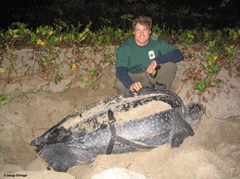
George Schillinger with a leatherback turtle. (Courtesy of George Schillinger)
The leatherback turtle is quickly approaching extinction. Now, scientists, conservationists and big business have come together to support the first Great Turtle Race to raise money and awareness about the plight of the leatherback. Host Steve Curwood talks with George Shillinger, a PhD candidate at Stanford University who came up with the idea for the race, and Johnny Glidden, a nine year old leatherback turtle enthusiast.
Transcript
CURWOOD: Sometimes Earth Day celebrations can take on the ambience of a county fair, and this year do we have a race for you! No, it’s not a harness race or even cute baby pigs chasing Oreos. This week, it’s the Great Leatherback Turtle Race. On April 16th, (the same day as the Boston Marathon) eleven massive leatherbacks set off from their nesting beach on the Pacific Ocean in Costa Rica for their favored feeding grounds near the Galapagos Islands. The turtles have each been outfitted with satellite tracking tags. Scientists are watching, of course, but these ancient and endangered beasts also have their own sponsors and cheering sections. Stanford graduate student George Shillinger came up with the idea for the race and joins us now from Pacific Grove, California.
Hello, welcome to Living on Earth!
SHILLINGER: Hello. Thank you very much for having me.
CURWOOD: And also joining us today is Johnny Glidden. Johnny attends the Hillside Elementary School in Closter, NJ. Johnny welcome to Living on Earth.
GLIDDEN: Thanks for inviting me over. This is really fun.
CURWOOD: Now Johnny I’ve met a couple leatherback turtles but I wonder if you could describe one for me?
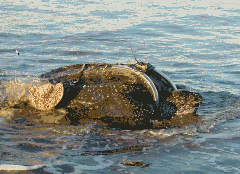
A tagged leatherback enters the water (Photo: George Schillinger)
GLIDDEN: Well, they are the biggest sea turtles and they do weigh a lot. They don’t live as long as the smaller turtles but they are very graceful and if you can see a mother laying her nest she is just driven to do it. And then they become into a trance where they just don’t stop laying eggs. So they don’t mind if someone will put a tracking device on.
CURWOOD: Now when you say big Johnny, how big is big? Is this like as big as a car or something?
GLIDDEN: Well sometimes yes. But usually about the size of half an SUV or something like that.
CURWOOD: And how long have these creatures been around, George Schillinger?
SHILLINGER: Leatherbacks have been around for about 100 million years.
CURWOOD: And how are they doing today?
George Schillinger with a leatherback turtle. (Courtesy of George Schillinger)
SHILLINGER: They are in pretty dire shape. They’re considered critically endangered. Their populations have declined in the eastern Pacific by upwards of 95 percent in the last twenty years and in the western Pacific levels of around 90 percent or so.
CURWOOD: All right well listen. I want to get onto this race now. The race has started. These turtles are going from off the Pacific coast of Costa Rica towards the Galapagos. So, ah, Johnny, which of these turtles is your favorite in this race?
GLIDDEN: Well, I have a couple favorites but I don’t think I should say them on the radio.
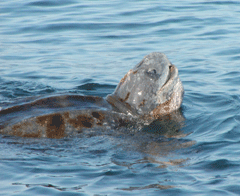
Leatherback turtle (Dermochelys coriacea) (Courtesy of Scott R. Benson/NMFS Southwest Fisheries Science Center)
CURWOOD: All right. We’ll let you keep your cards close to your chest. George can you tell us where you’re going to put your money down on this race?
SHILLINGER: Well let’s see. They’re all my favorites but I’m a big fan of Stephanie Colburtle the turtle and I really like Wendy and Billy. You know there are a couple really special turtles in this race as well. There’s the Bullis Charter School turtle, the New York Life Sciences Secondary School turtle and the Drexel turtle. And I love that these kids have gotten together and have turtles representing those institutions.
CURWOOD: You have quite an assortment of turtles in this race but there is one here that has I think has a great name for a turtle and that’s Perseverance. Tell me about this turtle Johnny.
GLIDDEN: Well, she’s the first leatherback I ever saw. I named her Perseverance because she went onto the beach and she tried to lay in a nest and three times the nest collapsed. And then it looked like she was going to go back to the ocean and another turtle came up and Perseverance then tried to dig a fourth nest, which then she got to deposit her eggs in and she then left after closing up her nest and throwing sand all over to camouflage it and um that’s why I named her Perseverance.
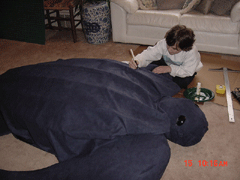
Johnny Glidden and his life-sized, stuffed, leatherback turtle, Perseverance. (Photo: Brooke Glidden)
SHILLINGER: Well truthfully, probably one their biggest challenges in years past is just getting out of the starting gate. And the beach where we work in Costa Rica, Playa Grande, is the last viable nesting beach for leatherbacks in the Pacific coast of the western hemisphere of the Americas. But once they get out of the gate they face a gauntlet of longlines and gillnets, both inshore and offshore. They face targeted hunting in certain places and they face problems with ingestion of plastics.
CURWOOD: Now Johnny, how is it that you came to care so much about the leatherback? Why is the leatherback your turtle?
GLIDDEN: Well one it’s the biggest. Two, it’s so graceful and looks so nice, and third it’s the most endangered. And since it’s the most endangered I thought I should go to it first because we don’t want it to become extinct. And just they need me.
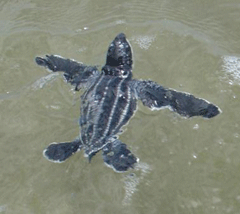
Leatherback turtle hatchling (Dermochelys coriacea)
(Courtesy of S.R. Livingstone/NMFS)
CURWOOD: Some people listening to us will say Johnny you’ve already picked your career. That in ten or 20 or 30 years from today you’re going to be known as one of the worlds most important turtle scientists. What do you think?
GLIDDEN: Well, I don’t know what I’m going to be, how popular I’m going to be, but I know I’m going to keep on working with the turtles and just I love them. I hope I can swim with them more. I just want to keep on protecting them.
CURWOOD: I want to thank you both for taking this time. Johnny Glidden attends Hillside Elementary School in Closter, New Jersey. Johnny thanks so much.
GLIDDEN: Thank you for inviting me.
CURWOOD: And George Schillinger is a doctoral student at Stanford’s Block Laboratory studying migratory predators. Thank you so much George.
SHILLINGER: Thank you very much for having Johnny and me.
CURWOOD: Johnny, do you have a cheer for turtles for us here?
GLIDDEN: Well, all I want to say is go leatherbacks!
[MUSIC: Phil Leadbetter “Happy Together (Instrumental)” from ‘Philibuster’ (Rounder – 1999)]
CURWOOD: And you can choose your own favorite for the Great Leatherback Turtle Race… go to a link on our website loe.org.
Links
Sea Turtle Restoration Project
Living on Earth wants to hear from you!
Living on Earth
62 Calef Highway, Suite 212
Lee, NH 03861
Telephone: 617-287-4121
E-mail: comments@loe.org
Newsletter [Click here]
Donate to Living on Earth!
Living on Earth is an independent media program and relies entirely on contributions from listeners and institutions supporting public service. Please donate now to preserve an independent environmental voice.
NewsletterLiving on Earth offers a weekly delivery of the show's rundown to your mailbox. Sign up for our newsletter today!
 Sailors For The Sea: Be the change you want to sea.
 The Grantham Foundation for the Protection of the Environment: Committed to protecting and improving the health of the global environment.
 Contribute to Living on Earth and receive, as our gift to you, an archival print of one of Mark Seth Lender's extraordinary wildlife photographs. Follow the link to see Mark's current collection of photographs.
 Buy a signed copy of Mark Seth Lender's book Smeagull the Seagull & support Living on Earth
© Copyright World Media Foundation. All Rights Reserved
Home | Contact | RSS | Donate | Newsletter