

Microbe's Big Role
Air Date: Week of March 30, 2007
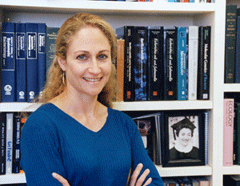
Professor Joe Handelsman (Courtesy of the University of Wisconsin-Madison)
A committee from the National Academy of Sciences has issued a report calling on the federal government to fund a ten-year effort to study the genomes of microbe communities. “Metagenomics” is a new field which analyzes the role micro-organisms play in regulating the health of the planet. Living on Earth’s Ian Gray reports.
Transcript
GELLERMAN: In the 1990’s the federally funded Human Genome Project set out to map every strand of human DNA. It succeeded and vastly increased our understanding of how genes function.
Now the study of genes is moving toward a new frontier. A committee of the National Academy of Science has just released a report on a brand new field that promises profound insights into the little known world of microorganisms. Living on Earth’s Ian Gray has this introduction to the brave new world of metagenomics.
GRAY: Remember the saying that it’s the little things that hurt? Well, it turns out that little things also help and some little things help out a lot.
HANDELSMAN: Microbes are incredibly important they run essentially every process on earth either directly or indirectly.
GRAY: That's Jo Handelsman. She’s a microbiologist at the University of Wisconsin in Madison. She studies the bacteria, algae, archaea and other tiny creatures that together are known as microorganisms—or microbes.
Professor Joe Handelsman (Courtesy of the University of Wisconsin-Madison)
GRAY: And less is known about microbes than just about any other forms of life on earth. What is known is that there’s a tremendous amount of microbial life out there and that a lot of it provides services and performs functions that are very useful to humans. Microbes help in the digestion of food, they process sewage, they even can help clean oil spills.
That’s why Handelsman is so excited about the possibilities presented by the new field of Metagenomics.
HANDELSMAN: Metagenomics may be the most important event in microbiology since the invention of the microscope. And although that sounds extreme, it is an entirely new way of studying microorganisms and it gives us a completely different picture than by any of the previous methods that we use.
GRAY: Until recently, microbes, and what microbes do, were generally studied in isolation, one by one, in a lab, often by splicing up and studying their DNA. But metagenomics takes samples of an entire local ecosystem and examines all of the microbes that live there together. Essentially, it looks at their collective genome.
HANDELSMAN: The biggest difference of metagenomics and sequencing an individual species like the human genome or a plant genome is the complexity of the DNA. We may have millions of different types of bacteria or microorganisms in a single sample.
GRAY: By analyzing the DNA of all microorganisms, in a teaspoon of soil for instance, scientists can determine how many new species the sample contains. Then begins the laborious process of figuring out what all the genes actually do, what proteins they code for and what functions they serve.
Metagenomics has emerged as recent breakthroughs in technology that have made it far cheaper and easier to sequence genes. One of the people responsible for this is Craig Venter, the scientist who raced the federal government to be the first to map the human genome. Venter’s lab perfected a method of genetic analysis called “shotgun sequencing” that allows thousands of strands of DNA to be analyzed at once.
Now Venter’s helping to mainstream metagenomics by living one of its basic principles: he’s gotten out of the lab and into the environment.
VENTER: We’re in the Sea of Cortez and we’re just heading around an island out to sea to sail further down toward the Pacific Ocean.
GRAY: Not a man of small ambitions, Venter is now circling the globe in his ship, the Sorcerer Two, collecting microbial life from the ocean.
His method is simple: Every 200 miles, they haul up a few buckets of seawater. Then, they take all of the organisms in the bucket, most of them invisible to the human eye, and use shotgun sequencing to fragment and read their DNA.
VENTER: The main question was whether we’d find unique diversity, everywhere we looked, or whether what many people thought that the ocean was just one giant homogenous soup.
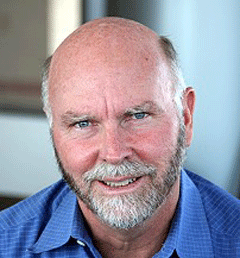
J. Craig Venter (Courtesy of U.S. EPA)
VENTER: We found that 85% of the sequences from each site assembled were unique which means that the relative organisms that are there are totally unique to those sites, you know, each two hundred liters of sea water can have 40,000 new species in it that we haven’t seen
GRAY: Now the trick is figuring out how to organize—and analyze—all this data. Metagenomics gives scientists an idea of the number of genes and organisms in a micro-community, but so far it doesn’t help them figure out which genes belong to which organisms what those genes do or what functions those microbes perform.
Jo Handelsman of the University of Wisconsin says that’s a huge challenge.
HANDELSMAN: that’s one of the big road-blocks in metagenomics is taking all of that information about the DNA and putting it back together in some meaningful whole that tells us about the physiology of the community and how it functions and what its life is like, what it responds to, what kind of factors affect it from the outside?
GRAY: Craig Venter’s group is hoping to get a jump on that challenge they’ve helped set up a new database at the University of California at San Diego to house material from the Sorcerer Two expedition. Along with the new genes they’ve discovered, the database includes information like the location of where the sample was collected and the temperature, pH and salinity of the water from which it was taken.
Now a panel from the National Academy of Sciences is calling on the federal government to fund a new ten-year Global Metagenomics Initiative, similar in scale to the Human Genome Project of the last decade. Microbiologist Jo Handelsman was co-chair of the committee. She says metagenomics has the potential to revolutionize our understanding of the world.
HANDELSMAN: It sometimes feels, as a biologist, like we’re just opening the door on biology for the first time.
GRAY: And on the other side of that door, Handelsman says, lies a far deeper understanding of the role that microorganisms play in the environment. Ahead as well she believes may be new ways of harnessing the power of microbes to help tackle problems in human health, food production, pollution and even global warming.
For Living on Earth, I’m Ian Gray.
[MUSIC: “Purer, Softer, Deader?” from ‘Kitchen Motors Family Album’ (Kitchen Motors – 2007)]
Links
Living on Earth wants to hear from you!
Living on Earth
62 Calef Highway, Suite 212
Lee, NH 03861
Telephone: 617-287-4121
E-mail: comments@loe.org
Newsletter [Click here]
Donate to Living on Earth!
Living on Earth is an independent media program and relies entirely on contributions from listeners and institutions supporting public service. Please donate now to preserve an independent environmental voice.
NewsletterLiving on Earth offers a weekly delivery of the show's rundown to your mailbox. Sign up for our newsletter today!
 Sailors For The Sea: Be the change you want to sea.
 The Grantham Foundation for the Protection of the Environment: Committed to protecting and improving the health of the global environment.
 Contribute to Living on Earth and receive, as our gift to you, an archival print of one of Mark Seth Lender's extraordinary wildlife photographs. Follow the link to see Mark's current collection of photographs.
 Buy a signed copy of Mark Seth Lender's book Smeagull the Seagull & support Living on Earth
© Copyright World Media Foundation. All Rights Reserved
Home | Contact | RSS | Donate | Newsletter