

Limiting Federal Regulators
Air Date: Week of February 2, 2007
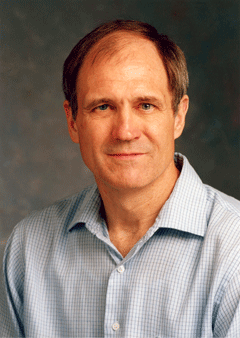
Tom McGarity is a Professor of Law at University of Texas, Austin and the President for the Center for Progressive Reform. (Courtesy of the University of Texas, Austin School of Law)
Living on Earth's host Steve Curwood talks with Texas University, Austin Law Professor Tom McGarity about President Bush’s executive order that will increase White House control over agencies such as the Environmental Protection Agency and the Occupational Safety and Health Administration. Professor McGarity says the new directive will change federal agencies’ ability to protect the environment and human health.
Transcript
CURWOOD: President Bush recently amended an executive order that limits the ability of federal agencies, such as the EPA, to create and implement regulations. The changes come as the Bush Administration faces increasing opposition to many of its policies from a Democratic Congress. Joining us to talk about the significance of these new restrictions is Tom McGarity. He’s a Professor of Law at the University of Texas, Austin and the President of the Center for Progressive Reform. Hello Professor McGarity.
McGARITY: Hello.
CURWOOD: Please characterize the President’s new executive order for us. What is it and what does it hope to accomplish?
McGARITY: Well, it’s really an amendment to an existing executive order that’s been around since the Clinton Administration and in fact has had predecessors that go back all the way to the Nixon Administration. Ah. the amendments are rather significant, however, in that they broaden the scope of the view of the White House really, through the Office of Management and Budget , over what the regulatory agencies and the, ah, federal bureaucracy can do by way of imposing new regulations on regulated industries.
Tom McGarity is a Professor of Law at University of Texas, Austin and the President for the Center for Progressive Reform. (Courtesy of the University of Texas, Austin School of Law)
CURWOOD: Yeah, if you could walk me through some of these new restrictions. For example let me ask you about the language in the new rule that states that when agencies plan on issuing a new regulation they have to prove that it addresses a specific quote “market failure.”
McGARITY: This is putting the burden on an agency before it can protect or issue a regulation that would protect human beings, or the environment, to identify as you say some failure of the market. Now a market failure is a situation in which the free market functions poorly. That is, for some reason their prices of a product don’t reflect all of the costs that the manufacturer impose. So this really begins from an assumption or a presumption that the market works well, and that government intervention is only justified in those, sort of, rare occasions when the market somehow fails us.
CURWOOD: What agencies would be most affected by this new rule? Can you give me an example?
McGARITY: Sure I mean, the Environmental Protection Agency first of all is probably the primary target of this rule. I would say that the Occupational Safety and Health Administration is a target of this rule too; could be the National Highway Traffic Safety Administration and the Department of Transportation which regulates cars and, ah, fuel economy standards. That may be what they’re trying to be sure that the agencies toe the line with the White House on things like fuel economy and auto safety.
CURWOOD: So what is the overall aim of this executive order?
McGARITY: Well it clearly represents an attempt by a president whose party has just lost Congress, ah, to assert control over the bureaucracy. And it requires rule-making initiative to get a sign off from a regulatory policy officer who is, I take it, kind of the OMB’s person in the agencies now. So it’s an effort by the White House to reach fairly deeply into the regulatory process and this is very unusual. Um, and of course the burden on the agency to identify market failure is going to mean that they’re going to be less likely to promulgate regulations in the future.
CURWOOD: Looking over, ah, the concerns that the Bush Administration has about bureaucracy what points of agreement do you have with them? Where does this executive order actually help relieve a bloated regulatory process in your mind?
McGARITY: Well, certainly management of a bureaucracy is important. Certainly bureaucracies need to be held politically accountable. And the entity to hold bureaucracies politically accountable is the White House. On the other hand to talk about a bloated bureaucracy putting a lot of, ah, constraints on the business community is simply talk of a generation ago. It’s the sort of thing that may have had some traction and credence during the Carter Administration when the environmental laws were first being enacted and EPA was out there very vigorously going about, perhaps over-vigorously, going about its business, and certainly OSHA was doing the same thing. Um, the argument simply doesn’t hold these days. The Occupational Safety and Health Administration has not issued a single significant regulation in the last six years. So it really doesn’t need constraining.
CURWOOD: Now somebody listening to our conversation might be thinking you know this is all pretty technical stuff, regulations, agencies bureaucracies. They’re going to need another cup of coffee to stay awake. How does this affect the average person on the street in America?
McGARITY: Regulation affects everything that we do. It affects virtually every aspect of our lives; from the food we eat, to the air we breathe, to the water we drink, to the vacation ah, that we’re planning in the woods, or on the ski slopes, to ultimately the national security. And the fact is that, ah, administrative agencies really matter. And if they weren’t there you’d know it really quickly because this market place is quite prone to failure. And people will be harmed. The food they eat will not be safe. The water they drink will have toxins in it. So I think that, as boring as it may be, it is absolutely a vital interest to everyone out there.
CURWOOD: Tom McGarity is professor of law at the University of Texas Austin also president of the Center for Progressive Reform. Thank you so much for taking this time sir.
McGARITY: Well, thank you for having me.
Links
Living on Earth wants to hear from you!
Living on Earth
62 Calef Highway, Suite 212
Lee, NH 03861
Telephone: 617-287-4121
E-mail: comments@loe.org
Newsletter [Click here]
Donate to Living on Earth!
Living on Earth is an independent media program and relies entirely on contributions from listeners and institutions supporting public service. Please donate now to preserve an independent environmental voice.
NewsletterLiving on Earth offers a weekly delivery of the show's rundown to your mailbox. Sign up for our newsletter today!
 Sailors For The Sea: Be the change you want to sea.
 The Grantham Foundation for the Protection of the Environment: Committed to protecting and improving the health of the global environment.
 Contribute to Living on Earth and receive, as our gift to you, an archival print of one of Mark Seth Lender's extraordinary wildlife photographs. Follow the link to see Mark's current collection of photographs.
 Buy a signed copy of Mark Seth Lender's book Smeagull the Seagull & support Living on Earth
© Copyright World Media Foundation. All Rights Reserved
Home | Contact | RSS | Donate | Newsletter