
No Pet Left Behind
Air Date: Week of October 13, 2006
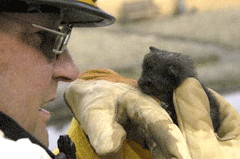
New Orleans, LA, 9-16-05 (Photo: Marvin Nauman/FEMA)
President Bush just signed legislation that requires states to have an emergency evacuation plan for pets, as well as people. Host Steve Curwood talks with Allen and Linda Anderson, authors of "Rescued: Saving Animals from Disaster" about the new animal rescue law.
Transcript
CURWOOD: After last years tragic hurricanes, President Bush said if he was ever forced to evacuate, the one thing he'd take would be his Scottish Terrier, Barney. And the president is not alone. According to a recent poll, sixty percent of Americans said they'd refuse to leave their homes if they couldn't take their pets. Well, in the future, presidents and American residents won't have to choose between evacuating and abandoning Fluffy and Fido. That’s because earlier this month George Bush signed a bill that requires officials to include pets in their disaster plans. The law ...leaving no animal left behind...is appropriately called: “PETS”: The Pets Evacuation and Transportation Standards Act. Joining me to discuss PETS are Allen and Linda Anderson, authors of the new book “Rescued; Saving Animals from Disaster”. Welcome to Living on Earth.
New Orleans, LA, 9-16-05. (Photo: Marvin Nauman/FEMA)
A. ANDERSON: Hi.
CURWOOD: This piece of legislation just flew through Congress. It passed the House and Senate virtually unanimously. Why do you suppose that was?
A. ANDERSON: Well the idea here is that people love their pets and people vote. And the President loves his dog, Barney. And as we all know from the trauma that we saw in the Gulf Coast, taking your pets with you and making sure there’s plans for evacuation-dual evacuation of people and pets during a crisis- is the only way to go in this country when pets are considered members of the family.
L. ANDERSON: Rescue a pet and you’ve rescued a family.
CURWOOD: Now specifically, what does the law do?
L. ANDERSON: What it does is it says that each state must have a disaster evacuation plan that includes pets. One of the best features of this law is that there is now money behind it. That will enable them to have pet evacuation along side human evacuation. And to set up temporary pet shelters adjacent to human shelters.
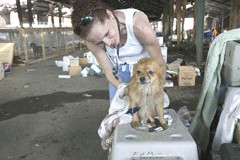
Bywater, LA., 9/18/2005 -- A Katrina volunteer dries a lost pet at a temporary animal clinic. (Photo: Andrea Booher/FEMA)
A. ANDERSON: I can see the point of view of, “I need to rescue this person and I want to bring that individual, that lady, to safety and we’re not allowed to bring her pet.” But unfortunately many of the people that were doing the rescuing weren’t going past what they considered to be the rules and maybe making exceptions in those extreme circumstances.
CURWOOD: So, with this new law then can people expect that they’ll just never have to leave their pets behind if they’re being forced to evacuate?
L. ANDERSON: In an ideal world. This is why we constantly are bringing out this message to be individually prepared. You cannot rely on any government or any entity to take care of your pets. You have to take personal responsibility.
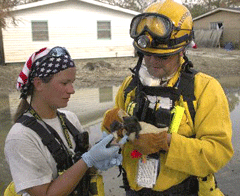
New Orleans, LA 9-16-05 -- Kathlean Baska & Roy Krueger from the "Missouri Boon County Urban Search & Rescue Task Force 1" found these kittens found while searching a house.(Photo: Marvin Nauman/FEMA)
A. ANDERSON: Do the basics: plan, prepare, and be proactive.
L. ANDERSON: You want to be able to survive for 72 hours. You want for you, your human family and your animal family, to have the food, the water, the medication. With the animals you want to have a pet evacuation kit that contains their records. You want to have a carrier for each pet. You want to have identification on the pets. It’s very good to have your animal micro-chipped.
A. ANDERSON: If your separated you need to of course have pictures in your glove compartment or anywhere on your person or so you’ll be able to identify your pet.
L. ANDERSON: Have a muzzle for your dog. That can make the difference on getting on an evacuation bus or a boat.
CURWOOD: So what happens if it comes down to a person or a pet? So six seats on the helicopter what five people and three pets?
L. ANDERSON: And one animal on your lap. We talked to people who did the most amazing things. When they had the animals on these buses and they’d finally talk a bus driver into having them on. And they’d sit there and they’d have a dog between their legs and a cat on their lap, a bird on their shoulder, what ever it took, a snake in the bag. Whatever it was that they needed. They managed to get those animals out of there.
CURWOOD: Allan and Linda Anderson’s new book is “Rescued; Saving Animals From Disaster: Life Changing Stories and Practical Suggestions.” Thank you both.
L. ANDERSON: Thank you.
A. ANDERSON: Thank you.
Links
"Rescued: Saving Animals From Disaster" website
Louisiana Society for the Prevention of Cruelty to Animals (LA/SPCA) website
Living on Earth wants to hear from you!
Living on Earth
62 Calef Highway, Suite 212
Lee, NH 03861
Telephone: 617-287-4121
E-mail: comments@loe.org
Newsletter [Click here]
Donate to Living on Earth!
Living on Earth is an independent media program and relies entirely on contributions from listeners and institutions supporting public service. Please donate now to preserve an independent environmental voice.
NewsletterLiving on Earth offers a weekly delivery of the show's rundown to your mailbox. Sign up for our newsletter today!
 Sailors For The Sea: Be the change you want to sea.
 The Grantham Foundation for the Protection of the Environment: Committed to protecting and improving the health of the global environment.
 Contribute to Living on Earth and receive, as our gift to you, an archival print of one of Mark Seth Lender's extraordinary wildlife photographs. Follow the link to see Mark's current collection of photographs.
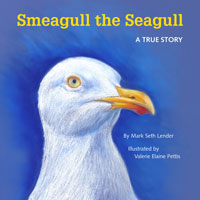 Buy a signed copy of Mark Seth Lender's book Smeagull the Seagull & support Living on Earth
© Copyright World Media Foundation. All Rights Reserved
Home | Contact | RSS | Donate | Newsletter