

Navigating Masculinity
Air Date: Week of October 13, 2006
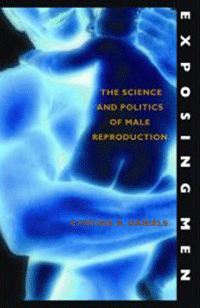
Exposing Men: The Science and Politics of Male Reproduction. (Courtesy of: Oxford University Press)
There is a growing body of scientific evidence linking men’s exposure to environmental toxins, such as cigarette smoke or herbicides, to reproductive health problems, and the health of their children. But society and the scientific world alike have been hesitant to accept the evidence, argues Cynthia Daniels in her book, "Exposing Men: The Science and Politics of Male Reproduction." Daniels is an associate professor of Political Science at Rutgers University and speaks with host Steve Curwood.
Transcript
CURWOOD: While much of the research on environmental hazards and reproductive health focuses on women, more and more research shows that men also run special risks.
Perhaps the most attention has been paid to men who were exposed to the defoliant Agent Orange while they were soldiers in Vietnam. Back home many of them fathered children with birth defects such as cerebral palsy and Spina Bifida. But as scientists have uncovered more evidence of the havoc toxic exposure can wreak on male reproductive health, little has been said about it. Cynthia Daniels hopes to change that. She has written a new book entitled “Exposing Men, the Science and Politics of Male Reproduction.”
Professor Daniels teaches Political Science at Rutgers University, hello.
DANIELS: Hello, thanks for having me.
CURWOOD: So, you’re a political scientist. What got you on to the subject of male reproductive health?
DANIELS: Well, in my previous work I had examined female reproductive health and female reproductive politics. Looking primarily at the criminal prosecution of women who had used drugs or alcohol during their pregnancy and then were criminally prosecuted for child abuse or delivering drugs to the fetus through the umbilical cord. In the course of doing that work I came across quite a substantial body of scientific research that indicated that men’s use of drugs and alcohol or men’s exposure to toxic substances could also produce harm in the children that they fathered. Increased rates of birth defects, increased rates of miscarriage. And so I was a little stunned by the fact that there was no public attention to this growing body of scientific evidence.
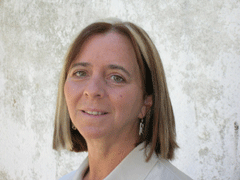
Author Cynthia R. Daniels (Photo: Katherine Daniels)
DANIELS: Well, women have historically been the property of men. So, I think we are looking at the historical vestige of the idea that we have a greater right to regulate and control the female reproductive body than the male reproductive body. And I think we still operate with this reproductive sexual division of labor where we see women as primary, it’s a cultural assumption that women have the primary responsibility for producing healthy children and caring for healthy children. And that men are really much more distant. So I think that has to do with what I see as outdated cultural assumptions about men and women’s different and disproportionate relationship to human reproduction.
CURWOOD: Perhaps as many as maybe about 15 years ago there was a lot of publicity about some research in Denmark showing that male sperm counts had dropped to, oh, maybe half of their previous levels from samples that had been taken I guess, back in the 1930’s. What was the public response to those findings and that publicity?
DANIELS: Oh, there were hundreds of newspaper stories and magazine stories about the sperm count drop. Many of them with pretty sensationalist titles like, “Sperm under Siege” and “Sperm Wars.” Many of them predicting, you know, doom and the end of the earth. It became a metaphor for what many saw as a crisis of masculinity.
CURWOOD: When these results come out the group in Denmark led by I believe it was Nils Skakkebaek and others came under tremendous attack. Why was this research group so questioned by the scientific and industrial community?
DANIELS: Well if you believe the evidence then you have to also believe that men are vulnerable to toxic harm, that men are no longer seen as the protectors of women and children, but perhaps they may even be more vulnerable to harm than women. So it undermines certain basic cultural ideals of masculinity, which I think very many people find threatening. And that, as a result, there is a great deal of both denial and panic in the public response to the evidence. I have to tell you that almost every researcher I have interviewed in relation to this book had themselves come under heavy attack every time they find positive associations between for instance male exposures to cigarette smoking for instance and increased birth defects. The response they get both from the scientific community as well as from the public at large is just, it’s just not believable. And there is still this level of denial that scientists are met with when they engage in this sort of research.
CURWOOD: So as a political scientist, where do you think we need to make changes in this society to deal with what you identify as a really serious crisis in male reproduction?
DANIELS: You know, we need to start asking the right questions. We need to start asking questions about men’s relationship to conception, to pregnancy, to childcare, child bearing. For instance the study that you had on air the other day about the association of ADHD with cigarette smoking and lead exposure. You know, I looked at that study and there were no questions asked about paternal cigarette smoking. Now how hard would it be in a study like that to ask the women not just about their own use of cigarettes but about paternal cigarette smoking. We’re not even asking the questions. Also that study indicated that there are higher rates of ADHD for baby boys, for boy children. Why then are we not asking questions about whether the male body is somehow more vulnerable to harm from lead than the female body? We seem to not even want to ask those questions.
CURWOOD: Cynthia Daniels is an associate professor of political science at Rutgers University. Her new book is called, “Exposing Men; the Science and Politics of Male Reproduction.” Thank you.
DANIELS: Thanks for having me.
Links
Living on Earth wants to hear from you!
Living on Earth
62 Calef Highway, Suite 212
Lee, NH 03861
Telephone: 617-287-4121
E-mail: comments@loe.org
Newsletter [Click here]
Donate to Living on Earth!
Living on Earth is an independent media program and relies entirely on contributions from listeners and institutions supporting public service. Please donate now to preserve an independent environmental voice.
NewsletterLiving on Earth offers a weekly delivery of the show's rundown to your mailbox. Sign up for our newsletter today!
 Sailors For The Sea: Be the change you want to sea.
 The Grantham Foundation for the Protection of the Environment: Committed to protecting and improving the health of the global environment.
 Contribute to Living on Earth and receive, as our gift to you, an archival print of one of Mark Seth Lender's extraordinary wildlife photographs. Follow the link to see Mark's current collection of photographs.
 Buy a signed copy of Mark Seth Lender's book Smeagull the Seagull & support Living on Earth
© Copyright World Media Foundation. All Rights Reserved
Home | Contact | RSS | Donate | Newsletter