

Supertanker Saftey Today
Air Date: Week of March 5, 1999
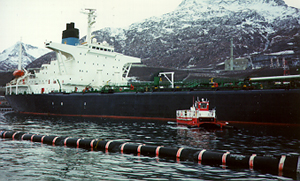
Oil Spill at Valdez Terminal: Crews respond to a recent spill from the Overseas Boston, a British Petroleum ship. A skimmer boat and crews with oil-absorbent fabric, clean-up the spill. (Photo: Terry FitzPatrick)
Congress passed sweeping laws after the Exxon spill, which forced the oil industry to invest in spill prevention and clean-up preparedness. These efforts have paid off: the number of tanker spills is dramatically lower today. We climb aboard a tanker and head to sea to examine how alcohol testing and updated navigation technology make these ships safer. However, some of the new tanker regulations do not apply to ports outside Alaska. And scientists are worried about a growing threat -- oil spills from freighters, barges, and vessels other than tankers.
Transcript
CURWOOD: Every month 50 supertankers sail from Prince William Sound to bring oil to the rest of the United States and overseas. In the wake of the Exxon Valdez, Congress passed sweeping reforms to make tankers safer and forced the industry to prepare for spills in the future. Living on Earth's Terry FitzPatrick has been investigating how well these reforms have worked. The number of US oil spills is down, but critics say the industry has a long way to go to make oil transport safe.
(Alarm and fog horns)
MAN: This is traffic, ARCO Alaska, preparing to get underway from Berth 3.
FITZPATRICK: A light snow is falling as the supertanker ARCO Alaska gets ready to sail from the Valdez oil terminal.
(Pumping)
FITZPATRICK: On deck the crew is topping off the tanks containing 38 million gallons of oil, while in the captain's cabin a unique procedure is underway.
(Whirring sounds)
MAN: Have you consumed any alcohol in the last 4 hours?
DEVINE: No.
FITZPATRICK: Valdez is the only port in America where a security guard gives the captain a Breathalyzer test. The ship cannot depart if the machine detects any trace of alcohol.
MAN: All right.
(Breathing sounds; beeps)
MAN: Thank you.
DEVINE: Okay.
FITZPATRICK: What's the number?
MAN: Point zero zero zero. Bon voyage.
FITZPATRICK: Breath tests are part of a strict new world for tanker crews. ARCO Captain Karen Devine is part of this changing culture.
DEVINE: Today's oil industry really demands a person that wants to do more than just be the salty dog. We're no longer out at sea where nobody knows us and where we do a job that nobody understands.
(Horns)
DEVINE: Rudder midship.
WOMAN: Midship, the rudder.
FITZPATRICK: As the voyage begins it's easy to spot other safety improvements.
DEVINE: Engine slow ahead.
FITZPATRICK: Tug boats now escort tankers through their entire 8-hour passage in Prince William Sound.
MAN: Steady, three zero zero.
MAN 2: Okay, thank you.
FITZPATRICK: On the bridge, there's a veritable video arcade of new navigation devices, including a computer that constantly plots the ship's location and heading on electronic maps.
(Beeping)
FITZPATRICK: A transponder automatically relays the information to a Coast Guard traffic control center.
(Beeps)
DEVINE: Let's come right to one five three.
MAN: One five three.
(Crashing waves)
FITZPATRICK: As darkness falls and the weather worsens, the importance of improved instrumentation is clear. The wind is howling and the snow is so heavy the crew can't see past the bow.
(Howling winds)
FITZPATRICK: Captain Devine peers at the glowing screen of the collision avoidance radar, as she passes the shoals where the Exxon Valdez made history.
DEVINE: Let's come right to one five zero.
MAN: Right. One five zero.
FITZPATRICK: The equipment and procedures on this ship are a direct result of Congressional action that followed the Exxon accident. According to Jim Polson, who edits a trade newsletter called the Oil Spill Intelligence Report, tanker regulations now include a powerful incentive that has forced industry to invest in spill prevention.
POLSON: The Oil Spill Act basically made it clear that if you spilled oil, you're responsible for what happens. It doesn't matter whether somebody else hit you or whether it was an act of God. It's your responsibility to deal with it.
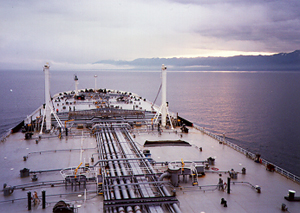
The ARCO Alaska enters Puget Sound in Washington state dawn. At 952 feet long, and 166 feet wide, its deck is large enough to hold three football fields. (Photo: Terry FitzPatrick)
(Crashing waves)
FITZPATRICK: In Puget Sound, where tankers deliver crude oil to refineries near Seattle, tug escorts aren't required for the entire trip. Local officials have been trying to develop a full escort system, but industry has resisted, claiming it isn't needed. The situation infuriates Kathy Fletcher of the environmental group People for Puget Sound.
FLETCHER: After the Exxon Valdez spill occurred, the protection system that was built in Prince William Sound exceeds the protection levels anywhere in this country and possibly anywhere in the world. The message to us is, we aren't going to be taken seriously until we have that catastrophe, and that's exactly the wrong order for these things to be done.
FITZPATRICK: The continuing struggle also involves a fight that many thought had been settled, the battle over double hulls.
(Waves crashing on hulls)
FITZPATRICK: In the bowels of a supertanker at sea, you can hear why environmentalists are concerned. Waves crashing into the bow sound like a thunderstorm.
(Crashing continues)
FITZPATRICK: Tanker hulls can bend like paper clips in heavy seas, creating hull fractures that allow oil to escape. The second skin of a double-hulled ship prevents these cracks from leaking and provides extra protection if a ship runs aground. However, 80% of the world's tankers still have single hulls. Shippers have been ordered to retire these vessels when they reach a certain age and replace them with double-hulled boats. But some companies have used loopholes to avoid the law. Right now, only one double-hulled ship is under construction in the US. Sally Lentz of the environmental group Ocean Advocates monitors the shipping industry.
LENTZ: I think they're coming up against the deadline, and they haven't necessarily prepared for it. So they're looking for ways to extend the life of their existing fleet. This is despite the fact that we have plenty of shipbuilding capacity in this country to build those double hulls. In fact, it would be a boon to the shipbuilding industry.

Reporter Terry FitzPatrick aboard the deck of the ARCO Alaska in Prince William Sound in Alaska.
BENNER: At the end of the day, safety has to be something that's achievable. We could legislate that you have quintuple hulls, and if nobody can afford to do it we aren't going to get them.
FITZPATRICK: There's widespread acceptance that eventually all tankers will be double-hulled. But the deadline for converting all ships is still more than 15 years away. Meantime, scientists have been focusing their attention away from tankers and toward other kinds of oil spills.
(Several voices speak at once)
FITZPATRICK: This is the War Room at the Seattle office of NOAA, the National Oceanic and Atmospheric Administration. Here a scientific strike team provides technical support for spill response crews nationwide. Marine biologist Alan Mearns says tankers are no longer the biggest culprit.
MEARNS: Just this week we have 1 pipeline spill, 2 blowouts from oil platforms in the Gulf, 1 freighter on a beach in Oregon. We've got 6 spills and ain't none of them are tankers. They're all something else.
FITZPATRICK: This team has studied the aftermath of the Exxon spill, and strives to avoid the mistakes which allowed that oil slick to wash ashore. Scientists have developed a new set of technology and tactics to keep oil off the beach. The key is to have equipment at the ready and act without delay.
(Bells and surf)
FITZPATRICK: One of the biggest tests for this aggressive approach occurred early this year in Oregon, where a storm blew the freighter New Carissa onto the beach. The freighter carried 400,000 gallons of oil in its fuel tanks. As pounding surf began to crack the hull, fuel began to leak. So, officials blew holes in the tanks and dropped napalm to burn the fuel before any more could escape. Mike Szerloch is with the Oregon Department of Environmental Quality.
SZERLOCH: What would most likely go to the beach is now being transferred to the air. It is a tradeoff; we do have pollutants now in the air. However, we feel that they are less of a hazard to human health and the environment.
FITZPATRICK: About 70,000 gallons of fuel did leak, but officials considered that amount to be manageable. It was about one half of one percent of the oil spilled by the Exxon Valdez.
(Surf and horns)
FITZPATRICK: Back on the tanker ARCO Alaska, the crew gets the command to drop anchor.
(Large chains)
FITZPATRICK: It's the end of another perfect run. In fact, this ship has spilled less than a barrel of oil in 20 years of service. Captain Devine thinks the memory of the Exxon Valdez will avert future problems.
DEVINE: I think the spill affected everyone everywhere, and I would like to believe that all companies are working to prevent that kind of disaster again.
FITZPATRICK: But not everyone is so sure. Recently, there have been a couple close calls, where large tankers actually collided. To environmentalist Sally Lentz, it comes down to a question of luck. And when the industry's luck will run out.
LENTZ: There's going to be another spill. The only question is, where and how much and which ship.
(Ship horns)
FITZPATRICK: For Living on Earth, I'm Terry FitzPatrick on board the supertanker ARCO Alaska.
Living on Earth wants to hear from you!
Living on Earth
62 Calef Highway, Suite 212
Lee, NH 03861
Telephone: 617-287-4121
E-mail: comments@loe.org
Newsletter [Click here]
Donate to Living on Earth!
Living on Earth is an independent media program and relies entirely on contributions from listeners and institutions supporting public service. Please donate now to preserve an independent environmental voice.
NewsletterLiving on Earth offers a weekly delivery of the show's rundown to your mailbox. Sign up for our newsletter today!
 Sailors For The Sea: Be the change you want to sea.
 The Grantham Foundation for the Protection of the Environment: Committed to protecting and improving the health of the global environment.
 Contribute to Living on Earth and receive, as our gift to you, an archival print of one of Mark Seth Lender's extraordinary wildlife photographs. Follow the link to see Mark's current collection of photographs.
 Buy a signed copy of Mark Seth Lender's book Smeagull the Seagull & support Living on Earth
© Copyright World Media Foundation. All Rights Reserved
Home | Contact | RSS | Donate | Newsletter