

Wave of Death
Air Date: Week of March 5, 1999
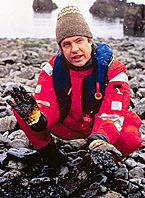
Many small communities in Prince William Sound rely on commercial fishing. Local residents and oil industry representatives disagree on how well fish stocks have recovered. (Photo: Terry FitzPatrick)
The ecology and economy of Prince William Sound were drastically affected by the spill. A wave of death washed up on 1500 miles of pristine beach. Thousands of fish, birds and marine mammals were killed. Local fishing communities and subsistence native villages were devastated. Exxon contends the ecosystem is "essentially recovered," but many scientists and local fishers disagree.
Transcript
CURWOOD: It's been 10 years since the spill. And this week we're devoting our program to the lasting legacy of the Exxon Valdez. We begin with a look at the fishing communities of Prince William Sound. Living on Earth's Peter Thomson recently traveled to the heart of the spill zone to bring us this report.
(Boat engine and chewing sounds up and under)
THOMSON: Cordova Harbor is as smooth as glass this winter morning. The town's 250 or so fishing boats are tucked into their berths, resting under a blanket of snow. The only ripples are made by a pair of sea otters munching on mussels.
(Motor and munching continues; fade to footfalls in snow up and under)
HOPKINS: This is the old gal here. Raven's child.
THOMSON: Jack Hopkins climbs aboard his boat. It's months till the next salmon season, but he wants to see how she's weathering the cold.
HOPKINS: Watch your step there, she's pretty slippery.
THOMSON: Jack Hopkins has been fishing here for 30 years. He and his Tlingit Indian
ancestors have seen a lot of changes in their time, but nothing like the shock of March of 1989.
HOPKINS: There's so much that happens in a catastrophe like that. You know, loss of income, the loss of your ecosystem that sustains your way of life, and pretty much shatters everything.
THOMSON: Exxon's poisonous cargo never actually touched Cordova's shores. But as the home of Prince William Sound's largest fishing fleet, Cordova has been called Ground Zero of the spill. And Jack Hopkins says that as the tenth anniversary approaches, his town is still feeling its effects.
HOPKINS: Well, you know, an anniversary is a time of celebration. This is more like a wake. You know, I mean, it's the time that you sit down and you kind of ponder, you know, what has happened. You just shake your head, you're just wondering when you're going to come out of this nightmare.
THOMSON: Outside the boat, jagged mountains lose themselves in the smoky gray sky, and the silver fingers of the harbor reach out around islands toward the open water of Prince William Sound. For generations of fishing families and native communities, this was the landscape of dreams. To outsiders it's still stunning, but to many Cordovans it's no longer the same.
(People milling)
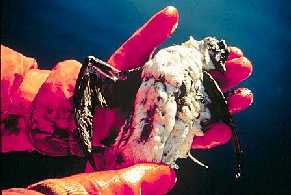
Volunteer handles oil-soaked bird. (Photo: Alaska State Archives)
THOMSON: At a cafe on Main Street, Sylvia Lange and Michelle Hahn O'Leary have shed their parkas and sat down to stay a while.
LANGE: Some tourists came to town this summer and they'd been on a cruise ship. And they said, "Well, looked clean to me," you know, we've been told it's beautiful and it's clean, and my husband just said, "Well, I guess it is, if you never go ashore and you've never been here before." It's not an event that took place 10 years ago but an event that's been going on for 10 years.
THOMSON: In their years of fishing these women learned every nuance of life in the sound before the spill. And they know the official story of the Sound today. Scientists say most of the oil is gone. Two key species, bald eagles and river otters, are considered to be fully recovered. A number of others are showing signs of improvement, including pink and red salmon, herring, clams, and murres. Researchers say still others, like loons, harbor seals, and killer whales, haven't bounced back at all. But these women say they don't need scientists to tell them what's going on. They just have to get on their boats.
LANGE: The last time I tried fishing herring, we worked for over 22 days straight and we lost money. But that wasn't the sad part. What was sad was returning to these bays that used to be so full of life. And instead of seeing maybe 50, 60 pods of sea lions I would be seeing maybe 1. Instead of seeing whales everywhere I would see none. Instead of seeing the bay boil with herring, I'd see a few herring here and there, and because the herring weren't there, the birds weren't there.
THOMSON: You can see the wounds of the spill in these women's eyes, and you can hear different versions of the same story all around town.
(Coffee pours)
THOMSON: At the offices of a local native organization, Patience Faulkner sips her coffee and looks out over the harbor. Isolated native villages were probably hardest hit by the spill, which wiped out much of their subsistence food supply and disrupted their traditional culture. Patience Faulkner says that natives who are firmly planted in the modern world have also felt the loss of old traditions built around the exchange of food from the sea.
FAULKNER: Last year our gillnet fleet didn't get any silver salmon. A friend of mine went out subsistence fishing. All he could share with me were 2 silvers. It really frightens me. When we don't have it, you know, we don't have the gatherings and we don't have the sharing. And we miss out. It's an important part of our life.
THOMSON: And Patience Faulkner says that even when commercial fishermen can catch salmon, they've had a hard time selling them.
FAULKNER: Because the market isn't there. Farm fish came in and took our little niche in the '89-'90-'91 era, and we haven't been able to capture it again.
S. MULLINS: In '88 the price of fish was what, 85 cents?
R. MULLINS: We were getting as high as $1.10 for pinks.
S. MULLINS: In '88?
R. MULLINS: In '88, yeah.
THOMSON: Sheelagh and Ross Mullins sit at their kitchen table in the warmth of an old oil heater.
S. MULLINS: Last year, oh no, it was '97, they had offered us 5 cents a pound.
R. MULLINS: Unbelievable.
S. MULLINS: Things have just been spoiled.
THOMSON: The Mullins haven't been able to knit back together the life that came unraveled 10 years ago. Ross still fishes, but says he makes less than half of what he used to. Sheelagh's still got a fishing permit but she doesn't use it.
S. MULLINS: My permit was worth $150,000. I couldn't sell it today. You know, where does that leave me? And that was my pension, my retirement.
R. MULLINS: The people that are here, a lot of them, you know, have seen some real serious economic consequences. Can't say it's 100% entirely devoted as a result of the spill, but I would say at least 50% to 75% of it is. So, there's a lot of angry people in this community still.
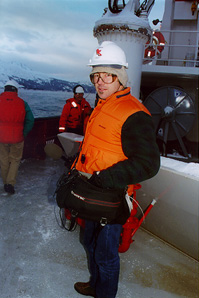
Peter Thomson onboard a new tugboat that escorts tankers in Prince William Sound. (Photo: Steve Curwood)
S. MULLINS: The social set-up here in this town, which was very supportive, just seems to be collapsing around us.
R. MULLINS: The mayor, who was the mayor shortly after the oil spill, committed suicide. A lot of people attribute it to that distress caused by the spill.
THOMSON: Sheelagh sits for a minute, then gets up and comes back with a mason jar.
(Jar being opened.)
S. MULLINS: Well, this is gravel and oil from a beach that was picked up last May. May 26, 1998. Want to smell that.
(Sniffing sounds)
THOMSON: Wow.
R. MULLINS: That's the day that Exxon made extra attempts to clean up. They went in there with a backhoe and they dug the beach up and they took it away, and this is still out there. You cannot get rid of this.
THOMSON: The gravel smells like hot asphalt from a paving crew.
S. MULLINS: That's over 9 years later, and after 3 cleanings. And I was talking to someone who had a picnic on that beach last summer. They were burning driftwood, and all of a sudden the fire took off. It had hit a pocket of oil.
THOMSON: Sheelagh puts away the jar of gravel. It's not just the lingering oil and the slow recovery of the Sound that make people feel that the spill still isn't over. In 1994, a court ordered Exxon to pay $5 billion in punitive damages to thousands of area residents. But Exxon appealed and the issue still isn't settled. The Mullins say the settlement wouldn't make up for what they've lost, but it would help.
R. MULLINS: I think it'll do a lot to get people back on their feet and give them, you know, at least the opportunity to move on with their lives.
(A dog comes in)
S. MULLINS: That's a good dog.
(Clanking, patting sounds)
THOMSON: Sheelagh and Ross's dalmatian trots in from the other room. Ross gets up and brings over another jar.
R. MULLINS: This is one of the products that's made here locally, smoked Alaskan silver salmon.
(Scraping sounds)
THOMSON: A jar of despair and a jar of hope, perhaps.
R. MULLINS: Yeah, it is good. I think that's probably one of the reasons we're still here (laughs).
THOMSON: There are fish to be had out there. Cordovans hope that over time they can rebuild a market for them, too. Already, the Mullins say, people in town are experimenting with things like specialty marketing of salmon, and they're debating ways to bring in more tourists. Despite everything they've been through, Cordovans want to stay here. But Sheelagh Mullins says sometimes it just gets to be too much.
S. MULLINS: Well, I'm leaving on Tuesday. I need to go away. I don't want to be here for this tenth anniversary. It's much too emotional. I don't know. I'll be back, because I don't seem to be able to stay away from Cordova.
THOMSON: For Living on Earth, I'm Peter Thomson in Cordova, Alaska.
Living on Earth wants to hear from you!
Living on Earth
62 Calef Highway, Suite 212
Lee, NH 03861
Telephone: 617-287-4121
E-mail: comments@loe.org
Newsletter [Click here]
Donate to Living on Earth!
Living on Earth is an independent media program and relies entirely on contributions from listeners and institutions supporting public service. Please donate now to preserve an independent environmental voice.
NewsletterLiving on Earth offers a weekly delivery of the show's rundown to your mailbox. Sign up for our newsletter today!
 Sailors For The Sea: Be the change you want to sea.
 The Grantham Foundation for the Protection of the Environment: Committed to protecting and improving the health of the global environment.
 Contribute to Living on Earth and receive, as our gift to you, an archival print of one of Mark Seth Lender's extraordinary wildlife photographs. Follow the link to see Mark's current collection of photographs.
 Buy a signed copy of Mark Seth Lender's book Smeagull the Seagull & support Living on Earth
© Copyright World Media Foundation. All Rights Reserved
Home | Contact | RSS | Donate | Newsletter