

Lasting Lessons
Air Date: Week of March 5, 1999
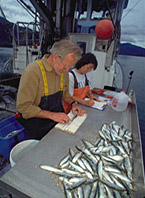
Many small communities in Prince William Sound rely on commercial fishing. Local residents and oil industry representatives disagree on how well fish stocks have recovered. (Photo: Terry FitzPatrick)
The impact of the Exxon spill reached beyond Alaska. Five authors, analysts, and activists offer poignant essays about their memories of the spill, and the significance for the nation of the tenth anniversary.
Transcript
STROHMEYER: What lessons did Alaskans learn from the oil spill? Not the ones they deserved to learn. I'm John Strohmeyer, author of Extreme Conditions: Big Oil and the Transformation of Alaska. The oil companies of course learned that spills are expensive in dollars and PR. The oil companies did upgrade their response teams and they did pledge to replace 18 ships with double-hulled tankers. But low oil prices and rampant cost cutting placed these commitments in jeopardy. The state, including its 3 powerful Congressmen, exert no visible pressure to enforce those promises, Alaska's attitude seems to be, "God did this to us once, but he wouldn't be so unfair as to do it to us again."
HUNTER: My name is Cecilia Hunter. I helped found the Alaska Conservation Society 40 years ago. A lingering effect of the Exxon oil spill is the loss of innocence. Many Alaskans believed the oil industry's promises, to use the utmost care to protect our environment. We've learned to our sorrow that oil promises are good only if they don't interfere with profits. The problem continues today. Since the spill we have seen the industry harass and fire whistle blowers who have pointed out serious maintenance and safety problems. And instead of working toward real safety, the oil companies are conducting public relation campaigns.
BAVARIA: I'm Joan Bavaria, President of Franklin Research and Development Corporation. Ten years ago my colleagues and I were drafting a set of principles which asked companies to value the health of the environment as highly as profits. Then the Exxon Valdez ran aground. That accident gave our idea greater urgency and its first name, the Valdez Principles, which was later changed to the CERES Principles. Companies which agreed to that ethic redesigned a wide range of their operating and management practices. In the decade since we've learned that this kind of corporate commitment makes a very positive difference. Over time an environmental ethic should be deeply embedded in corporate cultures. That would help ensure that disastrous shortcuts like the one taken by the Valdez crew are much less likely.
STROUP: I'm Richard Stroup, an economist at PERC, the Political Economy Research Center in Bozeman, Montana. The Exxon Valdez spill came soon after the catastrophic fires here in Yellowstone Park. Nature is recovering nicely in both places. But back then, scary close-ups of the spilled oil quickly changed to furious cleanup efforts, people blasting oiled rocks with hot water and scrubbing oily goo off sea birds. The cleanup efforts helped us feel better, but the hot water killed microorganisms that eat oil. And many scrubbed birds just died more slowly than others. Prince William Sound was already moving naturally toward a new equilibrium, equally beautiful it appears to me, but with a different balance of animals and plants. Research funded by the Exxon settlement will help us better understand nature's resilience, cause fewer such spills, and be much less destructive in reacting to future alarms.
TRIMBLE: This is Steven Trimble. I'm a writer and photographer. My home is Salt Lake City. Nearly 30 years ago I attended a hearing in Denver on a bill to preserve Alaska wilderness. As I rose to speak, a commissioner challenged me, "Have you been to Alaska?" No, I have not been there. Like Wallace Stegner, I believe that we need never see a wilderness to know it's worth saving. That the idea of such a refuge creates our geography of hope. Twenty years later, when oil and stupidity and greed soiled my dream of wildness, I was sick at heart. Feeling helpless but wanting to act, I sold my few shares of Exxon inherited and half-forgotten, and felt cleansed. Today I still write letters urging Congress to save Alaska wild lands. I still believe in acting, even if it may not make any real difference. I still think of Alaska as my shrine of wildness, and I still haven't been there.
RYAN: This is John Ryan, with Northwest Environment Watch in Seattle. I'm author of Over Our Heads: A Local Look at Global Climate. I remember the Greenpeace ad after the Exxon Valdez, with Captain Hazelwood's mug shot and the tag line, "It wasn't his driving that caused the Exxon Valdez oil spill, it was yours." Well, what was true then is truer today. We're driving more miles in vehicles that often resemble tanks. We're causing oil spills every day in our driveways, streams, and oceans. And we're spilling record amounts of petroleum byproducts, like carbon dioxide, into the air. This nonstop spill is changing our whole planet's climate. So I'd like to mark the Valdez anniversary with new campaigns to drive less. The new tag line: "Step away from the car and no one gets hurt."
Living on Earth wants to hear from you!
Living on Earth
62 Calef Highway, Suite 212
Lee, NH 03861
Telephone: 617-287-4121
E-mail: comments@loe.org
Newsletter [Click here]
Donate to Living on Earth!
Living on Earth is an independent media program and relies entirely on contributions from listeners and institutions supporting public service. Please donate now to preserve an independent environmental voice.
NewsletterLiving on Earth offers a weekly delivery of the show's rundown to your mailbox. Sign up for our newsletter today!
 Sailors For The Sea: Be the change you want to sea.
 The Grantham Foundation for the Protection of the Environment: Committed to protecting and improving the health of the global environment.
 Contribute to Living on Earth and receive, as our gift to you, an archival print of one of Mark Seth Lender's extraordinary wildlife photographs. Follow the link to see Mark's current collection of photographs.
 Buy a signed copy of Mark Seth Lender's book Smeagull the Seagull & support Living on Earth
© Copyright World Media Foundation. All Rights Reserved
Home | Contact | RSS | Donate | Newsletter