

Hard Aground
Air Date: Week of March 5, 1999
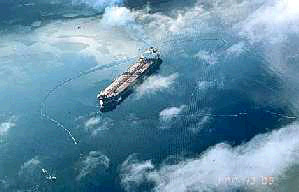
On March 24, 1989, the oil tanker Exxon Valdez ran aground in Alaska's Prince William Sound, spilling 11 million gallons of oil. (Photo: Alaska State Archives)
On March 24, 1989, the oil tanker Exxon Valdez ran aground in Alaska’s Prince William Sound. It spilled 11 million gallons of oil, the largest spill ever in the U.S. To millions of Americans, Exxon’s cleanup attempts seemed bungled, and its actions before the spill seemed reckless. The event became one of the most infamous chapters in American environmental history. This retrospective report includes archive tape of Captain Joseph Hazelwood's original radio call to the Coast Guard to report his ship was "hard aground."
Transcript
CURWOOD: This is Living on Earth. I'm Steve Curwood, coming to you this week from Prince William Sound in Alaska.
(Surf and birds continue)
CURWOOD: Alaska has some of the world's most dramatic landscapes. Here in the town of Valdez I'm surrounded by snow-covered mountains which drop thousands of feet straight into the sea. But 10 years ago the scene here was anything but beautiful. In March of 1989 Prince William Sound suffered one of history's most infamous environmental disasters.
(Horns blaring)
HAZELWOOD: Valdez traffic, Exxon Valdez, port.
COAST GUARD: This is Valdez traffic, over.
CURWOOD: It began with a midnight message to the Coast Guard from the oil tanker Exxon Valdez. The voice on ship to shore radio was Captain Joseph Hazelwood.
HAZELWOOD: Valdez back. We've fetched up hard aground.
CURWOOD: "We've fetched up hard aground," the captain said. His supertanker was stranded, bleeding oil into the sea.
HAZELWOOD: We're leaking some oil, and we're going to be here for a while.
CURWOOD: On March 24, 1989, the Exxon Valdez veered outside normal shipping lanes to avoid icebergs. It was night. But the tanker continued at full speed ahead. The ship hit a reef, ripping a half dozen holes in the hull.
LAWN: It's hard to describe the wall of death that came out from underneath the ship and spread across the Sound, and killed almost every living creature that it touched.
CURWOOD: Dan Lawn of the Alaska Department of Environmental Conservation was among the first to respond. He videotaped the ship from a small boat, describing what he saw.
(Boat motor runs)
LAWN: We're approaching the Exxon Valdez; she's hard aground.
When we got next to the ship, our boat was floating in oil. There was a wave of oil coming out from underneath the ship, that was approximately 2 or 3 feet higher than the surface of the liquid around it.
(Motor continues)
LAWN: We're looking at the hull of the ship. You can see a black oil line, right here.
The smells were, it was kind of like having your nose in the gas tank of your car.
(News music up and under)
REPORTER: The port of Valdez has been closed as the result of a massive oil spill by an Exxon tanker.
CURWOOD: News of the accident broke on local radio. It was the biggest spill ever in American waters. The official estimate: 11 million gallons of oil.
EXXON SPOKESMAN: I want to assure everyone that Exxon is mobilizing all available resources to mitigate the impact from this incident. Exxon has assumed full financial responsibility for the incident.
CURWOOD: Exxon quickly stabilized the ship, saying the crew had prevented another 40 million gallons of oil from escaping. But work was slow and disorganized when it came to cleaning up the oil that had already spilled. Containment booms and oil skimmers were broken or buried in snow. There wasn't enough equipment to handle the job. Three days of perfect weather were squandered as people argued about what to do. By the time adequate gear was flown to Alaska, it was too late.
EXXON SPOKESMAN: A problem right now is that most of the skimming equipment in the world is ineffective because we're now into the very heavy oil phase. As this sad incident has progressed, the oil has gathered a greater water content, and it's now something like the consistency of black mayonnaise.
(Surf; birds)
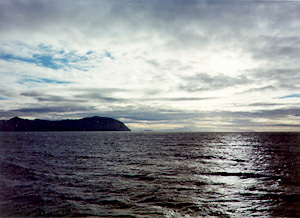
A glint of sun highlights Bligh Reef, where the Exxon Valdez ran aground. (Photo: Terry FitzPatrick)
MAN: I want to know what is the priority of Exxon? Are you really more concerned about money or the environment.
(Several people begin to shout)
MAN 2: One question at a time.
CURWOOD: Exxon officials were shouted down at a public briefing by people in the path of the growing oil slick.
WOMAN: We have a desperate plea that we'd like to put forth to the world. We need ocean standard, high seas barrier boom material to protect our fish hatcheries. We can't seem to get it through Exxon. Exxon can't deliver.
CURWOOD: These scenes played for weeks on the national news, along with heartbreaking pictured of oiled animals struggling to survive. To millions of Americans, Exxon's cleanup seemed bungled; its actions before the spill seemed reckless. Especially after this disclosure about the tanker's captain.
MAN: Exxon shipping company announced today that it has terminated the employment of Captain Joseph J. Hazelwood. The termination followed the announcement by government investigators that this employee had failed a blood alcohol test administered on the Exxon Valdez last Friday morning.
CURWOOD: Captain Hazelwood was quickly dubbed the most hated man in America. Drivers began to boycott Exxon products. The spill became a symbol of an environment under assault. Even for school children who wrote letters to students in Valdez.
CHILD: Dear Valdez friends, I really feel sorry for the animals. If only that captain wasn't drinking and he didn't put it on high speed.
CHILD 2: Dear Valdez third grader, I am sorry about the oil spill. Is your father a fisherman? If he is, it is too bad 'cause the fish are done.
CHILD 3: Dear Valdez third graders, we are sorry that the oil spilled in the sea. The man that did it made me so mad that I think he should stay in jail for the rest of his life.
Living on Earth wants to hear from you!
Living on Earth
62 Calef Highway, Suite 212
Lee, NH 03861
Telephone: 617-287-4121
E-mail: comments@loe.org
Newsletter [Click here]
Donate to Living on Earth!
Living on Earth is an independent media program and relies entirely on contributions from listeners and institutions supporting public service. Please donate now to preserve an independent environmental voice.
NewsletterLiving on Earth offers a weekly delivery of the show's rundown to your mailbox. Sign up for our newsletter today!
 Sailors For The Sea: Be the change you want to sea.
 The Grantham Foundation for the Protection of the Environment: Committed to protecting and improving the health of the global environment.
 Contribute to Living on Earth and receive, as our gift to you, an archival print of one of Mark Seth Lender's extraordinary wildlife photographs. Follow the link to see Mark's current collection of photographs.
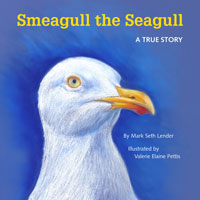 Buy a signed copy of Mark Seth Lender's book Smeagull the Seagull & support Living on Earth
© Copyright World Media Foundation. All Rights Reserved
Home | Contact | RSS | Donate | Newsletter