

Antarctica Series, Part 3: Is Global Warming Affecting Polar Ice Shelves?
Air Date: Week of April 26, 1996
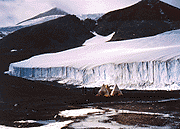
At the remote Taylor Valley Field Camp, scientists from the University of Maine are studying how periods of global warming affected the polar ice cap millions of years ago, in an effort to more fully understand the consequences of global warming today.
Terry FitzPatrick reports on the latest research into what is causing large masses of ice to break off the world's frozen continent. If uncontrolled global warming is in fact the cause, predictions forecast a significantly more watery world.
Transcript
CURWOOD: This is Living on Earth. I'm Steve Curwood. The dramatic blizzards, droughts, heat waves and hurricanes we've had in recent years have focused attention on some of the potential affects of global warming. There's another consequence of climate change, though, that in the long run could cause even greater problems worldwide. If a lot of polar ice melts in Antarctica, global sea level could rise dramatically, forcing millions of people to flee their homes. For the past 50 years, sections of Antarctica have been melting, but researchers aren't sure if it's part of a natural cycle or the result of greenhouse gas pollution from humans. Either way, the future of the ice cap is in question, as Living on Earth's Terry FitzPatrick discovered while accompanying research teams to Antarctica earlier this year.
(Winds whipping)
FITZPATRICK: No place on Earth is as cold and forbidding as the windswept interior of Antarctica, a region one and a half times the size of the United States that is draped by glaciers up to 3 miles thick.
(Wind continues)
FITZPATRICK: This frigid landscape makes a lasting impression on people who come here, even seasoned researchers like Kerry Peterson.
PETERSON: It's just you and the raw force of nature. There's the sky and there's the snow and that's it. And the horizon is just so broad, you can almost see the curvature of the Earth. I like it because you have the sense that you're really on a planet hurtling through space.
FITZPATRICK: A fragile planet, which Antarctica keeps livable. Think of Antarctica as a giant ice cube in a glass of water, cooling the world's oceans. As well, Antarctica's vast expanse of snow reflects sunlight back into space, cooling the Earth's surface. The snow fields and glaciers are also like a giant reservoir, locking up 70% of the world's fresh water and keeping global sea level in check.
(A clang; a motor runs)
FITZPATRICK: Because Antarctica plays a crucial role in shaping the world's environment, researchers are eager to learn if global warming could cause the ice cap to melt. To find out, they're drilling to the very bottom of the ice to look for clues.
PETERSON: We got -- oh, yes! Yes!MAN: That's nice.
PETERSON: All right.
FITZPATRICK: Ms. Peterson and her colleagues from the California Institute of Technology are pulling up an ice core.
PETERSON: Oh, beautiful.MAN: That's perfect.
FITZPATRICK: Three feet long and 3 inches around, this core contains a unique kind of ice formed by intense pressure inside the ice cap. The core starts to crackle as air bubbles begin to escape.
(Crackling sounds, feet on snow)
PETERSON: Oh, look at the clear ice! God, it's beautiful.ENGLEHART: This whole thing is one single crystal. Huge single crystals.
FITZPATRICK: Researcher Erman Englehardt hopes these crystals can explain why parts of the ice cap are breaking loose from Antarctica's bedrock and surging toward the ocean at the rate of 4 feet per day. Known as fast flowing streams, several of these massive rivers of ice have been discovered in western Antarctica. They have the potential to drain the entire West Antarctic ice sheet into the sea.
ENGLEHARDT: The ice streams can carry away large quantities of ice in a relatively short time. And if their movement changes, for instance, if they widen or they speed up, they can change the balance of the ice sheet dramatically. So we need to understand what controls the speed of these ice streams.
FITZPATRICK: This is where global warming might be involved. It might change how rapidly the streams empty into the ocean. Right now, the streams are kept in check by floating ice shelves that line the Antarctic coast. The floating shelves act like giant dams, holding back the streams. If global warming causes the ice shelves to melt, the ice streams would be free to race unchecked into the sea. The West Antarctic ice sheet could collapse.
ENGLEHARDT: And that could happen in a short time span like 50, 100 years, maybe 500 years. This we don't know exactly.
FITZPATRICK: In the past 50 years, 5 minor ice shelves have disappeared, the result of a 5-degree rise in temperature along the Antarctic coast. But the most important ice shelves seem stable for now. It's unclear how warm it must get before they could be in danger of melting.
(Indoor fans running)
FITZPATRICK: To find out if the West Antarctic ice sheet is likely to collapse in the future, researchers are trying to determine how it's responded to warming in the past.
(The fan continues, now with cellophane crackling)
FITZPATRICK: In a refrigerated lab, Richard Alley of Penn State University examines Antarctic ice cores beneath a microscope.
(Crackling continues)
FITZPATRICK: Just as rings in a tree reveal its age, the layers of an ice core are a window to the past.
ALLEY: And so you can say well, 10,000 years ago it snowed this much, and someone else will measure the dust and somebody will measure the composition of the gas bubbles that are trapped in the air. And we pretty soon start to draw a picture of the past climate. And so we're working very hard on reading that: what happened in the world's climate, what did that do to the ice sheets?
FITZPATRICK: Dr. Alley says the West Antarctic ice sheet has probably collapsed before and could collapse again. If it does, the massive melting of ice would raise global sea level by 20 feet. Twenty feet might not sound like much, but it's enough to inundate several small islands in the Pacific, and low-lying coastal regions in Southeast Asia, western Africa, the Middle East, and southeastern US. More than 200 million people could be forced to move. Millions of acres of farmland would be lost. Some communities would have to build extensive sea walls to protect against hurricanes and storms. However, it's not time to sell the beach house yet.
ALLEY: I wish to emphasize that this is not a prediction, this is the worst thing that could happen. And we have not yet been able to prove that it can't happen.
FITZPATRICK: Actually, there is one worse scenario which involves the eastern part of Antarctica melting along with the west. The east contains the bulk of Antarctica's ice, and if it goes, sea level could rise more than 200 feet. That would be a flood of Biblical proportions.
ALLEY: It would not be Water World, there would still be land sticking out. But the coastline would look enough different that you wouldn't immediately recognize it. You'd look for that finger of Florida pointing down there and it wouldn't be there.
(A helicopter chops)
FITZPATRICK: From the air, Eastern Antarctica looks just as frozen and desolate as the west. But there are major differences, which have sparked a scientific debate about whether it's possible for this part of the continent to melt. The eastern ice sheet is firmly fixed on high ground, and it's been that way, according to some researchers, for 15 million years. If these researchers are right, the eastern ice cap has survived several periods of global warming.
(Digging sounds)
FITZPATRICK: Other scientists, though, have uncovered evidence that East Antarctica has melted as recently as 3 million years ago.
HARWOOD: I'm trying to dig down as far as I can and see what's been accumulating here.
FITZPATRICK: David Harwood from the University of Nebraska has discovered plankton, leaves, and twigs in the Trans-Antarctic Mountains, one of the few ice-free regions of the continent. The only way they could get here, contends Dr. Harwood, is for the eastern ice to have melted, raising sea level and turning much of inland Antarctica into a beach.
HARWOOD: And the evidence that we're debating now would suggest that once those ice sheets formed, that they didn't stay, that they came and went and came and went.
(Digging sounds continue)
FITZPATRICK: Some researchers think Dr. Harwood is wrong. They believe the plankton and leaves were blown here by the wind. The debate has touched off a feud between rival camps of geologists over whose version of Antarctic history is correct. But the critical question is whether East Antarctica might melt in the future. On that point, Dr. Harwood isn't sure.
HARWOOD: The East Antarctic ice sheet in the past has been a key player. Whether or not future warming will, you know, bring Eastern Antarctica back into the game, I don't know.
FITZPATRICK: This uncertainty underscores how difficult it is to predict the future of the Antarctic ice cap. Various research panels have published widely differing views about what's likely to happen here in the next 100 years. Some scientists even think global warming could cause the ice to grow, by increasing snowfall throughout the continent. However, researchers do agree on this: Antarctica is isolated from the rest of the world but it's not immune to global environmental change. And just as importantly, we're not immune from what happens at the bottom of the Earth. For Living on Earth, this is Terry FitzPatrick reporting.
Living on Earth wants to hear from you!
Living on Earth
62 Calef Highway, Suite 212
Lee, NH 03861
Telephone: 617-287-4121
E-mail: comments@loe.org
Newsletter [Click here]
Donate to Living on Earth!
Living on Earth is an independent media program and relies entirely on contributions from listeners and institutions supporting public service. Please donate now to preserve an independent environmental voice.
NewsletterLiving on Earth offers a weekly delivery of the show's rundown to your mailbox. Sign up for our newsletter today!
 Sailors For The Sea: Be the change you want to sea.
 The Grantham Foundation for the Protection of the Environment: Committed to protecting and improving the health of the global environment.
 Contribute to Living on Earth and receive, as our gift to you, an archival print of one of Mark Seth Lender's extraordinary wildlife photographs. Follow the link to see Mark's current collection of photographs.
 Buy a signed copy of Mark Seth Lender's book Smeagull the Seagull & support Living on Earth
© Copyright World Media Foundation. All Rights Reserved
Home | Contact | RSS | Donate | Newsletter