
This Week's Show
Air Date: October 2, 2026
FULL SHOW
SEGMENTS
‘Blockbuster’ Climate Case at Supreme Court
View the page for this story
When the US Supreme Court set Monday, October 5th for oral arguments on an appeal from the Colorado State Supreme Court by Suncor and Exxon, it highlighted what could become a landmark case about damage from climate change and the role of fossil fuels. Patrick Parenteau, emeritus law professor at Vermont Law and Graduate school, speaks with Host Steve Curwood about why the case could make or break the ability of states and local governments to ‘make polluters pay.’ (11:08)
The Wild Dark: Finding the Night Sky in the Age of Light
View the page for this story
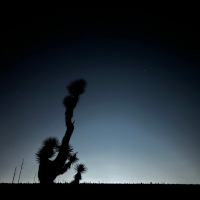
Our brightly lit modern world is increasingly drowning out the stars. To rediscover what we miss when we can’t look up and see the heavens in their full glory, award-winning author Craig Childs embarked on a journey by bike from blindingly bright Las Vegas into the dark skies of the remote Nevada desert. Craig Childs joins Host Jenni Doering to discuss his 2025 book, The Wild Dark: Finding the Night Sky in the Age of Light. (21:30)
“How to Love the Stars”
/ Jennifer JunghansView the page for this story
Being able to look up and see stars is something to be treasured in our modern age. And for writer Jennifer Junghans, a connection to the stars is also a connection to her dad. (03:37)
State Elections and the Climate
/ Dan GearinoView the page for this story
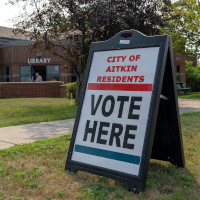
Much is at stake for the climate and environmental protection when it comes to this fall’s Congressional and Senate races, in the middle of the second Trump presidency. But the often-overlooked elections for state legislatures and governors can also go a long way towards shaping the future of these issues. Dan Gearino, clean energy reporter with our media partner, Inside Climate News, joins Host Jenni Doering to discuss a few key states to watch. (09:48)
Show Credits and Funders
Show Transcript
261002 Transcript
HOSTS: Steve Curwood, Jenni Doering
GUESTS: Craig Childs, Jennifer Junghans, Pat Parenteau
REPORTERS: Dan Gearino
[THEME]
CURWOOD: From PRX – this is Living On Earth.
[THEME]
CURWOOD: I’m Steve Curwood.
DOERING: And I’m Jenni Doering.
The US Supreme Court takes up a case with big implications for who pays for climate costs.
PARENTEAU: This is a blockbuster case on the court's docket for this term, and what it relates to is the ability of local governments seeking compensation from major oil companies like Exxon and Suncor for climate damage.
CURWOOD: Also, escaping the brightest city to find the darkest night.
CHILDS: When you're in these, like Bortle one skies, it's not flat, it's three dimensional. You're not looking at a picture, you're looking at depth, you're looking at light years, and you can really feel it. You can feel distances between stars.
CURWOOD: Plus how the midterms could matter and more, this week on Living on Earth. Stick around!
[NEWSBREAK MUSIC: Boards Of Canada “Zoetrope” from “In A Beautiful Place Out In The Country” (Warp Records 2000)]
[THEME]
‘Blockbuster’ Climate Case at Supreme Court
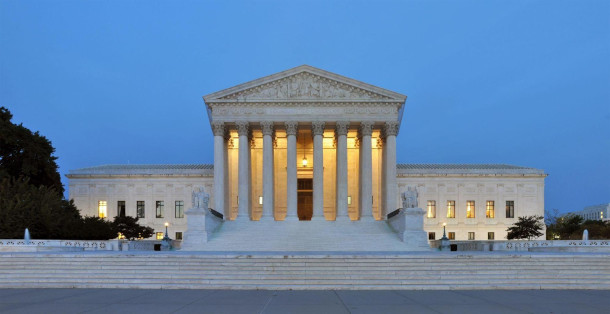
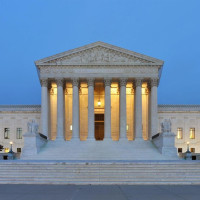
Oral arguments for Suncor Energy Inc. v. County Commissioners of Boulder County are scheduled for Monday, October 5, 2026, at the U.S. Supreme Court. (Picture: Joe Ravi, Wikimedia Commons, CC BY SA 3.0)
DOERING: From PRX and the Jennifer and Ted Stanley Studios at the University of Massachusetts Boston, this is Living on Earth. I’m Jenni Doering
CURWOOD: And I’m Steve Curwood.
When the US Supreme Court set Monday, October 5th for oral arguments on an appeal from the Colorado State Supreme Court by Suncor and Exxon, it highlighted what could become a landmark case about damage from climate change and the role of fossil fuels. Adding to the Monday courtroom drama is the absence of Justice Samuel Alito, who recused himself just days before the session. Here to explain it all is Patrick Parenteau, emeritus law professor at Vermont Law and Graduate school. Welcome back, Pat.
PARENTEAU: Thanks, Steve. It's good to be with you.
CURWOOD: So, what is this Suncor case at the Supreme Court, and what's at stake for the environment, in your view?
PARENTEAU: Yeah. So, this is a blockbuster case on the court's docket for this term, and what it relates to is the ability of local governments, in this case, Boulder County and City of Boulder, Colorado, seeking compensation from major oil companies like Exxon and Suncor for climate damage, and the money that would be gained through lawsuits like this would be used to fund adaptation for the climate damages that are, of course, accelerating. In Boulder's case, it's wildfires and floods and drought, that sort of thing, and there are over two dozen of these cases pending across the country right now in state court. So the Supreme Court has finally decided to take up the question: Are all of these cases barred by federal law? So the stakes are billions of dollars, and what would happen if the oil companies succeed is all of that money would land on taxpayers all across the country. That's really what's at stake.
CURWOOD: And if it doesn't, of course, then the fossil fuel companies would have to pay, I gather.
PARENTEAU: That's right, and it's a fair share kind of liability calculation. You look at how much each one of these companies has contributed to global pollution, carbon dioxide, and other pollution, and you assign to them their individual share. So, in no way is this going to cover all of the costs of climate damage, not even close. But the question is: Are these companies going to be held accountable for any of it?
CURWOOD: Now, the city of Boulder brought the case in state court in Colorado. So, in essence, in part, to what extent is this case about the rights of states to protect their inhabitants if the federal government does not, because last time I looked, the federal government was not charging the fossil fuel companies for any damage they might have caused.
PARENTEAU: Well, that's correct. There's no federal law that would impose liability on these companies at all. So yes, it's in state court, and yes, it's a matter of state sovereignty. You know, a negative decision in this case would have far-ranging implications for the rights of states to protect their citizens from corporate malfeasance. That's what we're talking about. We'll get to it. Corporate lying, corporate deliberate actions that made the climate situation worse and that prevented states from preparing for it for many decades, right? That's what's at stake. So, if the court sides with the oil companies, they are siding against state sovereignty.
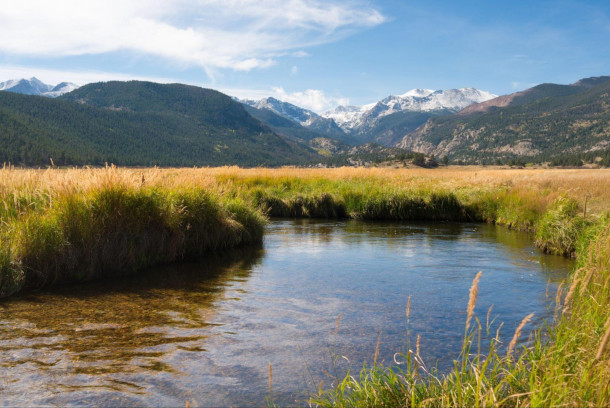
Moraine Park Valley in Rocky Mountain National Park, Colorado. Rocky Mountain National Park is a protected area partially within Boulder County, along with neighboring Larimer County and Grand County. In 2018, Boulder's city and county governments filed a lawsuit against ExxonMobil and Suncor Energy, alleging that fossil fuel companies misled the public about the climatic effects of their products. (Photo: Frank Schulenburg, Wikimedia Commons, CC BY SA 4.0)
CURWOOD: Now, back in 2023, the U.S. Supreme Court denied hearing an issue related to this case. How is the Supreme Court back in it this time, and what does it mean now that they have taken this up?
PARENTEAU: Well, it surprised a lot of us that they have previously refused to review these issues, most notably in the Hawai’i case out of Honolulu just a few years ago. And the Supreme Court technically doesn't even have jurisdiction at this point, to take up this case, and they've noted that as one of the questions that they have to deal with on October 5th, when the oral argument is going to occur in the court. You know, the court has actually said we're not sure we have jurisdiction to hear a case. There's no final judgment in this case. There may never be a final judgment. That's a long way away. A lot of the hurdles that the state has to overcome in the county of Boulder are formidable, right? Not least of which is can you actually prove that these companies did lie about what they knew about climate change, and did that actually result in the states and the counties not able to react in time to this, so there are a lot of hurdles to get to a final judgment, and there hasn't been one yet. So it is unusual, in fact, unprecedented, I would say, for the court to step into a case before it's even gone to trial.
CURWOOD: Wait a second, Pat, as I understand the folks in your profession, in a legal case, procedure can be and maybe is even more important than the facts of a case if the procedure is not being followed properly. In this case, the Supreme Court doesn't even know if it has the ability to take this case up. What's going on?
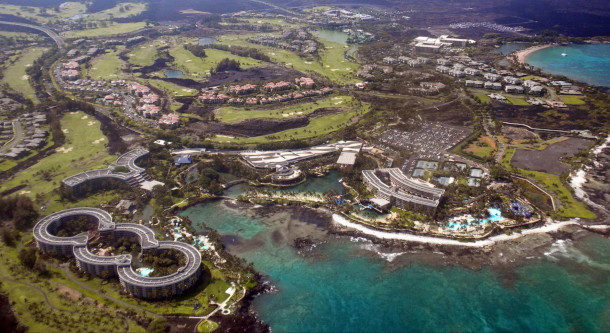
An aerial photo of the South Kohala coast on Hawai’i. Hawaii is involved in multiple climate change legal battles, including a climate accountability lawsuit that could be impacted by the U.S. Supreme Court's decision in Suncor Energy (U.S.A.) Inc. v. County Commissioners of Boulder County. (Photo: George, Wikimedia Commons, CC BY SA 3.0)
PARENTEAU: Yeah, I mean it is a puzzle, right? And it's obvious that something happened between the denial of review in Honolulu and granting review in the Boulder case, right? We don't know exactly what that was. We can guess as to why the court finally decided, well, maybe we should step in. One reason, of course, is the Trump administration, and they have reversed the position of the United States government under Biden, the Solicitor General, which was asked for her views on whether the court should take the case, said no, no, this case isn't ripe. It isn't ready for the court's review. And previously, the Supreme Court agreed with that position, so we know that a lot of pressure has been brought to bear on the court. There are over 70 amicus briefs, friend of the court briefs in this case. That's a record, okay. And everybody under the sun has a position on whether the case should be reviewed and whether the case should proceed to trial or not, and so I mean the Supreme Court is under tremendous pressure to step in, and maybe they will.
CURWOOD: So, when it comes to the arguments then, that are being planned for October 5th, what are going to be the principal questions asked then in that, that hour that's allowed to discuss a case like this?
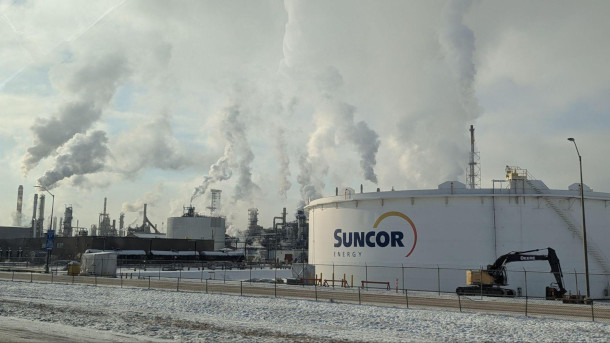
Pictured above is the Suncor Energy Edmonton Refinery which processes sands crude oil from northern Alberta. (Photo: Joli Rumi, Wikimedia Commons, CC BY-SA 4.0)
PARENTEAU: Yeah, so it's all about what we call federal preemption, whether federal law prevents the states from considering actions like this in state court. And there are two doctrines. I won't go into a long law school lecture here, I promise. But there are two basic doctrines of preemption: one, express preemption, that's where Congress has explicitly said in a statute like the Clean Air Act, which is at issue here, the states are preempted. And guess what? Congress did preempt the states when it came to motor vehicle pollution, right? Cars and trucks, except for California. There's what's called a California waiver, but otherwise, you know, the Congress knows how to preempt the states and did so in the Clean Air Act. But here's the thing: not for stationary sources like power plants and cement plants and oil and gas facilities and so forth. In fact, the Clean Air Act expressly preserves state law, preserves the right of states to pursue remedies under state common law, which is what Boulder is doing here, and you have an expression of Congress not to preempt the states. Now, the second ground of preemption is the one that I think is going to occupy most of the time, in the argument, and that is what we call implied preemption. How does that work? Number one, if state law conflicts with a federal law, well, that doesn't occur here. There's no conflict between what the Clean Air Act requires of industry. It requires it to install pollution control equipment and, and so forth. Nothing about what Boulder is seeking or the other states are seeking has anything to do with regulation of point sources of air pollution. Quite the contrary, it assumes that these point sources are going to continue putting carbon pollution to the atmosphere. It assumes that the oil companies are going to continue to produce oil and gas for some period of time, quite a bit of time actually. So no, there's no conflict with federal law. In truth, it's very hard to see where the court is going to find a precedent applying federal preemption to this particular case.
CURWOOD: You know, there is this time-honored tradition of you legal folks of reading the tea leaves at the Supreme Court. After these arguments, where do you think this particular court is going to come out? Given that Justice Samuel Alito has recused himself, and he has investments in fossil fuel companies, and likely would have supported the fossil fuel companies in this case.
PARENTEAU: Yeah, I think with Alito out, the chances for Boulder to get this case to trial have improved. I won't say it's going to be the difference in the case, that would be prejudging what the other justices are going to do, frankly. But with Alito out, you have a better working margin to get to the five votes you need to either decide we are not going to reach the merits in this case, or perhaps even we're going to decide in favor of Boulder getting to trial. Remember, the Colorado Supreme Court did not rule in favor of Boulder. It simply said you have alleged enough to get to trial, so that's really what's at issue right now in the case before the Supreme Court. Will you let this case go to trial or not? So we'll see what happens.
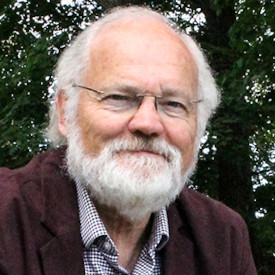
Pat Parenteau is a professor at Vermont Law and Graduate School. (Photo: Vermont Law and Graduate School)
CURWOOD: This all sounds very complicated, Pat. But what makes it so important?
PARENTEAU: Well, what makes it important is who's going to pay for these escalating damages from climate change in the multi-billion-dollar range all across the country, are you going to saddle all the communities of the United States with the full cost of paying for the damage that these companies have caused? I mean, regardless of how you feel about the need for fossil fuels, okay, the truth is, undeniably, it's their products that have brought us to this situation, and if the states are successful, it's their deception that has made matters worse and that have prevented communities from dealing with these problems long before the crises that we're seeing today. So that's what's at stake.
CURWOOD: Well, Pat, I want to thank you for taking the time with us today.
PARENTEAU: It's been a pleasure, Steve.
CURWOOD: Pat Parenteau served as EPA regional counsel under President Ronald Reagan, and he's an emeritus professor at the Vermont Law and Graduate School. Always a pleasure, Pat.
Related links:
- SCOTUSblog | “The Court’s Coming Climate-Change Case and the questions of Preemption”
- BloombergLaw | “Justice Alito Recuses From Supreme Court Suncor Climate Case (1)”
- Docket for Suncor Energy (U.S.A.) Inc., et al., Petitioners v. County Commissioners of Boulder County, et al.
[MUSIC: Slow Embrace]
CURWOOD: Coming up next on Living on Earth, a quest for the darkest skies.
[MUSIC: Slow Embrace]
ANNOUNCER: Support for Living on Earth comes from the Waverley Street Foundation, working to cultivate a healing planet with community-led programs for better food, healthy farmlands, and smarter building, energy and businesses.
[CUTAWAY MUSIC: Wes Montgomery “D-Natural Blues – Remastered 2025” on The Incredible Jazz Guitar Of Wes Montgomery (Remastered 2025), Craft Recordings]
The Wild Dark: Finding the Night Sky in the Age of Light
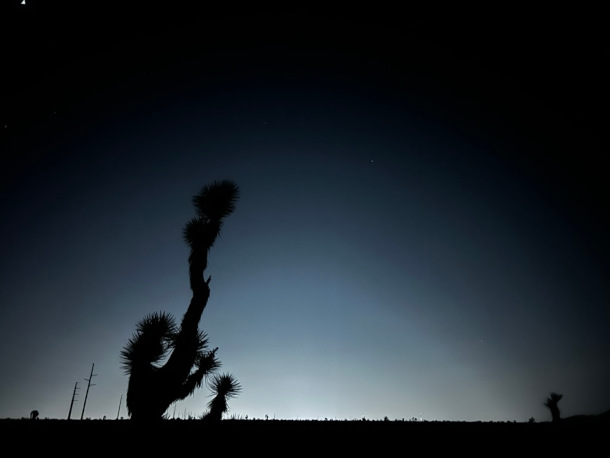
The second night of Craig Childs’ and Irvin Fox-Fernandez’s bike journey from Las Vegas to dark sky country, Bortle 8. (Photo: Craig Childs)
CURWOOD: It’s Living on Earth, I’m Steve Curwood
DOERING: And I’m Jenni Doering.
Think about the darkest sky you’ve ever seen. Did you see the Milky Way? Did starlight cast shadows? This kind of experience is becoming rare in our brightly lit world, but the stars are still out there, waiting for us to rediscover them. That’s the focus of the 2025 book, “The Wild Dark: Finding the Night Sky in the Age of Light.” Award-winning author Craig Childs joins me now from his home on the remote Colorado Plateau. Welcome back to Living on Earth, Craig!
CHILDS: Thanks. I'm really glad to be here.
DOERING: Well, we're glad to have you. So, what attracts you to the night sky and the stars, and when did you first feel this pull to reflect more on the mysteries above us?
CHILDS: I think it's impossible not to be attracted to the night sky. [LAUGHS] I think everybody is.
DOERING: Yeah.
CHILDS: That was that was kind of a nice thing about writing this, is where I thought, oh, here's something that everybody loves, even people who are disconnected from it, who don't see it. There's something intrinsic about looking up and seeing a sky full of stars. Something I wrote about in the book was when I was little, when I was five years old, I was camping out in the the woods with my mom and her boyfriend, and they took off into the night and left me on this mattress. They'd carried a full mattress out into the woods, and I was under all these blankets, and I was terrified of the dark. But then I saw the stars, and I remember that. I remember how clear they were, and and how much it calmed me down to look up and see, really to see infinity for the first time, or at least to recognize it for the first time, and to go, oh wow! I don't know what that is. I don't know what all those lights are, but there was something just deeply calming about it. To know that, that there was infinity that you could see forever, and it wasn't empty. It was just full.
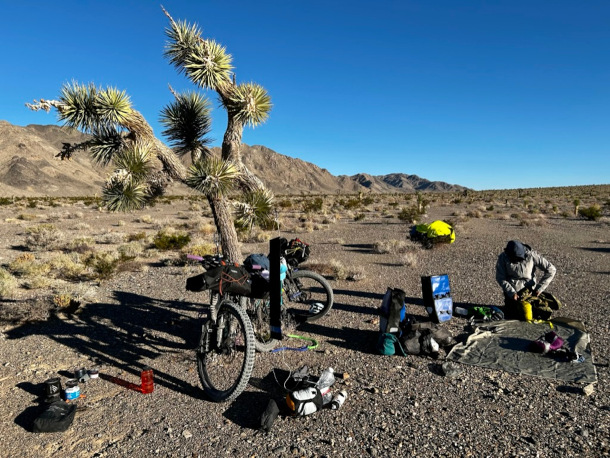
Craig and Irvin stop to camp in the Mojave desert. (Photo: Craig Childs)
DOERING: So, Craig, in this book, The Wild Dark, we follow you on this journey from one of the brightest places on Earth, Las Vegas, to one of the darkest. Why did you and your companion Irvin choose to bike through the desert to take on this quest? And what questions did you want to ponder while you were on this trip?
CHILDS: Well, you know, a bike made sense, human-powered speed, because driving out of Las Vegas, if you wanted to get to the darkest of the dark, you'd be there in three hours, and I was much more interested in the transition, in letting my eyes adjust and seeing what the different nights are like. And so that took us about 200 miles through the backcountry on fully loaded mountain bikes, self-supported. So we had everything with us, and the pace that we were going at was maybe 20 miles a day, and that was enough to make every night significantly different for nine nights. And that's, the the question I had was: What are each of these skies like? Not just the darkest, not just the brightest, but the ones in between. And how different are they?
DOERING: And of course, you mentioned the night to night change and nine days and I think you picked nine days, nine nights because there are nine different levels on this scale that we use to sort of delineate the quality of the skies at night. So what is the Bortle scale for people who haven't heard of this funny sounding thing?
CHILDS: The Bortle scale. And I just love the word Bortle because it sounds like, it sounds like it should be a space word, and it's actually somebody's name. It's John E. Bortle, who's an amateur astronomer who identifies comets, and he needed a way to express the night sky in non-technical terms, in naked eye terms, just looking up and saying, "Okay, where am I in the range? And he, he came up with the nine levels, Bortle One being the the darkest, and Bortle Nine being that, that lemony sky over Las Vegas. So we ended up following this pattern, this starting in a Bortle Nine and aiming for a Bortle One, and it's, it actually just worked out conveniently that 20 miles a day that that's until we get rid of Vegas. That's going to take about nine nine nights, which I wasn't sure. Vegas really hung on there. I mean, we were still getting shadow from Vegas 170 miles out, so it was hard to get away.
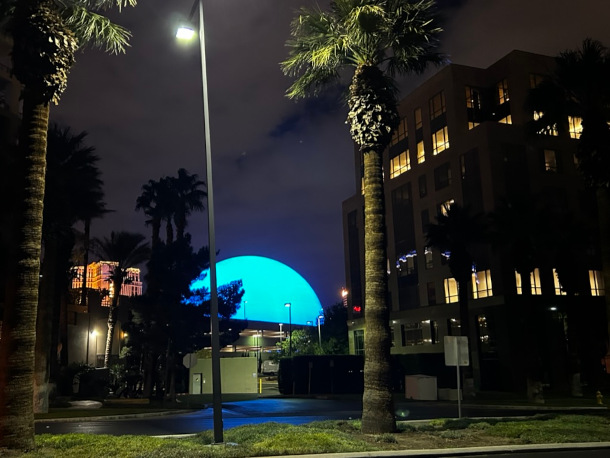
The “Vegas Sphere” in Las Vegas, Nevada. (Photo: Craig Childs)
DOERING: Yeah. So you know that on this show we talk a lot about the climate crisis and how it's rapidly changing our world, but what about what's happening with light? You know, just how fast is artificial light expanding, and, and how is it reshaping the way we live?
CHILDS: You know, writing this book, I hesitated to say, "Oh, here's another problem.”
DOERING: [LAUGHS] Right.
CHILDS: Like, add this to your load. Except, it's a different kind of problem than climate change or or heavy metals in a, in a river. These are all long term generational difficulties that take a lot of thinking, where light is something where you turn off the switch, and the night sky is there immediately. But the Earth has never had this much light in its history. I mean, we've gone through climate changes for billions of years. We've gone through extinctions, but this is an unusual one because it's just never been this bright, and it changes our circadian rhythms, changes how we relate to the world, and it takes away the night sky, which is something that I think kind of makes us human, that I imagine thousands of years ago, millions of years ago, we were looking up and going, "What is that?” Which is the same questions, we're we're still looking up, but still, it is this, this mystery. And to have that mystery still sitting there, that you can turn off the lights and still see it, that's powerful. And yeah, when the LED boom came in the the late '90s, early 2000s, lighting around the world increased dramatically, but I have talked to some lighting engineers who say that they think we are over the hump of peak lighting. That we're actually going to be changing the world in decades to come, where we, we understand light more, we understand how to place it more, we understand that it doesn't need to be everywhere, and it doesn't need to be lighting up the skies. And we don't need it to be safe, as in we don't need it to be blinding to be safe. We need it to be strategic. And so they're seeing the possibility that the world might actually darken, that nights might go back to the stars, and that's a future that I really am interested in because this is a problem we can solve very easily.
DOERING: I mean that's so heartening to hear that you know we understand the problem. Maybe we just need to be targeting the light we do use a little bit better, and there are ways to do that.
CHILDS: Yeah, it's something that's, that's right at our fingertips, which is relieving to me.
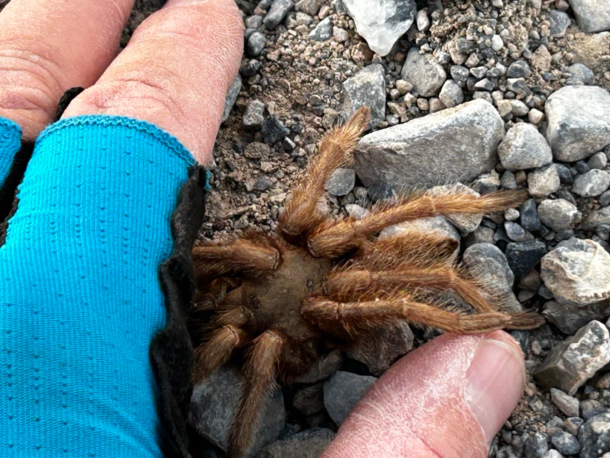
A tarantula gets cozy with Craig on the journey. (Photo: Craig Childs)
DOERING: So, Craig, what relationship does wildlife have to the night sky? You know, to what extent are animals and plants being affected by this currently bright planet?
CHILDS: Well, in a big way, it's it's navigation. When I was looking at Las Vegas, I was looking at these swarms of grasshoppers, millions upon millions of grasshoppers that sweep into the city at certain times, and they're drawn from the surrounding desert to the light. Animals are drawn to light, and birds are drawn to stationary light. Birds that are navigating spring and fall pay attention to where Polaris, the North Star, sits, because it's the one star that doesn't move, and that defines their north-south migrations. And, and when you have cities sitting along their major flyways, you have all these stationary lights, and they are pulled toward them. And you know, one thing I, I was down at the memorial lights for Ground Zero in Manhattan the year after the World Trade Centers fell, and those towers of light they put up. What I noticed when I got down right beneath them, looking up, was that they were just full of thousands and thousands of birds, and that's what really struck me. I hadn't expected that, and, and at the time I was just mesmerized and amazed by it. But since then I've learned that, oh yeah, that's killing birds. They're exhausting themselves. It's throwing off their biological sequences. They're flying into windows, and so now the Audubon Society is keeping an eye on it. And when it reaches a critical level, when the memorial lights are up in September, they turn them off for 20 minutes, and radar looking at those lights pick up 500 birds in the area when the lights are off, and when the lights are on, they're picking up about 16,000 birds.
DOERING: Wow. Oh my gosh.
CHILDS: So you can see what it does. It changes their lives.
DOERING: And you know, it turns out that the human body is also deeply influenced by what you say is actually a lack of access to darkness. What's going on there?
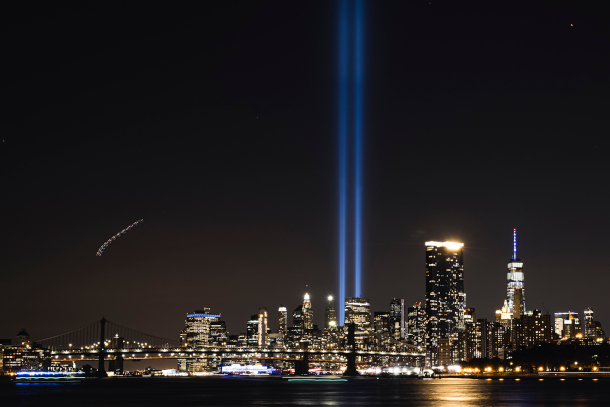
The memorial lights in New York City commemorating 9/11. When the lights are turned off, about 500 birds fly through the area. When turned on, the lights attract around 16,000 birds. (Photo: Florin Cee, Flickr, CC BY-NC-ND 2.0)
CHILDS: Well, we need both. We need light and we need dark. I mean, that's the nature of this planet, right? We have day. We have night. We've had it for 4 billion years. Every organism, or most organisms that are up on the surface, they react to this change, and that is built in from the first organisms. There is a circadian rhythm that says, "Okay, everything is about to change, so adjust all your metabolic levels, adjust your chemistry.” In the beginning, when organisms were under a thin atmosphere and getting burned by the sun at night, they could reproduce. They could repair their cells, and, and so that's just continued throughout evolution to the point where we have a circadian rhythm not only in certain parts of our brain that run our hormonal systems. We have circadian rhythms in every cell of ours. I mean, this is the most fundamental part of living on Earth is we have day, we have night, and and we adjust to it. And when we don't adjust to it, when we turn on the lights at night, when we don't go into our, our night metabolisms, then we start misfiring. We start producing melatonin or serotonin. At the wrong times, and it changes our physiological structures. And you know, one thing that I found really notable as I was writing the book was the prevalence of breast cancer in women working night shifts, where they had light at night and they had light during the day, so they never got darkness, and so basically, light at a certain point becomes a toxin, and to balance that toxin, you need the darkness.
DOERING: Of course, during your journey with Irvin across the desert, biking across from Bortle Nine to One, you guys were using often green headlamps, red headlamps to try and reduce your exposure to artificial light. Have you kind of kept up that practice after this journey?
CHILDS: Oh yeah, I've done it for a long time, and it's, what it's doing is it's getting you away from white light, which is a blinding light. Green, red, those softer, warmer lights are easier on the eyes, and and I just do it out of habit in the backcountry. I spend a lot of time out there, and what I found with Irvin is that we did this religiously for nine days. We didn't use any white lights, and our eyes adjusted. Until the end, we weren't using lights at all, which is partly your eye adjusting, and it's partly your mind adjusting, where you behave differently at night. You know, when you put your knife on the ground where you're cooking, you remember where you put it, so you don't have to go get a light and find it. You know, you you behave differently when it's dark.
DOERING: Yeah, I mean that reminds me. It's it's not just about putting yourself out there. That's important, of course, but it's largely so much of it here I think is about the attention that you're giving to the night sky, almost a religious practice of night after night for nine days, nine nights, letting yourself adjust, letting your brain adjust to the reality that's out there.
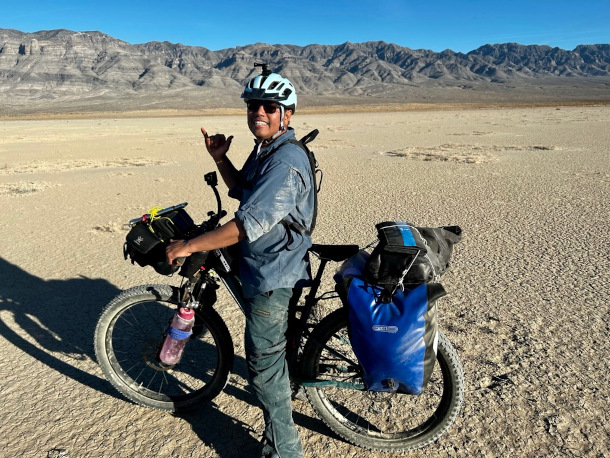
Irvin Fox-Fernandez on his bicycle. (Photo: Craig Childs)
CHILDS: That was really why I did this, was to, to take away the brightly lit place and be there for the transition. To watch stars come on every night, not just walk out into them, but to be there from sunset on, and to do that night after night, which for me gave me a more brilliant night sky than I have ever seen at the end, which is strange because I live in a dark place. I spend a lot of time in, in places that are equally as dark, but I don't see the sky like I saw it there. I saw it that way because I had been there for the transitions, and I adjusted and I paid attention. And so when the Bortle One sky finally came, my eyes were open to it, and I saw a sky that I'd never seen before.
DOERING: You're lucky, of course, in the West to see a lot of stars, to have such dark skies on the East Coast, it's a lot harder. But just recently, I was up in Maine in I think Bortle One or Two, perhaps, in the 100 Mile Wilderness, and man, just to see the Milky Way like that, which is not something you can see from Boston, it was, it was such a treat.
CHILDS: Yeah, it does something to you to see the Milky Way, doesn't it?
DOERING: Yeah!
CHILDS: It's different.
DOERING: And that's not even, you don't even need to be in a Bortle One to see the Milky Way, right? Is this like Bortle Five, Four?
CHILDS: Yeah, yeah, you can you can see it in a Five. You can start to pick out its, its structure and, and seeing that, I mean I was watching the Milky Way last night from home and just going, oh wow. It's such a powerful entity in the sky to see the disc of your own galaxy.
DOERING: Yeah.
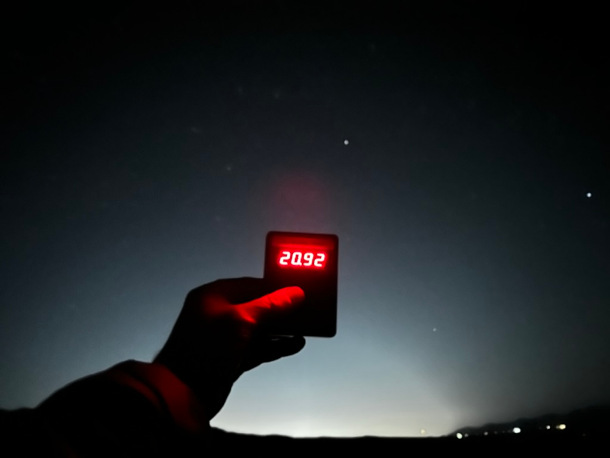
Third night, Bortle 7, with Craig’s Sky Quality Meter and the light of Las Vegas about 30 miles away. (Photo: Craig Childs)
CHILDS: It's different than the stars. Having a Milky Way up there gives you an even more powerful perspective. I imagine in Maine, you know that it's got to be so strong. One statistic I picked up is is that 80% of people on this planet cannot see the Milky Way from where they are, and and it's probably actually higher now. That statistic is is maybe 10 years old. And Jenny Ouyang, who who studies the the effects of changes on animals, she grew up in a city in China where she thought that stars were, were not real. She thought stars were lullabies. As a kid, she thought it was just some magical fantasy. And, and when she was in graduate school, she went to Joshua Tree, and she saw the Milky Way for the first time, and, and she said she started crying when she saw it. It was such a powerful experience. Everybody needs to see it somehow. There's got to be a way.
DOERING: It is reassuring, I think, that while this problem of light pollution, it has been getting worse as we've gotten better lights, brighter lights, LEDs, and and people are just expanding out into areas that were not populated before. Even though we have this problem of light pollution and the loss of dark skies, you're focused on solutions. You give us perspective that this can be reversed, that there are some things that we can do. So, what are some of the solutions here?
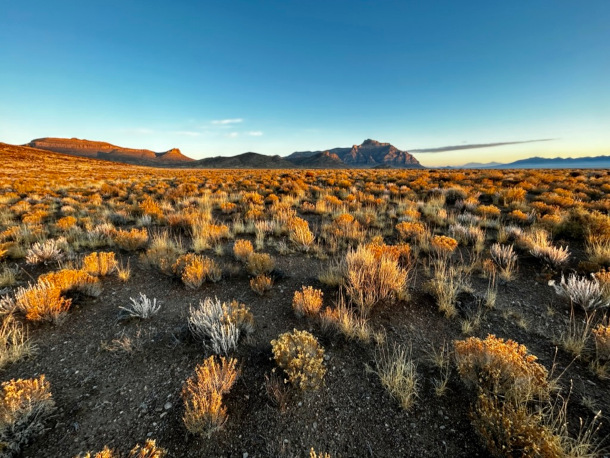
On Day 9 of the journey, after crossing from the Mojave Desert into the Great Basin Desert. Craig and Irvin had biked around 200 miles by this point in the ride. (Photo: Craig Childs)
CHILDS: Well, they range in a spectrum from what you can do yourself, which is just paying attention to your lights. You know, lights that are leaving your house, going out a window. Where are they going? Where are they landing? Are they going in somebody else's window? Which is something that's called light trespass, light unintentionally being sent to somebody else. And so, you know, pay attention to where your light lands, and then just adjusting your, your own personal lighting. How do you turn off your lights? One by one? Let the adjustment come? And then there's a bigger scale. There's the community scale, the cities, night sky communities, dark sky communities that have joined together and are changing their local requirements on on lighting, like Flagstaff, Arizona. Right now, they're replacing a lot of their colder lights, street lights, with warmer lights, and they're using LEDs that are more reds or oranges that are softer on the eye. And one thing that was really inspiring for me is that the city of Boulder City, Nevada, which is right next to Las Vegas, is a dark sky community, which seems odd because Vegas you can see for 200 miles, and this place is right next to Vegas, so it has an effect. And yet they are a dark sky community because they are not as bright as Vegas, and they're saying, "Okay, we're going to hold the line here. This isn't the darkest of the dark, but we have a little bit of dark here. Let's protect it." And that's heartening to me to see a place that that has light around it that is recognizing the value of the dark that it has. So it's not just protecting the sheer darkness of a Bortle One. It's protecting whatever dark you've got. I think Las Vegas could be a dark sky community someday, that they could change their lighting and change their hours, or I don't know what it is, but just say, okay, we, can we take this from a Bortle Nine to a Bortle Eight and hold it there?
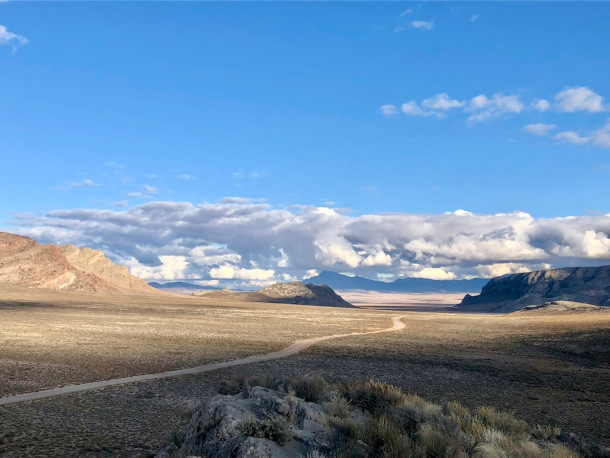
The last road of the journey through the Basin and Range region in Nevada. (Photo: Craig Childs)
DOERING: Yeah, a little change. It doesn't have to be a Bortle One, but just a little to see a little more, a few more stars would be really nice.
CHILDS: Yeah, yeah.
DOERING: So at the end of this bike ride, you finally make it to Bortle One. That's the darkest sky, but you find that it's not actually dark. For someone who's never experienced a Bortle One sky, Craig, what does it feel like to stand under that sky?
CHILDS: Yeah, yeah, we do talk about dark skies, and that's where it turns around. It's not dark; it's a bright sky. It casts shadows, and you know, often we'll look at the night sky and it'll seem flat. It'll seem like stars all painted on a surface or something. And when you're in these like Bortle One skies, it's not flat. It's three dimensional. You're not looking at a picture. You're looking at depth. You're looking at light years, and you can really feel it. You can feel distances between stars, and I hear from people that, that it makes them feel small, and I think that it's actually that it makes us feel like we lose our sense of scale. That you can't tell if you're small or if you're large. There's no longer a measurement. And I think our default is to go, oh, I feel so insignificant. But you could also feel like a giant, because what is small and large when you're seeing stars at that magnitude? It really changes the way you see the sky, the way you see yourself, the way you see this planet, it changes everything.
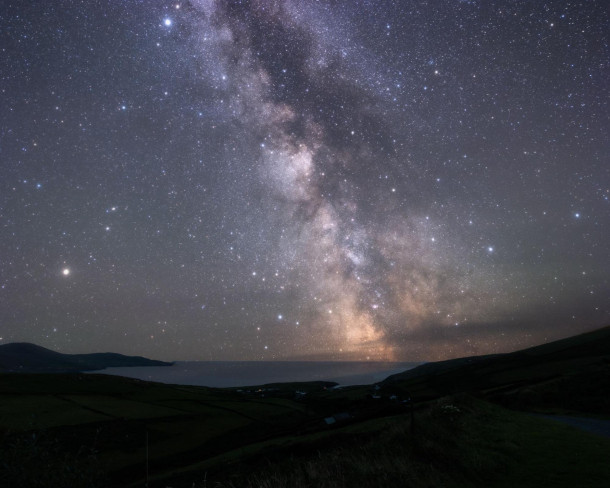
An example of a Bortle 1 sky in Ireland’s Kerry International Dark-Sky Reserve. (Photo: Photoneill, Wikimedia Commons, CC BY 4.0)
DOERING: Well, there's a passage at the end of your book where you describe this Bortle One sky. Could you please read this last paragraph for us? This is from page 194.
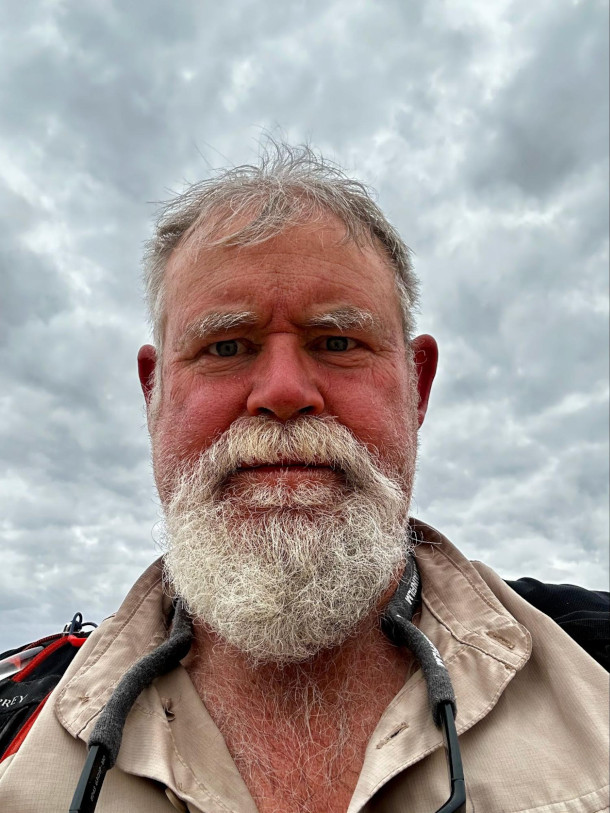
Craig on Day 8. Craig Childs is a writer, naturalist, wilderness explorer, and author of The Wild Dark: Finding the Night Sky in the Age of Light, among other books. (Photo: Craig Childs)
CHILDS: Yeah, and this little excerpt is dedicated to my college mentor Kim Malville, who was an astrophysicist at University of Colorado at Boulder, and I wrote, "This is a sky I can no longer call dark. By the metric of my eye, it is full of light. Knowing this will be the brightest night of the trip, bright without human lighting, I walk until voices fade, putting myself out in it. I am up to my neck in stars, in what Kim Malville reinforced in me as a menagerie of mythic, astronomical structures and possibilities, not just the void of space. The sensation of seeing it with your own eyes is akin to plunging your body into cold water--a sweeping rearrangement of what you understood the world to be by daylight. Zest enters the blood, and skin tingles. That you can't physically feel the night's weight is astonishing. A teaspoon of a neutron star coming in at 10 million tons, a sheer gas cloud several hundred light years across, knotting itself with enough mass to collapse into millions of suns. You should feel this on your shoulders. It should be singing with a beautiful voice. It lifts you off the ground."
DOERING: Craig Childs is a writer, naturalist, wilderness explorer, and author of “The Wild Dark: Finding the Night Sky in the Age of Light,” among other books. Thank you so much, Craig. This has been a real pleasure.
CHILDS: Oh, thanks for having me, Jenni. I appreciate it.
Related links:
- Learn more about Craig Childs
- Listen to our interview with Craig about his book Atlas of a Lost World: Travels in Ice Age America
- Explore this light pollution map to find a dark sky near you
- Purchase your copy of The Wild Dark: Finding the Night Sky in the Age of Light and support Living on Earth and independent booksellers
[MUSIC: Stars At Night]
CURWOOD: After the break, state elections you won’t want to miss. Keep listening to Living on Earth!
ANNOUNCER: Support for Living on Earth comes from Hansjörg Wyss in honor of Rosamund Stone Zander. Celebrated painter, environmentalist, and author of The Art of Possibility, who inspired others to see the profound interconnectedness of all living things, and to act with courage and creativity on behalf of our planet. Support also comes from Sailors for the Sea and Oceana. Helping boaters race clean, sail green and protect the seas they love. More information at sailorsforthesea.org
[CUTAWAY MUSIC: Flatland Park, “Revelation” Single, Flatland Park]
“How to Love the Stars”
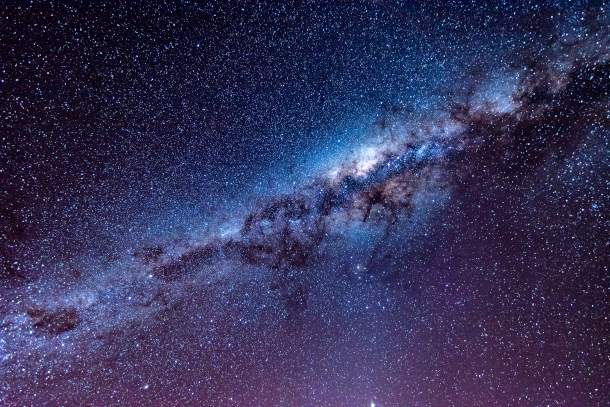
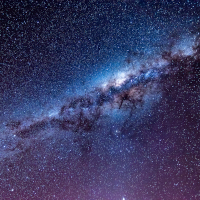
Jennifer Junghans observes that the stars are “light memories from the same stars the first hominids looked up and saw.” (Photo: Graham Holtshausen on Unsplash)
DOERING: It’s Living on Earth, I’m Jenni Doering
CURWOOD: And I’m Steve Curwood. Being able to look up and see stars is something to be treasured in our modern age. And for writer Jennifer Junghans a connection to the stars is also a connection to her dad.
[MUSIC: Blue Dot Sessions, “The Onyx”]
JUNGHANS: It’s a muscle memory now, to look up and search the night sky. Even if just for a moment to return to the time when I was young and my dad was too, him bursting with enthusiasm to unlock for my sister and me all the magic that lived in those stars.
He’d fiddle with the Dobsonian telescope he built, making endless minute adjustments. At last, he’d usher us to peer through the eyepiece at the magnified stars before Earth rotated them out of view.
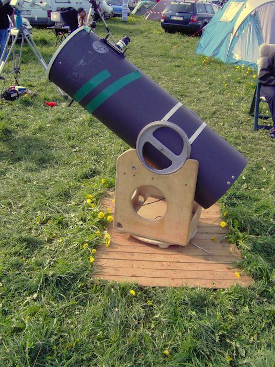
A homemade Dobsonian telescope (Photo: ECeDee, Wikimedia Commons public domain)
He’d name the stars and point upward, connecting the dots for us into constellations that I could never quite make out. Always with an urgency, as though his work as a father wouldn’t be done until he taught us how to love the stars.
I think he wanted us to know how to lose ourselves in the mysteries of the twinkling sky. To believe in possibilities beyond what we know. To accept with certainty, we’re supposed to be here even though we don’t yet understand how we fit into the grand scheme of the universe.
[MUSIC: Blue Dot Sessions, “The Onyx”]
Beyond the dazzling beauty, I fell in love with the constancy of the night sky. All the loss in our lives, the dreams that never came to be, the loneliness … I forget it all when I stargaze and bathe in the galaxy.
The signatures of light we see are the museums of these gaseous, fiery balls that have burned and pulsed for millions, sometimes billions of years. They’re light memories from the same stars the first hominids looked up and saw. The same ones that lit the sky when dinosaurs roamed.
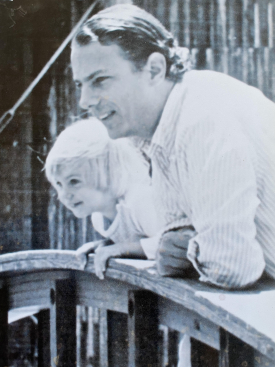
A young Jennifer Junghans with her dad, who taught her “how to love the stars” with a homemade telescope. (Photo: Courtesy of Jennifer Junghans)
The time continuum is almost unfathomable, this stitching together of all who came eons before us and all who will come after, bound in the accumulated history of the stars. They are the universal witnesses. And in this way, nothing is forgotten and everything still exists.
[MUSIC: Blue Dot Sessions, “The Onyx”]
I find great comfort in that as my dad’s memories dim. He’s transitioning like a giant star about to expire, exploding into a luminous, spectacular supernova. In the same way, his energy will outlast his physical body. I wonder where it will go? Could it disperse into the universe and form a new star that burns for another billion years?
It’s a legacy I think my dad would love. And it’s the one I’ll hold on to. Believing that when I look up into the night sky, it’s my dad’s light I’ll see.
[MUSIC: Blue Dot Sessions, “The Onyx”]
CURWOOD: That's writer Jennifer Junghans with her essay, "How to Love the Stars."
Related links:
- Watch: Step-by-step making of a Dobsonian telescope, with amateur astronomer John Dobson
- Jennifer Junghans’ website
[MUSIC: Blue Dot Sessions, “The Onyx”]
State Elections and the Climate
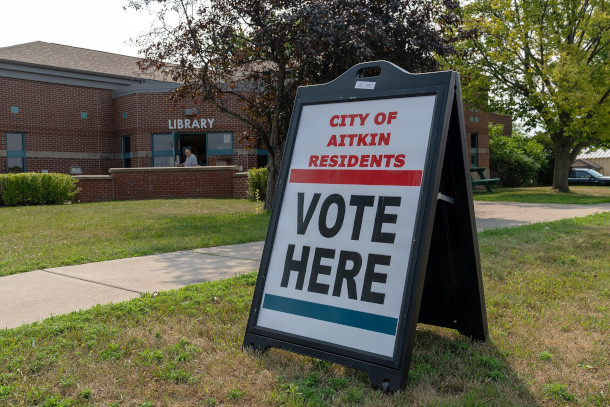
This year’s midterm elections could be pivotal in reshaping state climate and energy policy, Gearino says. Above, a “Vote Here” sign in Aitkin, Minnesota on Primary Election Day, August 11, 2026. (Photo: Lorie Shaull, Wikimedia Commons, CC BY 4.0)
DOERING: The races getting most of the media attention in this busy midterm election season are the ones that could determine which party controls the US House and Senate. And in the middle of the second Trump presidency, it is hard to understate just how consequential those elections could be for environmental and climate protection. But the often-overlooked elections for state legislatures and governors can also go a long way towards shaping the future of these issues. Dan Gearino, clean energy reporter with our media partner, Inside Climate News, has been following a few key ones. So Dan, welcome back to Living on Earth!
GEARINO: Yeah, great to be here.
DOERING: So, just how important are state legislatures in shaping climate and energy policy?
GEARINO: You just have to look at recent history. You look at the 2018 election, and then several of the election cycles right after that, where you saw Democrats gain control of governors' offices and then gain control of the legislature, gain what we call a trifecta, which is both houses of the legislature plus the governor's office. When Democrats have complete control of state government, you are much more likely to see policies become law that address climate change and encourage clean energy. And this is not a partisan statement, it's just a reflection of the results. You saw this in both Minnesota and New York, where Democrats can just gain control of that chamber. All of a sudden, the amount of room that both chambers and the governor have to take substantive action grows substantially. And then you look at the opposite, where Republicans have control of the governor's office and both chambers of the legislature. You have a really hard time passing anything that will seriously address reducing carbon emissions and will find ways to increase adoption of electric vehicles, thus wind, solar, and other renewable energy.
DOERING: So when we look at this year's midterms, Democrats are looking to gain trifectas, or control of the governorship and both chambers of the legislature in about five key states. Tell us about the three that seem most likely to shift. Those are all in the upper Midwest.
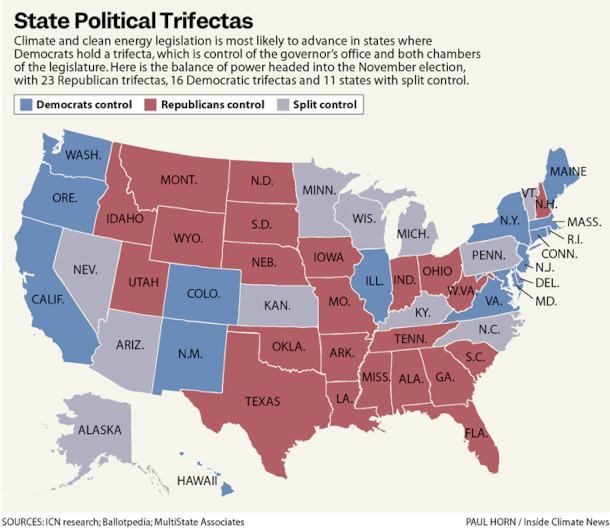
Gearino notes five key states that could be flipped to Democratic trifectas: Michigan, Wisconsin, Minnesota, Arizona, and Pennsylvania. (Photo: Paul Horn, Inside Climate News)
GEARINO: Yes, and they're actually right next to each other on the map. So let's take it from east to west. You've got Michigan, Wisconsin, and then Minnesota. A big asterisk there is that both Michigan and Minnesota had trifectas recently, and they used those trifectas to pass significant legislation. Wisconsin has not. The last time Democrats had a trifecta in Wisconsin was 2010. So if Wisconsin were able to elect a Democrat as governor and were able to flip both chambers of their legislature, the opportunity there is pretty substantial. That's a state that has a lot of wind energy, has a lot of opportunity for more solar, more battery storage, and the next governor and the next legislature, if they're kind of of one mind on this, there's a lot that they could do and a lot of untapped potential.
DOERING: Wow. And when it comes to the other two, Michigan and Minnesota, it sounds like just recently they did have trifectas, but then within the last couple of years they've become split.
GEARINO: Yes, and we're talking pretty narrow splits, so it would be pretty easy for Democrats to regain complete control. And I don't want to minimize the significance of those two states because it's important to pass the initial kind of landmark legislation saying our state will get to X point in the future on emissions or on renewable energy. Passing that initial bill in a lot of ways is easier than implementing that bill, and the implementation phase takes a long time, takes a decade plus, and you need to often pass subsequent legislation to stay on track. So it's not just that first landmark bill, it's the follow up, usually a couple years later, and then the follow up to the follow up a couple years later. It's an unending process, and if you have a period where the legislature can't take any action on this because it's just divided, it really is, is a challenge in terms of meeting long term goals.
DOERING: So Dan, you must be a big basketball fan because in your article you described those three states we were just talking about as free throws if they do pick up those trifectas. So that's Wisconsin, Minnesota, and Michigan. When it comes to Pennsylvania and Arizona, these two other states that maybe Democrats can pick up control of, you said it's more like a three-pointer. So why is it a little more tricky there, and what are the implications when it comes to climate and energy policy?
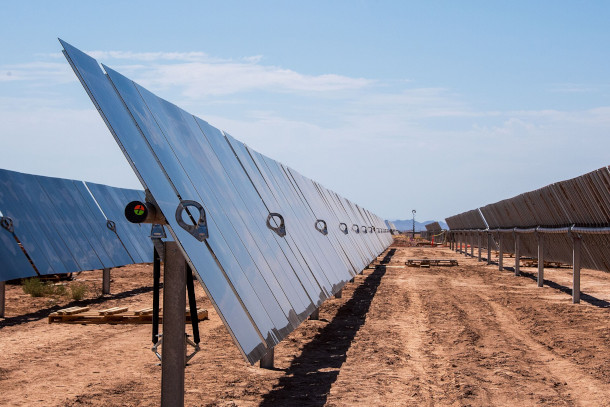
Arizona has huge potential for solar power as one of the sunniest states in the country, Gearino says. Above, solar panels in Yuma County, Arizona. (Photo: Bureau of Land Management Arizona, Wikimedia Commons, Public Domain)
GEARINO: So a big difference with Pennsylvania and Arizona is that the challenge to actually gain control of both houses of the legislature is substantial. These are just tough races. You need to be getting into the territory where Democrats have had a very good night, where they flip some seats that are really heavy lifts. But then, if you gain those majorities again, the opportunities are substantial. Pennsylvania has a very low level of renewable energy on its grid. It is a fossil fuel state, a major gas producer. You don't even need to encourage renewable energy a lot. You can just do it a little, and it would make a big difference in a state where there's not that much on the grid. Arizona is a different story. They are one of the sunniest states in the country. Arizona could have, if they could get in a time machine and go back about 20 years, invest like crazy and shift state policy to really encourage solar power. The clean energy economy in Arizona could be substantially larger than it is. So you look at that state and you say, well, there's a lot of solar power there already. Arizona's utility scale solar was 13% of their total last year. So 13%, that's a lot. That's more than most states, but it's not the national leader. California gets more than that. There are others that get more than that. So there could be a lot more. In both of those states there are just huge opportunities.
DOERING: And just give us a sense of the stakes here. I mean, what's happened in previous cycles when a Democratic trifecta has come in and passed clean energy legislation?
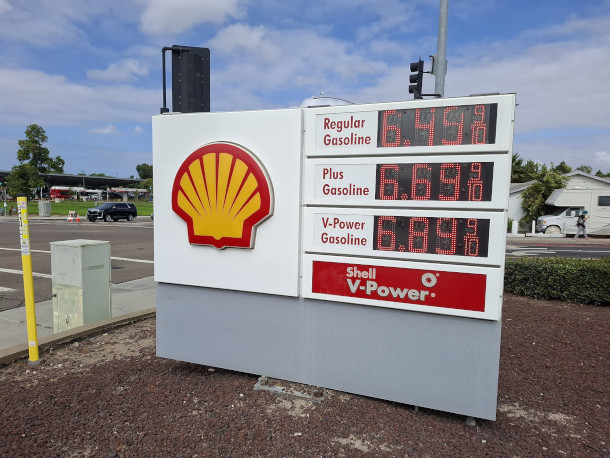
While climate change itself doesn’t usually drive people to the polls, rising gas and electricity prices are often big issues for voters, according to Gearino. Above, a gas price board in Chula Vista, CA, in September 2026. (Photo: Bnuuy, Wikimedia Commons, Public Domain)
GEARINO: Well, the key part of a trifecta is first electing a governor, and we saw in 2018 several states that had gubernatorial elections, in which the winner was someone who cared about climate and advancing renewable energy, and also the state was very close to being ready, if not ready already, to take action. In some states, it takes a few years, but you have a governor in place. You're kind of working on the legislation. You wait till that window of opportunity opens. Good example is like Michigan. Michigan, when Gretchen Whitmer was elected, she didn't have the legislature immediately that could pass kind of comprehensive legislation, and and eventually got it. But it's that electing the governor is, is a crucial step. And I also should say, in these kind of swing states like Michigan, the legislation that passes is always going to fall short of what a lot of environmental activists and clean energy advocates would like. They're going to kind of say it's weak tea. I've been writing about this stuff long enough to just know that it just always happens that way. They'll say, "Oh, this you know we had an opportunity to do something real and we did something that's inadequate." I suspect that these states passing comprehensive laws on the climate or clean energy, it's probably about as much as they could pass in terms of just counting the votes, and it was either pass that or, or pass something weaker. So, but if we do see these flips where we have these five states become controlled by Democrats, we can look forward to hearing that discussion again as well. Legislation passes, and it's considered kind of unsatisfyingly weak.
DOERING: So, looking beyond individual races, how much are climate and energy policies actually driving voters in these midterm elections?
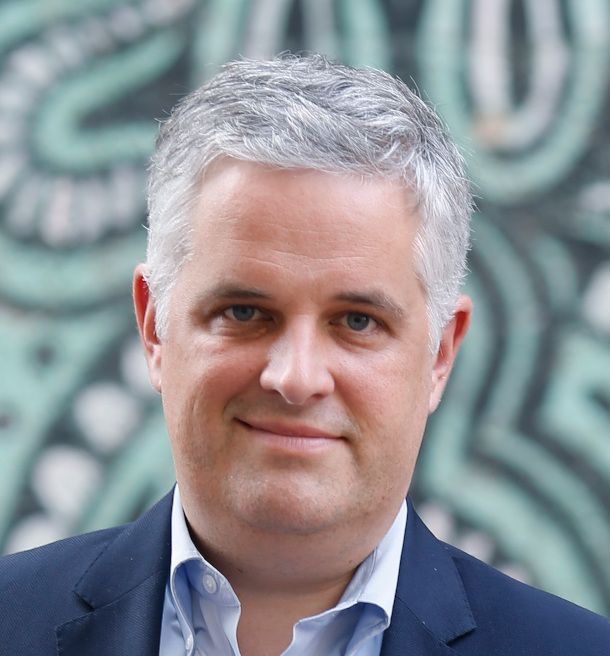
Dan Gearino is a clean energy reporter who writes for Inside Climate News, covering renewable energy and utilities. (Photo: Dan Gearino)
GEARINO: What we're seeing is concern about energy prices. You're seeing pocketbook issues, and that's not surprising. Climate change is not an issue that people vote on. We've seen enough election cycles in this period where we're seeing substantial warming and the effects of climate change, but it doesn't seem to move the needle much in terms of voter behavior. But you have electricity prices rising a lot. You have diesel prices just really hurting farmers, really hurting truckers, making everything more expensive. Electricity rates going way up. These are all things that people really notice, and these are things that are kind of part of the bigger picture of the way we manage energy, and that ties into how we both adapt to climate change and also how we try to take action to reduce emissions to make it so that climate change isn't as severe. So while someone might say I'm voting this way because I'm just, I'm ticked off and I want a new set of leaders because diesel's way too expensive. Yeah, it's all part of a much larger picture.
DOERING: And Dan, speaking more broadly, in the middle of the second Trump presidency, how pivotal are this November's midterms overall?
GEARINO: I've now lived through several times in which the midterm elections were described as the most important midterms ever, so perhaps I'm getting desensitized to hearing this every midterm cycle. But this clearly is a very important election in terms of the U.S. House and U.S. Senate creating a check on President Trump's energy and deregulatory agenda. I mean, a lot of the things he's done, he's done through executive power, but having Democrats gain control of one or both houses would make a big difference, and then at the state level, having several states flipping to complete control by Democrats would also be really significant. So it matters a lot, and you can just look back at how much it mattered in hindsight. The results of say the 2018 election, and you know, and others like it, where there was a change in control, and substantial things flowed from that.
DOERING: Dan Gearino is Clean Energy Reporter with our media partner, Inside Climate News. Thank you so much, Dan.
GEARINO: Yeah, great to be here.
Related link:
Inside Climate News | “These State Elections Could Reshape Climate and Energy Policy”
[MUSIC: After The Hearing]
CURWOOD: Climate action, species protection, clean air for public health, and more are on ballots nationwide on November 3rd, and we want to hear from you. For the most part, we are selecting people to address these challenges and opportunities, as well as weighing in on state and local referenda. So, please tell us, what’s at the top of your list, and why. We’re not looking for slogans or cheerleading for candidates. Instead, we want to know what will motivate you to exercise your constitutional right as an American citizen to express your feelings and values at the polls. What are your questions, hopes and concerns? Write us or send a voice note to comments at loe dot org. That’s comments at loe dot org. You can use any sound recording app on your smartphone, like Voice Memos or Voice Recorder. And please record your brief comment or question about the midterm elections in a quiet place so we can hear you. And let us know your name and how we can reach you in the daytime. Then email your words or your audio file to comments@loe.org, and we might play it on the air!
[MUSIC: After The Hearing]
CURWOOD: Living on Earth is produced by the World Media Foundation. Our crew includes Naomi Arenberg, Paloma Beltran, Abby Edgecumbe, Swayam Gagneja, Mark Kausch, Mark Seth Lender, Don Lyman, Ashanti Mclean, Nhung Nguyen, Aynsley O’Neill, Sophia Pandelidis, Jake Rego, Andrew Skerritt, Bella Smith, and El Wilson.
DOERING: Tom Tiger engineered our show. Allison Lirish Dean composed our themes. You can hear us anytime at loe.org, Apple Podcasts and YouTube Music, and like us please, on our Facebook page, Living on Earth. Find us on Instagram, Threads and BlueSky @livingonearthradio. And we always welcome your feedback at comments@loe.org. I’m Jenni Doering.
CURWOOD: And I’m Steve Curwood. Thanks for listening!
Living on Earth wants to hear from you!
Living on Earth
62 Calef Highway, Suite 212
Lee, NH 03861
Telephone: 617-287-4121
E-mail: comments@loe.org
Newsletter [Click here]
Donate to Living on Earth!
Living on Earth is an independent media program and relies entirely on contributions from listeners and institutions supporting public service. Please donate now to preserve an independent environmental voice.
NewsletterLiving on Earth offers a weekly delivery of the show's rundown to your mailbox. Sign up for our newsletter today!
 Sailors For The Sea: Be the change you want to sea.
 The Grantham Foundation for the Protection of the Environment: Committed to protecting and improving the health of the global environment.
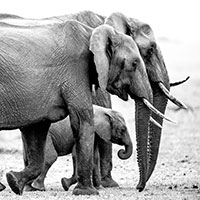 Contribute to Living on Earth and receive, as our gift to you, an archival print of one of Mark Seth Lender's extraordinary wildlife photographs. Follow the link to see Mark's current collection of photographs.
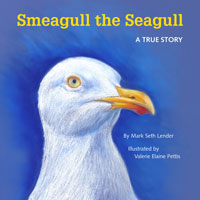 Buy a signed copy of Mark Seth Lender's book Smeagull the Seagull & support Living on Earth
© Copyright World Media Foundation. All Rights Reserved
Home | Contact | RSS | Donate | Newsletter