

The Wild Dark: Finding the Night Sky in the Age of Light
Air Date: Week of October 2, 2026
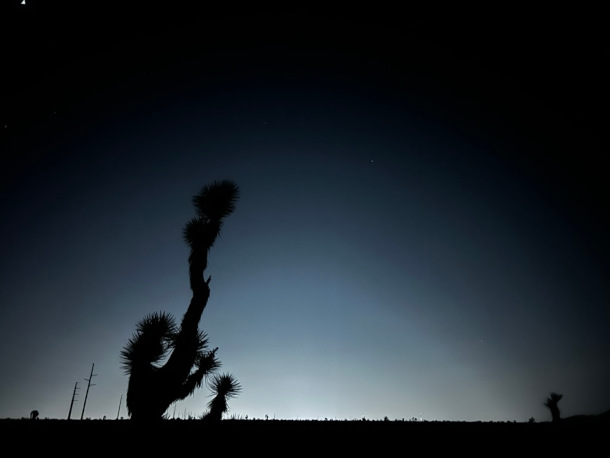
The second night of Craig Childs’ and Irvin Fox-Fernandez’s bike journey from Las Vegas to dark sky country, Bortle 8. (Photo: Craig Childs)
Our brightly lit modern world is increasingly drowning out the stars. To rediscover what we miss when we can’t look up and see the heavens in their full glory, award-winning author Craig Childs embarked on a journey by bike from blindingly bright Las Vegas into the dark skies of the remote Nevada desert. Craig Childs joins Host Jenni Doering to discuss his 2025 book, The Wild Dark: Finding the Night Sky in the Age of Light.
Transcript
CURWOOD: It’s Living on Earth, I’m Steve Curwood
DOERING: And I’m Jenni Doering.
Think about the darkest sky you’ve ever seen. Did you see the Milky Way? Did starlight cast shadows? This kind of experience is becoming rare in our brightly lit world, but the stars are still out there, waiting for us to rediscover them. That’s the focus of the 2025 book, “The Wild Dark: Finding the Night Sky in the Age of Light.” Award-winning author Craig Childs joins me now from his home on the remote Colorado Plateau. Welcome back to Living on Earth, Craig!
CHILDS: Thanks. I'm really glad to be here.
DOERING: Well, we're glad to have you. So, what attracts you to the night sky and the stars, and when did you first feel this pull to reflect more on the mysteries above us?
CHILDS: I think it's impossible not to be attracted to the night sky. [LAUGHS] I think everybody is.
DOERING: Yeah.
CHILDS: That was that was kind of a nice thing about writing this, is where I thought, oh, here's something that everybody loves, even people who are disconnected from it, who don't see it. There's something intrinsic about looking up and seeing a sky full of stars. Something I wrote about in the book was when I was little, when I was five years old, I was camping out in the the woods with my mom and her boyfriend, and they took off into the night and left me on this mattress. They'd carried a full mattress out into the woods, and I was under all these blankets, and I was terrified of the dark. But then I saw the stars, and I remember that. I remember how clear they were, and and how much it calmed me down to look up and see, really to see infinity for the first time, or at least to recognize it for the first time, and to go, oh wow! I don't know what that is. I don't know what all those lights are, but there was something just deeply calming about it. To know that, that there was infinity that you could see forever, and it wasn't empty. It was just full.
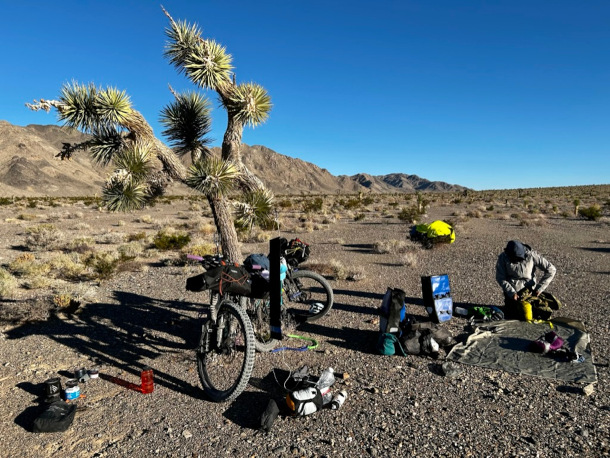
Craig and Irvin stop to camp in the Mojave desert. (Photo: Craig Childs)
DOERING: So, Craig, in this book, The Wild Dark, we follow you on this journey from one of the brightest places on Earth, Las Vegas, to one of the darkest. Why did you and your companion Irvin choose to bike through the desert to take on this quest? And what questions did you want to ponder while you were on this trip?
CHILDS: Well, you know, a bike made sense, human-powered speed, because driving out of Las Vegas, if you wanted to get to the darkest of the dark, you'd be there in three hours, and I was much more interested in the transition, in letting my eyes adjust and seeing what the different nights are like. And so that took us about 200 miles through the backcountry on fully loaded mountain bikes, self-supported. So we had everything with us, and the pace that we were going at was maybe 20 miles a day, and that was enough to make every night significantly different for nine nights. And that's, the the question I had was: What are each of these skies like? Not just the darkest, not just the brightest, but the ones in between. And how different are they?
DOERING: And of course, you mentioned the night to night change and nine days and I think you picked nine days, nine nights because there are nine different levels on this scale that we use to sort of delineate the quality of the skies at night. So what is the Bortle scale for people who haven't heard of this funny sounding thing?
CHILDS: The Bortle scale. And I just love the word Bortle because it sounds like, it sounds like it should be a space word, and it's actually somebody's name. It's John E. Bortle, who's an amateur astronomer who identifies comets, and he needed a way to express the night sky in non-technical terms, in naked eye terms, just looking up and saying, "Okay, where am I in the range? And he, he came up with the nine levels, Bortle One being the the darkest, and Bortle Nine being that, that lemony sky over Las Vegas. So we ended up following this pattern, this starting in a Bortle Nine and aiming for a Bortle One, and it's, it actually just worked out conveniently that 20 miles a day that that's until we get rid of Vegas. That's going to take about nine nine nights, which I wasn't sure. Vegas really hung on there. I mean, we were still getting shadow from Vegas 170 miles out, so it was hard to get away.
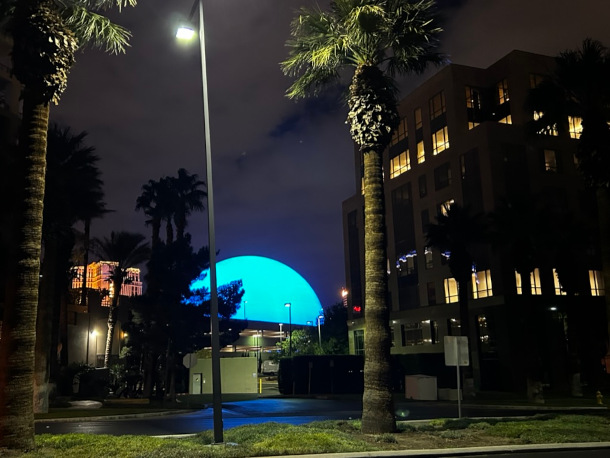
The “Vegas Sphere” in Las Vegas, Nevada. (Photo: Craig Childs)
DOERING: Yeah. So you know that on this show we talk a lot about the climate crisis and how it's rapidly changing our world, but what about what's happening with light? You know, just how fast is artificial light expanding, and, and how is it reshaping the way we live?
CHILDS: You know, writing this book, I hesitated to say, "Oh, here's another problem.”
DOERING: [LAUGHS] Right.
CHILDS: Like, add this to your load. Except, it's a different kind of problem than climate change or or heavy metals in a, in a river. These are all long term generational difficulties that take a lot of thinking, where light is something where you turn off the switch, and the night sky is there immediately. But the Earth has never had this much light in its history. I mean, we've gone through climate changes for billions of years. We've gone through extinctions, but this is an unusual one because it's just never been this bright, and it changes our circadian rhythms, changes how we relate to the world, and it takes away the night sky, which is something that I think kind of makes us human, that I imagine thousands of years ago, millions of years ago, we were looking up and going, "What is that?” Which is the same questions, we're we're still looking up, but still, it is this, this mystery. And to have that mystery still sitting there, that you can turn off the lights and still see it, that's powerful. And yeah, when the LED boom came in the the late '90s, early 2000s, lighting around the world increased dramatically, but I have talked to some lighting engineers who say that they think we are over the hump of peak lighting. That we're actually going to be changing the world in decades to come, where we, we understand light more, we understand how to place it more, we understand that it doesn't need to be everywhere, and it doesn't need to be lighting up the skies. And we don't need it to be safe, as in we don't need it to be blinding to be safe. We need it to be strategic. And so they're seeing the possibility that the world might actually darken, that nights might go back to the stars, and that's a future that I really am interested in because this is a problem we can solve very easily.
DOERING: I mean that's so heartening to hear that you know we understand the problem. Maybe we just need to be targeting the light we do use a little bit better, and there are ways to do that.
CHILDS: Yeah, it's something that's, that's right at our fingertips, which is relieving to me.
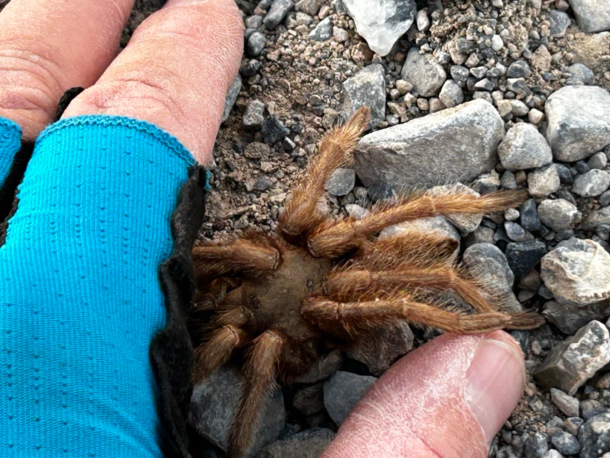
A tarantula gets cozy with Craig on the journey. (Photo: Craig Childs)
DOERING: So, Craig, what relationship does wildlife have to the night sky? You know, to what extent are animals and plants being affected by this currently bright planet?
CHILDS: Well, in a big way, it's it's navigation. When I was looking at Las Vegas, I was looking at these swarms of grasshoppers, millions upon millions of grasshoppers that sweep into the city at certain times, and they're drawn from the surrounding desert to the light. Animals are drawn to light, and birds are drawn to stationary light. Birds that are navigating spring and fall pay attention to where Polaris, the North Star, sits, because it's the one star that doesn't move, and that defines their north-south migrations. And, and when you have cities sitting along their major flyways, you have all these stationary lights, and they are pulled toward them. And you know, one thing I, I was down at the memorial lights for Ground Zero in Manhattan the year after the World Trade Centers fell, and those towers of light they put up. What I noticed when I got down right beneath them, looking up, was that they were just full of thousands and thousands of birds, and that's what really struck me. I hadn't expected that, and, and at the time I was just mesmerized and amazed by it. But since then I've learned that, oh yeah, that's killing birds. They're exhausting themselves. It's throwing off their biological sequences. They're flying into windows, and so now the Audubon Society is keeping an eye on it. And when it reaches a critical level, when the memorial lights are up in September, they turn them off for 20 minutes, and radar looking at those lights pick up 500 birds in the area when the lights are off, and when the lights are on, they're picking up about 16,000 birds.
DOERING: Wow. Oh my gosh.
CHILDS: So you can see what it does. It changes their lives.
DOERING: And you know, it turns out that the human body is also deeply influenced by what you say is actually a lack of access to darkness. What's going on there?
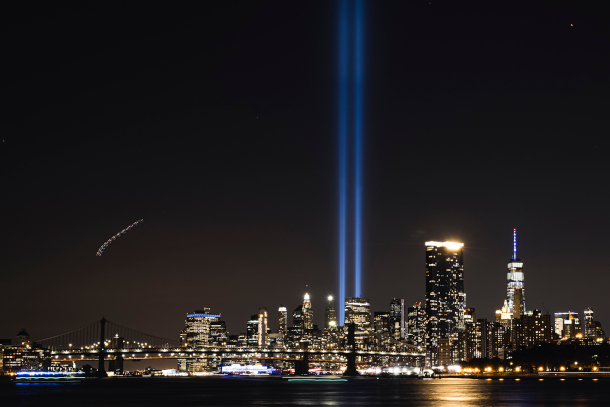
The memorial lights in New York City commemorating 9/11. When the lights are turned off, about 500 birds fly through the area. When turned on, the lights attract around 16,000 birds. (Photo: Florin Cee, Flickr, CC BY-NC-ND 2.0)
CHILDS: Well, we need both. We need light and we need dark. I mean, that's the nature of this planet, right? We have day. We have night. We've had it for 4 billion years. Every organism, or most organisms that are up on the surface, they react to this change, and that is built in from the first organisms. There is a circadian rhythm that says, "Okay, everything is about to change, so adjust all your metabolic levels, adjust your chemistry.” In the beginning, when organisms were under a thin atmosphere and getting burned by the sun at night, they could reproduce. They could repair their cells, and, and so that's just continued throughout evolution to the point where we have a circadian rhythm not only in certain parts of our brain that run our hormonal systems. We have circadian rhythms in every cell of ours. I mean, this is the most fundamental part of living on Earth is we have day, we have night, and and we adjust to it. And when we don't adjust to it, when we turn on the lights at night, when we don't go into our, our night metabolisms, then we start misfiring. We start producing melatonin or serotonin. At the wrong times, and it changes our physiological structures. And you know, one thing that I found really notable as I was writing the book was the prevalence of breast cancer in women working night shifts, where they had light at night and they had light during the day, so they never got darkness, and so basically, light at a certain point becomes a toxin, and to balance that toxin, you need the darkness.
DOERING: Of course, during your journey with Irvin across the desert, biking across from Bortle Nine to One, you guys were using often green headlamps, red headlamps to try and reduce your exposure to artificial light. Have you kind of kept up that practice after this journey?
CHILDS: Oh yeah, I've done it for a long time, and it's, what it's doing is it's getting you away from white light, which is a blinding light. Green, red, those softer, warmer lights are easier on the eyes, and and I just do it out of habit in the backcountry. I spend a lot of time out there, and what I found with Irvin is that we did this religiously for nine days. We didn't use any white lights, and our eyes adjusted. Until the end, we weren't using lights at all, which is partly your eye adjusting, and it's partly your mind adjusting, where you behave differently at night. You know, when you put your knife on the ground where you're cooking, you remember where you put it, so you don't have to go get a light and find it. You know, you you behave differently when it's dark.
DOERING: Yeah, I mean that reminds me. It's it's not just about putting yourself out there. That's important, of course, but it's largely so much of it here I think is about the attention that you're giving to the night sky, almost a religious practice of night after night for nine days, nine nights, letting yourself adjust, letting your brain adjust to the reality that's out there.
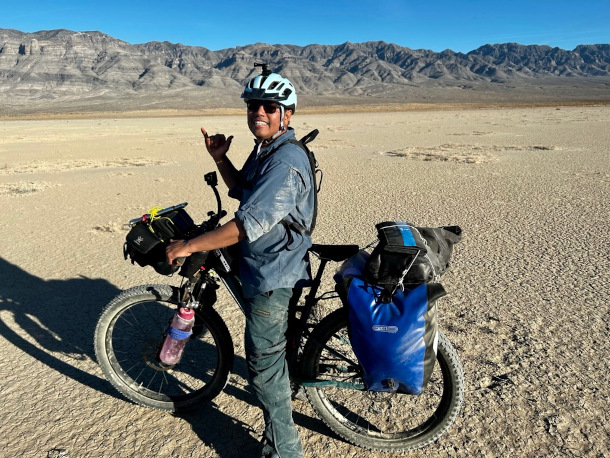
Irvin Fox-Fernandez on his bicycle. (Photo: Craig Childs)
CHILDS: That was really why I did this, was to, to take away the brightly lit place and be there for the transition. To watch stars come on every night, not just walk out into them, but to be there from sunset on, and to do that night after night, which for me gave me a more brilliant night sky than I have ever seen at the end, which is strange because I live in a dark place. I spend a lot of time in, in places that are equally as dark, but I don't see the sky like I saw it there. I saw it that way because I had been there for the transitions, and I adjusted and I paid attention. And so when the Bortle One sky finally came, my eyes were open to it, and I saw a sky that I'd never seen before.
DOERING: You're lucky, of course, in the West to see a lot of stars, to have such dark skies on the East Coast, it's a lot harder. But just recently, I was up in Maine in I think Bortle One or Two, perhaps, in the 100 Mile Wilderness, and man, just to see the Milky Way like that, which is not something you can see from Boston, it was, it was such a treat.
CHILDS: Yeah, it does something to you to see the Milky Way, doesn't it?
DOERING: Yeah!
CHILDS: It's different.
DOERING: And that's not even, you don't even need to be in a Bortle One to see the Milky Way, right? Is this like Bortle Five, Four?
CHILDS: Yeah, yeah, you can you can see it in a Five. You can start to pick out its, its structure and, and seeing that, I mean I was watching the Milky Way last night from home and just going, oh wow. It's such a powerful entity in the sky to see the disc of your own galaxy.
DOERING: Yeah.
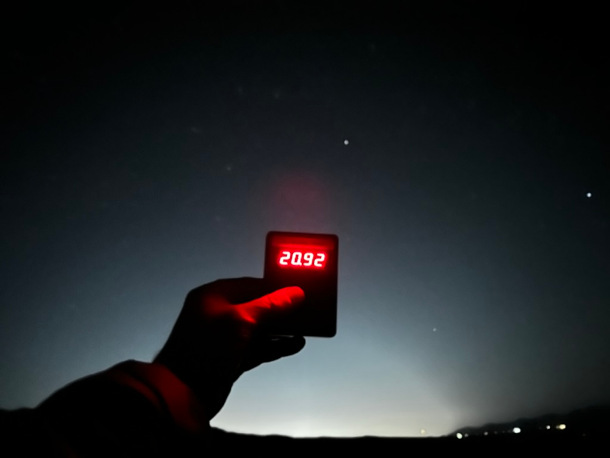
Third night, Bortle 7, with Craig’s Sky Quality Meter and the light of Las Vegas about 30 miles away. (Photo: Craig Childs)
CHILDS: It's different than the stars. Having a Milky Way up there gives you an even more powerful perspective. I imagine in Maine, you know that it's got to be so strong. One statistic I picked up is is that 80% of people on this planet cannot see the Milky Way from where they are, and and it's probably actually higher now. That statistic is is maybe 10 years old. And Jenny Ouyang, who who studies the the effects of changes on animals, she grew up in a city in China where she thought that stars were, were not real. She thought stars were lullabies. As a kid, she thought it was just some magical fantasy. And, and when she was in graduate school, she went to Joshua Tree, and she saw the Milky Way for the first time, and, and she said she started crying when she saw it. It was such a powerful experience. Everybody needs to see it somehow. There's got to be a way.
DOERING: It is reassuring, I think, that while this problem of light pollution, it has been getting worse as we've gotten better lights, brighter lights, LEDs, and and people are just expanding out into areas that were not populated before. Even though we have this problem of light pollution and the loss of dark skies, you're focused on solutions. You give us perspective that this can be reversed, that there are some things that we can do. So, what are some of the solutions here?
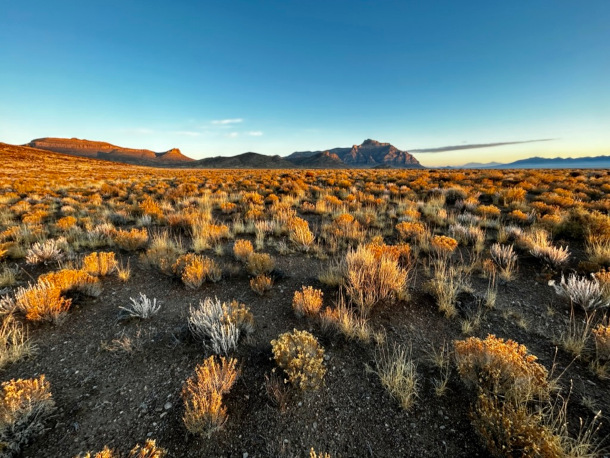
On Day 9 of the journey, after crossing from the Mojave Desert into the Great Basin Desert. Craig and Irvin had biked around 200 miles by this point in the ride. (Photo: Craig Childs)
CHILDS: Well, they range in a spectrum from what you can do yourself, which is just paying attention to your lights. You know, lights that are leaving your house, going out a window. Where are they going? Where are they landing? Are they going in somebody else's window? Which is something that's called light trespass, light unintentionally being sent to somebody else. And so, you know, pay attention to where your light lands, and then just adjusting your, your own personal lighting. How do you turn off your lights? One by one? Let the adjustment come? And then there's a bigger scale. There's the community scale, the cities, night sky communities, dark sky communities that have joined together and are changing their local requirements on on lighting, like Flagstaff, Arizona. Right now, they're replacing a lot of their colder lights, street lights, with warmer lights, and they're using LEDs that are more reds or oranges that are softer on the eye. And one thing that was really inspiring for me is that the city of Boulder City, Nevada, which is right next to Las Vegas, is a dark sky community, which seems odd because Vegas you can see for 200 miles, and this place is right next to Vegas, so it has an effect. And yet they are a dark sky community because they are not as bright as Vegas, and they're saying, "Okay, we're going to hold the line here. This isn't the darkest of the dark, but we have a little bit of dark here. Let's protect it." And that's heartening to me to see a place that that has light around it that is recognizing the value of the dark that it has. So it's not just protecting the sheer darkness of a Bortle One. It's protecting whatever dark you've got. I think Las Vegas could be a dark sky community someday, that they could change their lighting and change their hours, or I don't know what it is, but just say, okay, we, can we take this from a Bortle Nine to a Bortle Eight and hold it there?
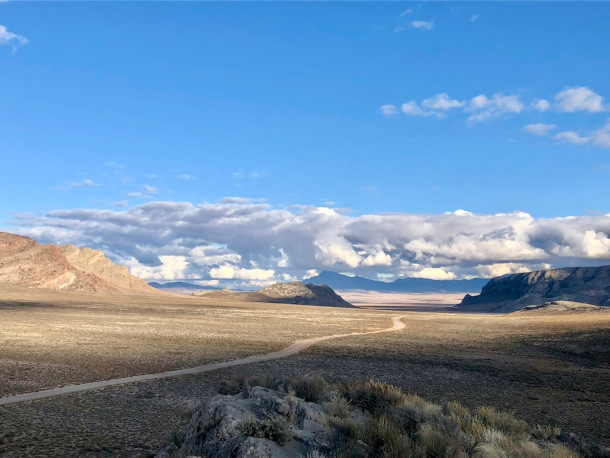
The last road of the journey through the Basin and Range region in Nevada. (Photo: Craig Childs)
DOERING: Yeah, a little change. It doesn't have to be a Bortle One, but just a little to see a little more, a few more stars would be really nice.
CHILDS: Yeah, yeah.
DOERING: So at the end of this bike ride, you finally make it to Bortle One. That's the darkest sky, but you find that it's not actually dark. For someone who's never experienced a Bortle One sky, Craig, what does it feel like to stand under that sky?
CHILDS: Yeah, yeah, we do talk about dark skies, and that's where it turns around. It's not dark; it's a bright sky. It casts shadows, and you know, often we'll look at the night sky and it'll seem flat. It'll seem like stars all painted on a surface or something. And when you're in these like Bortle One skies, it's not flat. It's three dimensional. You're not looking at a picture. You're looking at depth. You're looking at light years, and you can really feel it. You can feel distances between stars, and I hear from people that, that it makes them feel small, and I think that it's actually that it makes us feel like we lose our sense of scale. That you can't tell if you're small or if you're large. There's no longer a measurement. And I think our default is to go, oh, I feel so insignificant. But you could also feel like a giant, because what is small and large when you're seeing stars at that magnitude? It really changes the way you see the sky, the way you see yourself, the way you see this planet, it changes everything.
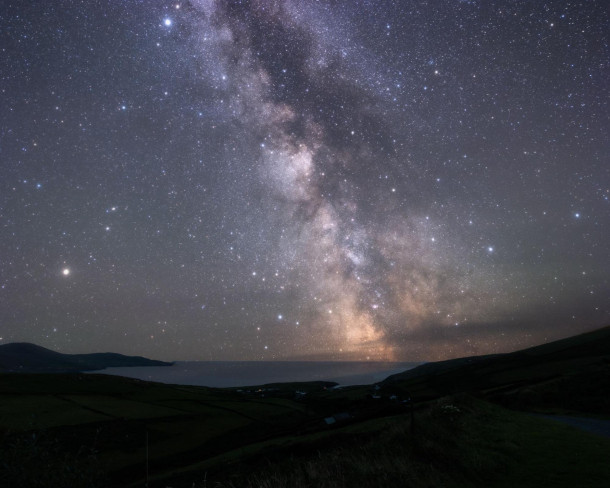
An example of a Bortle 1 sky in Ireland’s Kerry International Dark-Sky Reserve. (Photo: Photoneill, Wikimedia Commons, CC BY 4.0)
DOERING: Well, there's a passage at the end of your book where you describe this Bortle One sky. Could you please read this last paragraph for us? This is from page 194.
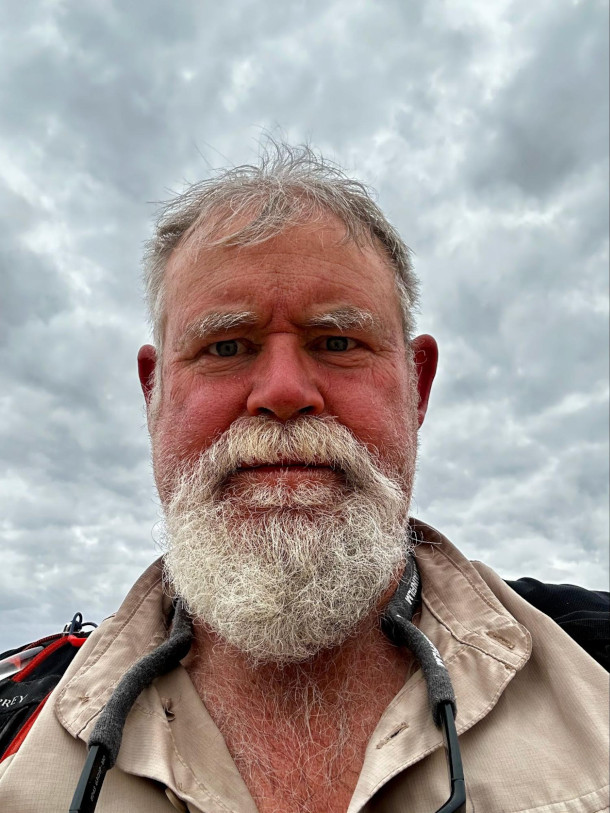
Craig on Day 8. Craig Childs is a writer, naturalist, wilderness explorer, and author of The Wild Dark: Finding the Night Sky in the Age of Light, among other books. (Photo: Craig Childs)
CHILDS: Yeah, and this little excerpt is dedicated to my college mentor Kim Malville, who was an astrophysicist at University of Colorado at Boulder, and I wrote, "This is a sky I can no longer call dark. By the metric of my eye, it is full of light. Knowing this will be the brightest night of the trip, bright without human lighting, I walk until voices fade, putting myself out in it. I am up to my neck in stars, in what Kim Malville reinforced in me as a menagerie of mythic, astronomical structures and possibilities, not just the void of space. The sensation of seeing it with your own eyes is akin to plunging your body into cold water--a sweeping rearrangement of what you understood the world to be by daylight. Zest enters the blood, and skin tingles. That you can't physically feel the night's weight is astonishing. A teaspoon of a neutron star coming in at 10 million tons, a sheer gas cloud several hundred light years across, knotting itself with enough mass to collapse into millions of suns. You should feel this on your shoulders. It should be singing with a beautiful voice. It lifts you off the ground."
DOERING: Craig Childs is a writer, naturalist, wilderness explorer, and author of “The Wild Dark: Finding the Night Sky in the Age of Light,” among other books. Thank you so much, Craig. This has been a real pleasure.
CHILDS: Oh, thanks for having me, Jenni. I appreciate it.
Links
Listen to our interview with Craig about his book Atlas of a Lost World: Travels in Ice Age America
Explore this light pollution map to find a dark sky near you
Living on Earth wants to hear from you!
Living on Earth
62 Calef Highway, Suite 212
Lee, NH 03861
Telephone: 617-287-4121
E-mail: comments@loe.org
Newsletter [Click here]
Donate to Living on Earth!
Living on Earth is an independent media program and relies entirely on contributions from listeners and institutions supporting public service. Please donate now to preserve an independent environmental voice.
NewsletterLiving on Earth offers a weekly delivery of the show's rundown to your mailbox. Sign up for our newsletter today!
 Sailors For The Sea: Be the change you want to sea.
 The Grantham Foundation for the Protection of the Environment: Committed to protecting and improving the health of the global environment.
 Contribute to Living on Earth and receive, as our gift to you, an archival print of one of Mark Seth Lender's extraordinary wildlife photographs. Follow the link to see Mark's current collection of photographs.
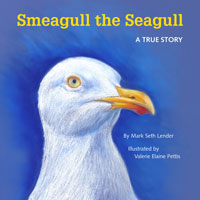 Buy a signed copy of Mark Seth Lender's book Smeagull the Seagull & support Living on Earth
© Copyright World Media Foundation. All Rights Reserved
Home | Contact | RSS | Donate | Newsletter