

August 28, 2026
Air Date: August 28, 2026
FULL SHOW
SEGMENTS
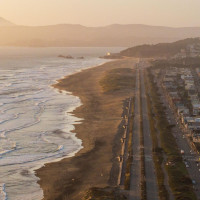
Highway Reborn as Public Park
View the page for this story
The four-lane Great Highway used to run along the Pacific Ocean on the west side of San Francisco, where it was at risk of flooding from sea level rise. Now it’s been transformed into a park where visitors can bike, walk, skate, and play next to the water. Zach Lipton, a volunteer with the nonprofit Friends of Sunset Dunes, speaks with Host Jenni Doering about this highway’s transformation. (12:50)
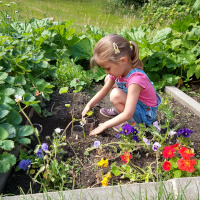
Gardening for Special Needs
View the page for this story
For people with developmental or physical disabilities, growing plants in a garden may offer personal growth opportunities that unlock new possibilities outside of the garden too. This kind of transformation is something avid gardener Jill Mays has seen again and again in her work with disabled children and adults, and she speaks with Host Paloma Beltran about her book Nurturing Nature: A Guide to Gardening for Special Needs. (16:15)
Great Blue Heron
/ Mark Seth LenderView the page for this story
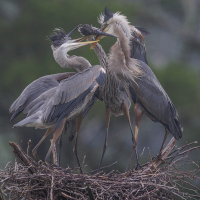
The subtle grey plumage of the great blue heron can be appreciated across open water and wetlands in much of the Western Hemisphere. Explorer in Residence Mark Seth Lender observed a mother heron nurturing her chicks by the Black Hall River in Connecticut. (02:17)
The Light Between Apple Trees
View the page for this story
As the air turns crisp in the northern U.S., many of us are heading out for the autumn tradition of apple picking. Priyanka Kumar, author of The Light Between Apple Trees: Rediscovering the Wild Through a Beloved American Fruit, joins Host Jenni Doering to share the fascinating and complex science and history behind the iconic apple and why apple trees have so captivated her since childhood. (15:21)
Show Credits and Funders
Show Transcript
260828 Transcript
HOSTS: Jenni Doering and Paloma Beltran
GUESTS: Zach Lipton, Jill Mays, Priyanka Kumar
REPORTERS: Mark Seth Lender
[THEME]
DOERING: From PRX – this is Living on Earth.
[THEME]
DOERING: I'm Jenni Doering.
BELTRAN: And I'm Paloma Beltran.
What makes a San Francisco Park so unique.
LIPTON: Sunset Dunes is a 50-acre park at the edge of San Francisco along the Pacific Coast. It used to be a four-lane highway and has been converted into a recreational space for people to walk and bike and sit by the ocean, have a bite to eat and just enjoy our Pacific coast.
DOERING: Also, why gardening can help people with special needs.
MAYS: You really want them to feel joy, you want them to experience joy when they’re in the garden and the first thing is that they feel like they understand what’s happening and they’re capable of doing what is asked of them.
DOERING: Plus the wonders of apples as picking begins--that and more, this week on Living on Earth. Stick around!
[NEWSBREAK MUSIC: Boards Of Canada “Zoetrope” from “In A Beautiful Place Out In The Country” (Warp Records 2000)]
[THEME]
Highway Reborn as Public Park
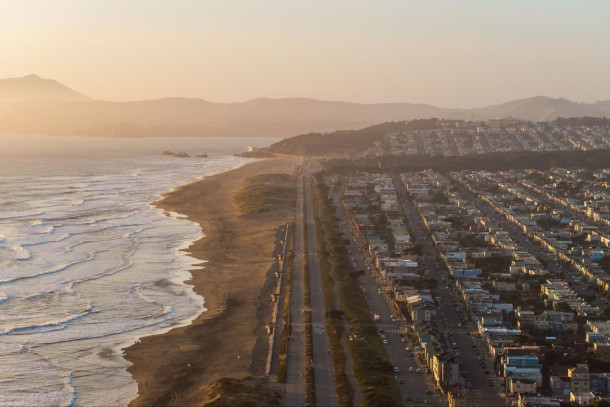
Sunset Dunes Park in San Francisco used to be a four-lane highway. (Photo: Jack Persons, Friends of Sunset Dunes)
BELTRAN: From PRX and the Jennifer and Ted Stanley Studios at the University of Massachusetts Boston, this is an encore edition of Living on Earth. I’m Paloma Beltran.
DOERING: And I’m Jenni Doering.
The four lane Great Highway used to run along the Pacific Ocean on the west side of San Francisco.
But in April 2025, this pavement became a little slice of paradise. Now visitors to Sunset Dunes Park can bike, walk, skate, and play next to the water.
Zach Lipton is a volunteer with the nonprofit Friends of Sunset Dunes and he joins us now to talk about this highway’s transformation. Welcome to Living on Earth, Zach!
LIPTON: Thank you so much. Glad to be here.
DOERING: So for someone who's maybe never been to San Francisco or to Sunset Dunes Park, what might they find at this park? You know, what is it like?
LIPTON: Sure, Sunset Dunes is a 50 acre park at the edge of San Francisco along the Pacific coast. It used to be a four lane highway and has been converted into a recreational space for people to walk and bike and sit by the ocean, have a bite to eat and just enjoy our Pacific coast. So we brought in eleven local artists to paint murals, five sculptures from around the Bay Area. The city has installed benches made out of logs that have fallen in recent storms from the park with natural log seeding, a bike park and a skate area down at slope, which has become popular. And of course, just the Pacific Ocean View is the star of the show.
DOERING: Yeah, and that wonderful ocean breeze. What about the sculptures? What are some of those things that kids can play around on?
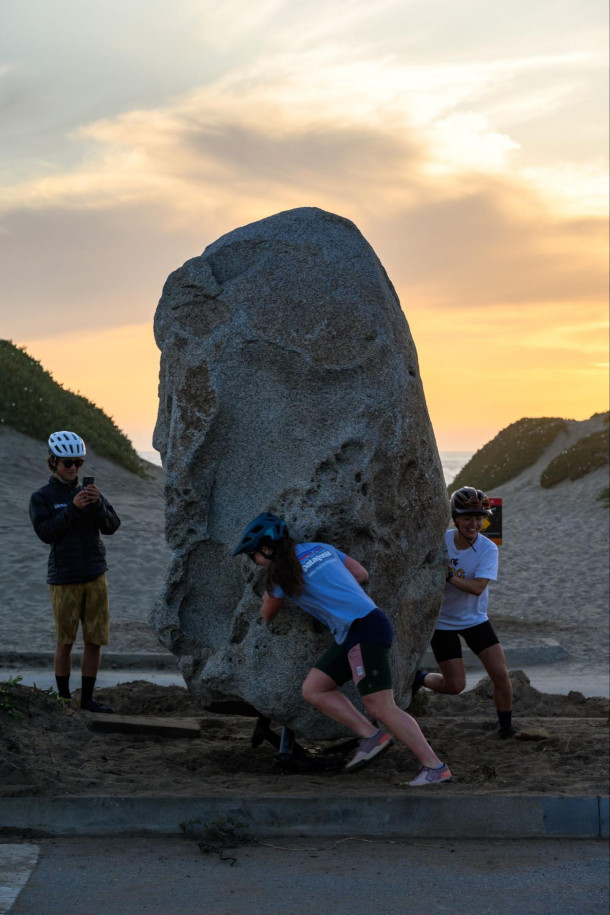
The “Spinning Rock” at Sunset Dunes Park. (Photo: Jack Persons, Friends of Sunset Dunes)
LIPTON: Sure. One of my favorites is a piece that, it's just called Spinning Rock. It's a 20,000 pound rock that is on a spinner. And just the look of delight when kids and adults, when everyone realizes you can just push this rock and start spinning it around. It's a lot of fun. We have a giant octopus the kids love to climb on, some giraffes down by the zoo. So it's been a lot of fun.
DOERING: And by the way, from the pictures that I've seen, it looks fairly flat. A lot of San Francisco famously has some very steep hills, but not so much for this park, huh?
LIPTON: Yes, it is a perfectly flat space, which is great for people, especially riding bikes. I know folks who have come out, learned to ride a bike there during the pandemic as an adult, using Sunset Dunes. And then, you know, they started off shaky and just kind of using it for recreation. And because of the confidence of that, started riding a bike for transportation all around the city. And so spaces like this, I think, are important to help people find alternative modes of transportation and get comfortable using them.
DOERING: So, you know, going from a four lane roadway to a coastal park, how exactly did we get here?
LIPTON: So let's go back all the way to just give you the long version of the history. The entire western side of San Francisco originally was just sand dunes, and in the 1800s some folks started creating a coastal path back when a road really was a recreational facility. This was a place to go ride your horse along the ocean. In time, that road was paved, but it always, for over a century, has been part of the city's Recreation and Parks Department, even though gradually, it kept shifting from a recreational use to really just transportation. Gradually it got widened to four lanes, and then during the pandemic, there was a huge need in San Francisco for socially distanced outdoor recreation, and the city converted a couple of streets to recreational facilities, including what was the Great Highway. And a lot of people really loved it, and just were coming out there for, for a daily walk, for a bike ride, and just to enjoy being there. And a group of friends and neighbors got together and started what was then called Friends of The Great Highway. We started putting on fun events like The Great Hauntway, which is an annual Halloween carnival for kids trick or treating along the road--
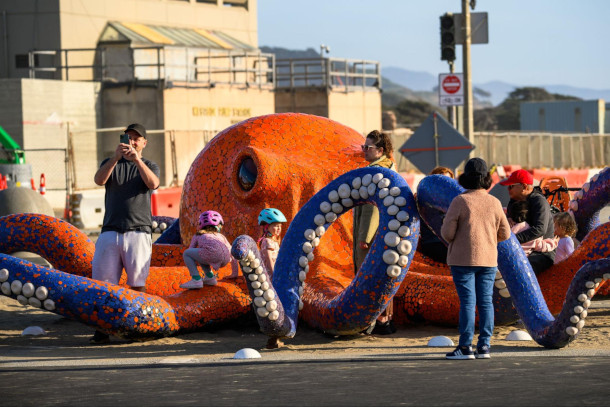
Kids and adults enjoy the octopus sculpture at Sunset Dunes Park. (Photo: Jack Persons, Friends of Sunset Dunes)
DOERING: Oh, cool.
LIPTON: --and other events, and ultimately organizing around what can we do to keep this space and preserve it? A few years ago, it was converted from full time park into part time. Cars would drive on it on weekdays, and people could use it on the weekends. And then ultimately, we ran a campaign, a ballot measure last November for the city to vote on its future. 55% of the city voted that they wanted it to be a full time park. And then we worked quickly with the city, with the California Coastal Commission, to make that vision a reality and start its transformation.
DOERING: Yeah, certainly the pandemic, it really kind of transformed the way that people thought about access to open space.
LIPTON: It really did. And I think there's a lesson there in that a lot of these things, you really have to try them in order for people to see the benefit of them. That we always like to say that the park sells itself more than we can ever explain its benefits to people. And this is something where if a few years ago, you said, yeah, let's turn the Great Highway into a park, people would look at you like you were crazy. But having tried it during the pandemic, and having just had the chance for people to experience it, all of a sudden, it makes a lot more sense. And I think there's a spirit of experimentation there that cities can embrace, whether it's this or other environmental efforts, that it's okay to just try things and see how they go.
DOERING: You know, one of the interesting aspects you mentioned is that this became a full time park by popular vote. How popular is the park now, and how in use is it?
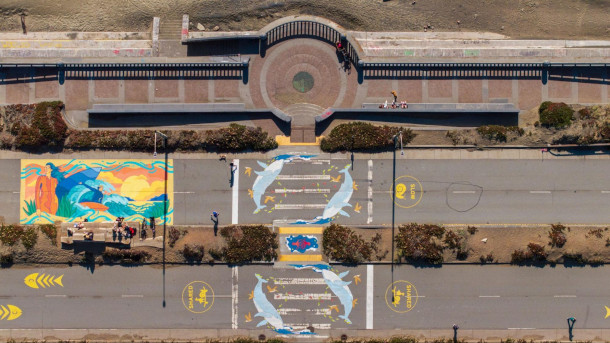
Eleven local artists have painted murals throughout Sunset Dunes. (Photo: Jack Persons, Friends of Sunset Dunes)
LIPTON: It's definitely very popular. It's become one of the city's most visited parks immediately, which is great to see. We're seeing over 10,000 visitors on the average weekend, we had 13,000 visitors come to our opening day in April. We have several thousand visitors every weekday coming and enjoying the park. At least for me, I think a lot of San Franciscans have, it's easy to take the ocean for granted here, and it's not a city that has been historically oriented along the coast, like a Santa Monica or Venice Beach or something like that. But we are so lucky to have the Pacific Ocean right here in our city, and it's really, I think, connected a lot of us more to the coast. And we're not just, you know, getting a quick glimpse of it as we drive by. We're really spending quality time there as well.
DOERING: Yeah, and by the way, how easy is it to get to the park?
LIPTON: Absolutely, there are two light rail lines that go directly to the park. A couple of our bus lines go there. It's connected to the city's bike network with a car-free path leading there. And of course, if you want to drive there, there's plentiful parking as well, so lots of options.
DOERING: Some of the neighborhoods just adjacent to the Great Highway, which is now Sunset Dunes Park, voted no on this ballot initiative at a rate of more than 80%. What are the concerns of people who are opposed to it?
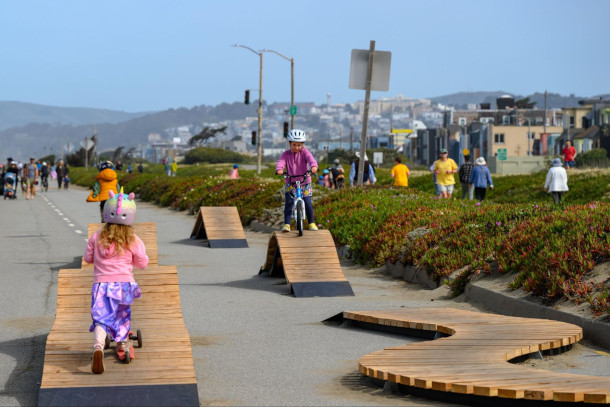
A skate park in Sunset Dunes. (Photo: Jack Persons, Friends of Sunset Dunes)
LIPTON: I've heard a few things. I think there were definitely some concerns about traffic, but the studies before the park opened, and then the studies that we've seen since the park has opened have been incredibly consistent. What we've seen overall is a change of about one to four minutes at rush hour less at other times in terms of drive times north-south across the city since the park opened. And the trade off for that is, we get a wonderful coastal park. It's also something where the road, the Great Highway, there are three different parts to it, and the southernmost part of the Great Highway was set to close anyway, due to coastal erosion threatening the city's wastewater infrastructure. So because that was happening, traffic patterns were going to need to change no matter what. So it was really a question of, where are people going to make that left turn inland if they're driving south, and if we make that left turn a little earlier, we can enjoy this wonderful coastal park instead. So that was definitely one concern, though I think both studies from the San Francisco Chronicle and the city's own data have borne out that traffic has really been okay and been just as predicted. I think there's a broader issue where of just sort of a fear or reluctance of change people are used to, this is the way it's always been, and this is the way they'd like it, and that's, that can be hard to adapt to.
DOERING: Well, it sounds like, you know, as the coast changes and erodes, and you know, certain parts were going to be shut down anyway, like you said, this sounds like a great silver lining as part of adapting to this changing future.
LIPTON: Exactly, change is going to happen one way or another. The ocean is going to win in the end. That is, we can't fight the ocean. So in terms of coastal adaptation, sea level rise adaptation, this is really an opportunity to create a great public space to do what's right for the environment. And ultimately, you know, I think it started to win people, even its critics, over just being able to be there and see the space. Certainly not everyone, but the great thing about public spaces and parks is that they're for everyone to enjoy.
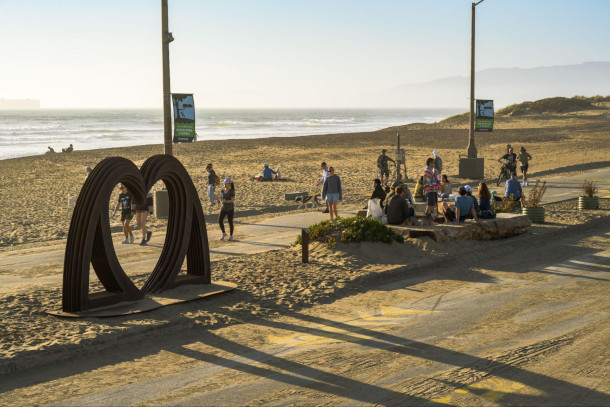
Visitors to Sunset Dunes Park enjoy a stroll along the Pacific coast. (Photo: Jack Persons, Friends of Sunset Dunes)
DOERING: So, you know, this park doesn't show up necessarily as a huge green swath on the map when you like, look at Google Maps or something like that. A lot of it is this roadway, but I understand there's also an ecological dimension to the park's transformation. How might Sunset Dunes Park contribute positively to the natural environment there?
LIPTON: There absolutely is. The sand dunes adjacent there have been neglected for a very long time, because when it's a roadway, the priority is preserving it as a roadway and pushing lots of sand around with bulldozers and invasive species all around it, invasive ice plant. So it's really not been treated as the environmentally sensitive area that it is. And the beach right adjacent there is home to the Western snowy plover, which is a federally endangered species. So this is a real opportunity to re-imagine that and do what's right for our coastal habitat. So we've started with the city and the National Park Service a dune restoration pilot where we had 100 volunteers transplanting native rye grass to introduce more native species to the area. That's been successful, and they're going to continue that effort during the planting season this fall. And it's also an area where this connects Golden Gate Park to Fort Funston and other natural areas south of there. So it's really about creating a green corridor all along the western edge of the city. Long-term, we're going to follow the science, and there are technical studies underway to analyze the effects of sea level rise on the area and to ultimately craft a plan for the dunes that will restore habitat and create a resilient coast that future generations can enjoy.
DOERING: So Zach, as someone who grew up in San Francisco, how are you hoping this park will transform the city and maybe influence its culture?
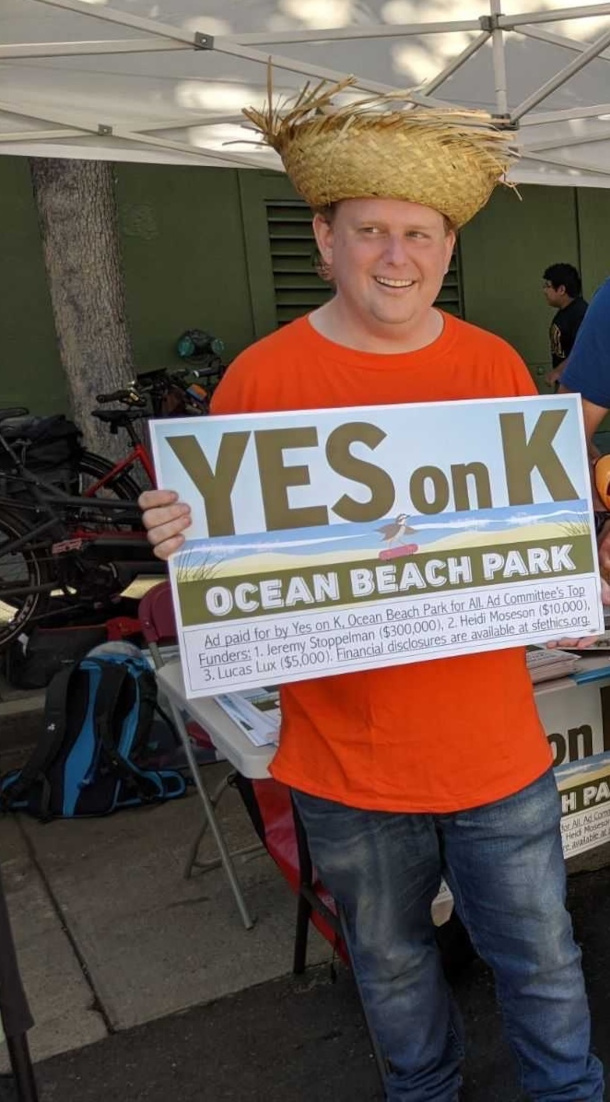
Zach Lipton is a volunteer with the Friends of Sunset Dunes nonprofit. (Photo: Drew McDaniel)
LIPTON: I think San Francisco has a bit of a tradition of doing things like this. The city tore down the Embarcadero freeway on our eastern edge of the city, and that's turned into a great waterfront promenade that is a popular tourist attraction. And I think that this is an opportunity to do something similar on the western side of the city, and really bring our city closer to the coast, and give people a reason to come out to the ocean and enjoy it and just have a better relationship with our Pacific Ocean.
DOERING: How do you think the story of Sunset Dunes creation could be a model for other cities looking to transform their spaces?
LIPTON: This is really something any city can do. It doesn't require years of study or millions of dollars in capital projects. You can just create public space like this and watch it evolve and see what happens. And so many of our cities have, you know, 99% of our streets or more are devoted to just the throughput of private car traffic from point A to point B. And really it's, you know, what if we shift that balance, even just 1%? All of a sudden, it opens up so many possibilities for transformation, and for the environment, for how we relate to public space and community space, to just be with each other. And I just want to stress that this is something that people in any city can do. You can get together with your friends and your neighbors and transform public space. And it really doesn't need to be an expensive, big public works project. This is something that anybody can take part in and make their city a better place together, and that's really been the most rewarding part of this, is just getting to work with everyone and making new friends and making the city a better place.
DOERING: Zach Lipton is a volunteer with the Friends of Sunset Dunes nonprofit in San Francisco. Thank you so much, Zach.
LIPTON: Thank you.
Related links:
- Read more about Friends of Sunset Dunes
- The San Francisco Chronicle | “Has the Great Highway Closure Led to a Traffic Nightmare? This Is the Most Complete Data Yet”
[MUSIC: Joni Mitchell, “Big Yellow Taxi” on Ladies of the Canyon, Warner Records Inc.]
BELTRAN: Just ahead, how gardening can help people on the autism spectrum grow confidence as well. Stay tuned to Living on Earth!
ANNOUNCER: Support for Living on Earth comes from the Waverley Street Foundation, working to cultivate a healing planet with community-led programs for better food, healthy farmlands, and smarter building, energy and businesses.
[CUTAWAY MUSIC: Edgar Meyer, “ Cello Suite No. 1 in G Major, BWV 1007” On Bach Unaccompanied Cello Suites Performed on Double Bass, by Johann Sebastian Bach/arr. Edgar Meyer, Nonesuch Records]
Gardening for Special Needs
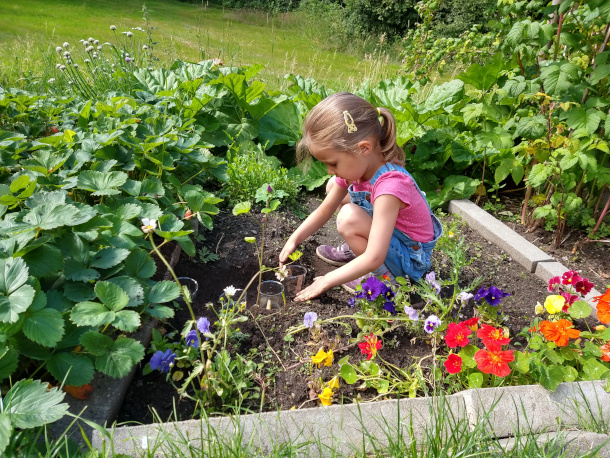
Gardening can help children regulate emotional health as well as learn mindfulness and resilience. (Photo: Elicarrera, Wikimedia Commons, CC BY SA 4.0)
DOERING: It’s Living on Earth, I’m Jenni Doering.
BELTRAN: And I’m Paloma Beltran.
In the late 1800s the British garden designer, writer and artist Gertrude Jekyll wrote: “A garden is a grand teacher... above all it teaches entire trust.” And for people with developmental or physical disabilities, growing plants in a garden may offer personal growth opportunities that unlock new possibilities outside of the garden too. This kind of transformation is something avid gardener Jill Mays of Cape Cod, Massachusetts has seen again and again in her work with disabled children and adults. Jill is an occupational therapist by training, and several years ago, she combined her interests and began to volunteer with the Truro Community Children’s Garden. Her book, Nurturing Nature: A Guide to Gardening for Special Needs, is relevant to people of all ages and abilities. She’s worked with people who have physical disabilities as well as those on the autism spectrum. Jill Mays, welcome to Living on Earth!
MAYS: Oh, thank you so much for having me.
BELTRAN: So Jill, you run a weekly gardening group for adults with disabilities. What is it about gardening that is so beneficial to this population?
MAYS: Well, the garden offers a smorgasbord of sensory input. You know, obviously visual, but then there's the smelling and hearing things, and then the moving around, and all of those things are very helpful and impactful to help engage this population. We have, like, millions and billions of input coming into our brain all the time, and we need filters to be able to figure out what to pay attention to and not to. And some people don't have effective filters in terms of being able to say, I can pay attention to this and not pay attention to that. And so a lot of people have hypersensitivities to touch. Others have hypersensitivities to sound. Even visual hypersensitivities can happen, where they have difficulty processing certain kinds of lights or whatever make them uncomfortable. And then there's people who, you know, have the whole ball of wax, so to speak, and you know, they're really in a very difficult state.
BELTRAN: How does participating in gardening mitigate that discomfort?
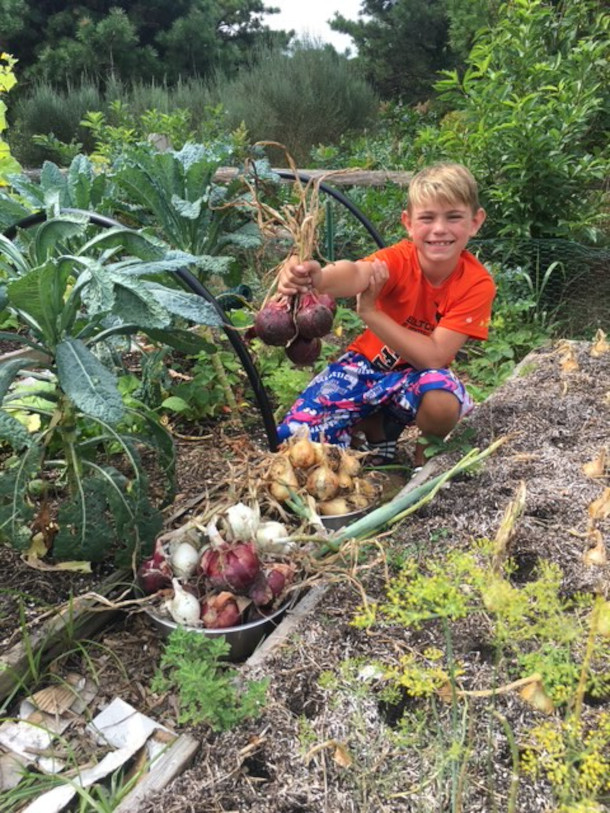
Pictured above is Jill Mays' grandson, holding onions in the garden. (Photo: Jill Mays)
MAYS: So for instance, after we have a welcoming and introductions where we're facilitating some socialization, we do a walk through an edible garden, an edible landscape. And along the way, we are looking at things and talking about our observations. And then we, there's always mint and lemon balm and things that I pull up and let them smell. And what that does is it activates the olfactory system. They love to look at the butterflies, because you can look at the details, and then they fly around. And so you're really activating the visual system in near point and then scanning. And then we always have a task to do. Usually it's weeding, and a lot of times they begin with, oh no, no, I don't want to touch the dirt, and I can't do that. And I'll say, I understand. All you need to do is five times, 12345, yay. You did a great job. The next time, it's 10 times. And so we begin to build resilience. And the other thing is, a lot of the people who are on the spectrum have a lot of hypersensitivities, especially to touch. And when they're in the garden, they're able to tolerate that, either by I, they have gloves, or I help explain to them that they're absolutely able to go wash their hands immediately. And so that's one aspect, is that they begin to tolerate in that respect, but also, because there's so much other sensory things, stimuli going on, it helps mitigate their focus on the discomfort of touch. And also, by being uncomfortable with touch, they have difficulty engaging with other people, because people are unpredictable, and they kind of want to stay in control, so the more we can help mediate that discomfort to touch, the more they're able to begin engaging socially.
BELTRAN: And can you tell us a story, Jill, you know, maybe, about a participant in the gardening group for whom you saw a significant change in their behavior over time?
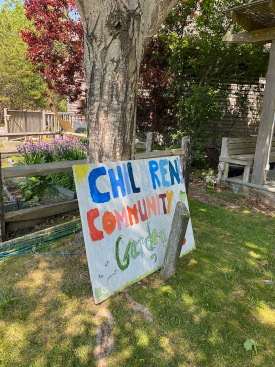
The Truro Children's Community Garden, a community project, was spearheaded by Sustainable C.A.P.E.* (Center for Agriculture, Preservation and Education) and the Truro library. Local businesses and volunteers helped build and run the group, which has been running since 2010. (Photo: Jill Mays)
MAYS: Absolutely. One young woman, very bright, on the spectrum, and has a lot of difficulty engaging with other people, so she would come to the garden group, and was very, very reticent to even, you know, always followed behind with, needed encouragement to follow our group on the tour, and was always like five or 10 feet behind. And over time, we were able to get her to be engaged in all of the tasks to the point where she became a helper. So in socialization, there's parallel work and play, where people are working alongside each other. So that was a first step. And over the course of a summer, at the end of each of our groups, we have a project that we do. And so things like potting up plants. And she was able to engage in cooperative work, helping another person and member of the group. So we went from very basic social skills to really much more engaged participation.
BELTRAN: So she really evolved in terms of teamwork, it sounds like.
MAYS: Teamwork, yeah, we actually end up with a good amount of teamwork, which is really lovely.
BELTRAN: So Jill, besides the anecdotal evidence, what does the science tell us about autism and gardening?
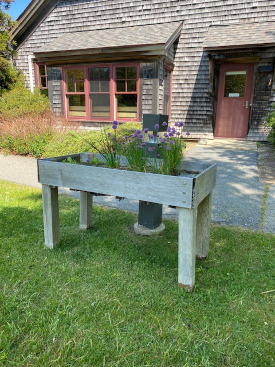
Wheelchairs can easily tuck under standing garden tables like the one pictured above, increasing gardening accessibility. (Photo: Jill Mays)
MAYS: So there have been several studies in which children participated in garden groups, and the studies have found that their emotional IQ, which includes self-awareness, self-regulation, motivation, empathy and social skills, that that improved and also social IQ, which is increased communication in this initiation and completion of tasks, and improvement in adaptive behaviors, that that also improved. So just participating for a six-to-eight-week program, they had really significant gains in those areas.
BELTRAN: And I understand that you were an occupational therapist. What are some of the experiences that inspired you to write a guide for gardening with special needs?
MAYS: Well, what I found when I started working in the garden, originally helping out with the children's garden that was in Truro, is that all of the skills that I worked at in the clinic and in classrooms were happening organically in the garden. So developing motor skills and the sensory processing, things that I talk about in terms of helping people engage more effectively, all of those things were happening in the garden.
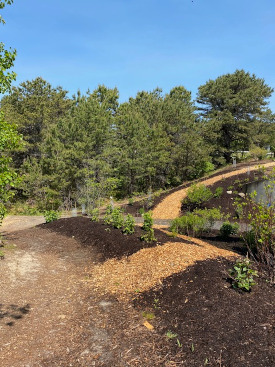
The Edible Landscape at the Truro MA Library. (Photo: Jill Mays)
And then I was invited to volunteer with a farmer in the school, in the Truro school, and what I saw was one particular event was with sixth graders. They were having to move compost from a big compost pile to the beds. You would think this would be like, oh my God. But you would think they were going to a rock concert. They were so pumped up, jumping up and down and happy. And it clicked for me that—so one of the huge things that I do in the clinic is working with children in terms of the filters that we've talked about, being able to help them with their sensory processing. And the first thing we need to do is something called heavy work, which activates nerves in the joints, and the nerves in the joints shoot up to the area of the brain that activates filters in the brain. The fancy word is inhibitory neurons, and so it's kind of like a Super Mario going [scratching sound], kind of erasing all of the extra input. So these are pre-adolescent, adolescent kids, and you know, they're like, climbing the wall. They're crazy with hormones and, you know, social anxiety and everything. And so what they did was—they were just really, really loving this. And this was a big aha moment for me, because I was like, wow, this gardening is so incredibly helpful for people to reduce anxiety and activate those filters.
BELTRAN: Yeah, nature really is healing and powerful. So if someone wanted to start a weekly gardening group in their own neighborhood, how might they make their gardening space more accessible for people with disabilities, like people on the spectrum, for example?
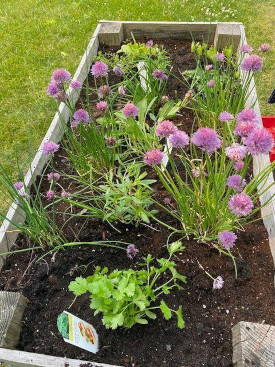
The Cape Abilities adult group cares for this herb box. (Photo: Jill Mays)
MAYS: Yes, there's certain considerations that you want to have for people who are on the spectrum and neurodiverse. The number one rule when you're forming a garden and you want to work with this population is first to make sure that it's a successful experience. That's number one. So number two is that you need to be flexible in the approach that you use with these people. So for instance, you want to take a look at what their abilities are and sort of match the activities and the tasks to what their abilities are, what their capabilities are. So for instance, let's take weeding. If an individual has a little bit of trouble, like discerning, say, visual perception -- being able to tell the difference literally, the weeds from the plants, so to speak -- you want to make sure that it's successful for them and they're not yanking up seedling tomato plants or something. So you're going to put them in an area where it's pretty much all weeds, or you're going to make very clear demarcation between what is the weeding and what is the actual plant. You know, even blocking off an area. Another example would be seeding. So that's something that requires fine motor control, and, again, visual attention. And there's a lot of people who struggle with that. And so you're going to look at a couple strategies that you might want to use. One would be looking at the size of the seeds. So for instance, bean seeds are great, and a lot of people can manage those. They can see them. They can see where they place them, and that's great. But something like a carrot seed or lettuce seeds are very small and flaky, and that would be really hard. However, that doesn't mean that individuals can't do that. You just have to be flexible in terms of what kind of sowing of the seeds that you do. And a lot of the groups that I've run, we do broadcasting, which is you take a fistful of seeds and you toss them in, and then a couple weeks later, when the seedlings come up, you have a new job, which is thinning the seeds. And that's a much easier task to do. So those are just examples of where gardeners have very specific ways that they do things, but you want to kind of think out of the box in terms of how you go about to make sure that these activities are accessible for them.
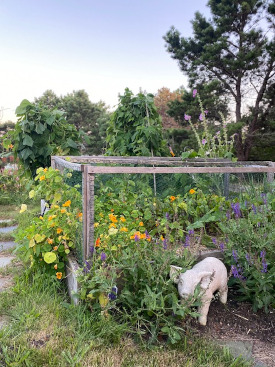
Gardens can be whimsical. This is the entrance to Jill May’s garden. (Photo: Jill Mays)
BELTRAN: You said, the number one thing for making gardening accessible for neurodiverse people is that they have a successful experience. What do you mean by a successful experience, and how do you do that?
MAYS: That's a great question. First of all, you really want them to feel joy. You want them to experience joy when they're in the garden, and the first thing is that they feel like they understand what's happening and they're capable of doing what is asked of them. You don't want them to feel overwhelmed. So you're going to make it very clear what the instructions are, and you're going to match the ability with what the individual is capable of doing. You also sort of coach them. And for instance, a lot of times, you know, the first response is, oh, I can't do that. Especially like weeding, you know, bending over, it's like, no, no, no, that's too hard. And so I measure it. I say, look it. I understand it is hard, so no worries. I'm just going to let you, you only need to do five, yank up five weeds, you know? And I say, 12345, and I give them a big hands, you know, yay, hooray. You did a great job, and you are all done. So you do incrementally, you don't start with, okay, today we're going to weed and we're going to plant, and where you just take little tiny tidbits of activities at a time. And I will say that over time, those individuals, for instance with the weeding, that are like, I can't do that, whether it was for tactile reasons or endurance reasons, by the end of the season, we're yanking up entire beds pretty successfully. So it builds over time.
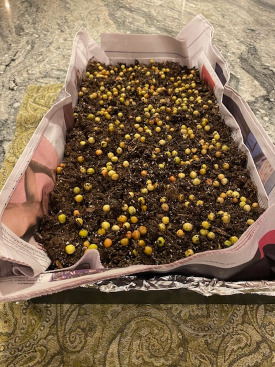
A great inside winter garden activity: pea shoots! In a few weeks you’ll have tasty 6-8 inch shoots for salads and stir fries. (Photo: Jill Mays)
BELTRAN: And then what about for people with physical disabilities, like people who use a wheelchair? How do we make gardening more approachable for those populations?
MAYS: Yes, that's a great question, and I might add that for a lot of the neurodiverse people, many of them have some physical limitations. So all the things that we just talked about are applicable and that we're going to talk about now specifically. So there's a lot of ways that you can activate making gardening accessible. One is something called a table bed, where you actually have the bed where you put the soil, and it's like, it literally is like a table with a lot of clearance, so wheelchairs can go underneath it, and they can work directly there. And obviously just having higher raised beds is helpful, but there's other strategies that you can use as well, like doing vertical gardening. So you have pots and then you have things growing, so it's much easier for someone with a walker or a wheelchair to reach. And then there's pots that you can put on dollies and move to the location that people are, as opposed to them having to go to it. And then for people who are still mobile but are starting to find their bodies are saying, this is too much for me, there's wonderful things like chairs and benches. And I just started because I needed to demonstrate at all the talks I give, you know, some examples of this. I got this beautiful purple kneeler that I absolutely love, because now I used to be able to only garden for about an hour or so, and then my body was saying, stop it. And now I am back to gardening three, four or five hours, because it distributes, I can push down with my arms so that it's not just my knees and hips. I can distribute all of the stress throughout my body instead.
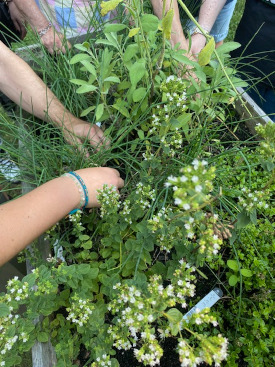
Group members from Cape Abilities at work weeding. Our guest Jill Mays says, "many hands make light the work". (Photo: Jill Mays)
BELTRAN: Yeah. One thought that came to mind when reading your book is that, you know, we will all progress into becoming differently abled people, right? So all of these tips and tricks are really useful for, for all of us, honestly, at the end of the day.
MAYS: Yeah, exactly. So the title of the book is, For Special Needs, Gardening for Special Needs . But we really all have special needs. And from the, from the birth, you know, from the cradle, children really need to be engaged, moving and outside. As we get older, we need to disconnect from our devices to help de-stress, and then way at the other end of the life cycle, it's a use it or lose it situation. So whereas children are gardening to develop skills, the elderly are gardening in a way that can help them maintain skills, in ways that, you know, just going to the gym doesn't do. It's incredibly impactful.
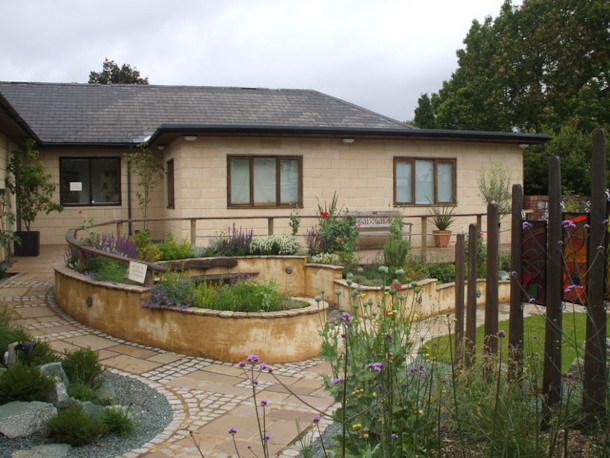
The Sensory Garden in the grounds of St Christopher's School in Westbury Park, Bristol, a school for children with special needs. (Photo: Michael Murray, Wikimedia Commons, CC BY SA 2.0)
BELTRAN: As a society, what do we lose by not incorporating differently abled people into nature-based activities like gardening?
MAYS: Well, these are the most vulnerable people, you know. They have a lot of stress in their life from internal things, and also they are oftentimes isolated. And gardening is something, as we've mentioned throughout talking, that there's so many ways that it helps to calm us down, de-stress us, it makes us healthier. And so they will be able to benefit enormously. But the other thing is that these are wonderful people, and gardening is a great equalizer, and so people of all different walks of life can garden together. And so it is an opportunity that there's more of a commingling, so to speak, and that both can share together in the joys of gardening.
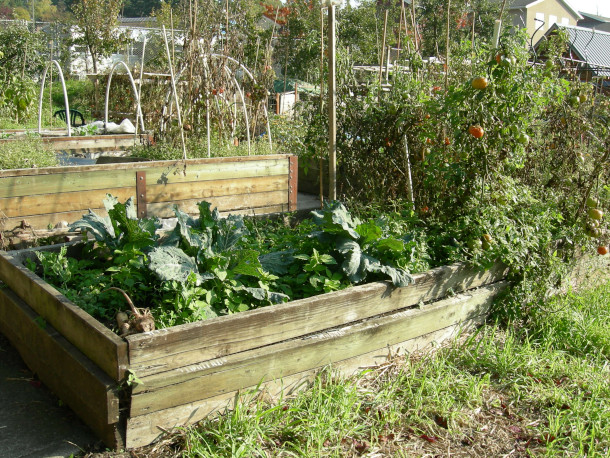
Picardo Farm, Wedgwood neighborhood, Seattle, Washington. A community allotment garden with raised beds for the physically disabled. (Photo: Joe Mabel, Wikimedia Commons, CC BY SA 3.0)
BELTRAN: Jill Mays is the author of Nurturing Nature: A Guide to Gardening for Special Needs. Jill, thank you so much for joining us.
MAYS: Oh, thank you. It was wonderful.
Related links:
- Purchase Nurturing Nature: A Guide to Gardening for Special Needs from Bookshop.org to support both Living on Earth and local independent bookstores
- Follow Jill Mays on Instagram
- Learn more about Cape Abilities
- Learn more about Sustainable C.A.P.E’s Children’s Community Garden at Truro Public Library
[MUSIC: Seckou Keita, Catrin Finch, “Listen to the Grass Grow” on SOAR, bendigedig]
Great Blue Heron
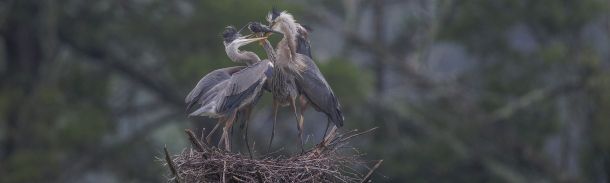
Great blue herons stand in their nest in the morning fog. (Photo: Mark Seth Lender)
DOERING: The subtle grey plumage of the great blue heron can be appreciated across open water and wetlands in much of the Western Hemisphere.
Explorer in Residence Mark Seth Lender observed a mother heron nurturing her chicks by the Black Hall River in Connecticut.
Feeding Time
Great Blue Heron Rookery
Black Hall River, Old Lyme
Connecticut
© 2026 Mark Seth lender
All Rights Reserved
LENDER: The fog is like snow. Snow when it is dry and fine and pure white, or blue white. Safe. A blanket. Safe and soft. Like pressing your face into fresh powder, eyes open. And though the sun is awake now, like snow on a very cold morning the fog, remains. And does not burn away. How it glows. The bright wick of a lantern that persists insensitive to the flame. Sound also is made indefinite. Vague. Yet I know what I hear: The roiling, crackling clatter of young great blue herons begging to be fed. I see their shadows now, through the fog. Their mother also, who has been long and far way, down the great river, into the tributaries and the shallows where she steps, carefully, creature of stealth and purpose who seeks until she finds. Only then does she return. She stands now at the rim of the nest high in the bare, bone-like limbs of the tree. Her neck long. Her long beak pointing. As if withholding.
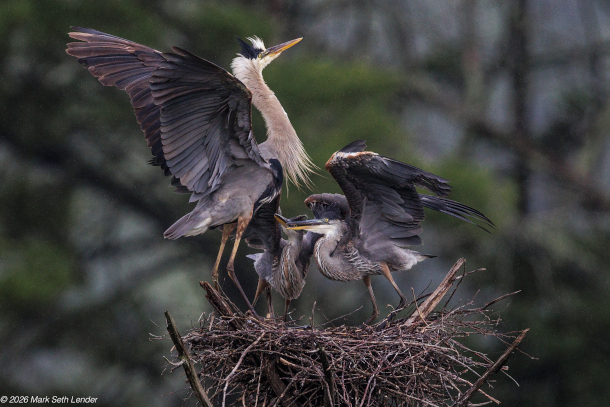
A mother heron comes to feed her chicks, who stab at her impatiently. (Photo: Mark Seth Lender)
Her children reaching, grabbing, stabbing, finally, finally she raises the fish from her crop. And lets it fall, between them…
It’s as if they have never been fed. Never. Neither one. As if the idea of food is novelle. How they struggle, with this pudgy little fish, how to approach it, grasp it, how to take it apart and swallow it, this new object that means, Life.
DOERING: That’s Living on Earth explorer in residence, Mark Seth Lender – and you can find pictures at our website, loe dot org.
Related links:
- Visit Mark Seth Lender's website
- Learn more about the great blue heron
[MUSIC: Carlos Nunez, “Two Shores” on Brotherhood of Stars, traditional northern Galician]
BELTRAN: After the break, the magic of apples and fall apple picking. That’s just ahead on Living on Earth.
ANNOUNCER: Support for Living on Earth comes from Hansjörg Wyss in honor of Rosamund Stone Zander. Celebrated painter, environmentalist, and author of The Art of Possibility, who inspired others to see the profound interconnectedness of all living things, and to act with courage and creativity on behalf of our planet. Support also comes from Sailors for the Sea and Oceana. Helping boaters race clean, sail green and protect the seas they love. More information at SailorsForTheSea.org.
[CUTAWAY MUSIC: Stan Samole, “Inch Worm” on Childish Dreams, Public Domain/arr. Stan Samole and David Antonacci, MCA Records/Jazz Inspiration]
The Light Between Apple Trees
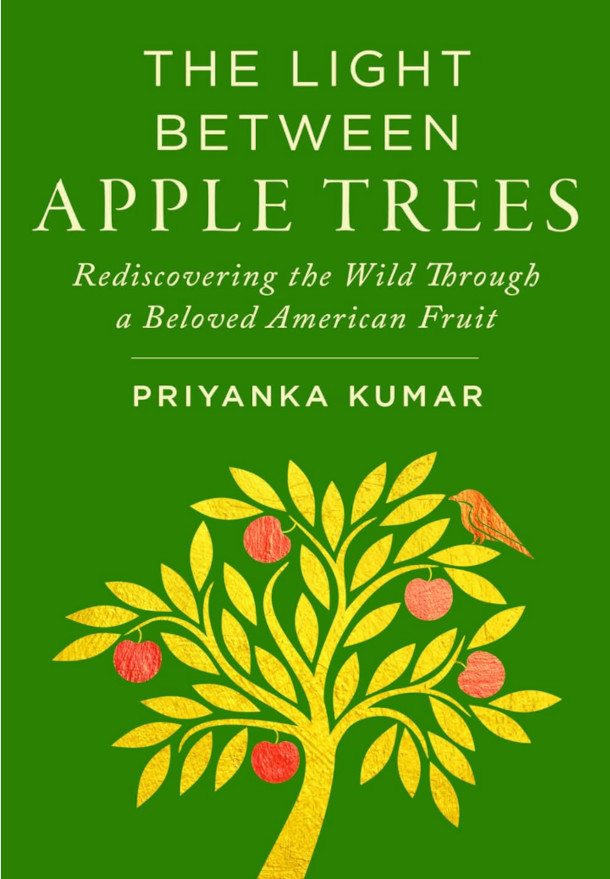
The Light Between Apple Trees: Rediscovering the Wild Through a Beloved American Fruit, by Priyanka Kumar. (Photo: Courtesy of Island Press, Jacket design by Jordan Wannemacher)
BELTRAN: It’s Living on Earth, I’m Paloma Beltran.
DOERING: And I’m Jenni Doering.
Apple picking season is just getting underway here in North America. We’ll sample Honeycrisp and Ginger Gold, Blondee and Mcintosh, Cortland and Macoun and of course fresh, hot, apple cider donuts. But few of us know the fascinating and complex science and history behind the iconic apple. Priyanka Kumar is the author of The Light Between Apple Trees: Rediscovering the Wild Through a Beloved American Fruit, and she joins us now.
Welcome to Living on Earth, Priyanka!
KUMAR: Thanks so much for having me here, Jenni!
DOERING: So throughout this book, you keep returning to some formative childhood experiences with apples and apple trees. Can you take me to the setting of your childhood and how did that environment shape who you are today?
KUMAR: Sure, I was incredibly fortunate to grow up in the foothills of the Himalayas, and these were beautiful, pristine areas that scientists now know are among the top 20 most valuable biodiversity hotspots on our planet. So I was living in the heart of the apple growing region there, and so I remember myself as a two-year-old child wandering among these mature apple trees, mother trees, and just feeling that they are these beings that are towering over me. And a little later, when I started walking to school every day, I would see these mountains that were streaked with snow, and strangely, I felt like they were my friends. I would have conversations with them. I mean, I would say that I didn't have a lot of toys to speak of, but in a sense, nature was my playground.
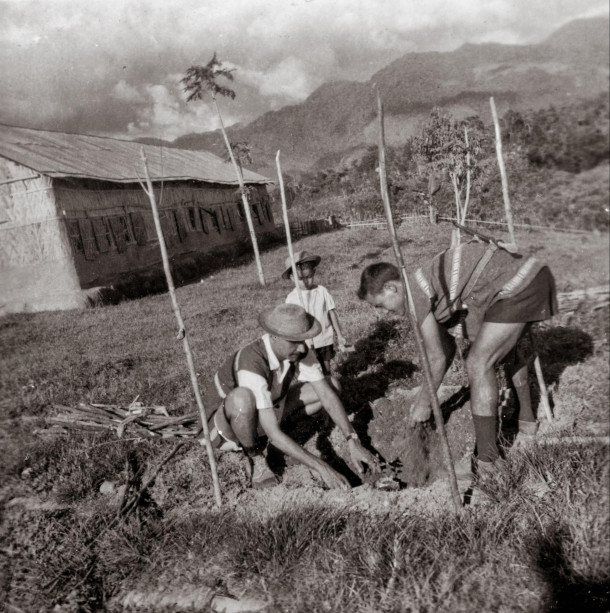
Priyanka Kumar’s father plants a tree outside their home in the foothills of the Himalayas. (Photo: Courtesy of Priyanka Kumar)
DOERING: I mean, it sounds like it was a place that was imbued with magic for you as a kid.
KUMAR: Yeah, and I think it really unlocked my imagination. I mean, for one, it made me a lifelong naturalist. I mean, certainly in this book, I circle back to a core formative memory. When I was about four years old, my dad took me to a magical apple orchard, and I spent the entire day weaving among the trees and experiencing the same connection that I did with the mountains. And I felt like these trees were living beings, and I could be with them and not be lonely. And then at the end of the day, we walked up to this little glass turret, I was sitting on my dad's lap, and the orchardist came up to us and offered us a yellow apple, and I took it and bit into it, and sitting up there in this glass turret, looking down at all those trees that I'd spent the whole day with, biting into this apple, I felt like the earth herself was giving me an apple-scented kiss. And I just felt very close to all the elements. And I felt like, this is it. I'm a child of all of these elements. I belong here, and I think in some way, I, that was the spark for the rest of my life.
DOERING: That's beautiful. So apple trees, fruit trees, have evolved and been cultivated over thousands of years. They appear in countless stories across cultures and religions. You write about this in your book, and here you are adding your own story to this tapestry. Why do you think the symbolism of the apple has endured for so long?
KUMAR: There's something powerful about fruit trees. I almost think sometimes that fruit trees are a symbol of love. I have a chapter in the book called, "Love Notes from Nature." I feel like a fruit tree is the ultimate love note from nature. It's giving you this shade. There's also this aroma, and you settle into yourself, you know, whether it's the blossoms or the ripening fruit, and then, you know, just the act of reaching up and grabbing the fruit, I feel like many of my joyous memories have to do with that. I mean, it's not always an apple tree, but sometimes it's like an apricot or a peach or a cherry tree, just this feeling of being supported by nature. I mean, I'm very interested, as a naturalist, in the inner workings of nature, but I think I'm also interested in all these fascinating ways in which nature supports us, and I think fruit tree is a very powerful symbol of that.
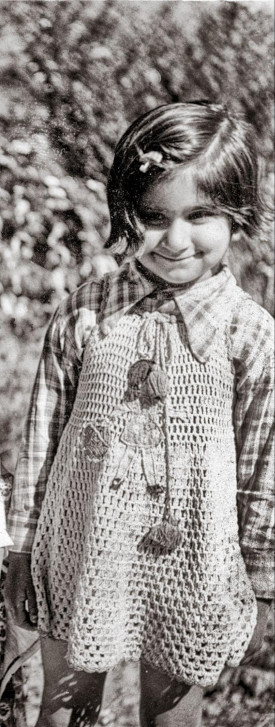
The author, Priyanka Kumar, as a young child. (Photo: Courtesy of Priyanka Kumar)
DOERING: Absolutely. And when you think about like, you know, it's love notes from nature, as you say, it's also all of the care that people have put into cultivating these varieties over time, there's a lot to be thankful for, I guess, when you reach for an apple in a tree.
KUMAR: I mean, the history of apple trees in America is mind blowing. And we've had apple trees here for over 400 years now. And if you go back and think about how the early settlers and the Jesuit priests brought, you know, they tucked apple seeds into their pockets, you know, when they were coming to America. And the first thing that they did, even before they started to, you know, make any kind of a one room dwelling, is they planted those seeds. That was, like the first act. It was so important.
DOERING: Yeah, you write about, you know, Quebec, when these Jesuit priests were coming to North America, they would plant apple trees there, and then also the Spanish in the southwest, where you are now.
KUMAR: Yeah. I mean, a lot of times we think about settlers from England bringing apple trees, or perhaps Ireland, and that is so true, but there's an equally rich history of French settlers and Spanish conquistadores bringing in little apple seeds, which they planted and nurtured with great care. So one of the things that really amazes me is there's a orchard here, Las Golondrinas. It's an old, old orchard, and they grow this apple that is called the Wolf River apple. And it's amazing to look into the history of this apple and to find that it was actually planted by French settlers in Quebec, way in the 1600s and then brought down to Wisconsin by a woodsman and planted there near the Wolf River, and then brought all the way down to New Mexico and planted here. It just increases your sense of connectivity.
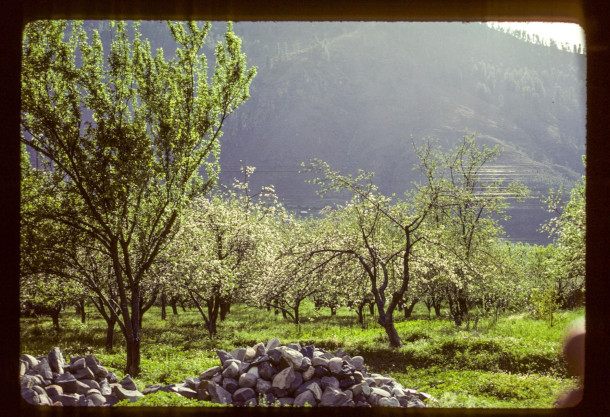
An apple orchard in Himachal Pradesh, India. (Photo: Wheeler, Mary Binney)
DOERING: So where does the apple come from? I mean, everything that we eat and have domesticated at some point came from a wild plant. Where did the apple come from?
KUMAR: That's a great question. So it turns out that the origins of the apple are wilder than we ever imagined. So for a long time, scientists believed that the primary ancestor of the cultivar apple, this is Malus domestica, the apple that we eat today, was the wild apple, the wild Kazakh apple that grows on the flanks of the Tian Shan mountains in Kazakhstan. Well, it turns out the story is much more complicated than that.
DOERING: Yeah?
KUMAR: It’s only in the last 20 years that genetic science has gotten us closer to understanding the true origins of the apple. It's true that they were growing and they still do grow in the Tian Shan mountains, but they were soon traveling along the Silk Route and traveling through parts of Europe where the apple, the wild apple, hybridized with the wild European crab apple, and then made its way to America. So now we know that the apple is this world traveler, a truly transnational fruit. So you know, when you hold an apple in your hand today, I mean, there's a sense of adventure there thinking about its roots.
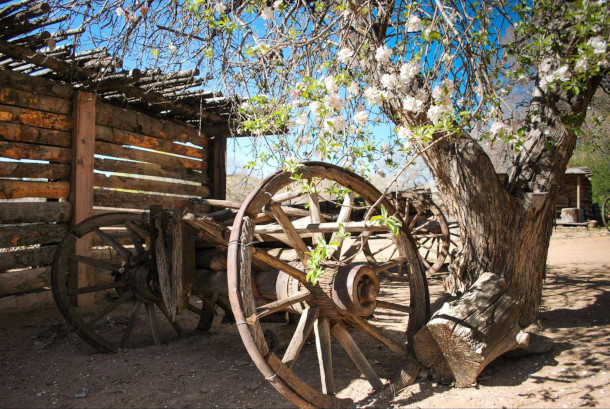
Los Golondrinas Orchard in New Mexico. (Photo: Priyanka Kumar)
DOERING: Yeah, and I love it as a metaphor for you know, when you're thinking about apples in America and this country as a melting pot of so many different traditions and cultures and ethnicities, like the apple itself is sort of woven together from different strands of ancient species.
KUMAR: Absolutely, I think, for those reasons you put it so well, Jenni, the apple truly is an American fruit because it, like America itself, the apple has been put together with all these strands, and some of those strands actually go back into deep time, where it comes from this ancient flowering rose that started growing on planet earth about 80 million years back.
DOERING: Wow, that's pretty deep roots.
KUMAR: That's pretty deep roots.
DOERING: So now is a perilous time in the apple's history. What are the climate threats facing apple trees today, both in New Mexico, where you live, and elsewhere?
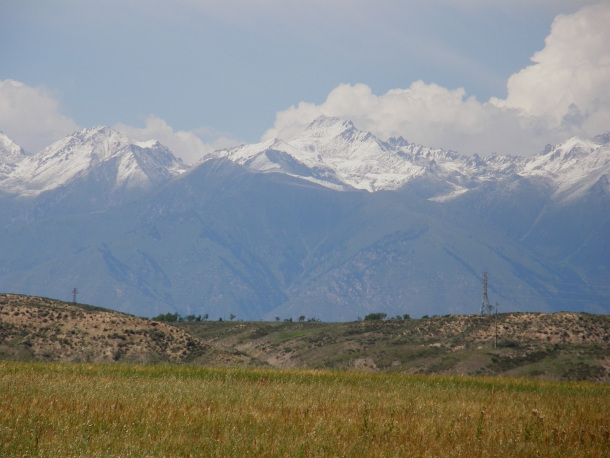
The Tian Shan mountains in Kazakhstan. The apples we eat today are a hybrid of the wild Kazakh apple and the European crab apple. (Photo: Malcolm Manners from Lakeland FL, USA, Wikimedia Commons, CC BY 2.0)
KUMAR: So scientists have come up with six climate metrics that can negatively impact apple trees, and they mostly have to do with exposure to severe heat, fewer chill hours. Apples tend to need about 500 to 1000 chill hours for proper development of the flower and eventually the fruit. We're in the southwest. We've been in a mega drought for the last 22 years, and it turns out that the apples in Yakima County, a lot of our apples come from Yakima County, and Oh, yeah. So, so the apples there have already been adversely impacted by five of these six metrics. So when it comes to climate change, it's not something that is going to happen five years from now. It's already happening. We're in the throes of it right now. And for me, it certainly came home when one of the orchards where I spent time, and I know the orchardist well, John Trujillo, told me that because of global warming, which had killed off essentially all of his cherry trees, he told me that it's just too hard. He's not going to plant fruit trees anymore. And for me, it was, it was a devastating moment. It really broke my heart, because John is a third-generation orchardist. You see how it's changing lives right in front of you, so it's no longer abstract numbers that you're dealing with but, but you're face to face with the people who are up against it.
DOERING: What can be done for apple trees amid these threats, and how might those actions also help the wider ecosystem to thrive?
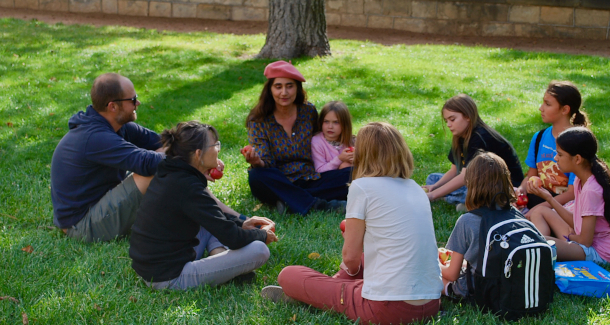
Priyanka Kumar (center) hosts an apple tasting, making “apple friendships” in the process. (Photo: Courtesy of Priyanka Kumar)
KUMAR: You know, back when America had a love affair with apples, I mean, I think we still love apples, but I think we really had a, we celebrated apples more and we were more connected to them. We were growing more than 10,000 varieties of apples in this country. I mean, that's--
DOERING: Wow. Incredible.
KUMAR: That's amazing. You know, there's, there's more than 16,000 named apple varieties, and today only about less than a fifth of those varieties are accessible to us. So one of the things that's happened with this distancing from nature, with this industrialization of apple growing, is that we have far fewer varieties, so that richness is gone. And so what happens in a changing climate, because apples are susceptible to disease, you know, viruses, fungal issues, when you have industrial apple growing with a monoculture of apples, a certain apple variety is hit, and then you lose all of those apple trees, you lose that variety. So I think if we were all growing different varieties, we would be more resilient to climate change.
DOERING: Priyanka, your book isn't just about the history and science of apples, although that is fascinating. It's also about connecting with people. How can apples and food in general build community in today's world?
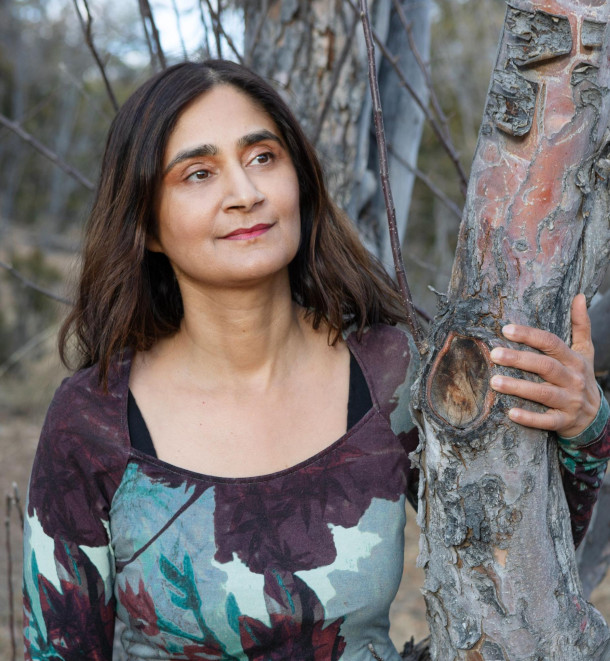
Priyanka Kumar is the author of The Light Between Apple Trees: Rediscovering the Wild Through a Beloved American Fruit. (Photo: Molly Wagoner)
KUMAR: That's a great question. So I come from a culture where hospitality is a very important value, and one of the things that I missed a lot during the pandemic is, I couldn't have people over, and so I started doing these apple tastings out on my porch, and I would bring all kinds of apple varieties, and have friends and neighbors and strangers waft through, and and I felt like I made a lot of lovely "apple friendships" through that. And then later, when I was in places like Charlottesville, for instance, I found that, you know, I would run into people where maybe we thought a little bit differently about some political issues, but we could always get excited about the same apple varieties, and we could talk about apple history. I would tell people about these wonderful apple stories. One of the most inspiring figures for me is John Adams, who was very hands on with his apple growing. I mean, he was putting seaweed into his compost pile and spreading it along on his meadow and growing his own apple trees and make, and he and his wife, Abigail, making their own cider.
DOERING: And he wasn't using slave labor like Jefferson was.
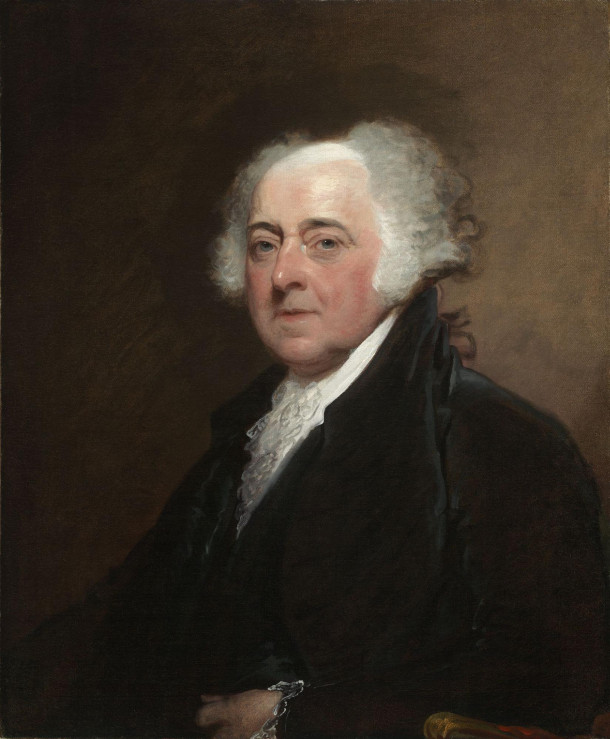
President John Adams planted his own apple trees, without slave labor. (Photo: National Gallery of Art, Wikimedia Commons, public domain)
KUMAR: Yeah, I mean that was the inspiring part. He was, you know, the only one of that group that wasn't using slaves. So, so it felt good to tell people some of these stories about how dedicated he was to having a gill of cider every morning. He thought it was a health-giving habit, and he was right. It was his dream that his grandchildren would one day eat an apple from an apple tree planted by his own hand. And for me, that's profoundly moving. It's the ultimate act of generosity to plant these trees and, and care for them and just trust that this is going to be your legacy. I know this was my dad's legacy to me, and so I feel like I want to have that be my legacy, not just for my own children, but for a cohort of children.
DOERING: Priyanka Kumar is the author of The Light Between Apple Trees: Rediscovering the Wild Through a Beloved American Fruit. Thank you so much, Priyanka.
KUMAR: It's my pleasure. Thank you, Jenni.
Related links:
- Find a copy of The Light Between Apple Trees (Affiliate link helps donate to LOE and local independent bookstores)
- Learn more about Priyanka Kumar
[MUSIC: Martin Klem, “Coyote Sundance” on Coyote Sundance, Epidemic Sound]
BELTRAN: Living on Earth is produced by the World Media Foundation.Our crew includes Naomi Arenberg, Mia DiLorenzo, Abby Edgecumbe, Swayam Gagneja, Mark Kausch, Mark Seth Lender, Don Lyman, Ashanti Mclean, Nhung Nguyen, Aynsley O’Neill, Sophia Pandelidis, Jake Rego, Andrew Skerritt, Bella Smith, and El Wilson.
DOERING: Tom Tiger engineered our show. Allison Lirish Dean composed our themes. Special thanks this week to Friends of Stewart B. McKinney National Wildlife Refuge. You can hear us anytime at L-O-E dot org, Apple Podcasts and YouTube Music, and like us please, on our Facebook page, Living on Earth. Find us on Instagram, Threads and BlueSky at living on earth radio. And we always welcome your feedback at comments at loe.org. Steve Curwood is our Executive Producer. I’m Jenni Doering.
BELTRAN: And I’m Paloma Beltran. Thanks for listening!
ANNOUNCER: Funding for Living on Earth comes from you, our listeners, and from the University of Massachusetts, Boston, in association with its School for the Environment, developing the next generation of environmental leaders. And from the Grantham Foundation for the protection of the environment, supporting strategic communications and collaboration in solving the world’s most pressing environmental problems.
ANNOUNCER 2: PRX.
Living on Earth wants to hear from you!
Living on Earth
62 Calef Highway, Suite 212
Lee, NH 03861
Telephone: 617-287-4121
E-mail: comments@loe.org
Newsletter [Click here]
Donate to Living on Earth!
Living on Earth is an independent media program and relies entirely on contributions from listeners and institutions supporting public service. Please donate now to preserve an independent environmental voice.
NewsletterLiving on Earth offers a weekly delivery of the show's rundown to your mailbox. Sign up for our newsletter today!
 Sailors For The Sea: Be the change you want to sea.
 The Grantham Foundation for the Protection of the Environment: Committed to protecting and improving the health of the global environment.
 Contribute to Living on Earth and receive, as our gift to you, an archival print of one of Mark Seth Lender's extraordinary wildlife photographs. Follow the link to see Mark's current collection of photographs.
 Buy a signed copy of Mark Seth Lender's book Smeagull the Seagull & support Living on Earth
© Copyright World Media Foundation. All Rights Reserved
Home | Contact | RSS | Donate | Newsletter