
Great Blue Heron
Air Date: Week of August 28, 2026
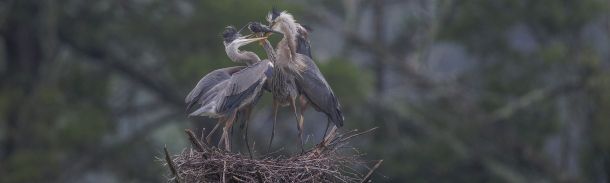
Great blue herons stand in their nest in the morning fog. (Photo: Mark Seth Lender)
The subtle grey plumage of the great blue heron can be appreciated across open water and wetlands in much of the Western Hemisphere. Explorer in Residence Mark Seth Lender observed a mother heron nurturing her chicks by the Black Hall River in Connecticut.
Transcript
DOERING: The subtle grey plumage of the great blue heron can be appreciated across open water and wetlands in much of the Western Hemisphere.
Explorer in Residence Mark Seth Lender observed a mother heron nurturing her chicks by the Black Hall River in Connecticut.
Feeding Time
Great Blue Heron Rookery
Black Hall River, Old Lyme
Connecticut
© 2026 Mark Seth lender
All Rights Reserved
LENDER: The fog is like snow. Snow when it is dry and fine and pure white, or blue white. Safe. A blanket. Safe and soft. Like pressing your face into fresh powder, eyes open. And though the sun is awake now, like snow on a very cold morning the fog, remains. And does not burn away. How it glows. The bright wick of a lantern that persists insensitive to the flame. Sound also is made indefinite. Vague. Yet I know what I hear: The roiling, crackling clatter of young great blue herons begging to be fed. I see their shadows now, through the fog. Their mother also, who has been long and far way, down the great river, into the tributaries and the shallows where she steps, carefully, creature of stealth and purpose who seeks until she finds. Only then does she return. She stands now at the rim of the nest high in the bare, bone-like limbs of the tree. Her neck long. Her long beak pointing. As if withholding.
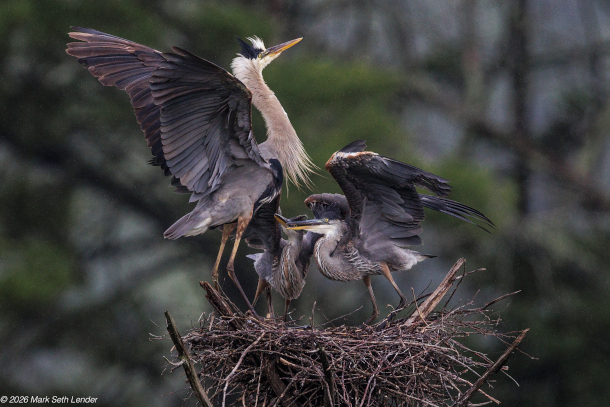
A mother heron comes to feed her chicks, who stab at her impatiently. (Photo: Mark Seth Lender)
Her children reaching, grabbing, stabbing, finally, finally she raises the fish from her crop. And lets it fall, between them…
It’s as if they have never been fed. Never. Neither one. As if the idea of food is novelle. How they struggle, with this pudgy little fish, how to approach it, grasp it, how to take it apart and swallow it, this new object that means, Life.
DOERING: That’s Living on Earth explorer in residence, Mark Seth Lender – and you can find pictures at our website, loe dot org.
Links
Living on Earth wants to hear from you!
Living on Earth
62 Calef Highway, Suite 212
Lee, NH 03861
Telephone: 617-287-4121
E-mail: comments@loe.org
Newsletter [Click here]
Donate to Living on Earth!
Living on Earth is an independent media program and relies entirely on contributions from listeners and institutions supporting public service. Please donate now to preserve an independent environmental voice.
NewsletterLiving on Earth offers a weekly delivery of the show's rundown to your mailbox. Sign up for our newsletter today!
 Sailors For The Sea: Be the change you want to sea.
 The Grantham Foundation for the Protection of the Environment: Committed to protecting and improving the health of the global environment.
 Contribute to Living on Earth and receive, as our gift to you, an archival print of one of Mark Seth Lender's extraordinary wildlife photographs. Follow the link to see Mark's current collection of photographs.
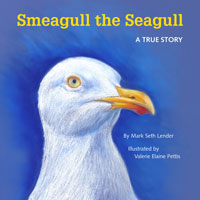 Buy a signed copy of Mark Seth Lender's book Smeagull the Seagull & support Living on Earth
© Copyright World Media Foundation. All Rights Reserved
Home | Contact | RSS | Donate | Newsletter