

June 5, 2026
Air Date: June 5, 2026
FULL SHOW
SEGMENTS
Trump Cuts Ocean Monitoring
View the page for this story
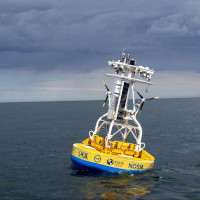
The National Science Foundation has announced it will begin removing most of the Ocean Observatories Initiative, a collection of roughly 900 instruments in the Pacific and Atlantic Oceans that gathers fixed-point data on temperature, carbon dioxide levels, and more. Craig McLean, formerly the assistant administrator for research and acting chief scientist at NOAA, joins Host Jenni Doering to discuss the importance of this monitoring system to understanding climate risks, vital ocean currents and more. (21:00)
Ancient Greek Sites Rich in Biodiversity
View the page for this story
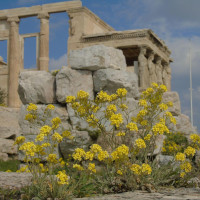
Today, the Agora and Acropolis of Athens, Delphi on Mount Parnassus, and other Greek archaeological sites preserve not only cultural heritage, but also animal and plant species, including some that were around in ancient times and described in historical accounts and Greek mythology. Panayiotis Pafilis is a professor of animal diversity at the National and Kapodistrian University of Athens who has studied this abundance of life at ancient sites, and he speaks with Host Aynsley O’Neill. (10:38)
I Know Where the Wild Crane Goes
/ Mark Seth LenderView the page for this story
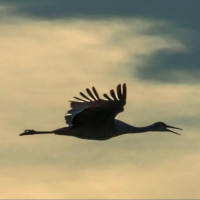
Sandhill cranes are now nesting up on the tundra, northwest of upper Hudson Bay. Explorer in Residence Mark Seth Lender has followed them there from their wintering grounds in Bosque del Apache National Wildlife Refuge, New Mexico. (02:52)
Seeking Environmental Justice in Papua New Guinea
View the page for this story
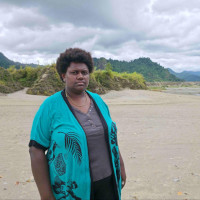
The indigenous residents of Bougainville island in Papua New Guinea say their home used to provide them with everything they needed—shelter, fertile land, and clean water. That is until a copper and gold mine run by British-Australian company Rio Tinto set up shop and operated in the 1970s and 80s. Today, heavy metals like copper sulfate and cadmium still pollute waterways, and Theonila Roka Matbob, the 2026 Goldman Environmental Prize Winner for Islands and Island Nations, has been fighting for years to pressure Rio Tinto into taking full responsibility for remediating this damage. She joins Host Jenni Doering. (12:20)
Show Credits and Funders
Show Transcript
260605 Transcript
HOSTS: Jenni Doering, Aynsley O’Neill
GUESTS: Theonila Roka Matbob, Craig McLean, Panayiotis Pafilis
REPORTERS: Mark Seth Lender
[THEME]
O’NEILL: From PRX – this is Living On Earth.
[THEME]
O’NEILL: I’m Aynsley O’Neill
DOERING: And I’m Jenni Doering.
The Trump administration orders the dismantling of an extensive ocean monitoring network that tracks changes in temperature, CO2 and more.
MCLEAN: I saw it as a companion piece actually to the National Science Foundation's moves to attempt to shut down the National Center for Atmospheric Research– NCAR. So it seems like a two-stroke hit here where we're going to the atmosphere and we're also going to the ocean.
O’NEILL: Also, the ancient Acropolis and other archaeological sites are rich in biodiversity.
PAFILIS: So we found many different species of birds, many different species of plants, but also species that we never expect inside the archaeological site, including foxes or badgers or wild boars.
O’NEILL: That and more, this week on Living on Earth. Stick around!
[NEWSBREAK MUSIC: Boards Of Canada “Zoetrope” from “In A Beautiful Place Out In The Country” (Warp Records 2000)]
[THEME]
Trump Cuts Ocean Monitoring
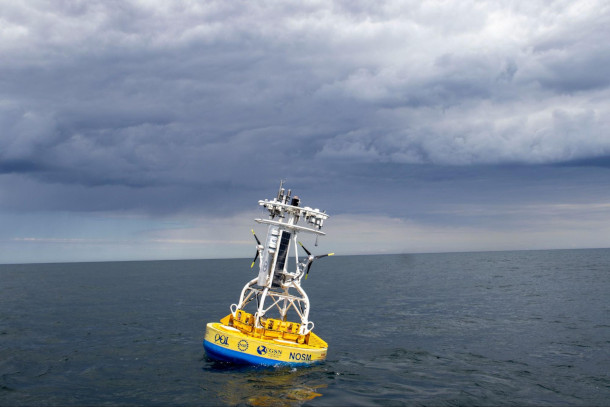
The Ocean Observatories Initiative uses ocean monitoring instruments, such as sensors attached to buoys for data transmission and collection (Photo: Woods Hole Oceanographic Institute, Courtesy of Suzanne Pelisson)
O’NEILL: From PRX and the Jennifer and Ted Stanley Studios at the University of Massachusetts Boston, this is Living on Earth, I’m Aynsley O’Neill.
DOERING: And I’m Jenni Doering.
In just the latest of a series of Trump administration moves against climate science, the National Science Foundation has announced dramatic cuts to the Ocean Observatories Initiative. That’s a collection of roughly 900 instruments providing data on ocean currents, temperature, carbon dioxide levels, and more. Ocean-based scientific readings have long been a crucial part of understanding our warming world, and some of the early observations came from the fossil fuel industry itself.
O’NEILL: In 1979, Exxon outfitted a supertanker to sample carbon dioxide levels in the air and water as it traveled between the Gulf of Mexico and the Persian Gulf. This research was uncovered through an investigation from Inside Climate News in 2015, a year before the Ocean Observatories Initiative was commissioned by the National Science Foundation. And for 10 years, the OOI has provided steady data from fixed points in the Atlantic and Pacific oceans, a necessary companion to the information gathered by mobile instruments like the international Argo program.
DOERING: For more on the implications of dismantling this ocean monitoring network, we turn now to Craig McLean, formerly the assistant administrator for research and acting chief scientist at NOAA, the National Oceanic and Atmospheric Administration.
Craig, welcome to Living on Earth!
MCLEAN: Thank you for having me. You have a great show, and I'm proud to be part of it.
DOERING: Well, thank you. First of all, what was your reaction to the news that the National Science Foundation plans to remove this ocean monitoring network?
MCLEAN: I was very disappointed, and I saw it as a companion piece, actually, to the National Science Foundation's moves to attempt to shut down the National Center for Atmospheric Research, NCAR, out in Boulder. So it seems like a two-stroke hit here, where we're going to the atmosphere and also going to the ocean. I think there's more to it than that. I don't think it's quite so strategic, but the Trump administration really has not described in any sufficient degree the reasons why.
DOERING: What does this network of monitoring instruments look like, and what kind of data is being gathered by it?
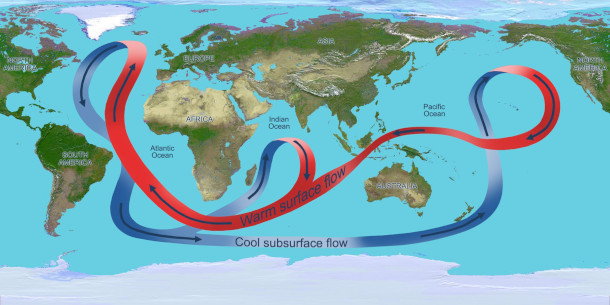
Accelerated warming from human activities have proven to be disrupting the planet’s natural thermal ocean system. (Photo: NASA, Wikimedia Commons, public domain)
MCLEAN: Well, the physical characteristic of these components are very exquisite sensors, which you could in some cases fit in the palm of your hand, in other cases they're much larger, but they're attached to buoys and cables that conduct them to the ocean bottom, so that they could be recovered and serviced, and then redeployed. There are also cable observatories. I just described vertical cables. There are also horizontal cables that are electrically conducting and can transmit data back to the beach, if you will, and then transmit that data onto various research centers. But what's exquisite about the Ocean Observatories Initiative is to be putting these same type of sensors in one place and leaving them there, so that they can continue to report on what are very remarkable, and one could say charismatic parts of the deep ocean, so that the biological profile, the physical profile, chemical profile can be continually measured and understand what's happening in those exact locations, because most of our other ocean measurements are mobile.
DOERING: And I mean, these days being able to track changes over time is vital, I think, when it comes to the temperature of the oceans, the acidity. What kinds of other things are important to be able to understand?
MCLEAN: Well, start with temperature. Temperature is responsible for an opportunity of error, that's about 180%, if we take away discrete ocean temperature measurements. So the Argo program, with 3900 thereabouts, floats in the global ocean, if that system didn't exist, just the United States contribution to that system would garner a 180+ percent error in global ocean heat, and as you know, global ocean heat is the engine behind the weather, it is the engine behind climate, and what we experience. So, components like the OOI installation, the Irminger Sea Array, which is just to the southeast of Greenland. If I were a European resident, I would be very concerned about the United States' choice of withdrawing that equipment, because the Great Conveyor Belt, as it's called, or the Atlantic Meridional Overturning Circulation, that it is more formally called, the conveyor belt of heat from the Atlantic tropics on up through and to Europe finds Europe to be much warmer than its latitude would be without such a heat transfer component of the ocean current. So, if we are slowing that down because of the melt of the Greenland glaciers– the land-based glaciers– and they are melting rapidly, I've been up there for two summers and looked at it very closely, and many people, far more qualified than I have made these observations, but as that fresh water comes in and it disrupts the salinity, it disrupts the temperature gradient, it starts to raise the question, it's not been conclusive yet, but it starts to raise the question of if the trend that is seen continues, what does that spell for the heat in Europe in coming decades, centuries? It's part of a normal earth process right now, but we're disrupting that earth process because we are far more rapidly melting the glaciers on Greenland than they would normally be. In fact, if we were not manipulating our environment, we would be headed towards another ice age. Those glaciers would be growing.
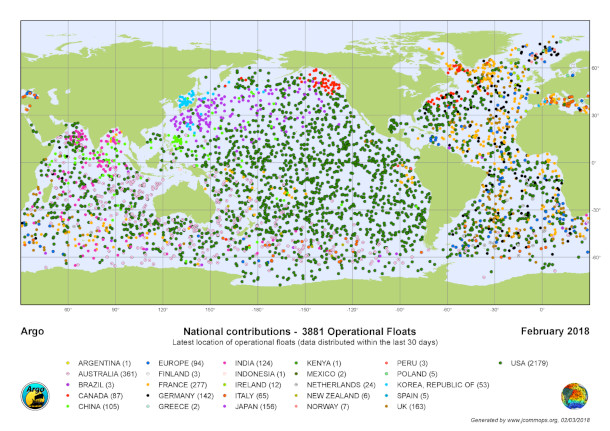
As of February 2018, the above map shows all of the operational floats that are part of the Argo system. These are mobile data collection devices, whose information Craig McLean says is bolstered by steady data from the fixed points of the OOI. (Photo: Hjfreeland, Wikimedia Commons, CC BY-SA 4.0)
DOERING: And just to drill down on this, how useful is the information that's gathered by this ocean monitoring network, this Ocean Observatories Initiative, not just for scientists but for the average American? How do we see this in our everyday lives?
MCLEAN: Unfortunately, the average American doesn't focus on what these types of measurements are generating for us, but when we look at measurements of the ocean temperature, something that's stationary, sedentary, like the ocean observatory components that we have in the OOI, they're resident, and they look long-term at what's happening, and that key question of what's happening tells our insurance companies what levels of risk we are going to have to buy and pay for in the coming season, in the coming decade. We're noting 500-year storms taking place twice in a decade nowadays. Certainly, what people should be concerned with is what is the period of your mortgage? How will your rates be determined for insurance on your property? That's an economy that's based on risk. Risk is determined to a major extent by the insults of the natural system, and we are perturbing the natural system. Agriculture, industry, all of the components that are reliant on any aspect of weather, and I could almost defy somebody to identify something that isn't a function that's influenced by weather. By analogy, I could show you an illustration of how many data points on the continental United States are used to make the daily weather forecast. These are National Weather Service, and these are private homeowners. These are meteorology stations from news broadcasts. Everyone contributes to these; oil companies, they all contribute to these data points. If you put that on a map, you just about cover the United States. It's a little bit light in the Midwest, but you just about cover the United States. If I were to do the same thing with ocean-based measurements, we're hardly scratching the surface. So, for us to have invested so much money of US taxpayer dollars to design, implement, and install this system, and now to flippantly, without any meaningful analysis or discussion of merits, decide to take it out on the simple and naked phrase that this activity is not consistent with the president's policies, but clearly there's no explanation by the Trump administration as to why this is a good idea. There are plenty of richly analytical explanations as to why installing it, leaving it, monitoring it, and abiding by the congressional instruction in an appropriation to do this work, spend this money, collect that information, and reveal it to the scientific community.
Under the Trump administration, the National Science Foundation has decided to start the process of removing the OOI’s in-water infrastructure from the Irminger Sea, Station Papa, Endurance and Pioneer Arrays. This is an estimated 85% of OOI instrumentation. (Photo: Official White House Photo, Wikimedia Commons, public domain)
DOERING: That's right. As I understand, the Trump administration has actually tried to cut this funding before, the annual budget of some $48 million a year, and Congress said no, we want to keep this funding in place.
MCLEAN: That's right, and it brings up the question of whether or not the president has the authority to ignore appropriations law, and that issue is headed to the Supreme Court, not based on OOI, but everything that is part of the federal budget, certainly as we might focus on the science part of that budget. If Congress has passed as law, and a president has signed as law that thy will be done, a subsequent president is not empowered in the methods that Trump is using to go ahead and abruptly change that. So, the question that the OMB chief, Mr. Vought, and others are raising is that we've not fully explored the power of the executive, and it will be the Supreme Court that determines that. But up until then, Trump is going to continue to do what he's doing, and unless people can find other reasons beyond the definitive determination of whether a president can or cannot ignore an appropriations law, for the remainder of Trump's administration, we're going to be where we are now.
DOERING: So, this Ocean Observatories Initiative, the system takes some $48 million a year to operate. What would you say to anyone who hears that number and says, well, maybe it does make sense to strike that from the budget?
MCLEAN: The return on those investments is huge. The return is to provide information on the current and future state of our earth. And what that really comes to is letting the agricultural community know with a level of discrete measure what's happening throughout this ocean process, because the OOI installations are sedentary and constantly focusing on the same area, giving an absolutely complete data record of those locations. What is learned from the OOI can be extrapolated and provide greater reliability on what the measurements are from the mobile systems, including Argo, and what does the citizen get out of that? First of all, $48 million, if you or I had to write that check, I doubt that we'd have the funds, but when you look at other components of the federal budget and you realize how low in cost $48 million might be, it is a bargain for the benefit of the public to know and understand the components of what's happening through and in the ocean. That affects our fisheries that feed us and provide an economic opportunity for many coastal communities and inland as well, given the distribution and the abundance of fishery-based products– shellfish, fin fish, the like. It also is the explaining element of what's happening in our earth that is going to, and does now, influence the weather. So, it's a force multiplier that without it we don't have the discrete knowledge of what's happening in the ocean that we can't get through the passage of a mobile sensing device. The fact that Argo is so high in number of devices, nearly 4000, in fact, 4000 is the target number of Argo floats, the Argo floats are made to be better understood because of what we're able to measure in the OOI permanent installations.
DOERING: So, Craig, you worked under the previous Trump administration at NOAA. You were actually their acting chief scientist for a number of years, as well as under other administrations. How does the approach towards climate science under this Trump administration compare to the first?
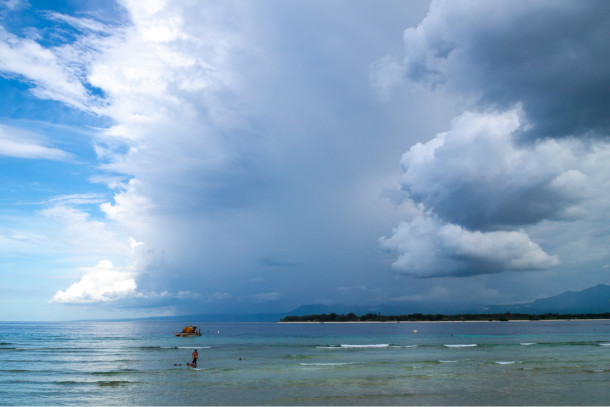
Shown above is a seascape view of the Lombok Strait in Indonesia. Ocean monitoring systems are responsible for providing data on ocean conditions, giving insight into weather patterns, carbon dioxide levels, and more. (Photo: Vyacheslav Argenberg, Wikimedia Commons, CC BY-SA 4.0)
MCLEAN: It is quite different. It's much more aggressive, it's punitive, it's even less thoughtful than the first Trump administration was. During the first Trump administration, I was approached by politically appointed figures at NOAA who told me that there was a new sheriff in town and we had to change the direction of our program and start opening up to have other voices participate in the climate discussion, and I continued to probe and to force people to commit to what they meant. I knew what they meant. They wanted basically climate deniers to be part of the climate boards, climate panels, and the like. And I explained to them that there was a grave problem with doing that, because the people that they were advising, not to the individual, but to the nature of the people they were advising to be included, they were the marketeers of disproven and fallacious theories that just don't even get on the credibility table. And while somebody might have a theological belief in it, there is no scientific fact for it. So, it continued for about another two months, three months, and I finally got to the point where I did two things; I showed them the law, I requested a memorandum be written by the General Counsel of my agency to describe the agency's responsibilities under the existing climate laws, and I showed that to them, and then I asked them if they would write on my performance plan what they expected me to do, because then I would have at their hand and in their hand, an instruction to me to violate the law. And I explained to them that I will not violate the law, but what you're asking me to do is not lawful, so therefore I'm not going to do it. But are you going to be the person that stands in front of this? And they backed down. What's different this time is that they want to be the person that stands in front of it, that wants to stand up and say yes, we're going to violate what you think is the law, but we think it's differently.
[MUSIC: Blue Dot Sessions "Sudden Courier"]
DOERING: We’re speaking with Craig McLean, former NOAA assistant administrator for research and current senior fellow at The Ocean Foundation. We’ll be right back after the break. Stay tuned to Living on Earth!
ANNOUNCER: Support for Living on Earth comes from the Waverley Street Foundation, working to cultivate a healing planet with community-led programs for better food, healthy farmlands, and smarter building, energy, and businesses.
[CUTAWAY MUSIC: Edgar Meyer, “Cello Suite No. in G-Major BWV1007: V. Menuets I & II” by Johann Sebastian Bach, Sony Classical]
O’NEILL: It’s Living on Earth, I’m Aynsley O’Neill
DOERING: And I’m Jenni Doering.
We’re back with Craig McLean, formerly the assistant administrator for research and acting chief scientist at NOAA, to discuss the Trump Administration’s order to remove most of an ocean monitoring network that tracks temperature, CO2, and more. Over decades of service at NOAA, Craig has seen shifts in how different administrations approach climate science, but he says what’s happening now is unprecedented.
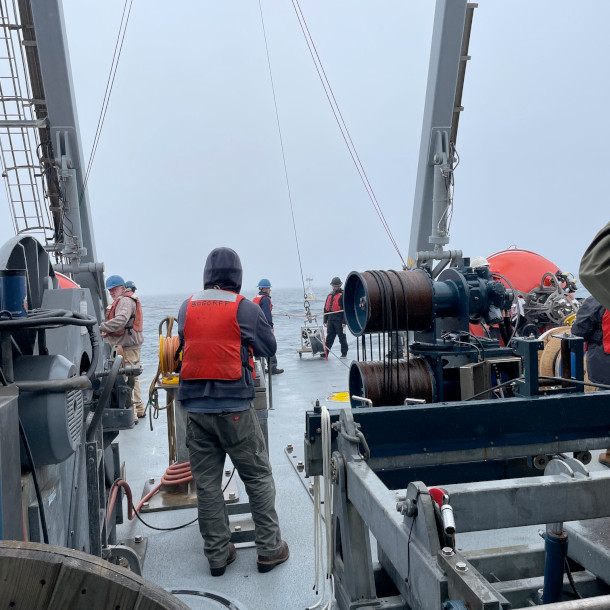
Shown above is a team in 2024, setting up a mooring at the OOI Irminger Sea Array, just before a storm hit. The mooring has wind turbines and solar panels that powered the instrument for a year during its time at sea. (Photo: Image from work supported by the U.S. National Science Foundation Ocean Observatories Initiative. Sheri N. White © WHOI.)
MCLEAN: Now I started under Reagan, and interestingly, I was in the NOAA Commission Corps. I was a uniformed officer, I was an ensign, brand new, and we had this thing called a government shutdown, which I think might have been the first one. We didn't know what that was, but all we knew was that you're in uniform, you come to work every day, and you just keep going. But now we have shutdowns with such routine rigor that we actually have plans that you just pull off the shelf when there's a shutdown. But, so from Reagan to let's say Bush, there was a question of climate as the scientific certainty continued to develop. I think the greatest lag was the conservatism of the IPCC types of reports where people didn't want to be too alarmist, and they also wanted to make sure they could carry everybody on board with what they were saying. It was a consensus-generated document, even though the science community, in the greatest levels of expertise, knew that the situation was more extreme and egregious than what would be comfortably reported in a consensus document. Along then comes George Herbert Walker Bush administration, and their choice was with what was then called global warming, because the globe is warming, therefore it's a logical term. But let's study it some more. Let's put some money into it, put more money into it, and budgets grew at that point in time, by and large, to get a better definition of the problem. It was a rational thing to be doing. Then, in between other administrations comes George W. Bush, and in the W. Bush administration, there was a verbally passed instruction from the White House. We don't call it global warming anymore, we're going to call it climate change, because that's not declaring so much that we're warming, it's just it's changing. No one, including myself, can ever recall seeing that in writing, but it was clearly distributed to us verbally in staff meetings and the like. So now go from global warming to climate change. So now, where are we? Well, it's not climate change, now it's resilience against extremes. Well, I don't care who you are. If you live in Charleston, South Carolina, if you live in Miami, your shins are getting wet when you walk on the street on the wrong day, and if you lived in LA or in Hawai'i, in Maui, your home and your town burned. These extremes are happening. You can call it whatever you want, and you could withdraw the kinds of science measuring systems that tell us how bad it's going to be in the future all you want, but it isn't going to make the problem go away.
DOERING: So, what is happening to climate science and climate research in the US these days. I mean, the Trump administration has accused that research of being alarmist. The National Center for Atmospheric Research has been targeted for dismantling. What's happening to the field, and what's your sense of the overall impact?
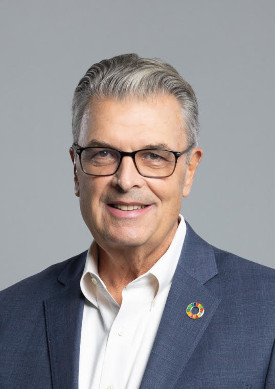
Craig Mclean formerly served as NOAA Assistant Administrator for Research and NOAA Acting Chief Scientist. He is now a senior fellow with The Ocean Foundation. (Photo: Courtesy of Craig McLean)
MCLEAN: The United States is being looked upon with antagonism, at the easiest, I'd say, disrespect, grave concern. The United States is losing the international reputation of excellence that it has held for 75 years, and that's hard to build. We will have to see how hard it is to recover. But climate science in the United States, the fact that the national climate assessment was taken down from public visibility, the fact that the next National Climate Assessment was shut down illegally; but once again, until the appropriations law is adjudicated by the Supreme Court, Trump will continue to be doing these things. So, the Trump people are trying to step-by-step disassemble components of the information that provides the finance market, stock futures, reinsurers, home values, etc., where risk is determined and quantified. Those erosions to that certainty has an economic consequence. Now, one thing I have to say is that quietly I do believe, and I do understand that, quietly, some professional associations of reinsurers, emergency managers, emergency response, and emergency preparation professionals, they are expressing themselves, and those expressions are reaching some of Trump's party, and that is one of the reasons why we see the appropriations continuing at a level that would fund these activities. What's disrupting it is the Trump interpretation that he, as president, is empowered to reject the law that has been passed by Congress and signed by a president and determine what he wants to do with it. And it’s destroying science. We are an embarrassment to the nation. First of all, there’s one nation in the world– one nation in the world– that is a rogue nation, and it is not a member of the IPCC. And that is the United States of America. There is no excuse for anyone to believe, with pride, that they could stand behind their president when he says climate change is a ruse.
DOERING: Craig, as someone who under the previous Trump administration ultimately stood up for what you thought was right, and you were asked to leave as a result of that. What advice would you have for any career scientists who are working in this Trump administration on oceans and on climate, for you know, making sure that the science that we need continues to be gathered?
MCLEAN: Two things: one is, know where your red line is, don't cross it, define what you're willing to accept for your own personal dignity and professional competency, and don't cross it. Leave before you cross it. But the second thing is, scientists are trained to be quiet and self-contained, and we can't be. We have to be vocal, and we have to express ourselves in plain language, clearly, to the public and offer your views as to what we should be doing rather than what we are doing.
DOERING: Craig McLean is former NOAA assistant administrator for research and NOAA acting chief scientist. Thank you so much, Craig.
MCLEAN: Thank you for having me.
DOERING: In a statement, a National Science Foundation spokesperson said the move to dismantle the Ocean Observatories Initiative “aligns with NSF's wider strategy of a nimbler approach to prioritize support for evolving scientific priorities and emerging technologies, as well as smart lifecycle management within its research infrastructure portfolio.” For the full statement, visit the Living on Earth website at loe dot org.
Related links:
- Learn more about the Ocean Observatories Initiative here
- Read about the OOI descoping here
- Craig McLean’s profile at The Ocean Foundation
- The New York Times | “Trump Administration to Dismantle Ocean Monitoring System”
[MUSIC: Blue Dot Sessions “Ultima Thule”]
Ancient Greek Sites Rich in Biodiversity
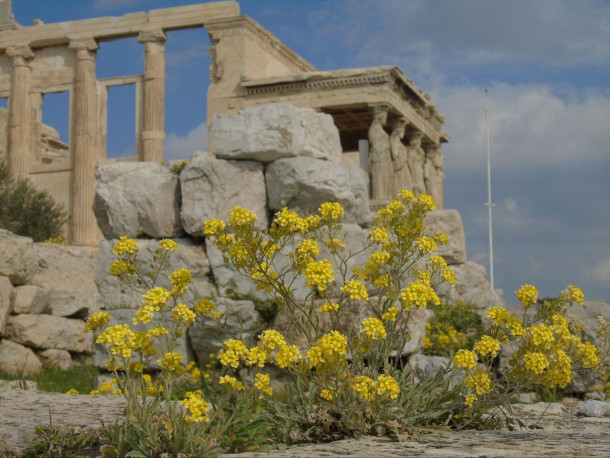
A recent study found that 11% of Greece’s biodiversity is present in 20 archaeological sites, which make up just 0.018% of Greece’s total area. Above, a Aurinia saxatilis plant, or “Basket of Gold” blooms on the Acropolis. (Photo: BIAS Photographic Archive/ Natural Environment and Climate Change Agency)
O’NEILL: If you’re lucky enough to visit Athens, at the top of your list would likely be the sacred Acropolis, perched high above the city, and the Agora just next door, the heart of public life and democracy in ancient times. The Agora was where Socrates, Plato, and Aristotle pioneered Western philosophy, including natural philosophy, the precursor to what we now call science. Aristotle is even regarded by some as both the first true biologist and scientist. Today, the Agora, Acropolis, and other Greek archaeological sites preserve that cultural heritage, but also a number of animal and plant species, including some that were around in ancient times. A study led by the Greek Ministry of Culture, Natural Environment, and Climate Change Agency, and the National and Kapodistrian University of Athens measured the biodiversity of 20 archaeological sites and found an abundance of life. Lead author Panayiotis Pafilis is a professor of animal diversity at the National and Kapodistrian University of Athens, and he joins me now. Welcome to Living on Earth, Professor!
PAFILIS: It's nice to meet you.
O'NEILL: So, your study surveyed species in 20 different Greek archeological sites. What did you find in this?
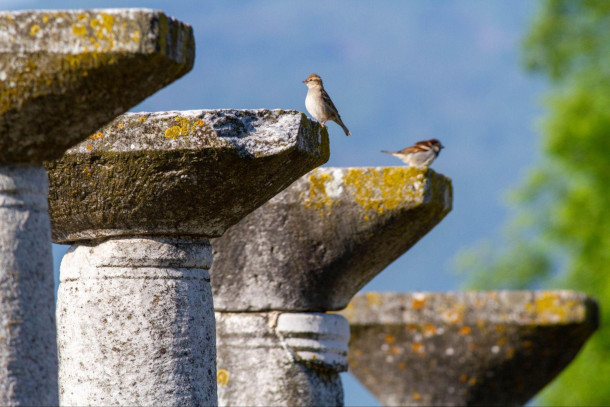
Archaeological sites can act as accidental havens for flora and fauna due to their protected status. Above, house sparrows make their home at the archaeological site of Philippi in northeast Greece. Though a common species, scientists were impressed by their abundance within the sites studied. (Photo: BIAS Photographic Archive/ Natural Environment and Climate Change Agency)
PAFILIS: We ended up having 4,405 species of animals and plants that live inside those archeological sites. I don't know whether, you know, this figure sounds impressive or not, but in Greece we have a total of around 31,000 species all around the country, and when we are working in this project, we focus only on these 20 sites that covers a mere 0.018% of the total Greek area. So, we found a rough 11% of the total biodiversity of the country in only 0.018% of the area. So, this is really something. And it's really very interesting that this initiative started not from biologists or from zoologists or botanists, but from the Ministry of Culture of Greece, and from herself, the Ministry of Culture, Dr. Lina Mendoni. So it was an idea that came from archeologists as an invitation to biologists to join forces to study what happens inside archeological sites in terms of biodiversity.
O'NEILL: And what makes an archeological site an ideal place for biodiversity?
PAFILIS: Most important, in our case, the archeological sites are effectively protected since early 19th century. In other words, those places, they are protected areas not only for antiquities but also for wildlife or biodiversity. We can get both in the price of one, if I may say so. So, that means nobody will hunt birds, nobody will harass snakes, and the result of all this is that we have very dense populations when we compare them with populations in the surrounding area, and also the animals, especially reptiles, they were really very tame, that there's a syndrome in island biology, we call it "island naivete," which means you don't know any enemies, so people inside an archeological site, they behave completely in a different way compared to outside, so snakes that normally typically would have the head crushed from a person walking, walking by, inside the site are well protected.
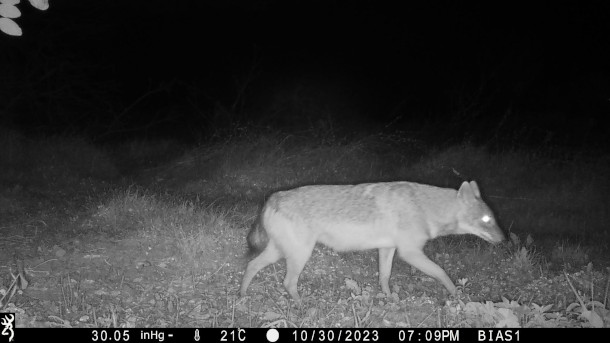
Night cameras set up by the researchers captured some surprising visitors, including a golden jackal at the Temple of Artemis. Other unexpected large mammals caught on camera included wild boars and foxes. (Photo: BIAS Photographic Archive/ Natural Environment and Climate Change Agency)
O'NEILL: So help us set the scene. If I were to walk up to one of these archeological sites, what am I going to be seeing there?
PAFILIS: Okay, so relax a little bit and start to hear, and it's impressive, the diversity and variety of sounds you can hear there. It's birds, it's frogs, insects. And then try to see small creatures creeping, crawling, running. There are lizards, there are snakes, there are small mammals, there are snails, and also plants. The plants are everywhere.
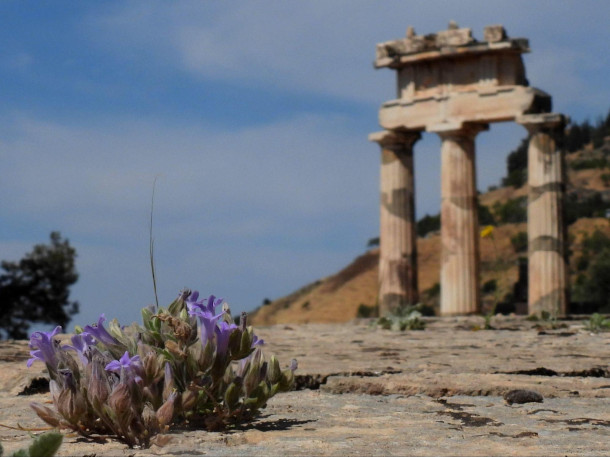
A campanula plant in Delphi. (Photo: BIAS Photographic Archive/ Natural Environment and Climate Change Agency)
O'NEILL: Now what sort of animals or plants are there that you've seen that were particularly exciting for you?
PAFILIS: So, we found many different species of birds, many different species of plants, but also species that one would never expect inside the archeological site, including foxes or badgers or wild boars. In one case, we try an experiment, so we set our cameras at night, and it was impressive to see, you know, the animal traffic jam inside the archeological site. So, from big mammals and big raptors of birds to tiny snails, we found many, many different species. We spotted many species that we were unaware of their presence in Greece. So, that was the very first record of their presence in Greece, like a very small grass species that was discovered in the archaeological site of Nicopolis. So, in this city, we found a species that we knew it so far from Asia Minor. That was the first time we discovered in the west part of Greece. And in the Oracle of Delphi, we found a small, a tiny snail that was a new species for science. So we were actually in the procedure to describe the new species. It’s tiny, is like a two millimeters the size of its shell, and it's a troglodytic species, that means that lives only inside caves that has water somewhere inside, so really, really very special findings.
O'NEILL: And tell us, what it was like on one of those days when you spotted one of these things that you didn't expect to see.
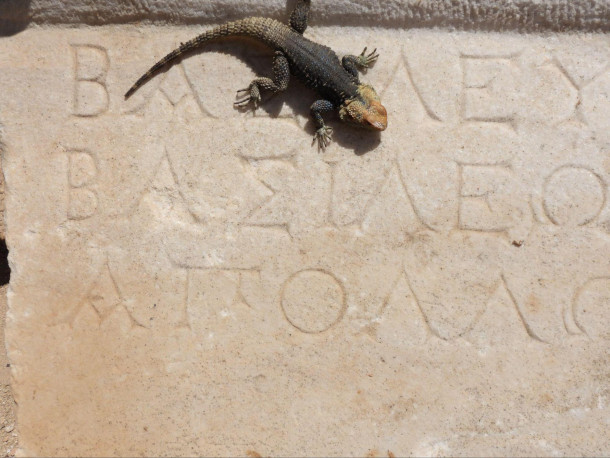
If you look closely, you’ll see all kinds of small creatures roaming around Greece’s archaeological sites. A star rock agama lizard wanders through an archaeological site in Delos. According to Professor Pafilis, the presence of the rock agama on Delos (and Mykonos and Naxos) is interesting due to the species originating in Asia. It likely appears in Greece due to human-mediated dispersal; notably, in antiquity, Delos was considered a very cosmopolitan place. (Photo: BIAS Photographic Archive/ Natural Environment and Climate Change Agency)
PAFILIS: Yeah, again, a very good question. You know, in the beginning we enter those places. Okay, I will speak for myself, I don't want to speak for my other colleagues, a little bit with an arrogant eye, that I know everything here, because I knew the place, you know, the places surrounding archeological sites, and it was a surprise to discover more and more new species like the one I mentioned earlier. But, also it's this very special feeling to discover species that we knew they were there in, during antiquity, and to find them again in the same place. For instance, in the Oracle of Delphi, according to the myths, the legend, Zeus said two eagles that they fly in the diverse directions, and after, you know, covering the whole globe, they met again in Delphi, so that is, the Oracle of Delphi was built there, and we find exactly the same species of eagle flying over the Oracle of Delphi today. The same goes for snakes in Epidaurus. Epidaurus was one of the first hospitals in antiquity, and there was a building in its structure, it was half under the surface of earth and inside ancient Greeks raised snakes, and the patients will enter this place. The snakes will touch them, and then Aesculapian, the god of medicine in ancient Greece, will visit the patients during their night's sleep to provide the cure, and we fight the exact same species, the Aesculapian snake– that's this is the vernacular name of the species– living there in the exact same spot. That was really amazing. It was like having a window from where we can see exactly the same things that people living there, like 25 centuries ago, would see.
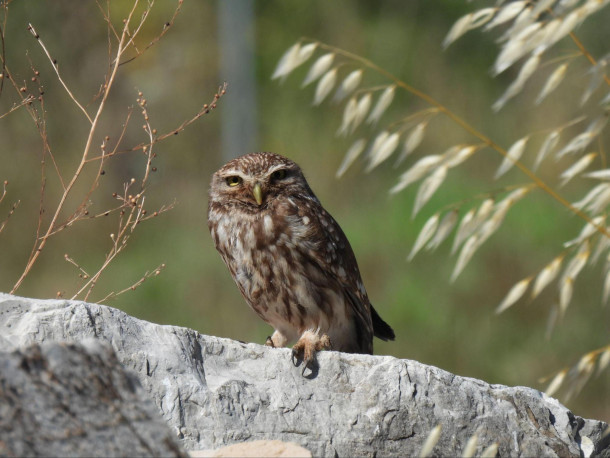
A “little owl,” also known as the owl of Athena, on the Acropolis. In mythology, Athena, the goddess of wisdom, strategic warfare, and handicraft, is often depicted with an owl on her shoulder. (Photo: BIAS Photographic Archive/ Natural Environment and Climate Change Agency)
O'NEILL: It's incredible that you say that about the snake, because I know many of us, even if we're not familiar with that story, would be familiar with the symbol of healthcare and medicine that includes the snake going up the staff, and so it's cool to see that that's where it comes from, and they're still there.
PAFILIS: Yeah, yeah, exactly. It's exactly like that, as you describe it.
O'NEILL: And for you and your colleagues, in particular, what's next? What further research are you planning on doing?
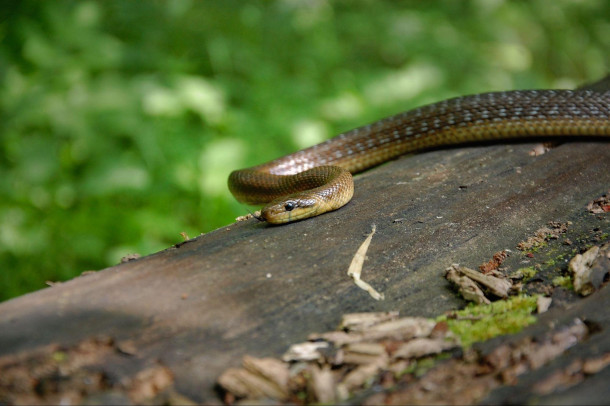
Researchers found the Aesculapian snake, which features in the well-known staff and snake medical symbol the Rod of Asclepius, still present in the same area where the story and symbol originated: Epidaurus, Greece. (Photo: Halfpeacee, Wikimedia Commons, CC BY 4.0)
PAFILIS: So, I'm in the happy position to say that now we are in BIAS phase two, which is the continuation of the project we're talking about now, and we add 36 new archeological sites all around the country, and the novelty now is that we're working together with archeologists in research. So, from our part, biologists, we do exactly the same thing. We go out to conduct field work, but our archeologist colleagues, what they do is they try to find their archives and artifacts and statues in coins, in literature, traces of wildlife. So, what we try to do here is to compare what we know from those sources used to live in these places and to see whether they're still there. And in our times, the times of climate change, that we have this crazy biodiversity loss, this is really very important.
O'NEILL: Well, when I think about this overall study, it's, it's really sort of a beautiful marriage between the historical conservation, the natural conservation; and the study was planned, but the results weren't planned. So, to what extent do you feel like this pairing between the historical and the natural, how does it resonate with Greek values in particular?
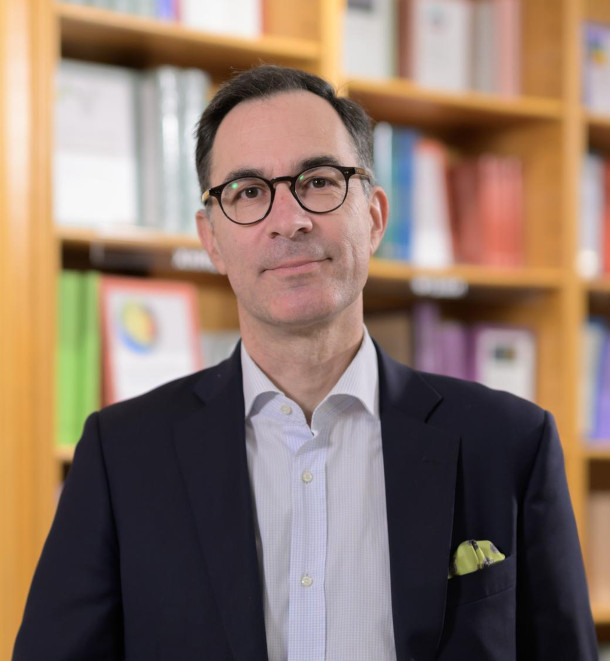
Panayiotis Pafilis is a professor of animal diversity at National and Kapodistrian University of Athens. (Photo: Crete University Press)
PAFILIS: I would say international values. Exactly, the project was not exactly planned, but there is a new term that was coined within this decade, it's the "cultural landscape," which is the landscape from the combined actions of human and nature. So, inside those places we see, in places like Greece or Italy or Middle East countries where humans are present for millennia, how both human and wildlife shape the environment, so inside those places you can find, you know, the fruits of this, if I may use the term, collaboration, and it's also very important to mention that in many cases an archeological site was also a UNESCO site and a Natura 2000 site, and that says a lot. So UNESCO protect the cultural heritage and Natura 2000 network protect the wildlife, so we see in action that those places is exactly what you just said, it's a meeting point of culture and nature.
O'NEILL: Panayiotis Pafilis is a professor in animal diversity at National and Kapodistrian University of Athens. Professor Pafilis, thank you so much for taking the time with me today.
PAFILIS: Thank you very much. It was really a pleasure.
Related links:
- Read the study here
- Read about the next phase of the study
[MUSIC: Blue Dot Sessions “Kechrinia“]
DOERING: Coming up, An intrepid environmental defender from Papua New Guinea is one of this year’s Goldman Environmental Prize winners. Keep listening to Living on Earth!
ANNOUNCER: Support for Living on Earth comes from the estate of Rosamund Stone Zander - celebrated painter, environmentalist, and author of The Art of Possibility, who inspired others to see the profound interconnectedness of all living things, and to act with courage and creativity on behalf of our planet. Support also comes from Sailors for the Sea and Oceana, helping boaters race clean, sail green and protect the seas they love. More information at SailorsForTheSea.org.
[CUTAWAY MUSIC: Thomas Konstantinou and Michalis Koumbios, "Spring"]
I Know Where the Wild Crane Goes
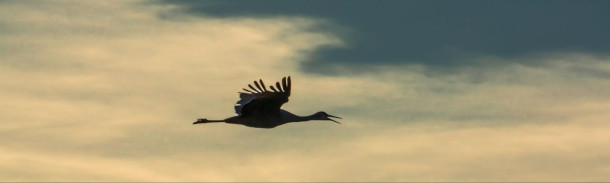
Mark Seth Lender’s most recent essay shares his experience seeing sandhill cranes at Bosque del Apache National Wildlife Refuge in New Mexico. (Photo: Mark Seth Lender)
DOERING: It’s Living on Earth, I’m Jenni Doering.
O’NEILL: And I’m Aynsley O’Neill.
Sandhill cranes are now nesting up on the tundra, northwest of upper Hudson Bay.
Explorer in Residence Mark Seth Lender has followed them there from their wintering grounds in Bosque del Apache National Wildlife Refuge, New Mexico.
I Know Where The Wild Crane Goes
Sandhill Crane
Bosque del Apache National Wildlife Refuge
© 2026 Mark Seth Lender
Sandhill cranes are working their way between the rows. In a place planted for them, made safe for them by nearby flooded fields that glaze in the night, firm enough to stand upon until morning breaks. A northern harrier comes coasting above the patchy snow and the jangle of grasses, listening, for small life that hides beneath. His owl-like face captures sound, the angular spread of his wings capturing air and silence. Cleaving to the scrub at the section fence, coyotes and foxes tread, so light of foot they barely leave a sign. Where even now the wind-scorched aspens hold to their leaves, a single kestrel lands. In the steel-blue light every manhood-color of his plumage on display. Redwing blackbirds lift settle lift again. Snow geese startled by rumor more than risk take flight, one coordinate mass of wings, and noise.
Now from the thousands, one sandhill crane sets himself apart. He will not bend down to the hard yellow corn. The seed heads native to the land are his take. He stands tall. His beak is long and dark. The ruddy orange of his wings, his feathers pristine and tight. He is clean. His will be a long life. The way he feeds is life lived, as it was lived.
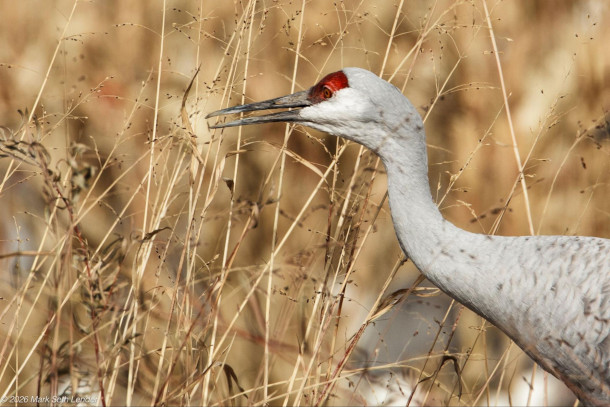
The Sandhill Crane migration routes stretch up and down North America every year. (Photo: Mark Seth Lender)
How the young cranes leap and gamble! White flake breaks from the greyness, falls upon their heads, the urging, the urging!
Yes, I know where the wild crane goes. North. Into unspeakable cold. That turns flesh stone at the glance of its touch, except in flight in the heat of migration. As long as there is North, and the Arctic willow thrives, the Arctic heather coated in rime far on the tundra where the Longest Day knows no night; as long as the permafrost holds, and the citadel of southern Refuge remains.
There will be Sandhill Cranes.
O’NEILL: That’s Living on Earth’s Explorer in Residence, Mark Seth Lender.
Related links:
- Explore more of Mark Seth Lender’s work
- Learn about Sandhill Cranes
- Read about Friends of Bosque del Apache National Wildlife Refuge
[MUSIC: Blue Dot Sessions “New Crescente”]
Seeking Environmental Justice in Papua New Guinea
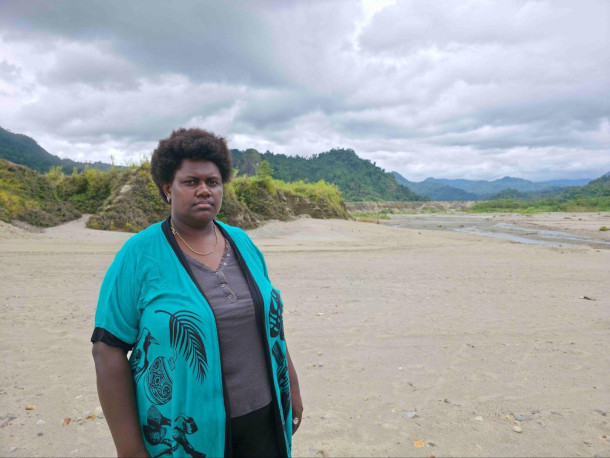
Theonila Roka Matbob is the winner of the 2026 Goldman Environmental Prize for Islands & Island Nations. (Photo: Goldman Environmental Prize)
DOERING: The indigenous residents of Bougainville island, part of an autonomous region in Papua New Guinea, say their home used to provide them with everything they needed—shelter, fertile land, and clean water. That is until the Panguna copper and gold mine, run by the British-Australian company Rio Tinto, set up shop there in 1972 and began to wreak havoc on the island’s ecosystem and its people, with heavy metals like copper sulfate and cadmium entering waterways. While Rio Tinto abandoned the mine in 1989, without a proper clean up, its toxic legacy persists. Theonila Roka Matbob, the 2026 Goldman Environmental Prize Winner for Islands and Island Nations, has been fighting for years to pressure Rio Tinto into taking full responsibility for remediating this damage. And due to her activism, in 2024 the company officially signed a landmark memo of understanding to address environmental and social devastation caused by the Panguna mine. But Theonila says this is not enough, and she’s here now. Theonila Roka Matbob, welcome to Living on Earth!
ROKA MATBOB: Thank you. Thank you very much.
DOERING: So what kinds of health impacts have your people seen from these toxic chemicals, copper sulfate and other things?
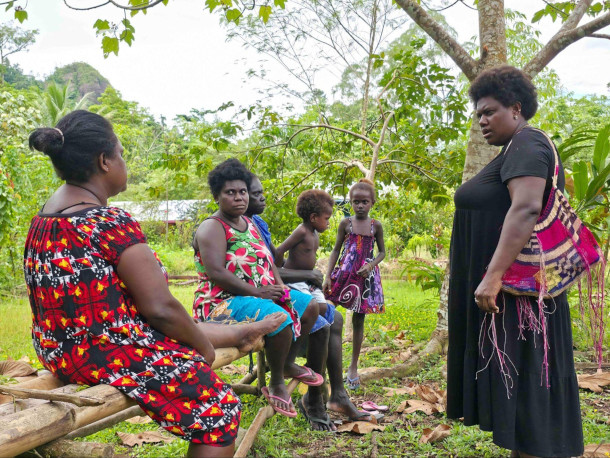
Theonila (right) saw firsthand how toxic chemicals from the mine impacted members of her community, ranging from skin conditions to impacts on mental health and fertility. (Photo: Goldman Environmental Prize)
ROKA MATBOB: One of the things that is physical and visible is– especially when we have like prolonged sun, like the dry season– you see skin cracking up, and if it's prolonged wet season, you're seeing people's, the tissues beneath the feet, they literally rot away, and even like sores on the skin. You see like, a skin on top of a skin building up or a growth, and that's because of the chemical's presence in the tailings. So that's how disturbing the impacts are to the people who are living on the environment right now.
DOERING: Oh my gosh. So you're describing sores, skin even like, rotting away on people's feet. And I think I have heard about some pregnancy complications as well. How has that affected the community?
ROKA MATBOB: One of the things that we've seen is the deformity, and also at the mental level, you can realize that those kids that are coming off post toxic environment, you will realize that their mental stability and focus is very limited, and these are children like, some are my generation, and some are younger than me.
DOERING: Theonila, I believe you're a mother,
ROKA MATBOB: A proud mother.
DOERING: A proud mother. Congratulations. What is it like, though, to see things like this affecting your community and the people around you, and, you know, affecting your generation and future generations?
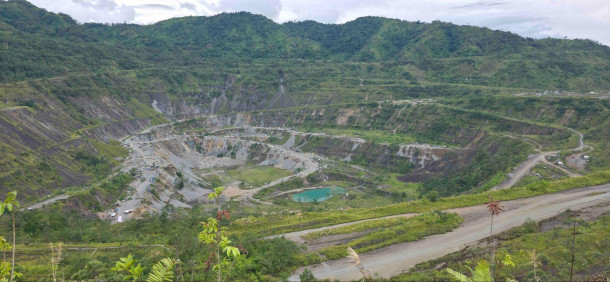
The Panguna copper and gold mine was abandoned by Rio Tinto in 1989, and no actions were taken to remediate the human and environmental harms caused during its operation. (Photo: Goldman Environmental Prize)
ROKA MATBOB: It's very challenging to give birth to a child to inherit a broken portion of the environment. It's like, you've got no explanation, and every time, like, your children ask you, like we're traveling there for holidays and we see fish in the water, why is it that we have a big river running by our house, there's no fish? There's no life? Like, this is not something any mother would easily answer, and the answer that you would give is not an answer that you will be proudly giving.
DOERING: Yeah, it must be really hard to explain that to your children.
ROKA MATBOB: Very challenging, very challenging.
DOERING: And I understand that, you know, even after the mine was abandoned in 1989, there was no cleanup of its toxic waste, and you were pretty upset about that, and you helped gather community testimonies about how this mine was impacting people decades later. What are some of the most powerful stories that you heard, and why do you think it's so important that these voices are highlighted?
ROKA MATBOB: There are two things that really inspired me to go back and start telling the story and demanding questions to be answered. The first is people, even before the mine, they were publicly coming out to say, we will die protecting the land. The second issue that really stood out when people were wanting to guard their land against all odds was the communication barrier. English is not a native language to us, and Rio Tinto, when it went on to the land, it used the language as a weapon.
DOERING: How so?
ROKA MATBOB: Well, because people can't speak that language, you know, and everything, all the documents that were needed to be signed, were all written in English, and my people were found at the time when there was no access to education. And those two issues really stood out for me, and I took that very personal, that we can't be fighting physically, but we need to demand answers. If we can speak the language Rio Tinto spoke coming in, then it is time to go back onto the table and say, I'm doing this on behalf of my family. I'm doing this on behalf of my clans and tribes.
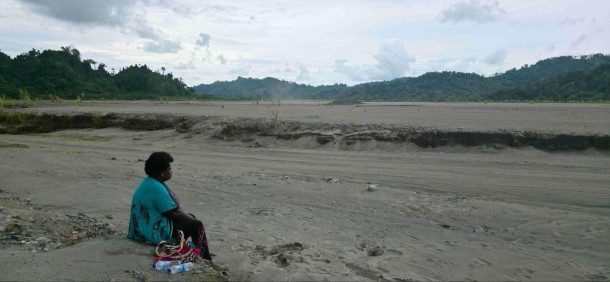
Language was a powerful weapon wielded against the people of Bougainville, Theonila reflects. Since English is not their native tongue, it put them at a disadvantage when communicating with Rio Tinto. (Photo: Goldman Environmental Prize)
DOERING: So in 2020, you led a complaint that accused Rio Tinto of environmental and human rights violations linked to this Panguna mines legacy. And you know, it's no easy feat to stand up against a powerful corporation like this. That kind of action comes with a whole lot of risk. So how did you even begin to fight back?
ROKA MATBOB: It was a very, very long journey that I'd say it had to take me to put my feet into the cold, even if it was gonna take and cost my life, at least there's a story that I can leave behind for the later generation to say that even though we do not deserve this, there is someone, there was a mother who came ahead, who wanted to do this. So it was a very slim sort of an opportunity, I'd say, because my country, Papua, New Guinea and Bougainville, have never done these things previously. They went through the courtroom where they wanted to approach it by suing Rio Tinto to court, but because obviously, the corporate courtroom is not our place, I thought that we should rather do it the mediation way. And we're so blessed to have had Human Rights Law Center in Australia to really give us that advice we needed. And the opportunity was there because Rio Tinto is Australian, and in their justice system, there's a place for facilitation of Australian corporate companies operating offshore. So we were blessed to have Human Rights Law Center giving us that advice on pro bono basis.
DOERING: So it takes courage from people like yourself, and it takes, I guess, allyship from other people in positions of power who are able to help, you know, communities like yours.
ROKA MATBOB: Yes.
DOERING: Theonila, as of 2024, Rio Tinto has officially agreed to address some of the worst impacts of its legacy, thanks in large part to the work that you have put in and your courage. At this point, what has Rio Tinto committed to?
ROKA MATBOB: So at the moment, what they've done is they're funding water supply distribution in the impacted communities, and also addressing the most imminent, severe risk that are in front, so they're already into it. But I am here, and my people are there to keep reminding them that there is more than just this.
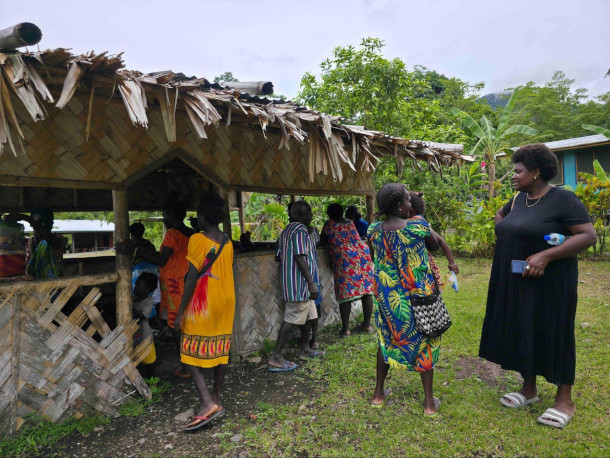
Theonila hopes that Bougainville can be an inspiration for other Indigenous communities taking a stance against large corporations. (Photo: Goldman Environmental Prize)
DOERING: And when you say severe risks, are you talking about the possibility that some of these mine structures left behind could collapse, and you know, run through a community?
ROKA MATBOB: Absolutely. There are actually a couple of them, and first imminent, which is the collapsing brick walls within the old infrastructure has been removed, and there's a chemical removal process as well. But look, it is one step towards the right direction, but Rio Tinto really needs to come out very clear to have its full commitment to taking our full responsibility in addressing the recommendations that came out from the Independent Assessment Report. It's not to say that what we're looking at will restore that balance we had, but this is what I expect, and my community expects, is for Rio Tinto to commit to funding a remediation package that would get people to still sustain themselves.
DOERING: So Rio Tinto is starting on the right path, it sounds like, maybe willing to work with you. More is needed, but to what extent do you think they could serve as an example for you know, other mining legacies that are really harming communities around the world?
ROKA MATBOB: Rio Tinto prides itself as a socially responsible company globally, and the process on Bougainville is an opportunity for them to really demonstrate that social responsibility card on the dent that has been abandoned. It's an opportunity that they can take with both hands to really prove their, their stance as socially responsible leader in the extractive industry, and that is where Bougainvillians are openly saying, even though we have lived with the impacts and the continuous destruction on the environment, the room is here, and it can be the pilot or prototype for the other indigenous communities impacted, not just by Rio Tinto, but every other corporate company who carelessly comes in without embracing the life and the culture of the people.
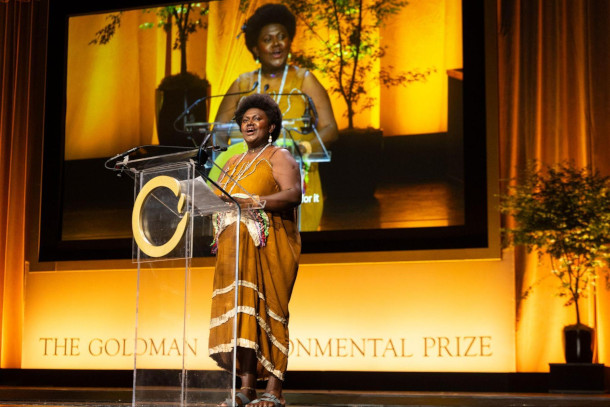
Theonila Roka Matbob at the Goldman Environmental Prize award ceremony. (Photo: Goldman Environmental Prize)
DOERING: And how does it feel to receive this Goldman Environmental prize?
ROKA MATBOB: It is really humbling to be recognized at the global level, because being a lone voice somewhere in the remotest part of the world is not an easy feat to be fighting and demanding accountability from a company that is massive. And sometimes you want to give up on yourself, and you're like, what am I doing? But to be recognized at this, this level is really humbling, and because my fight is not over. I am still on it, and being recognized is a push and a tap on the shoulder that we are not alone. There are hearts throughout the world who are watching and who are part of us, directly or indirectly, and it means, like I'm, I'm truly empowered by this recognition, and I am not going to give up, because there are so many people who are reliant on the ground, on this process, that if this process goes on, it is their healing, it is their closure.
DOERING: Well, it is such a pleasure and an honor to speak with you. Theonila Roka Matbob is the 2026 Goldman Environmental prize winner for Islands and Island Nations. Thank you so much for your time, Theonila.
ROKA MATBOB: Thank you very much, Jenni. It's lovely having this interview with you as well.
Related links:
- Theonila Roka Matbob’s profile at The Goldman Environmental Prize
- The Goldman Environmental Prize
- Watch The Goldman Environmental Prize video profile of Theonila Roka Matbob
- Human Rights Law Centre | “After the Mine: Living with Rio Tinto’s Deadly Legacy”
[MUSIC: Blue Dot Sessions “Steadfast“]
O’NEILL: Save the date for our next Living on Earth Book Club virtual event on July 14th at 8 pm Eastern! We’ll talk with Amy Bowers Cordalis, Yurok activist and attorney, about her book, The Water Remembers: My Indigenous Family’s Fight to Save A River and a Way of Life. Register at loe.org/events!
[MUSIC: Blue Dot Sessions “Steadfast“]
O’NEILL: Living on Earth is produced by the World Media Foundation. Our crew includes Naomi Arenberg, Paloma Beltran, Mia DiLorenzo, Abby Edgecumbe, Swayam Gagneja, Mark Kausch, Mark Seth Lender, Don Lyman, Ashanti Mclean, Sophia Pandelidis, Jake Rego, Andrew Skerritt, Bella Smith, and El Wilson.
DOERING: Tom Tiger engineered our show. Alison Lirish Dean composed our themes.
Thanks this week to the Bosque del Apache National Wildlife Refuge. You can hear us anytime at L-O-E dot org, Apple Podcasts and YouTube Music, and like us please, on our Facebook page, Living on Earth. Find us on Instagram, Threads and BlueSky at living on earth radio. And we always welcome your feedback at comments at loe.org.
Steve Curwood is our Executive Producer. I’m Jenni Doering.
O’NEILL: And I’m Aynsley O’Neill. Thanks for listening!
ANNOUNCER: Funding for Living on Earth comes from you, our listeners, and from the University of Massachusetts, Boston, in association with its School for the Environment, developing the next generation of environmental leaders. And from the Grantham Foundation for the protection of the environment, supporting strategic communications and collaboration in solving the world’s most pressing environmental problems.
ANNOUNCER 2: PRX.
Living on Earth wants to hear from you!
Living on Earth
62 Calef Highway, Suite 212
Lee, NH 03861
Telephone: 617-287-4121
E-mail: comments@loe.org
Newsletter [Click here]
Donate to Living on Earth!
Living on Earth is an independent media program and relies entirely on contributions from listeners and institutions supporting public service. Please donate now to preserve an independent environmental voice.
NewsletterLiving on Earth offers a weekly delivery of the show's rundown to your mailbox. Sign up for our newsletter today!
 Sailors For The Sea: Be the change you want to sea.
 The Grantham Foundation for the Protection of the Environment: Committed to protecting and improving the health of the global environment.
 Contribute to Living on Earth and receive, as our gift to you, an archival print of one of Mark Seth Lender's extraordinary wildlife photographs. Follow the link to see Mark's current collection of photographs.
 Buy a signed copy of Mark Seth Lender's book Smeagull the Seagull & support Living on Earth
© Copyright World Media Foundation. All Rights Reserved
Home | Contact | RSS | Donate | Newsletter