

March 6, 2026
Air Date: March 6, 2026
FULL SHOW
SEGMENTS
Justice Advances in Cancer Alley
View the page for this story
Descendants of enslaved people fighting pollution in Louisiana’s ‘Cancer Alley’ have been greenlit for a trial. Their lawsuit alleges the St. James Parish government discriminated against Black residents by repeatedly permitting industrial plants in predominantly Black districts while shielding mostly white districts from industry. Monique Harden, a longtime environmental justice attorney and advocate, joins Host Jenni Doering to explain how the 13th amendment outlawing slavery plays into the case. (11:56)
Trump, Glyphosate and Cancer
View the page for this story
President Trump has deemed glyphosate as essential for national security even though some 200,000 people have complained they have gotten cancer or other adverse health effects, while using it as directed. Meanwhile a Missouri state court has given preliminary approval to a class action settlement plan for people sickened by Roundup, which contains the herbicide glyphosate. Carey Gillam of The New Lede speaks with Host Steve Curwood about the latest developments in glyphosate lawsuits and why some in the Make America Healthy Again movement feel betrayed by the Trump Administration’s support for glyphosate. (16:27)
"Sneckdowns" and Reimagining Streets
/ Bella SmithView the page for this story
If you’re one of the millions of city-dwelling Americans who saw over a foot of snow in recent weeks, you might have felt a bit buried by the endless snowbanks. But all that snow made traffic slow down and gave people a chance to see sidewalks and streets differently than before. Living on Earth’s Bella Smith has this report on the phenomenon of the “sneckdown.” (02:33)
"The Frozen Creek"
/ Don LymanView the page for this story
Living on Earth’s Don Lyman has been finding reptiles and amphibians since boyhood. This long winter took him back to a childhood memory of finding a bull frog swimming under the ice in what he calls “The Frozen Creek.” (01:32)
Stinky Seaweed Menace
/ Teresa TomassoniView the page for this story
Though the floating seaweed known as Sargassum provides critical habitat for many species in the Sargasso Sea in the North Atlantic, it is now finding a fertile home in southern waters, where it’s wreaking havoc on coastal communities and ecosystems. Teresa Tomassoni, oceans correspondent with our media partner Inside Climate News, spoke with Living on Earth’s Aynsley O’Neill about impacts to respiratory health, tourism and sea turtles. (12:20)
BirdNote®: The Cuban Tody, A Caribbean Jewel
/ Michael SteinView the page for this story
A “must-see” bird for anyone traveling in the West Indies, the Cuban Tody is a tiny bird with a lot of personality. In this week’s BirdNote®, Michael Stein introduces us to these striking Cuban natives. (01:58)
Show Credits and Funders
Show Transcript
260306 Transcript
HOSTS: Steve Curwood, Jenni Doering
GUESTS: Clarence Eckerson Jr., Monique Harden, Teresa Tomassoni
REPORTERS: Don Lyman, Michael Stein
[THEME]
CURWOOD: From PRX – this is Living On Earth.
[THEME]
CURWOOD: I’m Steve Curwood.
DOERING: And I’m Jenni Doering
Descendants of enslaved people fighting pollution in “Cancer Alley” are greenlit for a trial.
HARDEN: The claim is that the St. James Parish government, through its decisions of land use that targets majority Black districts for toxic heavy industrial facilities, while protecting majority white districts from that type of industrial development is in violation of the US Constitution.
CURWOOD: Also, seaweed blooms wreak havoc on Caribbean beaches.
TOMASSONI: When it starts to decompose, it begins to release toxic gases: hydrogen sulfide and ammonia. This can cause respiratory issues; some people develop asthma. It can cause skin irritations, eye irritations. It can cause headaches and nausea.
CURWOOD: That and more, this week on Living on Earth. Stick around!
[NEWSBREAK MUSIC: Boards Of Canada “Zoetrope” from “In A Beautiful Place Out In The Country” (Warp Records 2000)]
[THEME]
Justice Advances in Cancer Alley
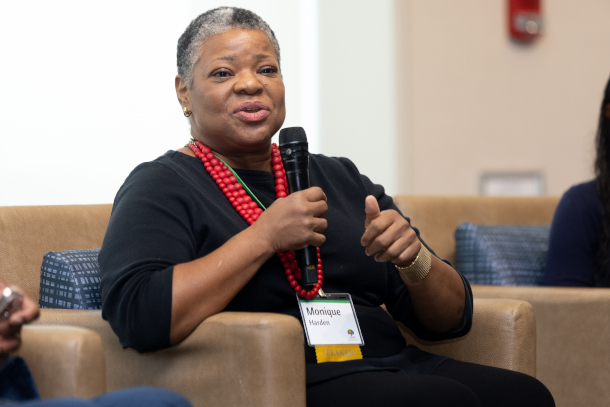
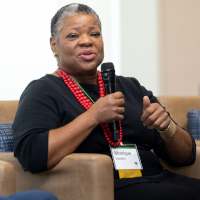
Veteran environmental justice attorney and advocate Monique Harden speaks about environmental justice and the law at the Center for Environmental Justice Media (CEJM) conference in September 2025. Harden discusses the history of the 13th and 14th Amendments as it relates to the Cancer Alley land use lawsuit brought by residents of St. James Parish. (Photo: CEJM)
CURWOOD: From PRX and the Jennifer and Ted Stanley Studios at the University of Massachusetts Boston, this is Living on Earth. I’m Steve Curwood.
DOERING: And I’m Jenni Doering.
As the Mississippi River winds its way from Baton Rouge, Louisiana down to New Orleans, it’s flanked by hundreds of industrial plants that refine and transform oil and gas into chemicals and plastics.
CURWOOD: Because of the toxic air that is also released by these plants, this area is commonly called Cancer Alley, and the Black residents of the region have borne most of the burdens of living amid this pollution. Many of them are descended from the enslaved people who labored on sugarcane plantations along the river, back when owning and brutalizing another human being was legal.
DOERING: But while the horrors of slavery may be mostly behind us, its ugly legacy lives on to this day with former plantation land zoned in ways that unfairly subject Black people to toxic air. That’s according to a lawsuit brought by residents against the St. James Parish government over its repeated decisions to greenlight industrial plants in predominantly Black districts.
CURWOOD: The plaintiffs invoke the 13th amendment of the United States Constitution, which outlawed slavery and led to laws to prevent Black Americans from being clawed back into enslavement. The 14th amendment which is also mentioned in the lawsuit, guarantees equal protection under the law and was also intended to protect all people including African Americans from discrimination.
DOERING: In a potent 34-page ruling, federal district judge Carl D. Barbier found that the plaintiffs presented enough evidence to move the case forward to a trial, marking an important step in the long arc towards justice for the Black residents of Cancer Alley. Here to discuss is Monique Harden, a longtime environmental justice advocate and attorney. Welcome back to Living on Earth, Monique!
HARDEN: Thank you. Glad to be back.
DOERING: And I hope you had a wonderful Mardi Gras.
HARDEN: We had a pretty rambunctious Mardi Gras here in New Orleans, but I'm glad to have survived it and to be on your show.
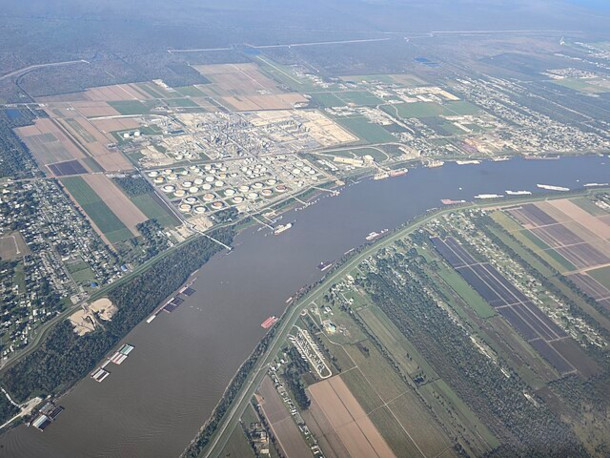
St. James Parish East and West Bank with Mississippi River. Black residents of St. James Parish, Louisiana, are suing their local government accusing it of a history of discriminatory land use practices in the siting of industrial facilities in majority Black districts. (Photo: Spatms, Wikimedia Commons, CC BY-SA 4.0)
DOERING: I'm glad you survived as well. We're here to talk to you about this lawsuit that concerns Cancer Alley and whether plaintiffs have been discriminated against in terms of land use. The judge denied the defendant's attempt to dismiss this lawsuit. What does this ruling really mean?
HARDEN: It means that the demand for equal protection under the law, the demand for racial equality and justice, and environmental justice in particular, now have a day in court. The residents in St. James Parish, Louisiana, organized as Rise St. James and Inclusive Louisiana, are the main plaintiffs who brought a challenge to the way that their local government in St. James Parish, Louisiana, has been deciding zoning and land use matters in a way that targets black communities for large, heavy, toxic, polluting industries.
DOERING: Monique, this case does touch on some fundamental issues of race and civil rights, and that's something that shows up a lot in the judge's 34-page ruling about the next steps here. So for instance, the plaintiffs claim that their 13th Amendment rights were violated. Passed in 1865 the 13th Amendment outlawed slavery, and the plaintiffs allege that the current land use plan operates as quote, “a badge and incident of slavery.” Can you explain for us what that means and how this relates to how the history of slavery colors this dispute?
HARDEN: Judge Karl Barbier, the Federal Court judge presiding over this case, really goes at length in discussing the constitutional claims brought by the community groups in St. James Parish. The violation of their rights under the US Constitution's 13th Amendment is an important one. Well, first of all, the 13th Amendment abolishes slavery and the in servitude, except for incarceration for a person convicted of a crime. That amendment has a second part to it that says Congress is to enact laws to enforce this abolition on slavery. The badges and incidents of slavery are those restrictions that a state government would impose on a population that results in Black residents being subjected to inferior treatment or being marked as subordinate to White citizens or White residents of that state or local government. Here, the claim is that the St. James Parish government through its decisions of land use that targets majority Black districts for toxic heavy industrial facilities, while protecting, actually, not just ignoring, but actually protecting majority White districts from that type of industrial development is in effect, continuing on a badge or incident of slavery within the parish government, and that is in violation of the US Constitution.
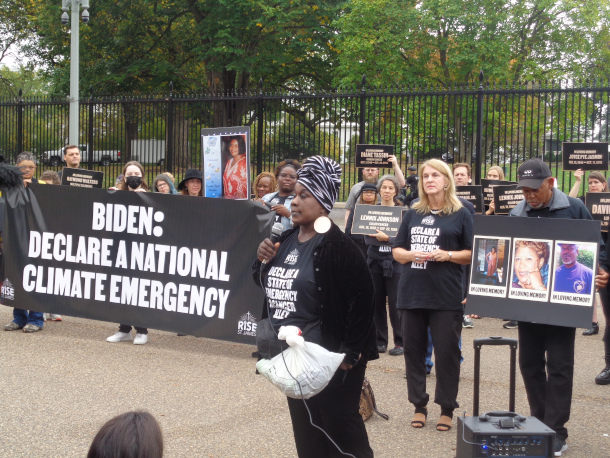
Members of RISE St. James march in Washington, D.C. in October 2022. The group is one of several plaintiffs suing St. James Parish in Louisiana alleging discrimination in its land use policies. (Photo: Frypie, Wikimedia Commons, CC BY-SA 4.0)
DOERING: What do you make of the fact that this judge, Carl D. Barbier, he seems to be open to this argument that this is a really long-standing history of practices. It's not just this one 2014 land use plan document, but this has been a historic pattern that's been established in this parish. What do you make of the fact that he is pretty open to that in this ruling?
HARDEN: The ruling is all about those decisions and the plaintiffs in this case, the Black communities and their attorneys represented by Center for Constitutional Rights and Tulane University Law School's Environmental Law Clinic have done the yeoman's work in providing the court with nearly 200 pages of decisions by the parish government that have led to where we are right now, with all of the toxic industries in that parish being in two adjacent Black communities, nowhere else in the parish, and so the facts of the pattern of time and time again, this consistent targeting. When requests are made by the community for a moratorium on industrial facilities, the parish government denies it. When a solar farm is proposed in a majority-White community and residents don't like it, the parish government accepts and denies that solar farm to protect the interest of majority-White residents elsewhere in the parish. And so the plaintiffs, they live in the community, they know their history, they know what happened in their lifetime, and the history of industrial development in their parish. So bringing all of that together in these court documents. It was just overwhelming. And you would think that of all the parties involved in this lawsuit, the one that would have the best access to this information is the defendant, right? It's the parish government. And they're saying, no, let's just talk about this one plan we did in 2014 and nothing else. And the planners were like, well, we're going to talk about that plan, of course, and we're going to talk about everything else that has been done in the name of St. James Parish government, because it all violates our rights under the US Constitution.
DOERING: And Monique, can you please explain this moratorium on industrial development that was requested by people in St. James Parish?
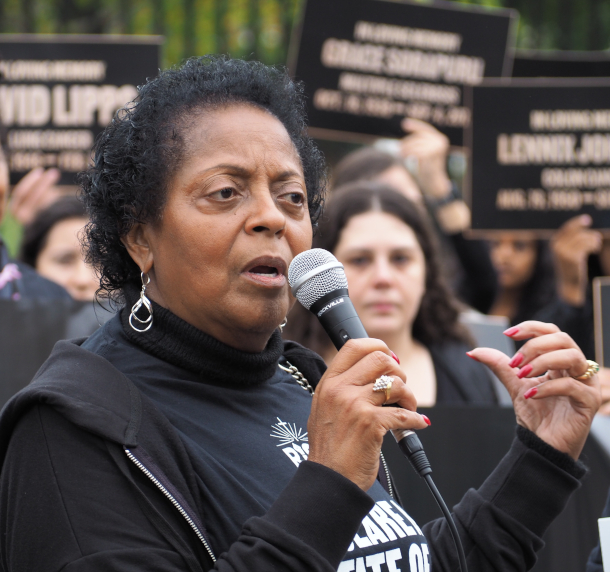
2021 Goldman Prize Winner Sharon Lavigne, founder of RISE St. James speaks during a rally in Washington, D.C. in 2022. Lavigne’s group is one of several suing St. James Parish over discriminatory land use practices. In February, a federal judge cleared the way for the lawsuit to proceed to trial. (Photo: Frypie, Wikimedia Commons, CC BY-SA 4.0)
HARDEN: Yes, Black residents organized as Rise St James developed advocacy campaign for a moratorium on toxic industrial facilities in the parish. Why? Because they lived with them, and many of their members, family, relatives died and are dying from it, the pollution that is spewed from these toxic facilities. And so they brought that demand for a moratorium on industrial development to their parish government, and they were rejected, just out of hand, just rejected, notwithstanding the pain, the harm and the hazards that they were seeking to prevent. And this moratorium idea is a very important one in terms of where this lawsuit goes, because it would mean that St. James Parish government would have to rethink its earlier rejection of the moratorium, and it also means that toxic industrial facilities really have no place near any residential area, regardless of the color of residents, regardless of the race. You know what has transpired over time is that it's Black communities, Latino, Asian, Pacific Islander, Indigenous communities that bear the brunt of the environmental burden of toxic industrial development in this country. And this moratorium that sought in St. James Parish is one that has definite national overtones to it, and that's now further reinforced in terms of connecting those local decisions on land use and siting to the US Constitution now.
DOERING: Monique, what's been the real impact to the communities there in the St. James Parish, especially the majority of Black districts. I mean, we're talking about land use, but we're also talking about actual impacts to the health and well-being of residents living there. So how do the plaintiffs say they've been affected by this?
HARDEN: You're absolutely right. This is not a land use decision without impact. This is about saving their lives. I can just tell you, as a resident of Louisiana and an environmental justice advocate. Every meeting in St. James Parish comes with notice of a death from cancer. So this is serious. This is a community fighting for its survival. The decisions come out of land use governance and policy and plans, but those decisions have been weaponized in such a way that people are not able to live and survive the onslaught of toxic chemicals in the air they breathe.
DOERING: Monique, the legal question at the heart of this case is a question of land use, how local regulations can really harm communities of color if residents are not vigilant, what's a solution here?
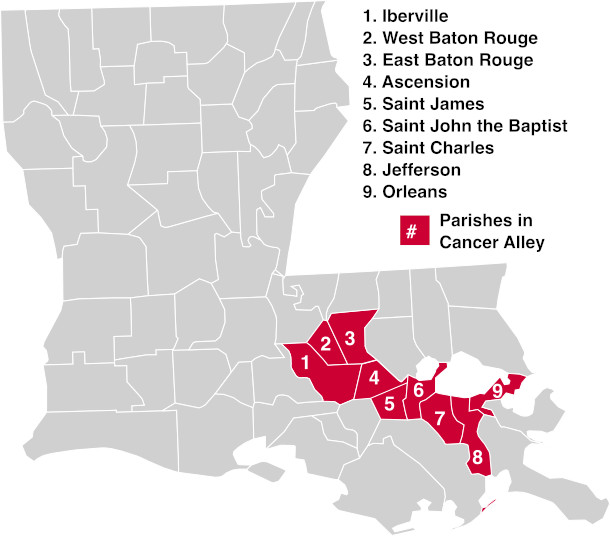
Shown here is a graphic depicting the 9 parishes of Louisiana’s Cancer Alley. (Graphic: WWWHHHHYYYYYY, Wikimedia Commons, Public Domain)
HARDEN: Step one is fighting for your rights under the law. And that's exactly what's happening here. And it's taken what might look like a mundane, routine land use decision, like all other land use decisions that have come before it, and continuing, and compared it against the ruler of constitutional right, and found it wanting right because it's those decisions that are violating basic constitutional rights. That's the first thing. The second is that the siting of industrial facilities is really outside of a permitting decision by the EPA or state environmental agency. It really rests with the local government. It might be a county government or municipal government, but it's the decisions around how an area of land will be zoned. Will it be zoned for commercial use? Will it be zoned for residential use or heavy industrial use where those parcels of land are located, and what can then take place on them can be, and has shown to be here in Louisiana, and looking at our Cancer Alley, in particular, a life and death decision.
DOERING: Monique, how encouraged are the Black residents of St. James Parish by the latest ruling?
HARDEN: Well, I can tell you, as an ally, that they are thrilled. They are thrilled with the results, and because it vindicates what they have been saying all along, that they want to be able to hold their parish government to account for citing toxic heavy polluting industries next to their homes, churches, and on in the areas that their ancestors were buried.
DOERING: Monique Harden is a longtime environmental justice advocate and attorney. Thank you so much, Monique.
HARDEN: Thank you.
Related links:
- NOLA.com | “Court Rules Louisiana Parish Held Illegal Secret Meetings on Proposed Chemical Plant”
- Capital B News | “Black Residents Win Key Ruling in ‘Cancer Alley’ Environmental Racism Case”
- Read the ruling document here:
- Center for Constitutional Right and Justice | “In Landmark Case, St. James Parish Residents Sue Parish Council to Protect Black Neighborhoods With a Moratorium on Hazardous Petrochemical Plants”
- Rise St. James’ website:
- Center for Constitutional Right and Justice | “Victory for Black Residents of Cancer Alley as Court Rules Landmark Lawsuit Seeking Moratorium on Toxic Industry Can Proceed on All Counts”
- Learn more about St. James Parish:
- Visit the St. James Parish Business Development webpage:
[MUSIC: Wynton Marsalis, “Bourbon Street Parade” on Standard Time Vol.2:Intimacy Calling, Sony Music Entertainment Inc.]
CURWOOD: Coming up, the Trump administration declares national security requires supplies of a pesticide that probably causes cancer. Keep listening to Living on Earth.
ANNOUNCER: Support for Living on Earth comes from the estate of Rosamund Stone Zander - celebrated painter, environmentalist, and author of The Art of Possibility – who inspired others to see the profound interconnectedness of all living things, and to act with courage and creativity on behalf of our planet. Support also comes from Sailors for the Sea and Oceana. Helping boaters race clean, sail green, and protect the seas they love. More information @sailorsforthesea.org.
[CUTAWAY MUSIC: Wynton Marsalis, “Bourbon Street Parade” on Standard Time Vol.2:Intimacy Calling, Sony Music Entertainment Inc.]
Trump, Glyphosate and Cancer
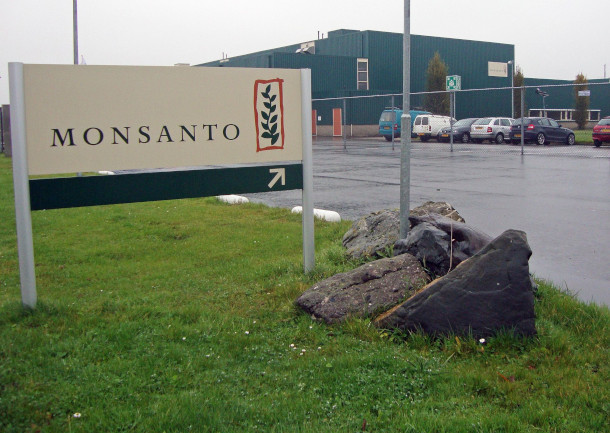
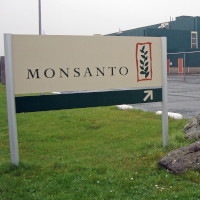
Monsanto, which was acquired by German-based biotechnology company Bayer in 2018, is facing a multitude of litigation related to its glyphosate-based pesticide RoundUp. (Photo: Karen Eliot, Wikimedia Commons, CC BY-SA 2.0)
CURWOOD: It’s Living on Earth, I’m Jenni Doering, And I’m Steve Curwood.
A Missouri state court has given preliminary approval to a class action settlement plan for people sickened by Roundup, which contains glyphosate, an herbicide used in the cultivation of genetically modified crops such as corn and soybeans. The move comes as the US Supreme Court prepares to hear a case in April that seeks to bar certain claims in state courts brought against Bayer, which purchased Monsanto, the original developer of Roundup.
DOERING: President Trump already issued an executive order this February declaring glyphosate is vital for food and national security, and its makers should be freed of any claims of liability. Glyphosate has been widely used since 1970, and some 200,000 people have complained they have gotten cancer or other adverse health effects, even though they used it as directed.
CURWOOD: HHS Secretary Bobby Kennedy Jr. was an outspoken legal advisor against glyphosate, and before the 2024 election brought him into office, his views on the pesticide resonated with the Make America Healthy Again or MAHA movement. Speaking on the line now is Journalist and author Carey Gillam of The New Lede, who says the MAHA movement is alarmed about the court actions and is wondering what happened with an executive order from the White House that seems to ignore Bobby Kennedy’s concerns about glyphosate.
GILLAM: This is a really dramatic move by the President really turned a lot of heads and shocked people that he would be taking such an effort right now to be so protective of one company, essentially, and one chemical that is highly controversial because it's been linked to cancer and reproductive harms and a whole array of environmental problems as well.
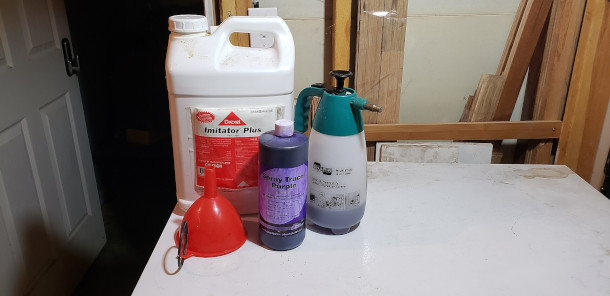
Glyphosate-based pesticides like Roundup have been linked to cases of Non-Hodgkin lymphoma, a form of cancer affecting the lymphatic system. (Photo: Slknight, Wikimedia Commons, CC BY-SA 4.0)
CURWOOD: So, how have people within Make America Healthy Again reacted to this executive order?
GILLAM: Well, the Make America Healthy Again group, MAHA, the grassroots movement, really did not take this well; they are outraged, they have expressed that in numerous ways. They are planning a protest in April 27 in front of the US Supreme Court, as the High Court takes up the issue of FIFRA, the Federal Insecticide Fungicide and Rodenticide Act, which governs pesticide registration in the US and preemption, which basically boils down to another way to try to protect glyphosate and try to protect Bayer from being sued by people who say that their exposure to this chemical has caused them to develop cancer. Many people see this executive order as direct messaging to the US Supreme Court, trying to, if you will, put, you know, a finger on the scale to try to get the Supreme Court to side with Bayer and provide further protections for its weed killers.
CURWOOD: Now, one of the sides of this issue on glyphosate and health is this class action settlement of Roundup litigation. Roundup contains glyphosate. Bayer, which acquired Monsanto, wants to settle all of this, and there's a group of law firms arguing that's what's being offered in terms of a settlement is not enough. Tell me what's going on there.
GILLAM: Yeah and this is Bayer's second attempt at a class action settlement. There have been close to 200,000 legal claims brought against Monsanto and then Bayer, which inherited this litigation. And again, these are brought by people who say that they developed Non-Hodgkin's lymphoma because of their use of glyphosate herbicides sold by Bayer or Monsanto, such as Roundup. And there have been earlier settlements through what is known as multi-district litigation. But this class action settlement would be different, because it would cover not just people who have already sued, but people who may want to sue in the future, maybe haven't been diagnosed yet with non-Hodgkin lymphoma that they would blame on their exposure. So the class action is really to cover current claims as well as claims that could develop over the next 20 years or so. And Bayer has said that they would pay out $7.25 billion over the course of the next several years. And there would be a tiered sort of settlement arrangement in which people who have a certain degree of aggressiveness of non-Hodgkin lymphoma, who might be of a certain age, who used it in a certain way, they would get, on average, a certain amount. It's all very structured and the payouts really aren't that much that are being proposed. They range, on average, from $10,000 a claim, to $165,000 a claim. And so, people who are suffering from cancer, the lawyers that represent them are saying, you know, this may not be enough, and we don't know that we really trust the company to fund the settlement. The company has threatened to file for bankruptcy because of this litigation. But Bayer is really looking at the whole scenario and really trying to pressure people into agreeing to this deal. They actively are saying, hey, you better watch out, you know, the US Supreme Court could side with us, and then you wouldn't be able to sue us in the future. They've also proposed legislation in various states, as well as at the federal level, that would do the same thing that would block future litigation. So they're telling these plaintiffs, you better grab this deal now, because you might not be able to sue us anyway in the future.
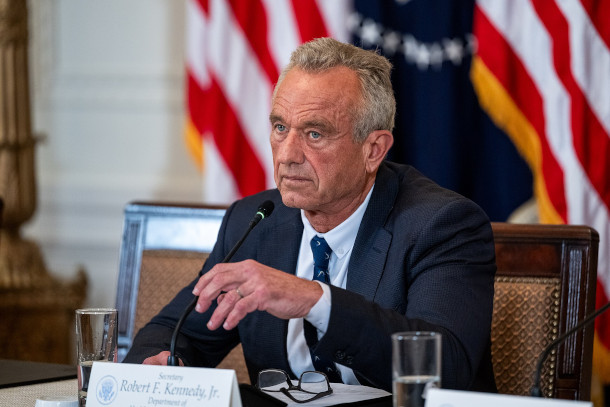
This presidential executive order boosting glyphosate has particularly angered supporters of the Make America Healthy Again (MAHA) movement, led by Health and Human Services Secretary Robert F. Kennedy Jr. (pictured above). MAHA supporters have indicated that they will protest when the Supreme Court reviews Monsanto’s appeal of a jury verdict in April. (Photo: The White House, Wikimedia Commons, CC0)
CURWOOD: So I understand that there were some settlements in California that involved many millions of dollars for exposure to glyphosate. How do those relate to this offer in the class action settlement?
GILLAM: Yeah, this litigation has been going on since late 2015 and as I said, there been close to 200,000 claims the company has settled or otherwise been able to find a resolution in close to 140,000 of those claims, and that has been through settlements, through jury verdicts you've seen some very large jury verdicts, over $2 billion in some cases, and then settlements paid out, and the company has won some of the cases that have gone to trial. They've lost others. They've settled others. So, they've already spent 10 to $11 billion on this litigation, and they're really hoping to put an end to it now, because it's weighed on the company, it's weighed on, obviously, the profits. Investors are very upset with the company. They really want to make this litigation go away.
CURWOOD: By the way, how does Bayer feel about buying Monsanto?
GILLAM: I think it depends on who you ask. Within Bayer, you know, the CEO who engineered the acquisition is no longer with the company. He came under great pressure. Investors have been very upset, very angry. The stock price has really taken a beating over the last few years because of this, and Bayer has promised the investors, many of them who are suing Bayer, that they will find an off route, that they will escape this litigation, and they are pulling out all the stops now. And as we said, the Trump executive order seems to be one of those tactics that Bayer has engineered to really try to put an end to this litigation.
The International Agency for Research on Cancer, which is part of the World Health Organization (logo shown above), found that there was enough evidence to declare glyphosate a probable human carcinogen when it examined peer-reviewed research in 2015. (Photo: The World Health Organization, Wikimedia Commons, CC0)
CURWOOD: Talk to me about some of the stories of the plaintiffs involved in this case.
GILLAM: Oh my, well I mean, there's so many people. The first person who, really, you know, that helped me understand this story, and sort of the human suffering and sadness behind it, was this couple out in Cambria, California, and, they were married for 40 years and had this beautiful little farm and he only sprayed glyphosate. Would not spray any other chemicals but because glyphosate was always represented as being very, very safe, he felt fine doing that, and would take his, you know, little grandson out in the fields with them, and the dog would romp along, and they would spray the fields, and he developed a very aggressive form of non Hodgkin lymphoma, and died the day after Christmas of 2015 and so I went out to Cambria and spent time with that family. And that is the first chapter of my book Whitewash, is the story of that family and how they came to understand, you know, the science showing that this glyphosate exposure could cause this aggressive Non-Hodgkin's lymphoma. And so many people after that, you know, all over, you know, farmers, but also residential users, people who buy a home and need to clear the land and build up what they hope to be their dream property, and spray liberal amounts of glyphosate and then later develop this terrible cancer. So, many, many people over the years, and sadly, many of them you know, have died during this timeframe.
CURWOOD: In this first case that you described, what funds, if any, did the family receive as a function of bringing in action? And by the way, to what extent was Bobby Kennedy Jr. ever involved in that case?
GILLAM: That case actually settled and never went to trial and we don't know the settlement amount. The very first case to go to trial and go through a trial was Lee Johnson, and that's the groundskeeper from Northern California, who sprayed Ranger Pro and other glyphosate based herbicides, again sold by Monsanto and Bayer, sprayed it in his job around school grounds and was doused in the chemical a couple of different times when sprayers would break and things would happen and developed just a really horrible, aggressive form of non-Hodgkin lymphoma. And I spent a lot of time with him, we talk about him in my second book. He had two little boys, and really fought hard in his trial, and Bobby Kennedy was one of the attorneys advising on that case. He did not actively represent Lee, but he was an advisor on that case, and was there on a daily basis, and they won $289 million on behalf of Lee Johnson in the jury verdict.
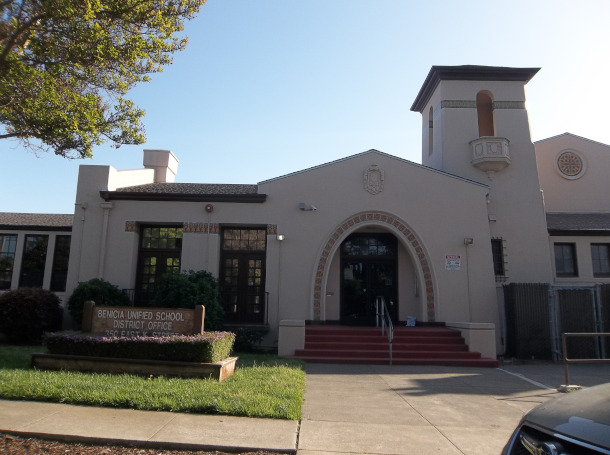
The first case against Monsanto to go to trial, rather than be settled out of court, was that of Lee Johnson. Johnson was a groundskeeper from northern California who used RoundUp in his job on school grounds and later developed an aggressive form of Non-Hodgkin lymphoma. Shown above is the office for the Benicia Unified School District, which employed Lee Johnson. (Photo: Lhimec, Wikimedia Commons, CC0)
CURWOOD: Carrie, what is the connection between glyphosate and cancer?
GILLAM: Well, there are many scientific studies that show an array of connections. The International Agency for Research on Cancer, part of the World Health Organization, in 2015 took a look at the published, peer reviewed scientific research that had accumulated to that date since the time that glyphosate was introduced in the 1970s and they found that there was enough evidence to declare it a probable human carcinogen, and they found a specific association to non-Hodgkin lymphoma. There have been subsequent studies, another one in 2019, another one just last summer, one in 2022 that have further provided evidence of a cancer connection. The EPA continues to say that they don't believe that glyphosate exposure, when used as intended, presents a risk or hazard to human health, but in 2022 the Ninth Circuit federal court threw out the EPA's assessment of glyphosate, saying that they weren't following their own scientific rules for how to assess science, and that it was faulty logic that they were using, and so they've thrown that out, and the EPA is supposed to at some point come back with another assessment, but continues to maintain, currently, that they do not believe that this causes cancer.
CURWOOD: So very specifically here, what are the arguments against saying that glyphosate is connected to cancer?
The EPA (logo shown above) continues to claim that glyphosate-based herbicides are safe to use when used as intended. In 2022, the Court of Appeals for the Ninth Circuit threw out the EPA’s assessment of glyphosate, stating that the EPA wasn’t following its own rules around assessing science but the agency has yet to follow up with an assessment that would be accepted by the Court. (Photo: United States Environmental Protection Agency, Wikimedia Commons, CC0)
GILLAM: Well, there's also a number of scientific studies, most of them that have been done by the companies themselves. There was a very prominent study that they released in the year 2000 that became really foundational for many regulators. The EPA has cited it in their review of glyphosate, as have European regulators and others. Monsanto put that study together, spent years actually working on it, writing it. Monsanto's own internal emails show that they referred to as ghost writing that study, it appeared to be independent. It had the names of independent scientists on it, not Monsanto scientists. We've known about that for many years because of all of the internal emails that came out and it was only recently, in the last couple of months that the journal actually retracted that scientific study, citing the ghost writing and the deception that went on behind it, and there are many other studies that we have been able to uncover that similarly, have ghost riding or have Monsanto's imprint on them that appear to be independent.
CURWOOD: I noticed that in Europe, an effort to have some sort of a EU wide concern about glyphosate did not go through, and only a few countries there tell their farmers not to use it. What's going on?
GILLAM: Yeah, there was a real push after the International Agency for Research on Cancer came out with its classification, there was a real push to ban it throughout the European Union, the vote came down to basically one swing vote, and that swing vote was Germany, that came in and weighed in on favor of keeping it on the market in Europe. That was at the time that Bayer, which is a German-based company, was getting ready to close on its purchase of Monsanto, so that was very interesting timing. But EKA, EFSA, these key regulatory bodies in Europe, have looked at the science. They look at science that's presented to them by the companies. There's a very large, powerful, wealthy lobbying force behind these regulatory overviews, and they have similarly followed sort of the EPA's view, where they are evaluating that they are not yet saying that they feel that this causes cancer. But if you go through the work, the bodies that advise these regulatory agencies are funded and backed and stacked by Bayer and the other agrochemical companies. It's a huge lobbying force around the world.
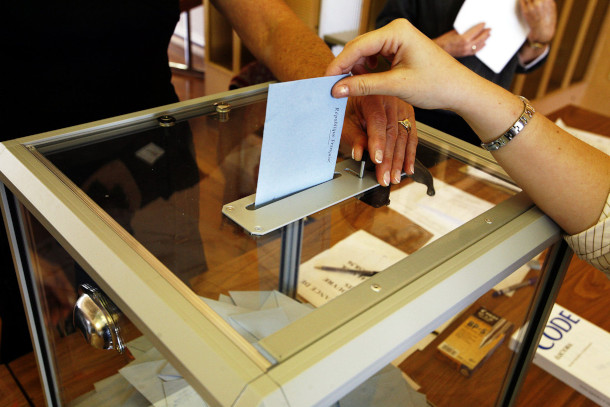
The Trump administration’s reluctance to challenge big agricultural companies continues to sow discontent among MAHA supporters, which could affect the midterm elections. (Photo: Rama, Wikimedia Commons, CC BY-SA 2.0 FR)
CURWOOD: Now, before you go Carey, to what extent can this issue of glyphosate chemicals and the health impact the upcoming midterm elections?
GILLAM: Yeah, you know this is such an interesting thing to watch. MAHA again, the grassroots, the moms out there and the families who have risen up kind of following Bobby Kennedy to the White House, hoping that Kennedy and Trump would respect and regard and embrace this MAHA movement. And of course, they say they have right, and Trump formed the MAHA Commission, which is led by Bobby Kennedy, and they've made a lot of noise about taking chemical food additives and artificial colors and trying to get those out of foods, particularly those that are fed to children, because of science that shows that these are harmful to children, these different chemicals, and they've made some moves on that. But when it really comes to anything that challenges Big Ag or the farm lobby or companies like Bayer, they have just folded, and this executive order has really infuriated MAHA. Refusal to make any restrictions on glyphosate, and really a whole deregulatory move and strategy by Trump, which is not surprising, but as it's playing out with pesticides, and particularly with glyphosate, the MAHA movement, the grassroots movement, are really angry, and they are threatening to try to really make a difference in the midterms and in the next presidential election, if they don't start getting some respect from the Trump White House. So, I think it remains to be seen how powerful they will or will not be, but, there's certainly people that see MAHA as a force that helped get Trump elected, primarily because of their belief that Bobby Kennedy could make a difference in the administration, and now I think that they're seeing that maybe that was wishful thinking.
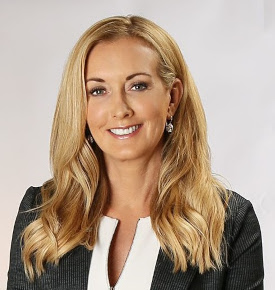
Carey Gillam is an investigative journalist and author of The Monsanto Papers: Deadly Secrets, Corporate Corruption, and One Man's Search for Justice. (Photo: Carey Gillam)
CURWOOD: Carey Gillam is an investigative journalist and the author of the Monsanto Papers: Deadly Secrets, Corporate Corruption and One Man's Search for Justice. Thanks Carey, for taking the time with us today.
GILLAM: Thank you so much for having me.
CURWOOD: Bayer CEO Bill Anderson issued a statement, that says in part “the proposed class settlement agreement, together with the Supreme Court case, provides an essential path out of the litigation uncertainty and enables us to devote our full attention to furthering the innovations that lie at the core of our mission: Health for all, Hunger for none.”.
Related links:
- The White House | “Promoting the National Defense by Ensuring an Adequate Supply of Elemental Phosphorus and Glyphosate-Based Herbicides”
- Read Bayer’s statement on the RoundUp class action settlement:
- Learn more about the cases brought against Monsanto that went to trial in California:
- Read more about Guest Carey Gillam’s book The Monsanto Papers: Deadly Secrets, Corporate Corruption, and One Man's Search for Justice:
- Purchase a copy of Guest Carey Gillam’s book The Monsanto Papers: Deadly Secrets, Corporate Corruption, and One Man's Search for Justice (Affiliate link supports Living on Earth and local bookstores):
[MUSIC: Wynton Marsalis, “When It’s Sleepytime Down South” on Standard Time Vol.2:Intimacy Calling, Sony Music Entertainment Inc.]
"Sneckdowns" and Reimagining Streets
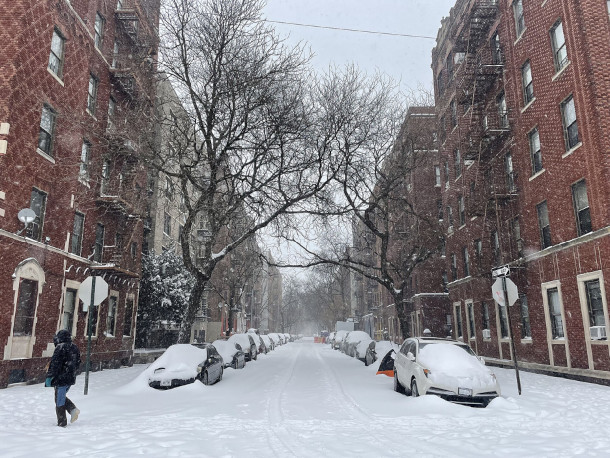
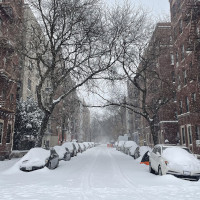
A snowy neckdown, or sneckdown, models how streets can be made safer for both cars and pedestrians by extending sidewalk space at intersections. February brought record-breaking snow to the Northeastern U.S., inspiring sneckdown hunters to take to the streets. (Photo: Wil540 art, Wikimedia Commons, CC BY 4.0)
DOERING: If you’re one of the millions of city-dwelling Americans who saw over a foot of snow in recent weeks, you might have felt a bit buried by the endless snowbanks. But all that snow made traffic slow down and gave us a chance to see our sidewalks and streets differently than we did before. Living on Earth’s Bella Smith has this report on the phenomenon of the “sneckdown.”
SMITH: Yes, you heard that right: sneckdown. It’s a portmanteau of the words “snowy” and “neckdown,” a traffic-calming feature that extends the sidewalk into the street at intersections. Sneckdowns occur after a snowstorm, when snow remains piled at intersections but cars continue carving their usual paths through the roadway — revealing space that often goes unused.
ECKERSON: I call it nature's tracing paper, because the snow comes down and then the cars start driving over, over the next few days. And then you can see, well look, cars barely or don't at all, use those few feet off of the intersection. Even trucks don't.
SMITH: That’s Clarence Eckerson Jr, director of StreetFilms, a project dedicated to documenting more livable urban spaces. He’s been helping to champion sneckdowns and the improvements they hint at since 2014.
ECKERSON: And that kind of shows you that that space could be reclaimed for, you could put benches, you could just put simple curb extensions. There's a lot of things you could do with it.
Sneckdowns have even inspired real-world change in cities like Philadelphia and Clarence’s native New York.
ECKERSON: I have taken a tour in one of my videos of downtown Manhattan and seen where there were sneckdowns and now there are painted curb extensions or safer havens for pedestrians.
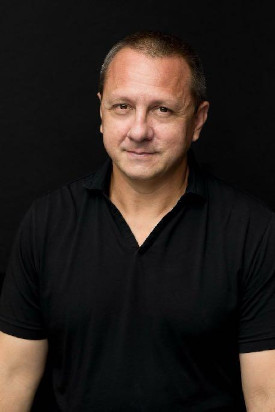
Clarence Eckerson, Jr. is the director of StreetFilms and has produced nearly 1,200 videos throughout his career to promote people-centered streets. (Photo: Courtesy of Clarence Eckerson, Jr.)
SMITH: And if you don’t get any snow where you live, don’t worry. The same kind of thing happens when leaves clump by the side of the road, creating “leafdowns”.
ECKERSON: And there was, even in California, people like, couldn't be left out. So they started noticing the palm trees, the palm fronds were falling and then kind of getting scuttled to the sides of the road and they were calling them palm frond neckdowns. So, you know, it's really had its own kind of [LAUGHS] fun journey to like, letting people get creative.
SMITH: And for those of us still struggling through snowbanks, snowy neckdowns or sneckdowns offer a simple, playful way to step outside, document your neighborhood, and imagine a safer transportation future for your community. So whether you’re welcoming the first signs of spring or still stuck in the winter blues, sneckdowns just might help you see your streets in a whole new light. For Living on Earth, I’m Bella Smith.
Related links:
- Bloomberg | “Want Safer Streets? Take Design Cues From the Snow”
- Explore all of StreetFilms’ videos.
[MUSIC: Village People, “New York City” on Sex Over the Phone, Can’t Stop Productions NYC]
"The Frozen Creek"
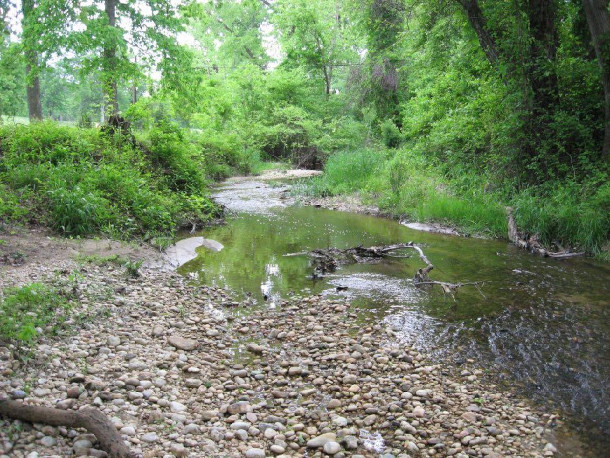
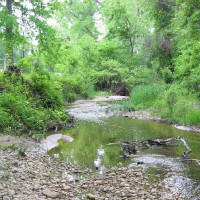
Don Lyman returned to Little Creek in May of 2013 to capture what the landscape looks like in Spring. (Photo: Don Lyman)
CURWOOD: This long winter took Living on Earth’s Don Lyman back to a childhood memory of what he calls “The Frozen Creek.”
LYMAN: On a cold winter day when I was 12 years old, I wandered along the edge of Little Creek, which flowed next to the golf course on the Quantico Marine Base in northern Viriginia. The creek was frozen over, but my thoughts drifted back to summer, and memories of splashing through the cool, flowing water on hot, humid days, looking for queen snakes and snapping turtles with my friends. Brightly colored minnows called red-sided dace swam in small schools, and darted into the safety of tree roots that dangled in the water in deep pools. Tall oaks, sweetgums, and yellow poplars provided shade for the young explorers, and protected us from the hot Virginia sun. Barn swallows flew under the golf course bridge. I wondered if they had nests there.
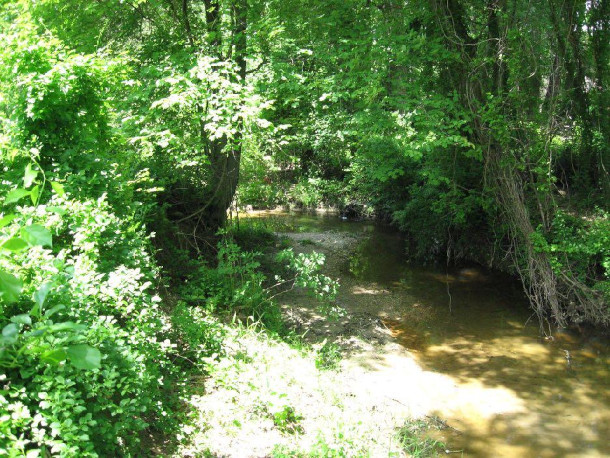
In the warmer months, Little Creek is lively and full of snakes, turtles, fish, and frogs. (Photo: Don Lyman)
But in the dead of winter, there were no snakes or turtles or dace or swallows. I felt forlorn, and longed for summer. Suddenly, I saw a frog, a big bull frog, swimming under the ice! It kicked along slowly, and I followed it. I couldn’t believe what I was seeing. I’d never seen a frog swimming under the ice. Shouldn’t the frog be fast asleep at the bottom of the stream?
Maybe the frog was restless, and longing for summer too.
CURWOOD: That’s Living on Earth’s Don Lyman.
Related link:
More from Don Lyman:
[MUSIC: Chet Baker, “Summertime” on Chet Baker Quartet Vol.2 (Chet Baker in Paris Vol.2)]
DOERING: Just ahead, A weed is just a plant in the wrong place, they say… and that can apply to seaweed, too. Stay tuned to Living on Earth.
ANNOUNCER: Support for Living on Earth comes from the Waverley Street Foundation, working to cultivate a healing planet with community-led programs for better food, healthy farmlands, and smarter building, energy and businesses.
[CUTAWAY MUSIC: Chet Baker, “Summertime” on Chet Baker Quartet Vol.2 (Chet Baker in Paris Vol.2)]
Stinky Seaweed Menace
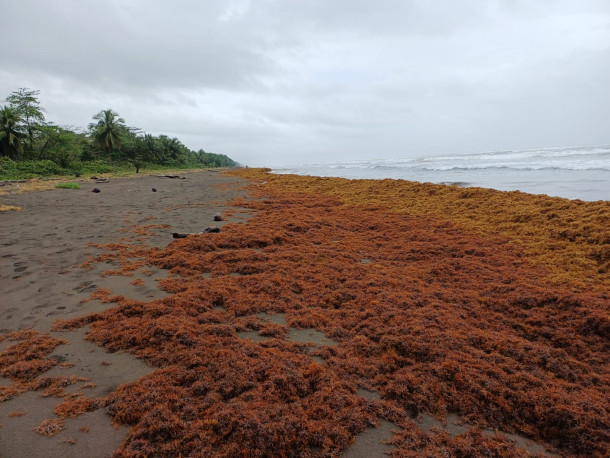
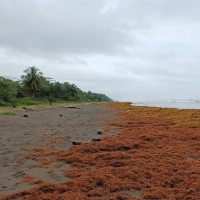
A sargassum bloom in Costa Rica in February 2026. 2025 saw a record bloom of sargassum in the Atlantic Ocean. (Photo: Carolina Calvo Brenes, Departamento de Comunicación Institucional del Ministerio de Ambiente y Energía, Gobierno de Costa Rica, Wikimedia Commons, Public Domain)
CURWOOD: It’s Living on Earth, I’m Steve Curwood.
DOERING: And I’m Jenni Doering.
So, maybe you’re dreaming of an escape from the frigid temperatures of the Northern Hemisphere this time of year. But your tropical vacation could be disrupted by something clogging those sandy shores.
CURWOOD: Sargassum is a floating macroalgae, and it saw a record bloom in the Atlantic Ocean in 2025, wreaking havoc on coastal communities. Most of this seaweed is normally contained by ocean currents in the Sargasso Sea in the north Atlantic, where it provides critical habitat for many species.
DOERING: But from 2009 to 2011, an unprecedented and prolonged wind event and possible ocean current changes pushed some sargassum out of the Sargasso Sea towards southern waters, where it’s found a fertile home. Teresa Tomassoni is an oceans correspondent with our media partner Inside Climate News, and she spoke with Living on Earth’s Aynsley O’Neill.
O'NEILL: So, what are these blooms looking like, and how do they affect coastal communities?
TOMASSONI: So the sargassum bloom that has occurred in the tropical Atlantic has actually formed what's called the Great Atlantic Sargassum belt. So this is a giant patch of about 5000 miles that stretches from the west coast of Africa to the Gulf of Mexico in the Caribbean. So this is a giant floating patch of sargassum that can be seen from space. It's the largest macroalgal bloom on Earth. And since 2011, we've seen with some variability, year to year, but overall, an increasing trend of this sargassum flooding beaches. 2025, last year was a record-breaking year. It was a 40% increase in the volume of sargassum in the Atlantic from 2022, the previous record year. And already scientists are saying 2026 is looking to be another record-breaking year. So scientists and governments are dedicating a lot of time and resources to understanding what is causing this bloom and how do we manage it?
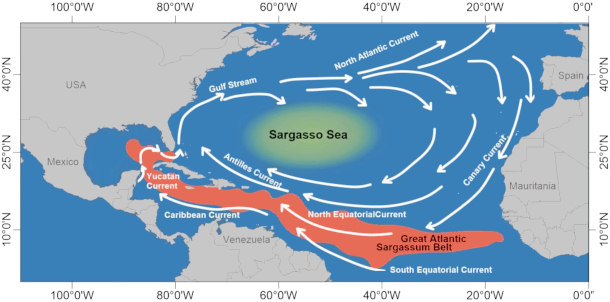
The Great Atlantic Sargassum Belt covers about 5,000 miles from the Gulf of Mexico to the West Coast of Africa. (Photo: López Miranda JL, Celis LB, Estévez M, Chávez V, van Tussenbroek BI, Uribe-Martínez A, Cuevas E, Rosillo Pantoja I, Masia L, Cauich-Kantun C and Silva R, Wikimedia Commons, CC BY 4.0)
O'NEILL: Well, Teresa, what's the primary driver behind these blooms? How much of this has to do with something like climate change versus another factor, something else going on?
TOMASSONI: It's a really interesting and important question that I haven't necessarily gotten straight answers from scientists. They're still trying to figure out what exactly caused this and what exactly is perpetuating this crisis. What we do know is that climate change was likely a culprit for driving that unprecedented wind event, current changes, those strong winds that blew the sargassum outside of the Sargasso Sea. Then this sargassum gets carried away into these currents, into warmer waters in the tropical Atlantic. And we know that sargassum does thrive in warmer waters. It also thrives in nutrient-filled waters. So the scientists that I've been speaking with have said it was sort of this perfect storm of conditions, warm temperatures and nutrient-filled waters from agricultural runoff from deforestation, off the mouth of the Amazon River Basin, off the mouth of the Congo, off the east coast of the US and in the Caribbean. Runoff from farms carries major amounts of nitrogen, phosphorus, iron, all of which help plants grow, and so in the ocean, it's helping sargassum bloom at unprecedented, massive rates. I think for a long time, it was thought that climate change is the primary driver for sargassum blooms, but as I mentioned, that might have been the initial culprit for getting sargassum outside the Sargasso Sea, but it's not necessarily the driving factor for these blooms. Warmer water conditions are favorable to sargassums, so it really thrives. But I'm also told that sargassum thrives within a certain range of temperatures, so if it gets too hot, it may actually stop growing.
O'NEILL: Well, in its original context, the sargassum was, you know, a boon. It was habitat for local fish populations. But what about in this situation? And what are some of the environmental consequences that happen when you have this overabundance of sargassum?
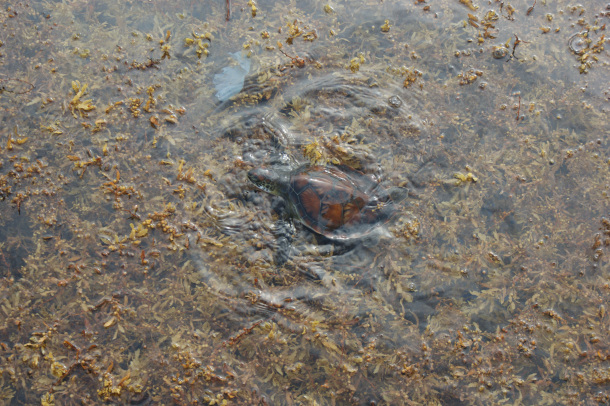
Normally, sargassum can provide excellent habitat for marine life, like baby sea turtles in the open ocean. However, when blooms cause the seaweed to congregate onshore, it can become an obstacle and hazard. (Photo: FWC Fish and Wildlife Research Institute, Flickr, CC BY-NC-ND 2.0)
TOMASSONI: You're right. Sargassum is this critical habitat. It's a good thing. We need sargassum in the ocean, but as several scientists mentioned, too much of a good thing in the wrong place at the wrong time can be bad. It can be really bad. So what we've seen with these blooms is very severe environmental consequences as well as economic consequences for the countries or the states that are most affected by these inundations, these floods of seaweed washing upon their shores. Environmentally, these dense mats of seaweed that are getting pushed towards shorelines by currents, by tides, are really devastating near-shore ecosystems. They're so dense that they block sunlight from filtering through the water. Coral reefs and seagrass beds need sunlight to survive, for instance, but that seaweed is blocking that sunlight from reaching them, and when it dies, it's falling and even smothering entire seagrass beds and coral reefs. It also becomes a hazard for some marine life. So it's no longer a constructive habitat for baby sea turtles or other marine life, for instance. It's actually too thick for them to, to get through. I spoke with one sea turtle biologist here in Turks and Caicos, and she said she's actually seen drowned adult sea turtles entangled in these beds of seaweed floating near shore. Also, a few years ago, I was reporting on leatherback sea turtle conservation in Panama, and while patrolling the beaches there with scientists and community members, I watched as they really had to aid these tiny, two-inch baby hatchlings, surpass, climb over, get to the shore, because there were these mountains of sargassum in their way that would either entangle or trap them or just block their path from reaching the ocean.
O'NEILL: And how are these blooms affecting humans?
TOMASSONI: These blooms are not only affecting marine life, they're affecting people too on various levels. There are major health consequences to these blooms. So once sargassum arrives on shore, in about 48 hours, it starts to decompose, and when it starts to decompose, it begins to release toxic gasses, hydrogen sulfide and ammonia. This can cause respiratory issues. Some people develop asthma if they're exposed to these gasses over a longer period of time. It can cause skin irritations, eye irritations. It can cause headaches and nausea as it decomposes. It's also producing this brown, toxic water, one scientist told me. It's filled with arsenic, and in places like the Yucatan Peninsula, where the land is very porous, that water is seeping right into fresh groundwater that's used for drinking water, into fresh water swimming holes like cenotes, so it can have even further health consequences for people.
O'NEILL: And I imagine there might also be some sort of economic consequence going on here too. I mean, there's these toxic mounds all over the beaches. So how does this affect local communities in that way?
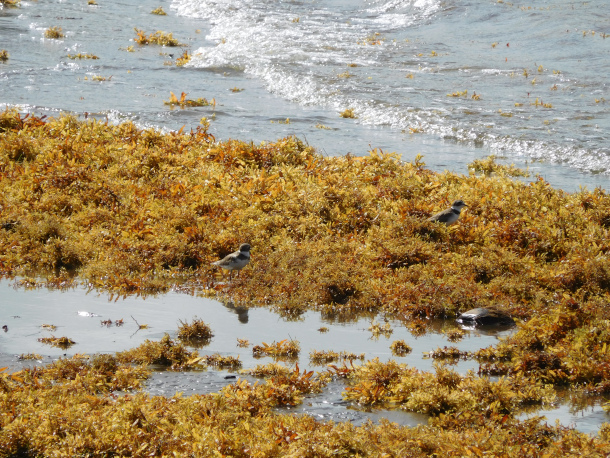
As it decomposes, sargassum can release toxic gases like hydrogen sulfide and ammonia, causing respiratory issues, headaches, and nausea. (Photo: Filo gèn', Wikimedia Commons, CC BY-SA 4.0)
TOMASSONI: Absolutely. These blooms are also really taking an economic toll on countries and states impacted in the Caribbean, in Florida, Puerto Rico, US Virgin Islands, some of these places are losing millions, if not billions of dollars each year in lost revenue they would have otherwise gained in various marine sectors: fishing, tourism, hotels, restaurants along the coast. There was just a recent study put out by the Woods Hole Oceanographic Institution, which puts numbers to this impact. The scientists who produced this analysis estimate Florida loses around $5 billion each year due to sargassum and the harmful impacts it causes. As I mentioned, sargassum, as it's decomposing, not only produces these toxic gases, it also produces this rotten egg smell, which is really a deterrent for tourists that want to relax on the coast and enjoy their vacation. I've spoken with people who either live along the coast or visit parts of the Yucatan Peninsula regularly, and they have decided to no longer visit there because they would prefer to go places inshore where that smell and those gases are not bothering them. So people are making real choices to avoid these areas, and that's having large economic impacts.
O'NEILL: Well, so how are local communities dealing with these blooms? I assume they're not just saying, yeah, we'll take those economic and health consequences. So what sort of management tactics are they using here?
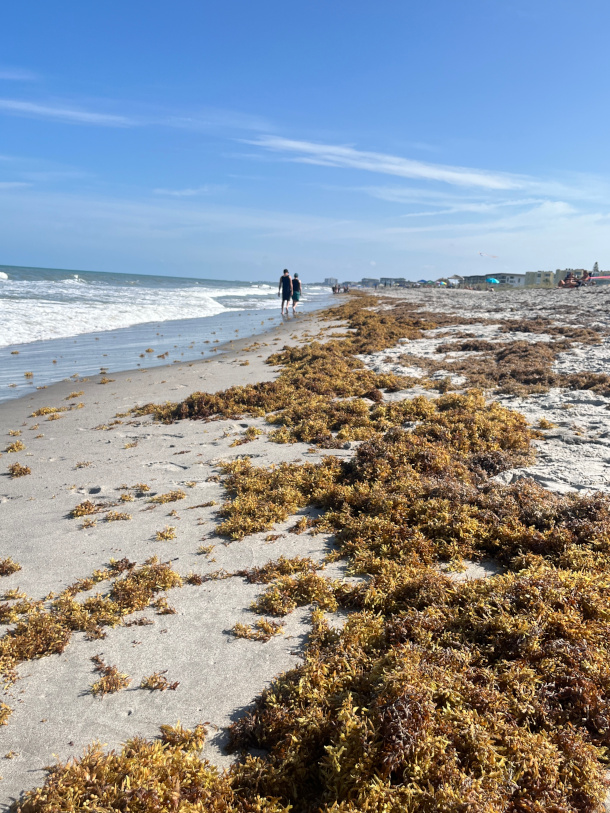
Sargassum on Cocoa Beach, Florida in May 2023. A recent study by the Woods Hole Oceanographic Institution estimates that Florida loses $5 billion a year due to the impacts of sargassum on industries like tourism, recreation, and fisheries. (Photo: Benoît Prieur, Wikimedia Commons, CC0)
TOMASSONI: Communities, really throughout the region, are struggling to cope with these sargassum inundations. You see people doing really arduous labor, using shovels, rakes, wheelbarrows, to dig up the sargassum, put it in a wheelbarrow, transport it off the beach, or dig these giant holes on the beach and just bury it if they have nowhere to transport the sargassum. And some areas are using these deflection barriers called booms, to prevent the sargassum from reaching the shore. But these are expensive, and not every place has access to these booms. There's also a question of what to do with the sargassum once they collect it on the beach. Sometimes it goes to landfills, which can have pretty severe climate impacts, one scientist told me. I mentioned that the sargassum releases hydrogen sulfide and ammonia, but it also starts to produce methane as it decomposes, and we know Methane is a potent greenhouse gas, stronger than carbon dioxide, and so amassing more and more sargassum in landfills is inevitably going to have a climate impact as well. So people are really starting to rethink how we collect the seaweed and where we put it to have the least environmental impacts, the least climate impacts.
TOMASSONI: And well, some people are saying, well, we can't just get rid of it, and we can't just bury it. So some are looking towards harnessing it. Do I have that right? What have you heard about that?
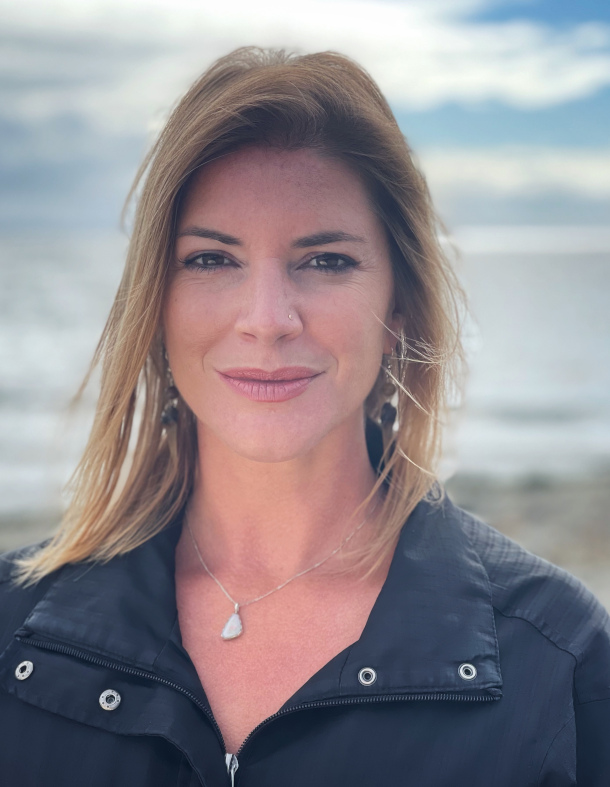
Teresa Tomassoni is an Oceans Correspondent with our media partner Inside Climate News. (Photo: Andrew Grenier)
TOMASSONI: You're correct in that a lot of folks, including various entrepreneurs, scientists, governments, startups, are all trying to think creatively about, how can we harness this seaweed? Out in the ocean it was once a good thing. How can we create something good again, out of it, and not leave it on shore to decompose on shore or in the landfills where it could harm people or the environment. So one organization, one UK startup, for instance, called Seafields, is looking to actually create these farms of sargassum offshore. I mentioned the deflection barriers, these booms that basically serve as a blockade to Sargassum reaching the shorelines. So Seafields is actually looking to create what they call these paddocks, or farms offshore as well. So they would use the booms to basically funnel the sargassum into these paddocks, where they would intentionally keep the sargassum alive, because it has less harmful impacts when it's alive than dead, and they would keep it alive until it was ready to be harvested and then used to create other products. Some startups and entrepreneurs are using sargassum to create biochar. Biochar is kind of like a type of charcoal. It stores CO2 long term and is being used to actually be added to concrete to reduce concrete carbon footprint, and also it's been proven to make concrete stronger. Some entrepreneurs in Mexico, I'm told, are using sargassum to add to plastic to make these wave like flexible roof panels to make sandals. Others are using sargassum to make these sort of fertilizer additives, these biostimulants to make the soil healthier and prompt faster growth of plants. We know sargassum grows well, so it's got a lot of properties that can potentially help other plants grow efficiently as well. This problem, unfortunately, is not likely to go away anytime soon. One scientist told me that for the next ten years, at least, unless there's a major climate event that stops the growth of sargassum, this is the new reality, and we have to face it.
DOERING: Teresa Tomassoni of our media partner Inside Climate News spoke with Living on Earth’s Aynsley O’Neill.
Related links:
- Woods Hole Oceanographic Institution | “New Study Quantifies Sargassum’s Multi-Million Dollar Impact to U.S. Coastal Economies”
- The Guardian | “Scientists Warn of ‘Regime Shift’ as Seaweed Blooms Expand Worldwide”
- Oceanographic | “Turtle Hurdles: Florida’s Sargassum Surge Is a Crisis for Sea Turtles”
- National Library of Medicine | “Sargassum Seaweed in the Caribbean: A Major Public Health Problem Still Unsolved”
- The New York Times | “Shifting Climate Alters Pattern of Atlantic’s Giant Seaweed Blobs”
- Learn more about Teresa Tomassoni
[BIRDNOTE THEME]
BirdNote®: The Cuban Tody, A Caribbean Jewel
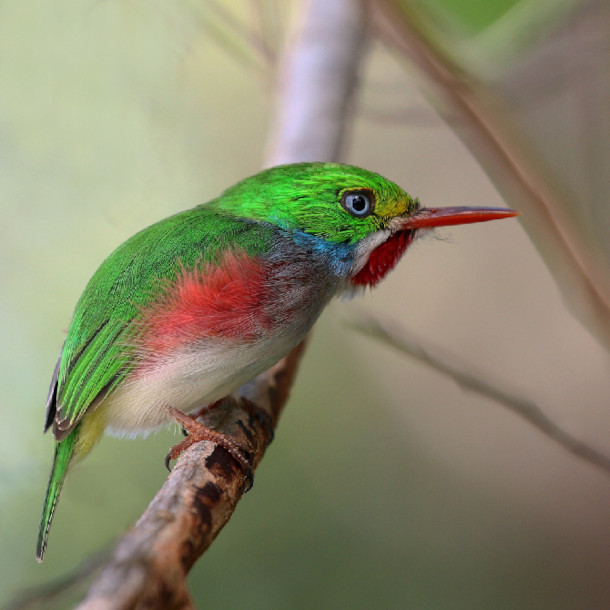
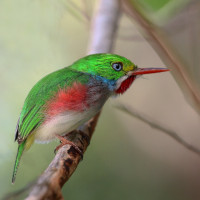
A colorful Cuban tody perches on a stick. (Photo: Charles J. Sharp, Wikimedia Commons, CC BY-SA 4.0)
CURWOOD: In the woodlands of the West Indies lives the Cuban Tody, a tiny bird no bigger than a cigar. But as Michael Stein tells us in today’s BirdNote, the little Tody has a voracious appetite for flying insects.
[Call of Cuban Tody]
This staccato call comes from the throat of a Cuban Tody. [Call of Cuban Tody]…
A bird that’s almost indescribably cute – and the top of the "must-see" list of any birder heading for the West Indies. Because although it’s not much bigger than a hum-mingbird, a Cuban Tody packs a lot of pizzazz into its tiny body.
[Music]
It’s big-headed. Short-tailed. Brilliant leaf-green with a geranium-red throat. And as if that weren’t enough to be noticed, the Cuban species features a touch of blue on the sides of its throat. Its long, flattened bill looks like it’s built for insect-catching. And indeed it is.
In woodlands throughout the island of Cuba, Todies are terrific foragers. In fact, their Puerto Rican cousins have been known to catch up to one or two insects a minute, hunting from dawn to dusk. Their wings make an audible whirring sound each time they do this, and you may find a Tody just by listening for that sound.
[Call of Cuban Tody and music]
I’m Michael Stein.
###
Written by Dennis Paulson
Music and bird sounds provided by The Macaulay Library of Natural Sounds at the Cornell Lab of Orni-thology, Ithaca, New York. 'Traditional Cuban Music' 62981 recorded on the roof of the Libertad Hotel, Santiago by Gregory F Budney; Cuban Tody 112183 recorded by Gregory F Budney.
BirdNote's theme music was composed and played by Nancy Rumbel and John Kessler.
Producer: John Kessler
Executive Producer: Dominic Black
Associate Producer: Ellen Blackstone
© 2018 Tune In to Nature.org September 2018 Narrator: Michael Stein
https://birdnote.org/show/cuban-tody
CURWOOD: For pictures, migrate over to the Living on Earth website, loe dot org.
Related link:
Find this story on the BirdNote® website.
[MUSIC: Andy Narell, “Sugar Street” on Down The Road, 1992 Windham Hill Records]
CURWOOD: Living on Earth is produced by the World Media Foundation. Our crew includes Naomi Arenberg, Paloma Beltran, Sophie Bokor, Swayam Gagneja, Mark Kausch, Mark Seth Lender, Don Lyman, Ashanti Mclean, Nana Mohammed, Aynsley O’Neill, Sophia Pandelidis, Jake Rego, Andrew Skerritt, Bella Smith, Julia Vaz, El Wilson, and Hedy Yang.
DOERING: Tom Tiger engineered our show. Alison Lirish Dean composed our themes. You can hear us anytime at L-O-E dot org, Apple Podcasts and YouTube Music, and like us please, on our Facebook page, Living on Earth. Find us on Instagram, Threads and BlueSky at Living on Earth radio. And we always welcome your feedback at comments at loe.org. I’m Jenni Doering.
CURWOOD: And I’m Steve Curwood. Thanks for listening!
ANNOUNCER: Funding for Living on Earth comes from you, our listeners, and from the University of Massachusetts, Boston, in association with its School for the Environment, developing the next generation of environmental leaders. And from the Grantham Foundation for the protection of the environment, supporting strategic communications and collaboration in solving the world’s most pressing environmental problems.
ANNOUNCER 2: PRX.
Living on Earth wants to hear from you!
Living on Earth
62 Calef Highway, Suite 212
Lee, NH 03861
Telephone: 617-287-4121
E-mail: comments@loe.org
Newsletter [Click here]
Donate to Living on Earth!
Living on Earth is an independent media program and relies entirely on contributions from listeners and institutions supporting public service. Please donate now to preserve an independent environmental voice.
NewsletterLiving on Earth offers a weekly delivery of the show's rundown to your mailbox. Sign up for our newsletter today!
 Sailors For The Sea: Be the change you want to sea.
 The Grantham Foundation for the Protection of the Environment: Committed to protecting and improving the health of the global environment.
 Contribute to Living on Earth and receive, as our gift to you, an archival print of one of Mark Seth Lender's extraordinary wildlife photographs. Follow the link to see Mark's current collection of photographs.
 Buy a signed copy of Mark Seth Lender's book Smeagull the Seagull & support Living on Earth
© Copyright World Media Foundation. All Rights Reserved
Home | Contact | RSS | Donate | Newsletter