
Kelp ‘Forests of the Sea’
Air Date: Week of November 27, 2026
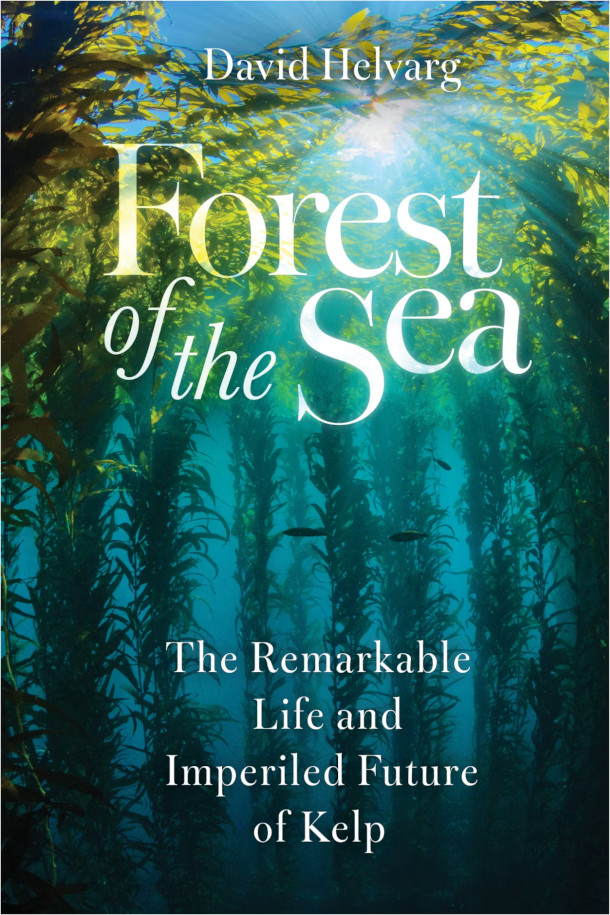
In his latest book, Forest of the Sea, David Helvarg takes you on his deep dives into the ocean’s kelp forests. (Photo: Courtesy of David Helvarg)
Kelp forests are among the most productive ecosystems on the planet and produce as much oxygen as all Earth’s rainforests – so you could say they’re the Amazon of the ocean. That’s according to David Helvarg in his latest book, Forest of the Sea: The Remarkable Life and Imperiled Future of Kelp. And just like the Amazon, as the planet warms, kelp forests can burn -- not with flames, but with marine heatwaves and pollution. David Helvarg speaks with Host Steve Curwood about these threats and ways to bring kelp back.
Transcript
DOERING: It’s Living on Earth, I’m Jenni Doering
CURWOOD: And I’m Steve Curwood.
Kelp forests are one of the most productive ecosystems on Earth, and the nearly one million square miles of them along the colder coastlines of the world have increasingly come under threat from climate change. But the vulnerability of kelp to changing ocean temperatures was barely mentioned at “the 2026 blue COP” in Türkiye and only recently these giant algae have even been given a place in ocean conservation next to mangroves and coral reefs. Yet kelp fronds, leaves and stems with a total area the size of Mexico pull a lot of carbon out of the sea and give back a fifth of the Earth’s oxygen. That’s as much as all of our rainforests combined. In other words, kelp forests are the Amazon of the ocean, as our guest David Helvarg argues in his latest book, Forest of the Sea: The Remarkable Life and Imperiled Future of Kelp. And like the Amazon, as the planet warms, kelp forests can burn, not with flames, but with marine heatwaves and pollution. David Helvarg joins us now, welcome back to the show, David!
HELVARG: Thank you, Steve. Been a long time.
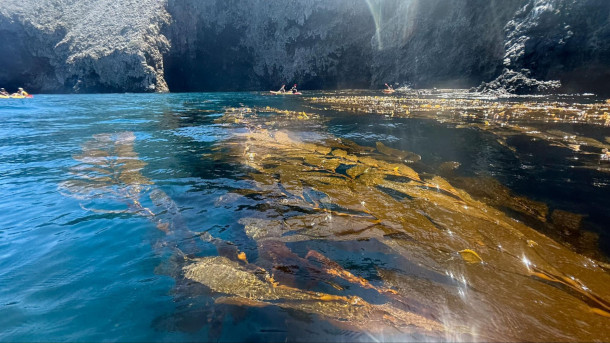
From the surface, kelp forests – like one here in California’s Channel Islands National Park — look like patches of light-brown blades, swaying in the waves. (Photo: Nhung Nguyen
CURWOOD: Indeed. Now this is what your sixth book, your seventh book. How many of these?
HELVARG: Seventh book, six about the ocean, and one about environmental politics.
CURWOOD: Yeah, you know, reading your book, one of the takeaways is: look, there's so much going wrong with the ecosystem based on what we've done to the climate, and people kind of feel a little helpless. But one possible inflection point is to deal with kelp because we still have a lot of it, comparatively speaking, and it will make a huge difference for dealing with a climate emergency. To what extent is that statement true?
HELVARG: It's very true. Unfortunately, unlike coral reefs or rainforests, people know very little about the world's kelp forests, which actually cover more territory than the Amazon, up to almost a third of the coastlines of the world. And along with estuaries and salt marshes, mangroves and seagrasses, they generate 20% of the oxygen. They have a tremendous amount, obviously, because they're an algae that photosynthesizes, they absorb huge amounts of carbon dioxide in the water in the agriculture sector. Unlike farmland, which often results in deforestation and also needs all these inputs like fossil fuel-based herbicides and fertilizers, kelp and seaweeds get their nutrients out of the water and produce very high value foods. Most people don't know; they still think that seafood is mostly wild caught. Today, it's 140 million tons of agricultural product a year versus 90 million of wild caught species, and of that 100 40 million, 30 million tons a year is seaweeds, including kelps and other high nutrient value crops.
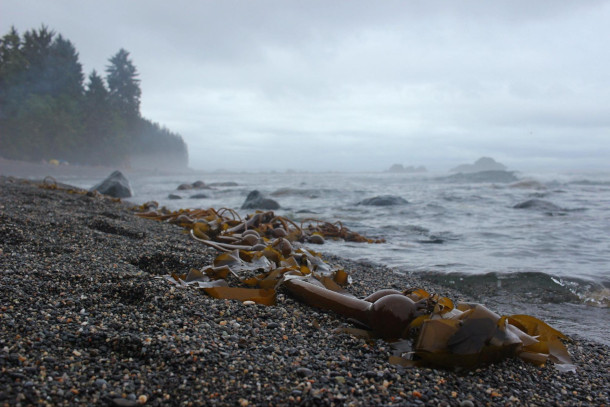
Few people get to see these underwater wonders, and many simply associate kelp with the piles that have washed ashore. (Photo: Thomas Mastromonaco, Pexels, Pexels license)
CURWOOD: So, David, you know, given that kelp forests are so large and so vital, why do you suppose most people don't know about them? They seem to be unknown to the general public.
HELVARG: They're just offshore, but they're offshore in really colder waters where tourists don't go. People walking the beach, they may see the canopy offshore, but mostly they just see it as piles of smelly kelp that's washed up and is covered with flies. And most people don't realize that, in fact, the kelp is 40% alginate, which is a great stabilizer and emulsifier. And and so that kelp product is in all our processed foods, in our toothpaste, our cosmetics.
CURWOOD: Ice cream too, right?
HELVARG: Ice cream too. It makes it more creamy and less icy. We wouldn't have chicken nuggets without alginate, and at the same time, it's in medicines like take an anti-acid capsule, and there's algae there too. It's worth 500 billion a year, and yet, as you said, few people kind of know it's there.
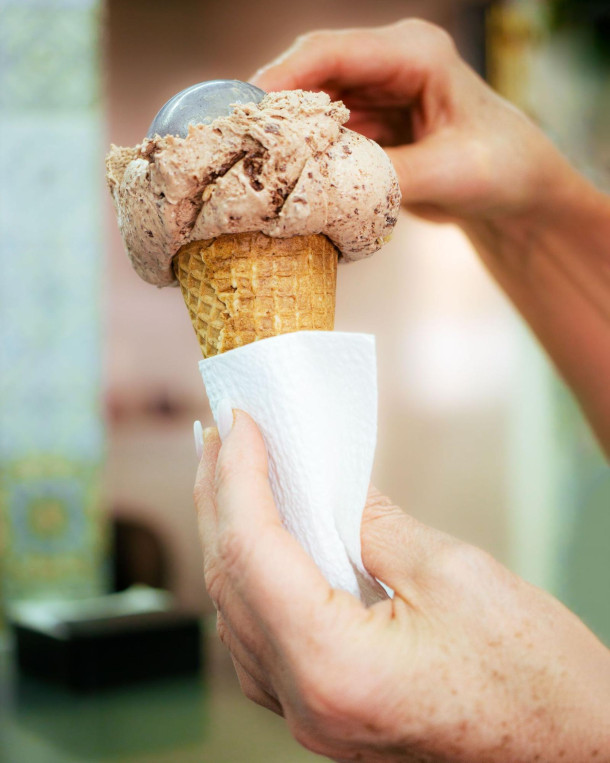
Kelp-derived emulsifiers are found in a number of foods. For example, they can be used to make ice cream smooth and stable. (Photo: Elchino portrait, Pexels, Pexels license)
CURWOOD: So let's go into the science of this for a bit. I've seen some kelp forests. There's some wonderful ones in Monterey Bay and also off of South Africa, Cape Town, where I spent a little bit of time. They look like trees, but in fact, there's something else. There, some sort of super algae we're talking about here.
HELVARG: Yeah, I mean, it's what they call evolutionary convergence. The kelp forests look a lot like plants, but they're actually an algae. They're really big algae, like the giant kelp we have here in California, and the bull kelp. Literally, they're the bamboo of the ocean. They can grow a foot, two feet a day. But it's better than plants, you know, because the algae gave birth to the plant system. The first complex life on Earth was 1.2 billion years ago when different algae formed in the seaweed, and eventually that led to the plant systems on land. And 600 million years later, the animal kingdom rose up. So it's you know when we say the forest of the sea, we scientifically have to point out it's algae, it's not plants.
CURWOOD: So David, talk to me about what the kelp do in the ecosystem. What organisms, aside from themselves, of course, do they nurture?
HELVARG: Sure. I mean, aside from providing protection from erosion and storm impacts and providing oxygen, they protect over 1000 species, like leafy sea dragons and wolf eels that I've encountered, but most people don't know that the life cycles of a lot of our edible wildlife, like salmon and cod and herring, also depend on the kelp forest where they mature and spend a year or more breeding. Herring roe on kelp is one of the first foods of springs for indigenous community all along the Pacific Coast. Again, it's this diversity of food. So commercial fishers around the world are very dependent on it, and other people are dependent on it as a harvest. That in Asia there's huge amounts of kelp harvesting for food and other products.
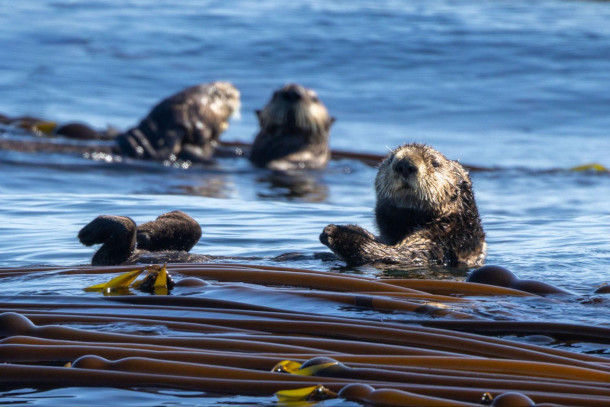
Sea otters wrap kelp around their bodies as an anchor to keep themselves from drifting while resting. Predators like sea otters and sunflower seastar act as keystone species in these forests, hunting sea urchins and preventing them from overgrazing the kelp. (Photo: Sergey Guk, Pexels, Pexels license)
CURWOOD: David, you're both a journalist and a scuba diver. What was it like to experience these forests for the first time? Tell me what happened when you went down there.
HELVARG: Well, it's kind of amazing. So even if it wasn't producing $500 billion in a year in goods and services, it's just inherently one of those places with a sense of awe and wonder that you're part of something mysterious, and it's like fun to dive in coral. But kelp diving is a full contact sport. You're going through these thick and tangling kelp, and it's dark and it's murky. And then suddenly the light will break through. And I looked up, and it was like somebody fired a shotgun through a barn door. You just had these intense shafts of light that were lighting up the world around us, which is a world of giant Garibaldi's. They're like goldfish on steroids, and then I look down, and there's a big eel, wolf eel, they call them, just big gray teeth and snaggle tooth, just so ugly it's attractive.
CURWOOD: Ooh, scary.
HELVARG: Well, it's it's all scary, but in a way that makes you know you're alive, and sometimes suddenly something large moves nearby, but there's only six foot visibility. You wonder what it is, and yeah, it could be a sea lion, it could be a leopard shark, it's-
CURWOOD: or a great white, huh?
HELVARG: Yeah, they tend to only transit through the kelp.
CURWOOD: So, how did this experience of encountering the kelp forest change your perspective as a environmental journalist?
HELVARG: Well, it's sort of you know, as I saw it beginning to decline, it kind of fed into what I've been doing for a long time as an environmental journalist advocating for what I call the blue beat. And so, when the blob, as they called it, the marine heat wave, struck down California's kelp beginning around 2015, I thought, here's a great story that needs to be told.
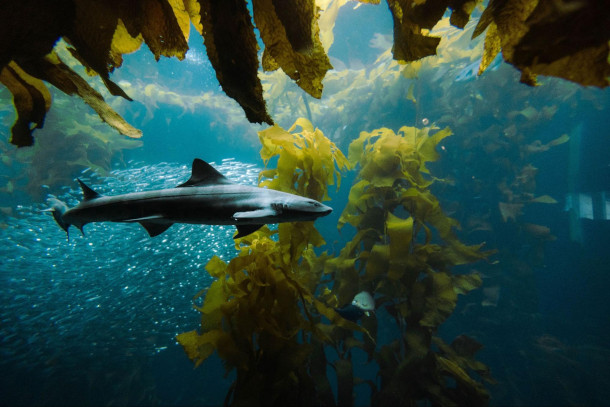
As you plunge into a kelp forest, you’ll find it teeming with life, so get ready to swim alongside sharks, seals and schools of fish. (Photo: isaac mijangos, Pexels, Pexels license)
CURWOOD: Yeah, I mean, the situation is pretty dire, though. I mean, you document that kelp forests are in great decline around the world. Tasmania has this giant kelp that's 95% gone. In Northern California, the bull kelp has suffered the same fate, and the kelp highway along the Pacific Rim is is a moonscape. Tell me, why are we having this decline in kelp in such large numbers? Is this human activity extracting kelp and the critters that are part of the kelp ecosystem? Is it our warming? Is it the change in the acidification of the ocean? What's causing this massive decline that you've documented?
HELVARG: 20 years ago, when I started my ocean nonprofit Blue Frontier, the main issues for both coral and kelp were overfishing and pollution. I mean, there's illegal harvesting down in South America now, in Chile and Peru, but the mechanical harvesting, the overfishing, the pollution were the problems 20 years ago. Today, I'd say the overwhelming problem is the ocean's hotter than it's ever been, and 80% of the ocean saw marine heat waves at some point last year. The kelp forests like it in the 40 to 50 degree range, but when I was up in Alaska, Prince William Sound had had a marine heat wave where it went to 76 degrees and killed all the kelp and all the species that depend on it. I mean, this is normally 46 degree water that jacked up, and we had this blob that between 2013 and 2017 that took out 95% of our bull kelp in Northern California. So, to keep the forest alive, we really need to deal with the marine heat, which means we need to deal with climate.
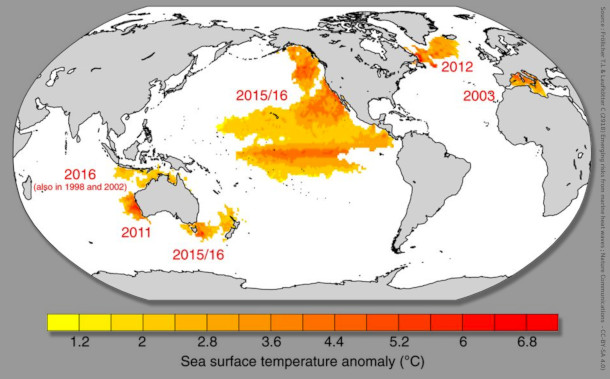
The map shows the maximum sea surface temperature anomaly in regions where temperature exceeds the 99th percentile using NOAA’s daily Optimum Interpolation sea surface temperature dataset. These major marine heatwaves — prolonged periods when ocean temperatures are abnormally high — have been observed occurring around the world, upending underwater ecosystems, including kelp forests. (Photo: Lamiot, Wikimedia Commons, CC BY-SA 4.0)
CURWOOD: So, David, what will happen if the kelp go away? If the kelp get overheated as the climate overheats, what will happen to the ecosystems?
HELVARG: The worst-case scenarios for kelp loss have been in Tasmania and Northern California. And here in Northern California, what we saw is that communities like Fort Bragg, fishing community up a few hours north of San Francisco and the Golden Gate, they lost their urchin fishery. They lost the recreational abalone diving season, which brought in 20 to $30 million a year because the abalone feed on the kelp, and the big urchins went away when the little purple ones took over. What had happened there was when this hot water came in, it supercharged sea star wasting disease. The last top predator in Northern California was this sunflower sea star. It's like this giant cannibalistic starfish that can grow 24 arms and weigh as much as a bald eagle. They were up there eating the little urchins that would otherwise eat the kelp. They got wiped out. 99% of them got wiped out by this wasting disease, and so there's nothing left. The little purple urchins came out of their hidey holes and ate the kelp forests away for 350 miles and replaced them with what are called urchin barrens. And what's scary is people are literally out there with mineral hammers smashing the urchins in Southern California. I visited 80 acres of restored kelp forest, but it took them 10 years and had to take out 6 million urchins to create the conditions for the kelp to come back.
CURWOOD: Oh my! So, in the midst of this huge decline in kelp, it does seem to be recovering in other places. What are those places, and what's behind the advancement of kelp there?
HELVARG: With kelp, luckily, I mean, I've been diving in a kelp forest that 10 years ago was in urchin barrens, two years later it was back. So if you create the conditions, kelp can recolonize very quickly and grow incredibly fast. It's triage. It's saving what we can while we can, and making the right decisions. I mean, South Korea, their fisheries agency realized that healthy wild kelp forest, the mother seed for the aquaculture industry, that's essential. It's a food security issue. So they invest $29 million a year in restoring kelp. They've restored 50,000 acres. They plan to restore 130,000 acres by 2030. There's also massive healthy kelp forests in the southern cone of Latin America that are being protected by marine parks, we gave the president of Azores an award recently for protecting his kelp. The best way to resist also involves intact kelp systems, which means like having predators like marine weasels that we all know as sea otters. They're the keystone predators that eat the urchins that keep the kelp forest healthy. The scientist that I spoke with down in Tasmania in Australia, he said it's amazing. We can we know how to restore kelp. We can do it. It's expensive, but if we're not off fossil fuels by the end of the century, we're not going to have real kelp forests. We're not going to have coral reefs.
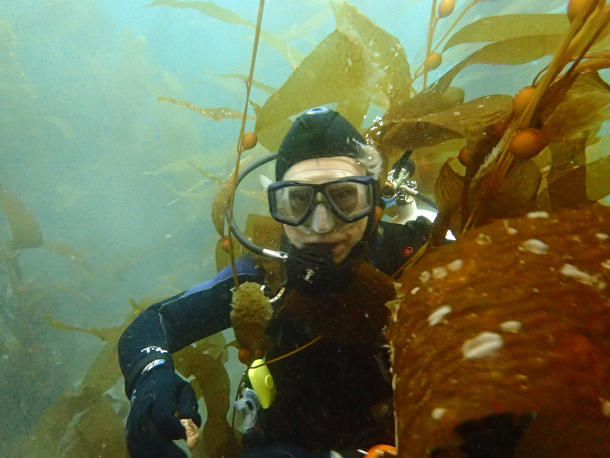
For author David Helvarg (above) — a journalist and a scuba diver — plunging into the world of kelp gives you a sense of awe and wonder. He says it makes you feel “that you're part of something mysterious”. (Photo: Jessie Altstatt)
CURWOOD: Now you explore the growing interest in kelp and seaweed as part of the so-called blue economy. Take us to one of the places you visited that is taking economic advantage of this notion that saving kelp can also help save money, save economies.
HELVARG: Yeah, I mean, up in Alaska, I went out with indigenous fishermen who's now harvesting kelp. He sees the problems with the warming ocean. He thinks that to maintain marine-based harvesting, which his community has done for 1000s of years, they need to diversify kelp's away. In Maine, I went out with a lobsterman who's also planting kelp because, as he pointed out, with the changing warming of the Gulf of Maine, the lobster going further north or further out to sea, so he's looking his kelp his way to diversify, and then in Turkey, it's micro, not macro algae. But I visited the first carbon negative bio refinery where they're growing different algae, feeding them with carbon dioxide from a cement factory and sugars from a soft drink factory, and these algae are being used for jet fuel for Turkish airlines and downstream products like omega threes and soil supplements. So the potential that's offered by algae and kelp is just beginning to be realized, and that's what I mean by a blue economy. That this is something that can really get us more into a nature-based chemistry and product lines.
CURWOOD: So replanting them is one thing, but restoring the forest, the size that we've lost, is another. So, in your view, what would it take to do this to scale?
HELVARG: Not my view, but a scientific report in Nature suggested that for $14 billion, you could at least expand the kelp forest significantly closer back to what they were when I was young, and 14 billion is sounds a lot until you realize there's half a trillion dollars of value, including like right here in California with this year's Super El Niño coming ashore. Areas that have kelp forests, like Central California and Monterey Bay, are much more protected from storm surges than areas that don't have the kelp forest. It's very much like the coral reefs protecting island from their impacts. Again, you're not going to get that 14 billion until people have the awareness of like the South Korean fisheries agencies and communities where they have kelp festivals and where they they commit the money for their own sense of security. People are amazed. You tell them there's like a whole rainforest, but it's under the water and you don't know about it. I wrote stories about the wildfires here in California, but to discover that there's a second forest disaster underway can wake people up. And I think when people become aware, then they're going to engage. And there's you know there's a help the kelp bill in in Congress that would put 5 million a year into restoration and research. It's not a hopeless story. It's what's hopeless is if we don't act.
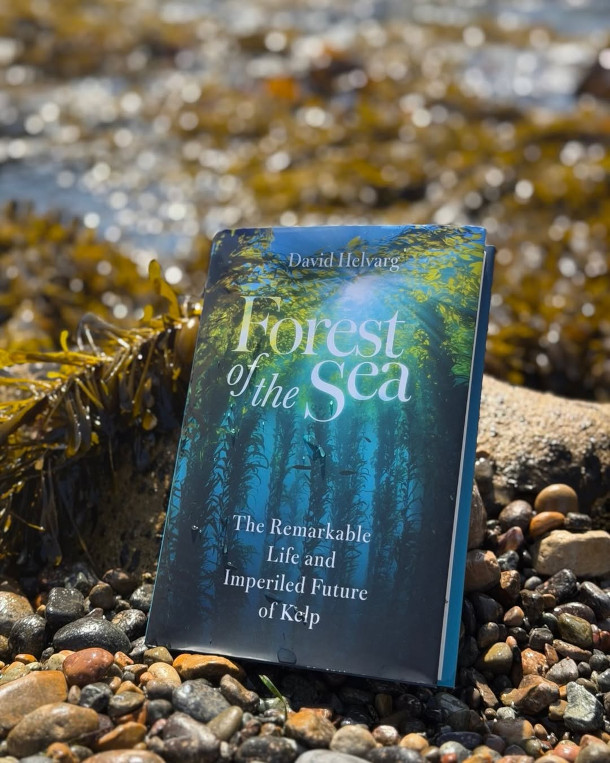
David Helvarg is a journalist and author. (Photo: Courtesy of David Helvarg)
CURWOOD: So, David, before you go, tell me what are your hopes for the future of kelp?
HELVARG: My hopes for the future of kelp are at this point much like my hopes for the future of coral in all living seas, and in terms of the kelp forest, they're more resilient. I've been diving off Palos Verdes in a kelp forest that was just urchin barrens a decade ago, and to see all the shoaling fish and the lobsters returning was just hopeful. I think the hope for the kelp is the hope for the ocean, which we expand our awareness, appreciation, and then do what we can to save what we can.
CURWOOD: While we have time.
HELVARG: While we have the time, now is the time. We've delayed too long. We've done too much damage, but we have the knowledge. What we need is the awareness and the political commitment to do what needs to be done.
CURWOOD: David Helvarg's latest latest book is called Forest of the Sea: A Remarkable Life and Imperiled Future of Kelp. David, thanks so much for taking the time with us today.
HELVARG: Thanks for having me, Steve.
Links
Monterey Aquarium | "Kelp Forest Resilience and Recovery Research"
Living on Earth wants to hear from you!
Living on Earth
62 Calef Highway, Suite 212
Lee, NH 03861
Telephone: 617-287-4121
E-mail: comments@loe.org
Newsletter [Click here]
Donate to Living on Earth!
Living on Earth is an independent media program and relies entirely on contributions from listeners and institutions supporting public service. Please donate now to preserve an independent environmental voice.
NewsletterLiving on Earth offers a weekly delivery of the show's rundown to your mailbox. Sign up for our newsletter today!
 Sailors For The Sea: Be the change you want to sea.
 The Grantham Foundation for the Protection of the Environment: Committed to protecting and improving the health of the global environment.
 Contribute to Living on Earth and receive, as our gift to you, an archival print of one of Mark Seth Lender's extraordinary wildlife photographs. Follow the link to see Mark's current collection of photographs.
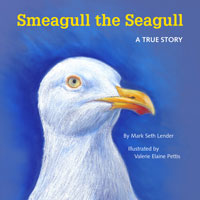 Buy a signed copy of Mark Seth Lender's book Smeagull the Seagull & support Living on Earth
© Copyright World Media Foundation. All Rights Reserved
Home | Contact | RSS | Donate | Newsletter