

Rancor and Relief at COP31
Air Date: Week of November 27, 2026
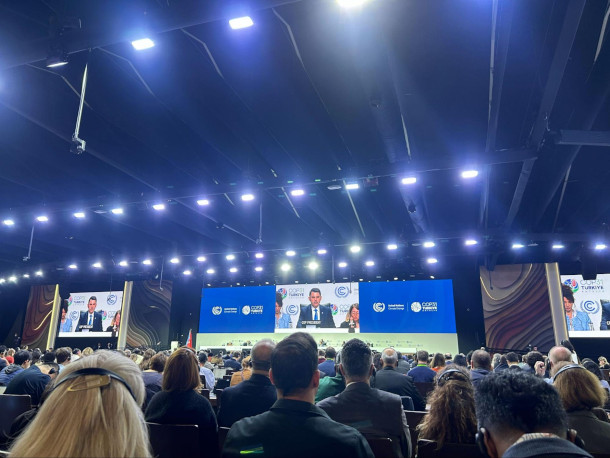
The 31st Conference of the Parties of the UNFCCC ended without a formal update of measures under the UNFCCC and Paris Climate Agreement, a decision that Climate Action Network’s Tasneem Essop said “opens the door for the fossil fuel industry.” Above, the COP’s President, Murat Kurum, addresses the plenary. (Photo: Courtesy of Paloma Beltran Fontes)
As the UN climate treaty negotiations in Türkiye stretched a grueling 40 hours into overtime, Living on Earth Producers Paloma Beltran Fontes and Sophia Pandelidis were there, talking with frustrated delegates and members of civil society. They share what they heard with Hosts Steve Curwood and Jenni Doering as they look back on the failure of nations to reach consensus, and despite the impasse, what was in fact accomplished at COP31.
Transcript
DOERING: Let’s turn now to our colleagues, Living on Earth producers Paloma Beltran Fontes and Sophia Pandelidis who were also there on the ground at COP31. Hey Paloma, how are you?
BELTRAN: Hi Jenni, I’m good. COP 31 was definitely an exhausting experience but quite gratifying.
CURWOOD: And what about you Sophia?
PANDELIDIS: Well, Steve, I’m okay, we survived, over 40 hours past the official close of these negotiations, it was actually so long it turned out to be a record for these COPs. It was supposed to be over on Friday, but we, along with other journalists and delegations, kept waiting through delay after delay until that final plenary meeting on Sunday afternoon.
BELTRAN: Yes, there were endless hours of boredom, filled with constant suspense that an agreement to achieve consensus might be announced at any time. And finally, right before the plenary started, a lot of drama was going down. Several civil society groups expressed their discontent with the final draft, including the Climate Action Network or CAN. They actually waited for Australia environment minister and COP31 co-president Chris Bowen to hand him a letter. Here’s CAN’s executive director Tasneem Essop, speaking as storm clouds seemed to be thickening for a deluge to wash away consensus.
ESSOP: The cover decision includes so many dangerous options, opens the door for the fossil fuel industry. There's in fact nothing in this cover decision that protects people who are dying because of climate impacts. We have come here from the start, raising our voices about the need for finance to protect people who are dying, who are being impacted by the climate crisis. We call on governments to reject this cover decision unless it is dramatically changed, which, of course, the presidencies could facilitate in these very last and late hours.
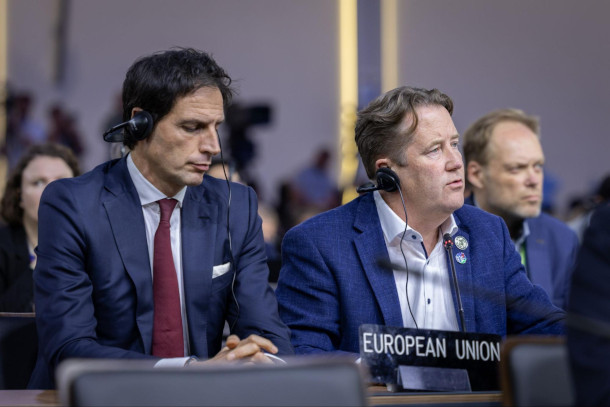
Above, the EU Commissioner for Climate, Wopke Hoekstra (left), and the lead negotiator for the EU, Darragh O'Brien (right). O'Brien declared the EU would not endorse a climate pact that does not mention fossil fuels. (Photo: Kiara Worth, UN Climate Change, Flickr, CC BY-NC-SA 4.0)
PANDELIDIS: Yet there was still hope. Up until the last moment we still didn’t know what would happen. Would there be a walk out? Would they push through? We truly were on the edge of our seats.
DOERING: Wow! Down to the wire… And as we now know, negotiators did not reach consensus on several key issues. And You guys were in the room when these objections started rolling in to be officially recorded in the plenary. What was that like?
BELTRAN: Honestly, it was quite tense. Country after country rejected consensus, starting with the EU, then Panama, the Marshall Islands and you know it became clear that this document was not going to make it through.
PANDELIDIS: And in a very ordered and polite space like the UN, this scene felt very dramatic. Here’s what Ireland's Climate Minister Darragh O'Brien, representing the EU, had to say:
O’BRIEN: We will not endorse a decision that does not respond to the science, that disregards the implementation gap, and that actually risks deepening the chasm between global commitments and the action required to correct the overshoot and bring 1.5 degrees back to within reach. We will not endorse a cover decision or an Antalya pact that does not even mention fossil fuels, which is the key driver of climate change, and we will not accept negotiating backwards in time, and we will not accept a COP that greenwashes fossil fuel.
Panama’s Environment Minister, Juan Carlos Navarro, was a leading voice of opposition to the draft language that omitted reference to a transition away from fossil fuels. Above, Navarro addresses the press in Spanish. (Video: Courtesy of Paloma Beltran Fontes)
CURWOOD: And of course, this summer the climate emergency hit Europe especially hard with deadly heat that killed at least 50,000 people.
BELTRAN: Right Steve, and the stakes of the climate crisis are even more dire for those who live right at sea level like the Marshall Islands.
JETNIL-KIJINER: We were presented with the worst possible response to overshoot, a response to enhance oil and gas, we will not be forced to accept false solutions. We will not compromise our future to benefit fossil fuel interests. We will not accept an outcome that undermines our security and threatens our future. Presidencies, we sincerely appreciate the efforts you have made throughout this process, but we cannot accept this text. To accept this deal would be a betrayal to the Marshallese people. Thank you, Chair. (applause)
BELTRAN: And that was the Marshall Islands lead negotiator, Kathy Jetn̄il-Kijiner.…
DOERING: Ah - the poet and climate activist we’ve had on Living on Earth before! I thought I recognized her voice.
Living on Earth’s Paloma Beltran Fontes says she got the sense from many participants that they would sooner reject a climate treaty than to accept one that doesn’t meet their needs. Above, a COP31 participant reads a text on the final day of the conference. (Photo: Kiara Worth, UN Climate Change, Flickr, CC BY-NC-SA 4.0)
PANDELIDIS: And you know there was a growing number of countries that made their disapproval of the drafts known in the days leading up to the final decision like Panama. Here’s their minister Juan Carlos Navarro, a strong voice of opposition speaking to the press on Friday before the plenary.
NAVARRO: We fully respect the position of every country. However, this is the climate change COP. We are not going to change the name to the Conference of the Petroleum. We're going to keep the climate change COP. Here, we're fixing the climate change crisis, and our position is very clear: to fix it, we need to cap and maintain the current levels of petroleum production. This doesn't even cost them anything, petroleum producers. We're saying, as a first step, stop getting so rich. Let's just keep it as it is. Let's keep the balance. We don't want trauma. We don't want to affect the quality of life of any citizen on Earth.
CURWOOD: So Paloma, Sophia, this breakdown at COP has only happened a couple of other times. So what other reactions did you hear from civil society?
BELTRAN: Well, many people were obviously disappointed that the text did not mention transitioning away from fossil fuels, and that electrification didn’t prioritize renewable energy sources… We talked to Teresa Anderson of Action Aid.
ANDERSON: We all came here assuming that electrification meant that renewable energy would be promoted, and that that would help the phase down of fossil fuels, and indeed that people that lack energy access would be prioritized. But in fact, none of those conditions or elements made it into the electrification target. So, it was more likely to position actors such as data centers and indeed the fossil fuel companies to benefit from that target. When people realized that the target was nothing about the climate, that's when the death knell sounded for this text.
PANDELDIS: The championing of unproven carbon capture and storage technology was another line in the sand for some delegations and activists. Here’s Bill Hare, CEO of Climate Analytics.
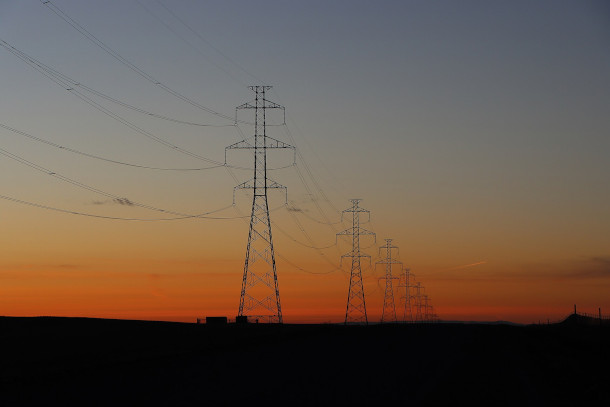
The “35 by 35” goal of increasing the global electrification rate to 35% by 2035 was criticized by Bill Hare of Climate Analytics, who said that implementing the goal without mandating clean power would encourage more gas in the power sector. Above, power lines in Alberta, Canada. (Photo: Kkiefuik, Wikimedia Commons, CC BY 4.0)
HARE: The only thing in the text that relates to fossil fuels is text on carbon capture and storage, which would enable more fossil fuel use. And indeed, if you look at the electrification text, the 35% electrification by 2035 decision, it also allows for more gas in the power sector. So, I would say it's a bit of a win for the fossil fuel industry.
BELTRAN: And to be clear, while there wasn’t an official text adopted, voluntary 35 by 35 pledges on electrification did move forward. And depending on who you talked to, there was a sense that rejection of a bad text was better than acceptance of a weak one. Here’s Savio Carvalho from 350.org.
CARVALHO: You could hear the clapping and the applause in the hall itself. That shows that there is a pretty much pressure around the place that this text, the cover decision, is unacceptable and it cannot go through. And I think that that voice from Panama and more will come as we go along. Is it's not just it's a roaring sound. It's a shout. It's a plea. Stop this. This has to stop. COP 31 leadership has failed. Not COP itself, but the leadership of COP 31 have failed this process and have failed the planet this year.
PANDELIDIS: Some say delegations stood up for what was important rather than giving in. But the EU was accused of using their rejection of the deal to cover up their limited commitment to climate finance. Here’s Teresa Anderson of Action Aid again.
ANDERSON: I personally hope that the EU's terrible language coming into climate negotiations that any deal on climate finance would be dead in the water. I think that that astonishingly bad position, actually really needs to be exposed and needs to lead to a reboot and a questioning of EU's values. Now, EU has in fact been poised as the hero of this COP by being the first to stand up to a weak text on fossil fuels, and that is really doing a lot of good for their reputation. But that crown sits crookedly if they if they continue to be unwilling to help those who are suffering the impacts of the EU’s historical pollution.
BELTRAN: Now the EU countries weren’t the only nations under scrutiny Australia, the UK, and other rich nations were called out as well. And let’s not forget the US has removed itself entirely from the process under President Trump and is pledging NO new money to UN climate funds.
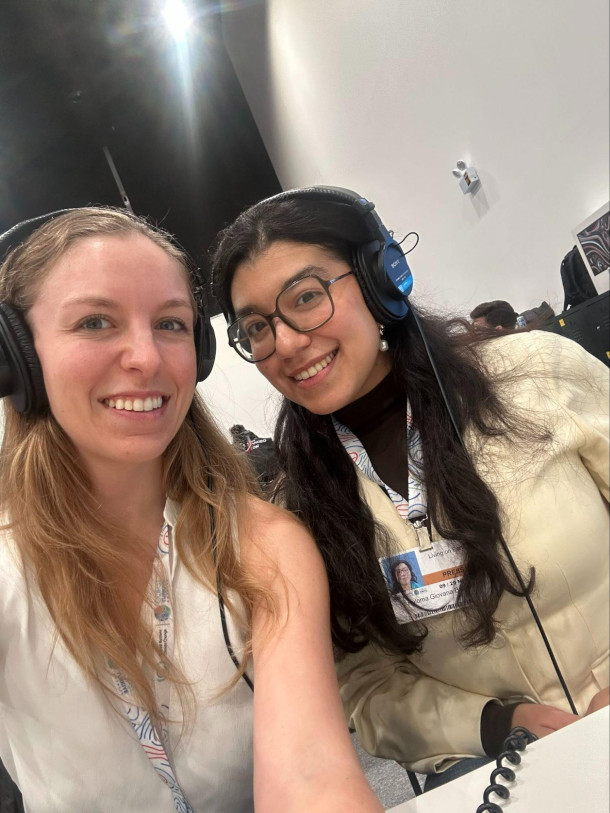
Living on Earth’s Sophia Pandelidis (left) and Paloma Beltran Fontes (right) report from COP31 in Antalya, Türkiye. (Photo: Courtesy of Paloma Beltran Fontes)
CURWOOD: Okay Paloma and Sophia so we know that the central process here did not end in agreement. But, there were some bright spots that Alden shared from the negotiations, what about those?
BELTRAN: Yeah, even though the headline text was not accepted, the process didn’t break down completely. Like we heard from Alden, there were agenda items that were passed. And the star of the show really were those voluntary pledges, on issues like electrification, methane, and decarbonizing industries like steel.
DOERING: And last week, you talked to us, Sophia, about the call for this to be the “Blue COP,” highlighting oceans in the climate conversation. So, just how successful was that agenda?
PANDELIDIS: Well, we did lose binding agreement on oceans with the rest of the official decision. When it was clear consensus could not be reached, Fiji led a bid to pass a standalone resolution on oceans. That didn’t happen. But it should be noted that no countries actively objected to the formal oceans proposals and voluntary pledges still stand.
CURWOOD: Okay, let me ask you both – what did you take away from reporting on COP31?
BELTRAN: Well, it was a whirlwind, honestly a complicated process. But on a more personal level it’s bittersweet, I feel a mix of disappointment and inspiration. And I truly commend the delegations, activists, and civil society who worked hard to address the climate crisis in Antalya, Türkiye.
PANDELIDIS: Yeah, my favorite part was definitely meeting folks from all over the world they are all so passionate about protecting our survival. It’s frustrating, tiring, but it seems people are going to come back and meet in Ethiopia to try again.
DOERING: So, the work continues. Well, thank you both for all of your hard work over these last two and a half weeks, that’s Paloma Beltran Fontes and Sophia Pandelidis.
CURWOOD: Yes, thank you to you both!
BELTRAN: Thanks Steve and Jenni!
PANDELIDIS: Thank you!
Links
UN News | “COP31 Ends Without Climate Pact as UN Chief Warns There Is ‘No Ambiguity in the Science’”
Read Panama's press release following COP31 (Spanish language)
Read the European Union's Joint Declaration on the COP31 Cover Decision
Learn more about Climate Action Network
Living on Earth wants to hear from you!
Living on Earth
62 Calef Highway, Suite 212
Lee, NH 03861
Telephone: 617-287-4121
E-mail: comments@loe.org
Newsletter [Click here]
Donate to Living on Earth!
Living on Earth is an independent media program and relies entirely on contributions from listeners and institutions supporting public service. Please donate now to preserve an independent environmental voice.
NewsletterLiving on Earth offers a weekly delivery of the show's rundown to your mailbox. Sign up for our newsletter today!
 Sailors For The Sea: Be the change you want to sea.
 The Grantham Foundation for the Protection of the Environment: Committed to protecting and improving the health of the global environment.
 Contribute to Living on Earth and receive, as our gift to you, an archival print of one of Mark Seth Lender's extraordinary wildlife photographs. Follow the link to see Mark's current collection of photographs.
 Buy a signed copy of Mark Seth Lender's book Smeagull the Seagull & support Living on Earth
© Copyright World Media Foundation. All Rights Reserved
Home | Contact | RSS | Donate | Newsletter