

Fossil Fuels Impasse at UN Climate Treaty
Air Date: Week of November 27, 2026
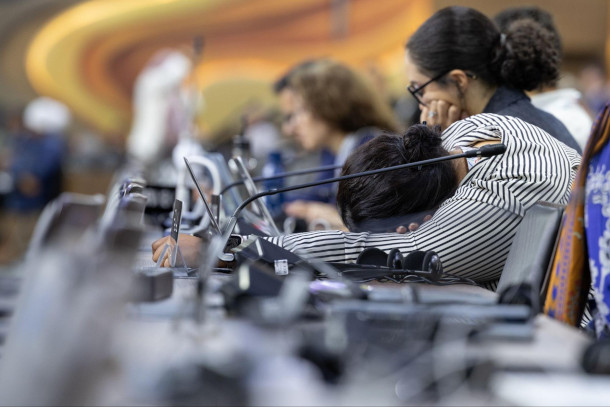
The COP31 talks ran over by two days before ultimately collapsing when negotiators could not finalize language for a climate pact. (Photo: Kiara Worth, UN Climate Change, Flickr, CC BY-NC-SA 4.0)
When petro states rejected transitioning away from fossil fuels at this year’s UN climate treaty negotiations in Türkiye, the European Union, small island nations and allies refused to accept what they said was a dangerous deal. Longtime COP observer and E3G senior associate Alden Meyer joins Host Steve Curwood to analyze the breakdown of the treaty talks, progress that was made on other agenda items, and why the world is much better off thanks to the UN climate treaty, despite the challenges of reaching consensus.
Transcript
DOERING: From PRX and the Jennifer and Ted Stanley Studios at the University of Massachusetts Boston, this is Living on Earth. I’m Jenni Doering.
CURWOOD: And I’m Steve Curwood.
Today we are following up on our report last week on the UN climate treaty’s COP31 in Türkiye with reporting and analysis of the dramatic breakdown of the talks when delegates failed to reach consensus on the critical issue of committing to the transition away from fossil fuels. The COP or conference of the parties’ process has only imploded twice before, first back at COP6 in the year 2000 when the US insisted on getting credit for afforestation in the Adirondacks as an offset for its emissions, and so doomed the full adoption of the Kyoto Protocol.
DOERING: Consensus also failed at COP15 in Copenhagen in 2009 when the US and major economies bypassed the COP's official negotiating channels to craft what some developing countries called a back room deal to avoid binding limits on emissions and minimize help for poor nations. This year Saudi Arabia and Russia, two of the world's biggest hydrocarbon producers, refused to join consensus if it called for the transition away from fossil fuels, though such language was agreed in Dubai three years ago.
CURWOOD: And though COP31 foundered on its most central issue, delegates were able to adopt several decisions, moving forward things like the Just Transition Work Program and a Global Goal on Adaptation. Joining me now is Alden Meyer, a senior associate of the climate think tank E3G, just back from Türkiye. Hi there!
MEYER: Hey Steve, it's great to be with you again.
CURWOOD: Alden, you have been to all but one of these COPs for the last 30 years. How do you feel about the outcome of this one?
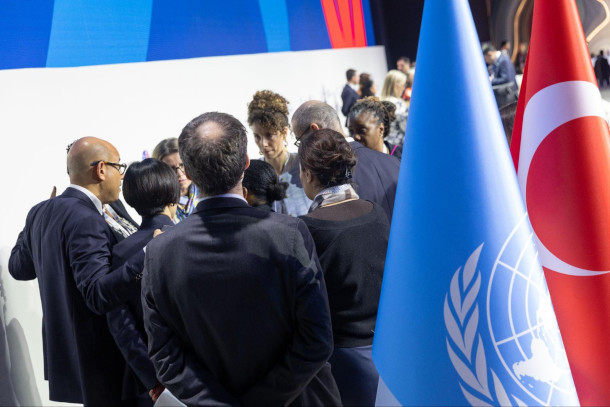
Alden Meyer notes that discussions broke down in part over petrostates refusing to include language on a transition away from fossil fuels in the cover decision text. (Photo: Kiara Worth, UN Climate Change, Flickr, CC BY-NC-SA 4.0)
MEYER: Well, it was obviously a disappointing outcome on the major cover decision that they were trying to negotiate. It's reminiscent a bit of Copenhagen when they could barely get agreement on the Copenhagen Accord. We did make progress on a lot of underlying decisions, and in the real world there were a lot of announcements in the action agenda on electrification, on national transition away from fossil fuel roadmaps, and other things that we can talk about. But on the centerpiece negotiation that Australia and Turkey were trying to drive forward, you have to say it was a failure or a collapse, mainly over the issue of fossil fuels, which has bedeviled us for the whole process. It took 28 COPs before we even got a formal acknowledgement in a COP decision on the need to transition away from fossil fuels, as they are the source of over half of global warming emissions, and clearly some of the countries that agreed to that in Dubai three years ago, Saudis, Russia, other petrostates have had buyer's remorse, and they have been trying to back away from that agreement ever since. And they insisted on scrubbing any reference to the need to address fossil fuels from this cover decision text, and that was too far for the European Union, the UK, the small island countries, and some of the other developing countries that said we're just not going to be held hostage by these big emitters that are trying to block progress.
CURWOOD: So, in your view, what went wrong? What wasn't done right for the conduct of this COP?
MEYER: Well, it's always a hard time when you're trying to get a consensus among 194 countries. But I think some of the fault lies with the Australian-Turkish hybrid presidency for the way they conducted the negotiations. We were hearing that they were meeting frequently with the Saudis, Russia, China, some of the other big players, and were not giving much air time to the small island states, to the vulnerable countries, even at times to the European Union. So it was not the transparent and inclusive negotiation process that they had promised. But let's be honest: the real problem here was the decision by a handful of these major petroleum and and fossil fuel-based economies that they would disrupt the process at any cost if it threatened their business interest. And for whatever reason, the Australians and Turks didn't go ahead and put forward a decision that included the fossil fuel transition language and forced them to try to block it on the floor of the plenary, in the view of the entire world, that was the way I would have suggested they do it. Rather, they continued to water down the text to the liking of the Saudis, the Russians, and others, and they forced the European Union and progressive developing countries to block it in the closing plenary, which is what we saw play out.
CURWOOD: There was very visible audio and video about Africa standing up and saying, "We didn't come here to beg." What went wrong, in your view, with the concerns about finance?
MEYER: Well, I think you have to lay this on the European Union and other developed countries that, really, in my view, didn't come to the COP prepared to negotiate about finance. It's one thing to say we can't put new money on the table right away, but they should have been more forthcoming in the discussions about how they intend to deliver the pledge they made last year on tripling adaptation finance by 2035. They should have come prepared to say more about what they are going to do to deliver the 300 billion a year commitment by 2035 that was made two COPs ago in Baku, and they should have come having diplomatically engaged the small island states, the least developed countries, and others before the COP so they came in with a strategy rather than angering developing countries by saying, as Commissioner Hoekstra did before the COP started, that any idea that we're going to put additional finance on the table is dead in the water, quote unquote. And of course, having seen what we just saw in Nepal, with the glacial collapse and the flooding, that was a very unfortunate phrase for him to use.
CURWOOD: And that's the EU Commissioner you're referring to there.
MEYER: That was the EU Commissioner Hoekstra, and he was the leader of the European delegation there, along with the minister from Ireland, because Ireland holds the rotating presidency of the European Union right now.
CURWOOD: And Alden, please briefly summarize what went right. What do you see are some of the key accomplishments of COP31?
MEYER: On the negotiation side of the house, we did get agreement on extending the just transition work program, which is trying to help countries and communities make a transition away from fossil fuels. We did get agreement on the global goal on adaptation, which is trying to help countries develop national plans to deal with the mounting impacts of climate change. So that's on the negotiation side. On the non-negotiations or coalition of the willing side, we saw over 20 countries indicate that they either were developing or intended to develop their own national plans for transitioning away from fossil fuels. And of course, that's something the Saudis and Russia can't block, since it's a national commitment. We saw over 70 countries endorsing the Turkish pledge to try to increase the share of electricity in energy to 35% by 2035, up from the current 23%, which of course, if it's fueled with clean electricity, would do quite a bit to accelerate emission reductions. We saw some very interesting commitments on methane, on forests, on other sectors, clean industrialization for steel, cement, and other sectors. So a lot of progress, sort of out of the limelight at the COP in moving forward what's called the action agenda.
CURWOOD: And Alden, tell us what happened with methane.
MEYER: Well, methane is a very important front. It's the second largest greenhouse gas, and because it doesn't stay in the atmosphere as long as carbon dioxide, if you can make progress on methane, it can actually help quite a bit in the near term. We already had the global methane pledge going into this COP, with a number of the major countries committing to take action on methane. There was some building on that, both in the oil and gas methane emissions sector and in waste landfills. I had my annual check-in with Al Gore near the beginning of the meeting, and he told me an amazing fact, which is that methane emissions from uncovered landfills globally are six times the emissions in total from data centers around the world. Now, given how much attention data centers and data center emissions are getting, that was an amazing factoid to me. And that's only one part of the methane problem. A much bigger part, obviously, is unchecked fugitive emissions from oil and gas production, and that's something that we need to really crack down on. So, as again, you make incremental progress on these initiatives year by year, as we saw in forests, as we saw in other sectors. But I think methane, there's a growing recognition that there's some real opportunities here to address warming in the short term by making methane emission reductions.
CURWOOD: So, Alden, after 30 years, there's still no worldwide cap on global warming emissions. How up to the job is this UN climate treaty in the face of the growing climate emergency, do you think?
MEYER: Well, it is true that we're not where we need to be. But if we didn't have this process, if we didn't have the Paris Agreement, we would probably be on track for four degrees Celsius or more. Right now the estimates range from two and a half to 2.8 degrees Celsius, depending on whether countries implement all the commitments they made. That's far above the 1.5 degrees that we need to be shooting for, but it's not nothing. We've basically cut the gap in half or more because of Paris. We need to double down and do more. The problem is, of course, this is a voluntary, bottom-up process. As we just saw in Antalya, decisions can be blocked by a small minority of countries that don't agree with the direction of travel. But it's not the process at fault. It's the governments, it's the disinformation campaign by the fossil fuel industry and other factors. We hold up a mirror to ourselves every year at these COPs and say, "How are we doing as a species in dealing with the climate emergency?" And I say, if the image that we see in the mirror is ugly, it doesn't do a heck of a lot of good to blame the mirror. So yes, we do need to make some reforms in the COP process, but the deeper problem is the countries that have no interest in responding to the climate crisis and the fossil fuel industry.
[MUSIC: Çözülmemiş]
DOERING: We’re speaking with Alden Meyer, longtime observer of the UN climate process and senior associate of the climate think tank E3G, and we’ll be back with more after the break. Stay tuned to Living on Earth.
ANNOUNCER: Support for Living on Earth comes from the Waverley Street Foundation, working to cultivate a healing planet with community-led programs for better food, healthy farmlands, and smarter building, energy and businesses.
[CUTAWAY MUSIC: Çözülmemiş]
DOERING: It’s Living on Earth, I’m Jenni Doering
CURWOOD: And I’m Steve Curwood.
Let’s get back to my conversation with longtime UN climate observer Alden Meyer, a senior associate at E3G. Before the break we heard what went wrong at the session in Türkiye known as COP31, which failed to reach consensus on a key document. Petro states like Saudi Arabia and Russia pushed to scrub any reference to transitioning away from fossil fuels, while the European Union, small island states and other low-income countries insisted on preserving that language, which the world already agreed to three years ago in Dubai. The dramatic breakdown of the talks as they ran days into overtime rekindled doubt from some about the entire UN climate process. But Alden as you pointed out, if we didn’t have these COPs the world would probably be on track for four degrees Celsius or more of warming, rather than the 2.6 or so we’re headed for now. So, Alden - what about the overshoot problem? The target of one and a half degrees warming seems to be out of reach, perhaps, now.
MEYER: Yes, it's clear that we now are going to exceed the one and a half degree Celsius Paris temperature limitation goal. The challenge now is to keep that exceedance as short-lived and as shallow as possible. There is analysis that has been done that say if we take the action we need to take, implementing the current commitments and going beyond them, we can limit temperature increases at most to maybe 1.7 or 1.8 degrees, and return to 1.5 degrees by the end of the century. That obviously is not ideal. It means we will see some greater impacts than we should have seen, but it certainly is better than the track we're headed on now for two and a half degrees or more, which would be truly catastrophic, according to the scientists.
From Antalya to Addis Ababa, the journey to #COP32 begins!
At #COP31, #Ethiopia reaffirmed its readiness to host COP32 in 2027. The momentum continues as Addis Ababa prepares to welcome the world for the next chapter of global climate action. https://t.co/Fi0YZNO98V
— COP32 Ethiopia (@cop32ethiopia) November 23, 2026
CURWOOD: So, what's planned next for the UN climate treaty?
MEYER: Well, the next stop on this tour is Addis Ababa next year, the COP32 summit hosted by Ethiopia. They obviously have the burden of salvaging a lot of the things that did not get done at this COP, so climate finance we've discussed, landing the implementation strategy for the adaptation finance tripling goal, creating the new just transition mechanism to help countries, particularly developing countries, access finance for their own national strategies, laying the groundwork for the next global stock take, which happens at COP33. And every five years we do a very deep dive into how well are we doing implementing the Paris Agreement. So that will be the time when we will need to look at what's working well and what's not working well in this process and how we reform it. So a lot will be on Ethiopia, but not just Ethiopia. Next year we have the UK being the presidency of the G20. We're working with them to try to get some progress on finance, on impacts, on climate security issues, and other fronts. And of course, there will be the next meeting of the Santa Marta process, which is the 50 plus countries that came together in Santa Marta, Colombia, in April to talk about ways to move forward on fossil fuel reductions. Ireland and Tuvalu are picking up the lead, and that summit will be next July. So there's a lot of things that will be happening in the run-up to Addis Ababa that help lay the groundwork, hopefully for a much better COP. But we're still going to be dealing with some of the geopolitical headwinds, trade tensions, conflicts in the Middle East, Ukraine, and elsewhere, and of course the absence of the U.S. from any of this process.
CURWOOD: And to be clear, that what's coming up in July in Tuvalu is in the framework of having no fossil fuels anymore.
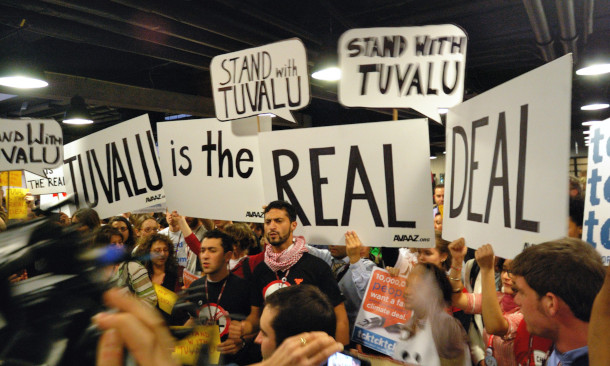
Above, a demonstration in support of Tuvalu at COP15. Tuvalu is one of the nations on the front lines of sea level rise, and will be co-hosting a conference in 2027 as part of an effort to create a fossil fuel non-proliferation treaty, geared to promote the effort to make the transition away from fossil fuels, alongside Ireland. (Photo: Lauri Myllyvirta, Wikimedia Commons, CC BY 2.0)
MEYER: It's basically saying how do we live into the commitment we made by consensus three years ago in Dubai, to transition away from fossil fuels, and it's getting very specific about how do you develop national roadmaps? How do you deal with workers and communities that are reliant on fossil fuel production and make sure that they're dealt with equitably? How do you deal with whole of economy issues? For example, Colombia, which hosted the talks in Santa Marta in April complained that when it indicated it wanted to reduce exports of fossil fuels, the credit markets downrated their debt and their bonds and said, we don't know how you're going to service and repay the money you owe us, so we need to deal with whole of economy issues. So there's a lot of momentum on that front. I think we'll have more than the 57 countries that participated in the process last time. And very interesting, President Lula, when he was in Antalya the week before last, indicated that Brazil had a moral responsibility to continue to provide leadership in this transitioning away from fossil fuels, and indicated that Brazil would be willing to host the next major gathering of these countries in 2028 in Brazil.
CURWOOD: So, Alden, America has played a positive role in this process, such as the Paris Climate Agreement in 2015, when the U.S. hammered that out directly with China. But the U.S. is also linked to the failures of COP6 and COP15 that we talked about before, and this time the U.S. didn't even participate. What should Americans know about our role in climate negotiations, and what should America be doing?
MEYER: Well, let's break this down. As you mentioned, the U.S. was not present in Antalya. This is the second year in a row because President Trump has withdrawn the U.S. from the Paris Agreement, and early next year, withdrawal from the entire framework convention that was negotiated in Rio will take effect. So the U.S. is not present. Of course, they have allies there like the Saudis and Russia who were doing some of the work for them in terms of trying to block progress on fossil fuels. They didn't really need to be there, and most of the negotiators and NGOs I talked to said, with the current stance of the Trump administration, it's probably better that they weren't there. On the other hand, we did have a very robust delegation of governors, mayors, business leaders, and a congressional delegation that came in and gave a very different view of where the U.S. stands and the need for U.S. leadership, and that I think brought some hope to people that maybe there's some change underway that in a couple of years could lead to a different stance of the U.S. And meanwhile, our companies, investors, states, and governors are very engaged in the global network of activists and subnational allies that are driving forward some of these technology deployment strategies in different sectors. So it's sort of two faces of the U.S. The U.S. federal government is AWOL, absent without leave, not at the table, but the U.S. is represented at the subnational level, and that's been very important.
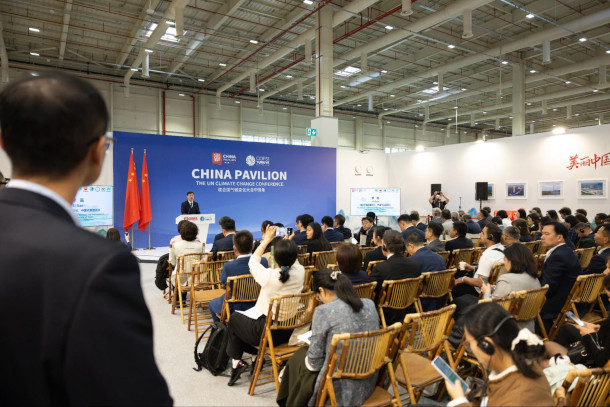
China has to strike a balance when it comes to decarbonization, says Alden Meyer, pointing out the country’s current reliance on coal power as well as their position as a global leader in clean energy technologies. (Photo: Miranda Grant, UNEP, Flickr, CC BY-NC-SA 4.0)
CURWOOD: And by the way, where was China in all of this?
MEYER: China was very active behind the scenes, and actually, just a day or two before the end of the COP, reached an agreement with Australia to commit to the 35 by 2035 electrification target, and we're told they were supporting that behind the scenes. But of course, China is a member of the like-minded developing country group, and so they were aligned with their positions on issues like climate finance and resistance to putting any specific quantified emission reduction goals in the decision. China is kind of complicated because, on the one hand, they are benefiting tremendously from the drive to decarbonize the global economy. They're the leading source of clean emission technologies from batteries, electric vehicles, photovoltaics, wind, etc. But on the other hand, they still have massive investments and reliance on coal domestically as part of their energy strategy, and they don't want to come under any pressure to reduce that. So you always have to watch what China is doing, understanding that just like us, they have complicated politics and interest groups at play back in Beijing.
CURWOOD: If there was one thing you could point to that might lead to a breakthrough, what would it be?
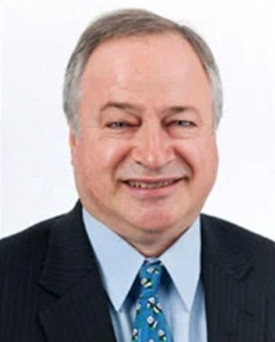
Alden Meyer is a Senior Associate at E3G working on US and international climate policy and politics. He is a Principal at Performance Partners, which provides a range of consulting services to clients in government, business, and the non-profit sector. (Photo: Courtesy of Alden Meyer)
MEYER: I would say, as Rahm Emanuel, former White House chief of staff, liked to say, never let a good crisis go to waste, and I think just like Copenhagen was in 2009, this might be a wake-up call to leaders, to governments that we need to really get our act together and come in with a much more coherent strategy at the next COP. I'm hopeful that can happen. I'm seeing this generate some interest in doing that in countries around the world. That, together with what's continuing to drive forward in the coalitions of the willing that I mentioned on methane, on forests, on energy, clean industrialization, etc., gives me hope. Of of course, you know, there is no way the way the rules are set up now that you can overcome the resistance of a handful of blocker states, and we're just going to have to live with that. But I think we can get a lot done despite that limitation if we build more powerful coalitions between developed and developing countries.
CURWOOD: Alden Meyer, senior associate of the climate think tank E3G. Alden, thanks so much for taking the time with us today.
MEYER: It was good to be with you again.
Links
Inside Climate News | “UN’s COP31 Climate Conference Fizzles Out as Global Policy Divides Deepen”
The United Nations Environment Programme | “UNEP Executive Director Statement on Closing of COP31”
BBC | “What Failure of COP31 Reveals About a Divided World”
International Institute for Sustainable Development | "COP31 Summary Report, 9–21 November 2026"
Living on Earth wants to hear from you!
Living on Earth
62 Calef Highway, Suite 212
Lee, NH 03861
Telephone: 617-287-4121
E-mail: comments@loe.org
Newsletter [Click here]
Donate to Living on Earth!
Living on Earth is an independent media program and relies entirely on contributions from listeners and institutions supporting public service. Please donate now to preserve an independent environmental voice.
NewsletterLiving on Earth offers a weekly delivery of the show's rundown to your mailbox. Sign up for our newsletter today!
 Sailors For The Sea: Be the change you want to sea.
 The Grantham Foundation for the Protection of the Environment: Committed to protecting and improving the health of the global environment.
 Contribute to Living on Earth and receive, as our gift to you, an archival print of one of Mark Seth Lender's extraordinary wildlife photographs. Follow the link to see Mark's current collection of photographs.
 Buy a signed copy of Mark Seth Lender's book Smeagull the Seagull & support Living on Earth
© Copyright World Media Foundation. All Rights Reserved
Home | Contact | RSS | Donate | Newsletter