

Climate and the Changing Congress
Air Date: Week of November 13, 2026
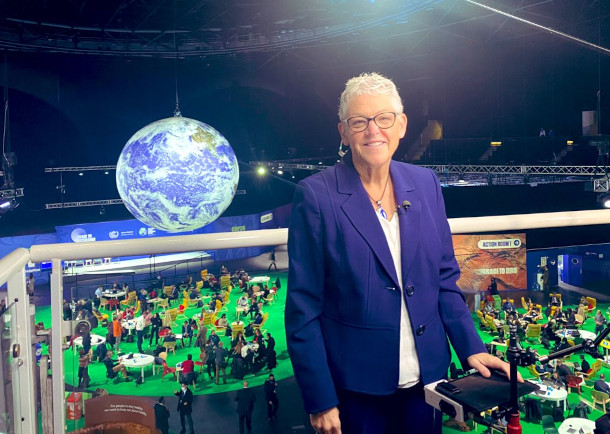
Pictured above is Gina MacCarthy in her role as US National Climate Advisor at COP26 in Glasgow, Scotland in 2021. (Photo: Office of White House Director of Broadcast Media, Wikimedia Commons, Public Domain)
Although climate did not play a direct role in the "blue tsunami" of the midterm elections, voters' concerns over high energy costs bring it back into play. Gina McCarthy, former EPA Administrator and President Biden's national climate advisor, talks with hosts Steve Curwood and Jenni Doering about the opportunities and challenges ahead for climate policy as Democrats prepare to take charge of the US House and Senate.
Transcript
CURWOD: It’s Living on Earth, I’m Steve Curwood.
DOERING: And I’m Jenni Doering.
Following the "blue tsunami" that swept through the US midterm elections, conversations about what a greener future could look like under the incoming Democratic-led Congress are gaining momentum. And although climate did not play a direct role in the election outcome, voters’ concerns over high energy costs bring it back into play.
CURWOOD: Here to talk us through some climate priorities for the Democrats is Gina McCarthy, former Administrator of the U.S. Environmental Protection Agency and President Biden’s national climate advisor. She joined us before traveling to Turkiye for COP31. So, Gina after these election results – do I hear you laughing, do I see you smiling?
MCCARTHY: [LAUGHS] I am smiling ear to ear, in case you're not looking directly at me. You know, I'm really excited. As I think you probably might have guessed that this is a moment of time that I think, at least for me and most of the folks I work with, we're really excited about the way the election turned out. So I couldn't be more thrilled, and it's great to be here with you because I know you know these issues inside and out, and we can have a great discussion about them.
CURWOOD: Yeah, and you know, while not many candidates focused on climate, what do you see as the prospects for dealing with the climate emergency now with this tectonic shift on Capitol Hill?
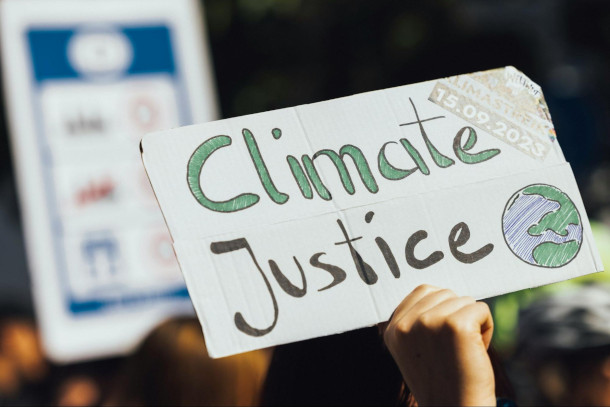
Above, a protester holds a sign calling for "climate justice" during a global climate strike in 2023. According to a 2024 report from the CDC, 11.9 million Americans—disproportionately people of color—live with exposure to unhealthy air pollution levels. (Photo: Markus Spiske, Unsplash, Unsplash License)
MCCARTHY: You know, I think that what you saw was a pretty wise move on the part of the folks that were running in this campaign to realize that people were hurting by high diesel costs, rising power bills, and all of the work that Trump was doing to try to, it seemed to me at least, make our lives more miserable. And I think instead of worrying about climate, we made it a human issue. You know, we wanted to talk about the challenges we were facing and what we needed to do from this point forward, but we had to give it a face. We had to make people see that there were challenges that we were all facing, but we had to face them together, and I think that's what really led to this shift, is you know, you saw all the young people, you know that were campaigning and out on the stump. I mean, I'm 72. I wouldn't look good to them for 50 years from now. Do you know what I mean? It's just so fun to see young people who are taking over our states and local level communities and and really doing the work that they know they had to do. So to me, it was really groundbreaking for me, frankly. I was in seventh heaven and continue to be till now, because it's the first time I can remember when we've had this big a shift in how people are thinking about our country and the challenges that we have, and and how we work together to tackle those challenges. And you know, these young folks seem pretty well prepared to take on the future, and I'm with them all the way.
DOERING: Now, so what are you hoping to see in this next Congress when it comes to anything that relates to climate, energy, environment? What are you hoping to see?
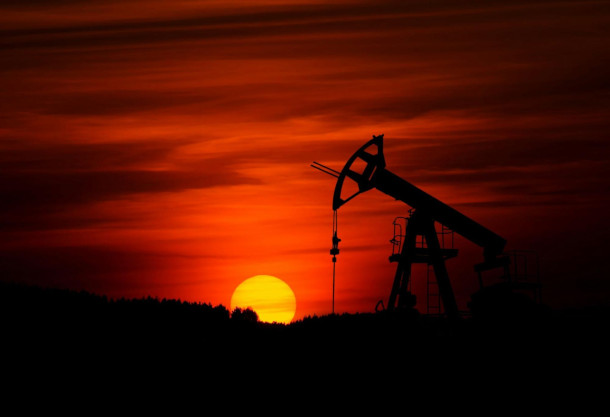
The United States is the largest oil producer in the world, which influences both its national and foreign policy. (Photo: Zbynek Burival, Unsplash, Unsplash License)
MCCARTHY: Well, I think we're going to, you know, obviously have challenges because we still have a Trump administration. And the Trump administration is, I think we all know, they're climate denialists, and I think we have to recognize that he is going to do everything he can to advantage fossil fuels and disadvantage our ability to move forward with clean energy. The only challenge I think he's really going to face is that we're already moving towards clean energy. He may be missing that fact, but you know when you have an energy supply now that can save people's money, that can clean up our air, that can help keep our water safe. This is what the American people want to hear about. They want to know what we can do together, you know. And despite all the craziness during this administration, I think we've still been able to make because of state and local governments and communities that are stepping up, they realize that this is our opportunity to not just clean up our act, but to do it in a way that puts people's money in their pockets again, that makes them recognize the benefits of clean energy that are extraordinary, and it's also an opportunity, I think, right now to look at how the broader communities across the U.S. can get together and to talk across aisles instead of against one another. And what I see from the young people who were elected, we are going to have a real opportunity to get away from the screaming and yelling, and back to what it means to really serve people in our communities. That's what I always wanted to do, and I've tried to do. And I think we all have to figure out how to get this nastiness out of the situation and start taking advantage of it for our kids.
CURWOOD: So we have another two years of President Trump, though, with a new Congress. But the Democrats are in control of this incoming Congress. What could this mean for the future of things like EV tax credits or other clean energy subsidies, the clean energy tax credits that you worked so hard on in the Biden administration? What could it mean in terms of trying to bring those back? Well, in the face of a continued Trump administration.
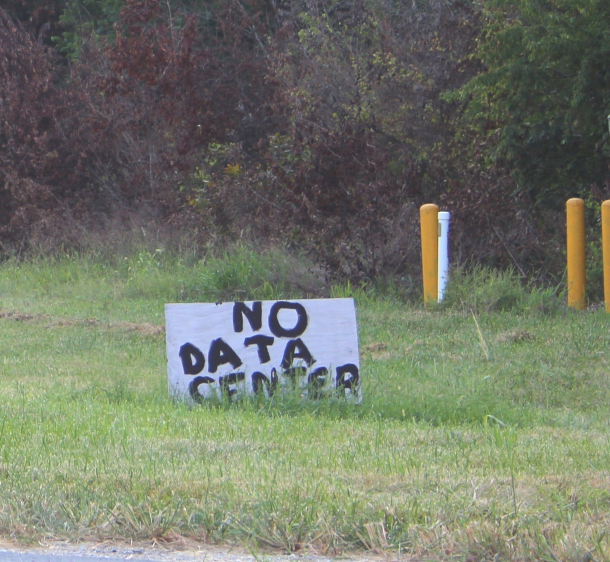
A handwritten sign on the side of Illinois’ Route 4, opposing plans to open a data center in nearby Talkington Township. During the 2026 midterm elections, there were 41 data center-related ballot measures across 10 states and most voters backed restrictions. (Photo: Visviva, Wikimedia Commons, CC BY-SA 4.0)
MCCARTHY: Well, you know, one of the things that at least I think I try to do because I've been in and out of the administrations for a while, and you know, I try not to do what I used to do. I try not to just revisit what we did before and put them in place. Today is a different era. Young people really want to have a voice in these decisions, not just wait around to hear what Congress says, what states are doing. And I think it's just really important for us to recognize that. And I think the good thing that we're seeing is that the opportunities right now to advance clean energy are really quite striking, and I think young people know that. They want to have a future that's clean, they want to have a future they can be proud of, and so for me, I'm going to spend a lot of my time talking about these issues as well as others that are more challenging, like the ongoing data centers that we're seeing. You know, there continue to be, thankfully, something new, right?
CURWOOD: Mm-hmm.
MCCARTHY: I mean, we never talked about data centers before. You know, this is amazing to me, and this is because you know young people are fully engaged. They saw what the Trump administration was doing to try to really take our country away from us, and instead they're giving us that opportunity now to jump on board. And I just think it's a moment in time for all of us.
DOERING: And to what extent might some of this offer bipartisan opportunities?

High gas prices played a major role in 2026 U.S. midterm elections. (Photo: engin akyurt, Unsplash, Unsplash License)
MCCARTHY: I sort of hinted at that. I absolutely believe that bipartisanship is essential. It has never been like it is today, where we don't even talk to each other, where we have Republicans over there and Democrats over there. That's not how it used to be, and I hate to sound as old as I actually am, but I remember the days when we used to negotiate. I remember those opportunities, and frankly, it's about time to revisit those opportunities. We can't just stand in our own little corners and spout about what we want or don't want. That's not how the United States developed. That's not what got us where we are now. So I think one of the huge values of looking at, not just I know that the Democratic wave was a large one, but I don't believe that that wave is going to be designed to actually take out the voices of others. We have to make sure that just because we won a big victory, that that victory shouldn't be shared by others like the Republicans who want to do the right thing, who want to build and have kids that grow up to have healthy lives. There's a human effort here that I think we have to keep reminding ourselves of, which isn't where I grew up, but it's how I'm living. It's about how my kids are going to live, and how we can get away from the incredible partisanship that has divided us, and and it's been going on for a while, a whole lot longer than I think any of us would have liked to have seen. So I'm hoping, and in the meantime, you know, we still have Trump, a president who is supposedly a leader, but is clearly leading us to hell in a handbasket, if I can quote my mother.
CURWOOD: [LAUGHS] And here's the thing: the Trump administration brought a wrecking ball to so many environmental initiatives and opportunities. So, to what extent does this incoming Democratic majority have to do to clean up the mess that's been left behind? I mean, thinking you know the agency that you ran, the EPA, and the administrator Lee Zeldin there implemented a bunch and rather dramatic set of rollbacks of environmental policies and regulations. What should be done with that at this point?
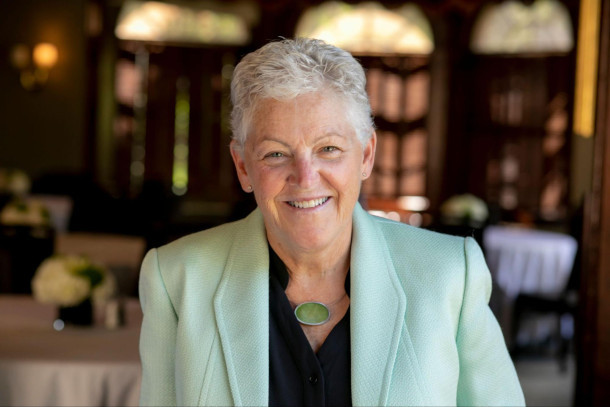
Gina McCarthy was the Administrator for the Environmental Protection Agency from 2013-2017 and the first White House National Climate Advisor from 2021-2022. She is now the Managing Co-Chair of America Is All In. (Photo: Harvard University)
MCCARTHY: Yeah, I'm pretty well aware of all those, [LAUGHS] as you might guess. But you know, honestly, one of the challenges that we still face, obviously, is we still have a Trump administration, and we still have a Lee Zeldin, and you know, we have opportunities, I think, to take action, but we're hemmed in a lot by Trump's veto authority, his veto pen. So Democratic leaders really have to step up and use oversight power, pounce on hot button issues like the data centers, so that we can bring people back to a reality that they can work with or deal with. The trick I think is going to be that we don't just sit up on our high horse, but we also go to folks in the Republican administration whom many of us have worked with before in a collaborative way, and start building those bridges again.
DOERING: So, Gina, what are the stakes here when it comes to environmental justice and public health? I mean, we've seen in the last few years how this current administration has taken away platforms such as EJ Screen that help us identify communities that are vulnerable to pollution. What are your thoughts there in terms of environmental justice and public health, and the stakes?
MCCARTHY: The stakes remain very high. You know, they always have remained high, because we have had in our country so many communities and individuals that have faced environmental risks for like longer than any of us would ever have thought possible, really. So I mean, I spent much of my time at EPA for about eight years there, and I feel like we still didn't make the kind of change we had to make. You keep struggling and doing things, but there's always a river of money and resources in the system that tend to keep pulling you back, questioning whether or not you should be doing what you're doing, or whether or not you're spending money that you shouldn't. And so, for me, the issue of environmental justice is, I think, one that has been far too long, not addressed in an effective way, and I think that's one of the key issues that we really have to make sure become front and center. Look, you can see it in the communities that are stepping forward.
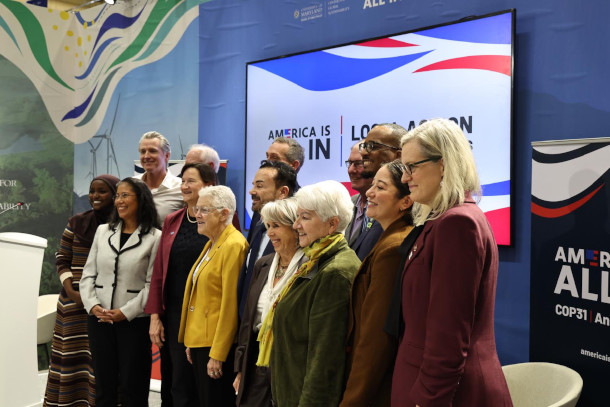
Gina McCarthy (shown center, in yellow) at the America Is All In pavilion during COP31 in Antalya, Turkiye. Other attendees who attended include (back to front, left to right) California Governor Gavin Newsom, Minnesota Governor Tim Walz, Mayor Michael Cahill of Beverly, Massachusetts, Mayor Joe Ganim of Bridgeport, Connecticut, Mayor Aaron Brockett of Boulder, Colorado, Mayor Roderick D. Hampton of Haynesville, Louisiana, Mayor Nadia Mohamed of St. Louis Park, Minnesota, Mayor Martha Guerrero of West Sacramento, California, Mayor Vicki Veenker of Palo Alto, California, New Mexico Governor Michelle Lujan Grisham, and Mayor Janet Cowell of Raleigh, North Carolina. (Photo: Courtesy of Liz Purchia)
If you look at who voted and who voted Democratic, you will see that the environmental justice community stood up for us. When are we going to stand up for them? When are we going to stand up for them? That's what we need to do. And I think it's very difficult because I know we deal with communities that are very much in need, but I also know that there are communities of considerable wealth. We have to find a way to make sure that we're doing our jobs here in the United States in giving people who don't have enough food to eat, who don't have a healthy place to live. Those people need to be served, and they need to be first in line, not last.
DOERING: Gina McCarthy is the former administrator of the U.S. Environmental Protection Agency, who served as the first White House National Climate Advisor. Thank you so much, Gina.
MCCARTHY: My pleasure. Thanks so much for having me.
Links
Living on Earth wants to hear from you!
Living on Earth
62 Calef Highway, Suite 212
Lee, NH 03861
Telephone: 617-287-4121
E-mail: comments@loe.org
Newsletter [Click here]
Donate to Living on Earth!
Living on Earth is an independent media program and relies entirely on contributions from listeners and institutions supporting public service. Please donate now to preserve an independent environmental voice.
NewsletterLiving on Earth offers a weekly delivery of the show's rundown to your mailbox. Sign up for our newsletter today!
 Sailors For The Sea: Be the change you want to sea.
 The Grantham Foundation for the Protection of the Environment: Committed to protecting and improving the health of the global environment.
 Contribute to Living on Earth and receive, as our gift to you, an archival print of one of Mark Seth Lender's extraordinary wildlife photographs. Follow the link to see Mark's current collection of photographs.
 Buy a signed copy of Mark Seth Lender's book Smeagull the Seagull & support Living on Earth
© Copyright World Media Foundation. All Rights Reserved
Home | Contact | RSS | Donate | Newsletter