

COP31 Kicks Off
Air Date: Week of November 13, 2026
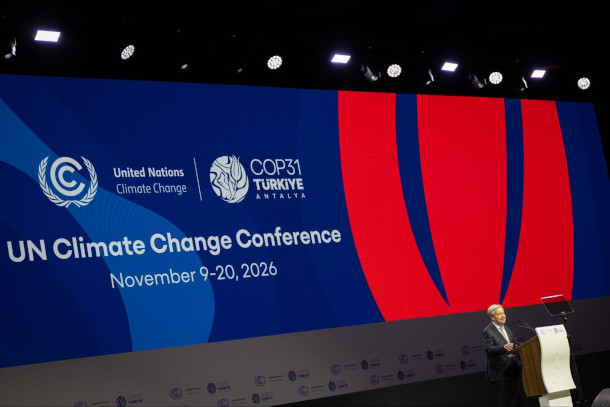
United Nations Secretary-General Antonio Guterres speaks at the opening of the high-level segment of COP31 on November 11, 2026. (Photo: Kiara Worth, UN Climate Change, Flickr, CC BY-NC-SA 4.0)
The annual negotiations of the UN climate treaty or COP31 are now in full swing in the coastal city of Antalya, Turkiye, with some one hundred thousand attendees. Assisted by field producer Sophia Pandelidis, Living on Earth producer Paloma Beltran is there. She joins hosts Steve Curwood and Jenni Doering to share some of the voices they have gathered from around the world: from Australia to Vanuatu to Inuit territory and beyond.
Transcript
CURWOOD: From PRX and the Jennifer and Ted Stanley studios at the University of Massachusetts Boston, this is Living on Earth. I’m Steve Curwood
DOERING: And I’m Jenni Doering.
The annual negotiations of the UN climate treaty are now in full swing in the coastal city of Antalya, Turkiye. And picking up from last year’s session in Brazil, delegates from over 180 countries are at this 31st conference of parties, or COP 31 for short.
CURWOOD: And on the ground there Living on Earth Producer Paloma Beltran assisted by Field Producer Sophia Pandelidis. So, Paloma, we hear there are around a hundred thousand people there. What have you seen?
BELTRAN: Yeah, it’s pretty crazy! And it really kicked into gear on November 11, when world leaders spoke. One of those leaders was Brazil's president Luiz Inácio Lula da Silva who was just reelected after much tension. And as he passed the torch for the COP to the joint presidents of Türkiye and Australia, Lula pulled no punches with his call to action.
LULA [SPEAKING THROUGH TRANSLATOR]: Friends, Brazil went to the ballot box two weeks ago, in an unprecedented mobilization, the Brazilian people took to held the arms of democracy. We contested those who denied the evidence of science that threaten the survival of the biggest tropical forest, the biggest biodiversity, and the biggest fresh water reserve in the world. This was not the triumph of a political party or a candidate, but it was the choice of a project of nations that has sustainability as its pillar. The fight against climate change goes beyond diplomatic halls. It is waged by the vote of each woman, of each man who wishes to make a difference. May the leaders gathered here rise to the expectation of everyone throughout the world who aspire to a just and sustainable future. Brazil is back to defend the continuity of a healthy planet. Good luck to us all.
CURWOOD: “Brazil is back” – with the help from a translator of course. Paloma, what about China?
BELTRAN: Yes, although Xi Jinping did not come to COP he did send his Vice President Han Zheng, who in his remarks pointed to the goal China set this year for non-fossil fuel energy sources to provide 50% of power generation by 2030.
DOERING: Yeah, that’s huge. They are the world’s current largest emitter.
BELTRAN: Yeah, and although COP31 is focused on the climate, it can’t be disentangled from geopolitics. Israel was not invited, and the Trump Administration has withdrawn the US from the UNFCCC process altogether. While Russia and Ukraine sent representatives, neither was on the schedule to speak at the high-level session. But Lebanon was. And Steve and Jenni, I should point out that there are keffiyeh scarves everywhere as a sign of solidarity with Palestinians. The most pointed connection to climate and conflict was made by Masoud Pezeshkian, the president of Iran.
PEZESHKIAN [SPEAKING THROUGH TRANSLATOR]: Today one cannot speak of the future of the planet without speaking of the wars that target soil, water, air, natural resources, and human lives. The environment is the silent victim of wars whose destructive effects will remain for generations after the conflicts have ended. The recent unlawful and murderous aggression by the United States of America and the Zionist regime of Israel against the Islamic Republic of Iran, in addition to its immense human and economic dimension, has caused serious damage to the environment, including by releasing massive volumes of pollutants and greenhouse gasses into the environment, hence endangering public health.
DOERING: Calling for peace for the planet. So, it sounds like much of the rest of the world is moving ahead with tackling the climate crisis. But of course, as you know, ever since the Trump administration entered the picture, the US has been in various phases of being in and out of the 2015 Paris Agreement and of course, is now out of the entire UNFCCC treaty. So they are no longer in the formal negotiating rooms. Paloma, what does the US presence look and feel like at this year’s COP?
BELTRAN: I mean, there are a few pavilions, like the “America is All In” pavilion, and the Oceans Pavillion from Woods Hole Oceanographic Institution. So, some people from the US are participating outside of the official talks. And some well-known US figures have made appearances and hosted panels, like former Secretary of State John Kerry, former EPA administrator Gina McCarthy, governors, mayors and over a dozen members of Congress including Senator Sheldon Whitehouse, a Democrat from Rhode Island.
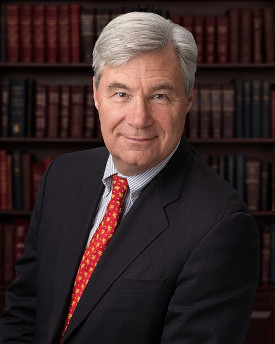
Senator Sheldon Whitehouse (D-RI) has served in Congress since 2007. (Photo: Office of Senator Sheldon Whitehouse)
BELTRAN: What's your message for Americans who are frustrated about the current political governance and are very concerned about the climate crisis?
WHITEHOUSE: Well, I think the first thing to say is thank you, because you just delivered an enormous change in governance in the United States, and we take that very, very seriously. And the second is that as climate change comes home to roost in so many people's family budgets, that has our full attention. And you will see that in the new Congress, real attention is paid to supporting clean energy and reducing climate dangers, and that will be good both on the public concerns about the cost of living and the public concerns about the corruption of government.
BELTRAN: Thank you very much, Senator.
CURWOOD: But you know, Senator Whitehouse and the other US officials there have no say in the negotiations, and they were essentially like the hundred thousand or so other people at COP without diplomatic credentials and simply there as citizens of the world. What do the folks from civil society tell you?
BELTRAN: Yeah, there’s a lot of people here. It’s quite overwhelming to say the least. I actually take the tram line to get to the event every morning and it’s been absolutely packed.
[ SFX TRAM ]
But I did get the chance to talk to some excited COP31 participants. Like Augustín Ocaña, who’s originally from Ecuador and founded the Global Youth Coalition.
OCAÑA: I guess it brings me here, the hope that I have for everyone in the world to have a future, including the youngsters, but also the people older than us, because we all deserve to have a planet where we can actually like coexist, and that sense of hope – Whoa, we almost fall down! That sense of hope keep me bringing to COP. This is my fourth COP actually, and yeah, that's why I'm here.
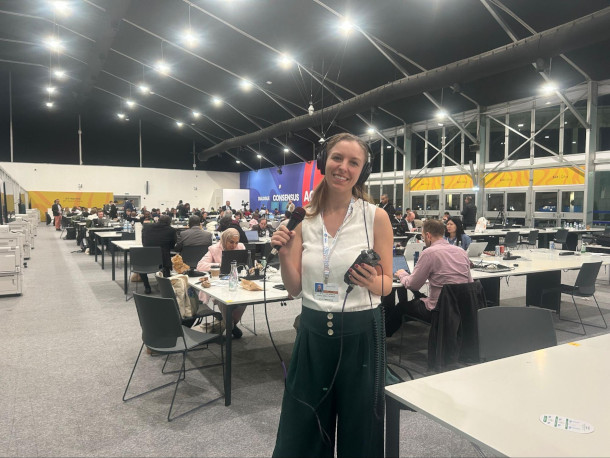
Living on Earth’s Sophia Pandelidis in COP31’s media room. (Photo: Courtesy of Sophia Pandeledis)
BELTRAN: We’re very packed here in the train. [LAUGHS] We’re all pushing each other, it’s an experience.
OCAÑA: It’s the COP31 experience. Every COP has its own details.
YOLI: Is it always busy like this?
OCAÑA: Yeah…
YOLI: It’s my first COP ever, I’m so excited!
BELTRAN: That’s Yoli. She had this huge smile despite the overpacked tram and jet lag from a five hour difference with Singapore. She’s a researcher at the Tropical Marine Science Institute and was invited to COP by Augustín’s org.
DOERING: Right and speaking of marine science, we hear that this COP is actually meant to be a "Blue" COP, meaning there’s a push to focus on oceans. So, how do people there feel about that aspect?
BELTRAN: Yeah, so there’s a lot of people including Yoli who are here because of the push for ocean research.
YOLI: Basically, I came here because I'm a marine ecologist, and this is the first Blue COP ever. And next week they actually have an ocean day. And as marine ecologists, I feel like people don't realize the ability of ocean, of seagrass in absorbing carbon, and they also don't realize how vulnerable the marine ecosystem is under climate change. Like, if we actually exceed the 1.5 degree threshold, we're gonna lose, more than 90% of all the corals. So I'm here to see what kind of actions will be taken on marine this year.
BELTRAN: And on that packed tram I also met some fellow journalists like Mohammad Musad from SATV. He’s covered stories across Bangladesh, Pakistan and Nepal.
MUSAD: Different reports suggest that Pakistan is ground zero when it comes to climate change, and it's one of the worst hit countries. All of South Asia, for that matter, India, Pakistan, Bangladesh, Sri Lanka, even countries like Nepal and Bhutan. You must have seen the news regarding Nepal a few weeks ago, so we're having droughts, we're having cloud bursts, we're having extended periods of rain. So every major problem with climate change, we're experiencing that in our countries.
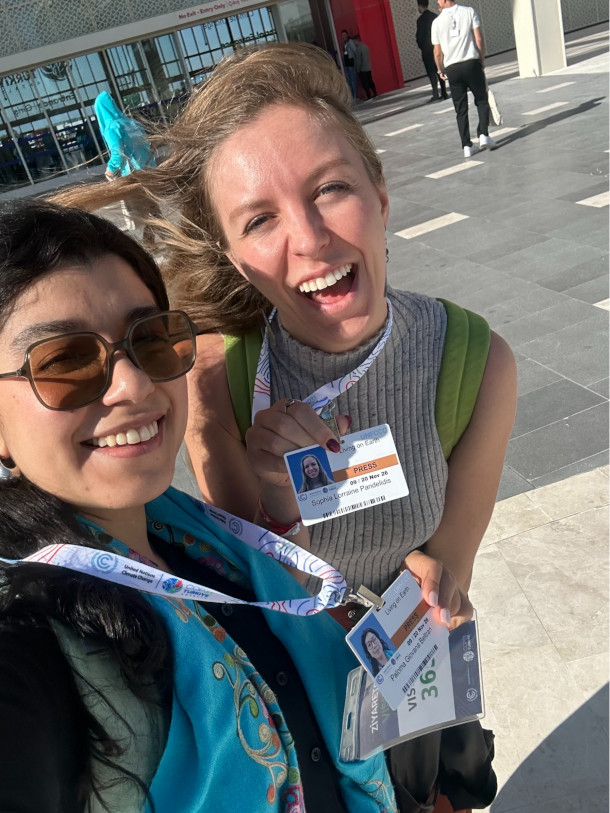
Living on Earth’s Paloma Beltran (left) and Sophia Pandelidis (right) are reporting from COP31 in Antalya, Turkiye. (Photo: Courtesy of Sophia Pandelidis)
CURWOOD: Paloma, you know, these meetings have been going on for a long time. I was there all the way back in 1997 at COP3 in Kyoto, Japan, and we’ve been reporting on this ever since. And while I guess you can say there’s been consistency, some people feel that time is running out. Others say huge changes can take a lot of time. So, to what extent is there frustration and to what extent is there hope?
BELTRAN: Yeah Steve, you’ve been there from the beginning and I imagine you’ve heard about the frustration that can build up at these negotiations. There are those who no longer believe in the climate talks because you're right, the Paris Agreement was established back in 2015 with the goal to limit greenhouse gas warming below 2 degrees Celsius by the end of the century. But the UN says we’re currently on track for 2.8 degrees. This an existential crisis, so some people are still committed to making it work. For example, Charles Karangwa is from Rwanda. He was dressed quite nicely, you know, sharp suit and briefcase. And he’s the director of International Forest Governance Center. He’s based in the UK.
KARANGWA: Yeah, I think every decision, every action, every change we see comes from how we govern and make decisions. If the governance system is corrupt, the whole entire system is corrupt. If the governance system is inclusive, transparent, accountable, we see more action going forward. We see more benefiting people. We see more action that is inclusive, and I believe in the climate conversation, it is not about the Global South or the Global North. It's about all of us together working towards a common goal.
CURWOOD: So Paloma, I take it this was just the first hour on that tram. And you have, what, another two weeks at this conference?
BELTRAN: Yeah, it was really just the beginning of some of these conversations we got to have, which is really exciting. And it was still chaotic once we got into the venue, but my producer, Sophia Pandelidis, and I managed to pull a few people aside. Like Rikki Dank, whose traditional name is Lludibpina, a Gudanji person from the Northern territory of Australia. She was wearing some white face paint for the occasion. In her women-led Marabana Country, she’s what’s called a traditional owner, which means she makes decisions for the community. And she told us how the setting of COP, you know this huge convention, can feel strange.
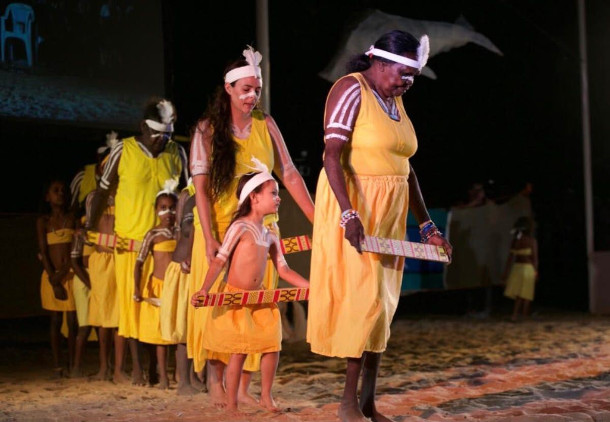
Rikki Dank (center) with her daughter and grandmother in front of her. (Photo: Rikki Dank)
DANK: COP's an interesting place because it's far away from what we're actually fighting for, you know. It's really surreal to be in a room, and it feels very, like fake and made up and plastic, and then to see the suits, and that's it, it's corporate! It's so corporate. And then when you're here and you're an Indigenous person and you're fighting for your country, you're fighting for, not only your country, your family, your culture. And for us, it's 65,000 years of culture, continuous culture. It seems really far and really far away from what we are actually fighting for, and we, I think, collectively forget that.
DOERING: Paloma, she sounds a bit skeptical, eh?
BELTRAN: Well, I think the disconnect is somewhat jarring for her. But she did say she still thinks coming to COP is in part valuable.
DANK: I see COP as a way to voice our concerns as women and as, you know, women who make decisions for their country in a patriarchal society. So you know, I'm here because my grandmother can't be here. I'm here to represent my family, who otherwise, you know, we would not have a voice.
CURWOOD: Paloma, did you hear from anyone else in that region? I mean, from my understanding the Pacific is in pretty dire straits in terms of the climate crisis.
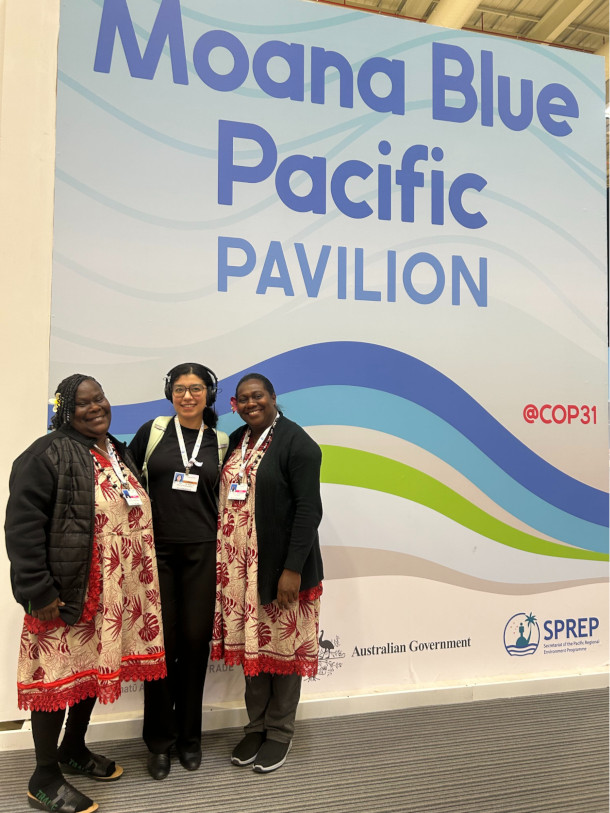
From left to right: Nancy Naupa, Living on Earth’s Paloma Beltran, and Janet Iatiknu. Both Nancy Naupa and Janet Iatiknu are part of the Women I Tok Tok Tugeta (WITTT) network on the island of Tanna in Vanuatu, and they work closely with ActionAid Vanuatu to advance women-led disaster preparedness, climate resilience, and disability inclusion. (Photo: Courtesy of Paloma Beltran)
BELTRAN: Yeah, I also talked to a group of women from Vanuatu at the Moana Blue Pacific Pavillion who were all wearing the same dress stamped with tropical plants and they all had a beautiful flower behind their ear. They had just been part of a presentation on women leading climate resilience on climate and innovation. Nancy Naupa is a community organizer in Vanuatu.
NAUPA: At the moment, there is a lot of climate change changing our weather pattern, sea level rise, and it’s also costing our livelihoods. I want this outcome of this COP 31, that our leaders will understand our issues and will respond immediately because we are facing it, and if they respond, this outcome of the COP meeting, respond positively, we understand that our children will be safe in the future that is coming.
BELTRAN: There are folks here from the South Pacific, and all the way to the far north, like Adamie Delisle-Alaku, a leader from northern Canada.
ALAKU: Well, for us as Indigenous Inuit, we feel we need to be heard and to ensure that our realities are at the forefront and not being spoken about by other third party, or people that do not know our realities. So it's very important that they hear it firsthand from Indigenous people that are truly living in the north and that are seeing the real impacts on climate, from long storms to erratic weather patterns to freezing rain in the dead of winter, to hail to very strong winds for several weeks on end. So, these experiences and these stories matter because they need to be heard from the people that are living them on a day-to-day basis.
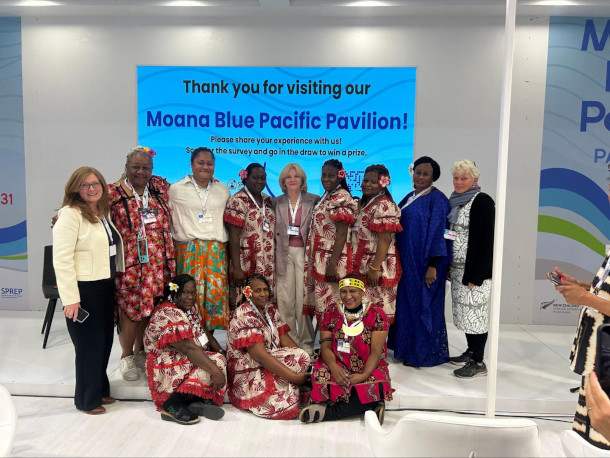
COP31 attendees pose for a photo in front of the Moana Blue Pacific Pavilion, which is hosting events with a particular focus on Pacific Island nations. (Photo: Courtesy of Paloma Beltran)
CURWOOD: Indeed, so the most ancient way we communicate is still the most vital. Thanks Paloma Beltran, to you and Sophia Pandelidis for bringing us those stories, and looking forward to what you find next there in Turkiye!
BELTRAN: Thanks, Steve, thanks Jenni!
Links
Reuters | "Iran Tells COP31 It Wants Compensation for Environmental Damage From US-Israeli Strikes"
More on ActionAid Vanuatu and the Women I Tok Tok Tugeta (WITTT) Network
Living on Earth wants to hear from you!
Living on Earth
62 Calef Highway, Suite 212
Lee, NH 03861
Telephone: 617-287-4121
E-mail: comments@loe.org
Newsletter [Click here]
Donate to Living on Earth!
Living on Earth is an independent media program and relies entirely on contributions from listeners and institutions supporting public service. Please donate now to preserve an independent environmental voice.
NewsletterLiving on Earth offers a weekly delivery of the show's rundown to your mailbox. Sign up for our newsletter today!
 Sailors For The Sea: Be the change you want to sea.
 The Grantham Foundation for the Protection of the Environment: Committed to protecting and improving the health of the global environment.
 Contribute to Living on Earth and receive, as our gift to you, an archival print of one of Mark Seth Lender's extraordinary wildlife photographs. Follow the link to see Mark's current collection of photographs.
 Buy a signed copy of Mark Seth Lender's book Smeagull the Seagull & support Living on Earth
© Copyright World Media Foundation. All Rights Reserved
Home | Contact | RSS | Donate | Newsletter