

Public Lands Protection in the New Congress
Air Date: Week of November 6, 2026
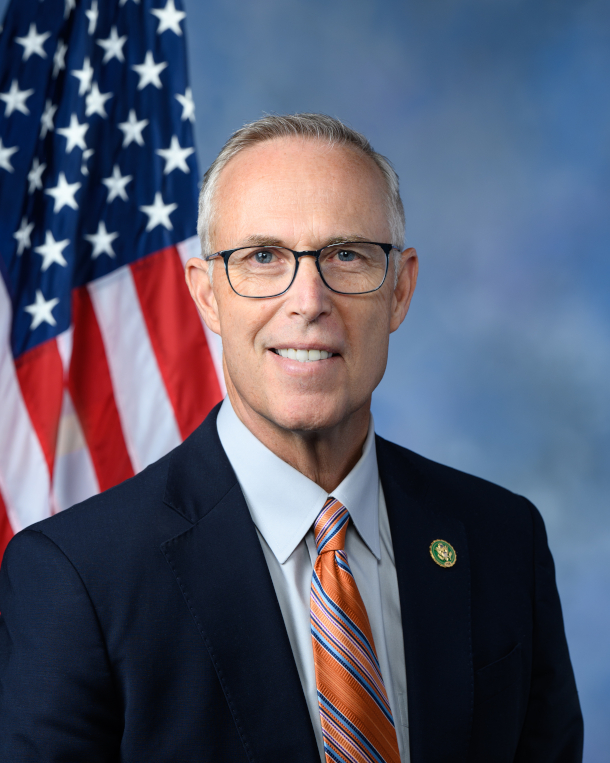
US Congressman Jared Huffman (D-CA). (Photo: United States Congress, Wikimedia Commons, Public Domain)
Congressional committees originate legislation and oversight investigations, and as Democrats take control their senior members will presumably become chairs with broad subpoena powers. Congressman Jared Huffman, who has represented northern California since 2013 is an environmental lawyer and in line to chair the House Natural Resources Committee. He joins Hosts Steve Curwood and Jenni Doering to share his priorities for the committee in the new Congress.
Transcript
CURWOOD: It’s Living on Earth, I’m Steve Curwood.
DOERING: And I’m Jenni Doering.
Congressional committees originate legislation and oversight investigations, and under the seniority system, as Democrats take control, their senior members will presumably become chairs, and many house chairs have broad subpoena powers.
CURWOOD: Jared Huffman, who has represented northern California since 2013 is an environmental lawyer who is in line to chair the House Natural Resources Committee. He’s on the line now – Congressman, welcome to Living on Earth!
HUFFMAN: Well, thanks. It's great to be with you.
CURWOOD: So, Representative Huffman, what can we expect to be a top priority from you and your committee when it comes to energy, say?
HUFFMAN: On all of the subjects before our committee, within our jurisdiction, it's going to be a two-part agenda. We're going to have to do oversight and investigations to make up for the fact that we haven't really had a Congress for the last two years. There haven't been checks and balances. So we will be digging into and investigating so many different things on energy and, and other subjects that we oversee. But then we've got to move an affirmative policy agenda as well. And we can't, in my opinion, constrain ourselves to just what Donald Trump might sign into law. I think we've got to advance an agenda that reflects our values and our priorities, even if we draw some vetoes from this president. There's enormous value in drawing that contrast.
DOERING: And Congressman, just how important do you think energy and access to affordable energy was in these midterm elections?
HUFFMAN: It was part of the affordability backlash that I think helped shape this blue wave for sure. The fact that electricity bills, utility bills have been skyrocketing as Donald Trump pays offshore wind developers to walk away from projects that could bring cheap, reliable, clean energy onto the grid, as he does everything he can to strangle clean energy, which is the cheapest, fastest form of energy that can help lower utility bills. I think people connected those dots, and they also, I think, put together the connection with the corruption, with just the fact that the fossil fuel industry was so programmed with Donald Trump on all of this and was making money hand over fist, war profiteering, and Donald Trump in his closing argument boasted, in his words, "We are making a killing on the war in Iran" while people were struggling to afford fuel, so I mean, all of that I think helped shape the election in a big way.
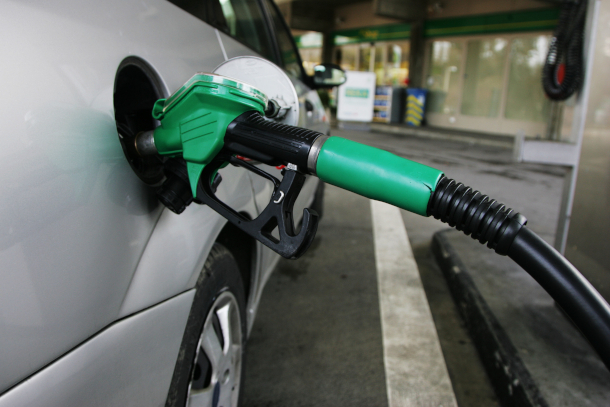
Our guest, Congressman Huffman, says consumers are frustrated by the recent energy affordability crisis. (Photo: Rama, Wikimedia Commons, CC BY-SA 2.0 FR)
CURWOOD: I think it's fair to say that in many campaigns we didn't hear the words climate change or the climate emergency, and yet, to what extent do you think the concern about the climate is part of this blue wave?
HUFFMAN: Yeah, climate is part of it, even if it wasn't articulated with that specific phrase. When you look at the inability to get insurance or the inability to afford insurance, when you look at skyrocketing food costs, when you look at all of these other impacts. When you look at the fact that American consumers found themselves stuck on the fossil fuel roller coaster once again, with no way off, because Donald Trump had burned the bridge to clean electric vehicles, or at least tried to do so, while the rest of the world is moving forward in a way that will liberate them from that fossil fuel roller coaster. So, I think these were significant elements, and climate was on the agenda, whether folks realized it or talked about it as such or not.
DOERING: And Congressman, how is the climate crisis affecting your district and your constituents? What are you hearing from them?
HUFFMAN: Well, right now, I'm hearing them kind of stunned that in the middle of sunny days, at high tide, we have coastal areas under water because of what's called a Kelvin wave. This pulse of warm water that's moving up the west coast due to El Niño, which is more intense because of human-caused climate change. All the science tells us this, and the reality that really comes home when you're in the middle of a sunny day. There's been no storm, and you have roads and bike paths and trails and coastal buildings underwater.
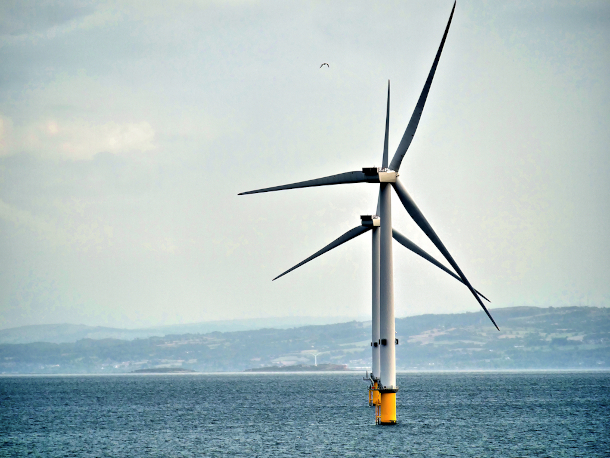
President Trump has halted many offshore wind projects, cutting off consumers from clean, affordable energy. (Photo: Offshore Wind Turbines at Burbo Bank by David Dixon, Wikimedia Commons, CC BY-SA 2.0)
CURWOOD: So you are chair, in a few weeks, of the House Energy and Natural Resources Committee, if I have that correct.
HUFFMAN: Yeah.
CURWOOD: That's a very powerful position over a number of things. Looking at your newfound power, your expected power, what's at the very top of your list to get done while you have this opportunity to influence things?
HUFFMAN: We need to do a permitting reform bill on our terms. That's going to be high on my priority list, if I'm allowed to do it. You know, when we get back to Washington next week, everybody's going to be consumed with this fight over the Senate permitting reform deal, a deal that was cut behind closed doors by four people, two of whom are coal state Republicans. A deal that was written largely by the oil and gas industry. And I think waking up after that just profoundly huge blue wave statement by the American people, people I hope are going to question why we would constrain our permitting reform ambition to this, which was negotiated with zero leverage for Democrats. Why wouldn't we give Democrats a chance to use this newfound power to cut a better deal that doesn't throw the Endangered Species Act and Native American tribes and the Clean Water Act, and all of these other core values under the bus. And a deal that actually ends the war on clean energy, so that we can give, you know, the next president a chance to lead on climate action instead of tying his hands, which is one of the things that this bill would inadvertently do.
CURWOOD: So, to what extent is that going to move ahead, though, in a lame duck session?
HUFFMAN: They're going to try to jam it. That's very clear. This deal is premised on a very rapid, no hearings push through the Senate and the House. A lot of the votes have already been lined up, and it is just a good old-fashioned jam job that is going to hit us as soon as we get back to town next week.
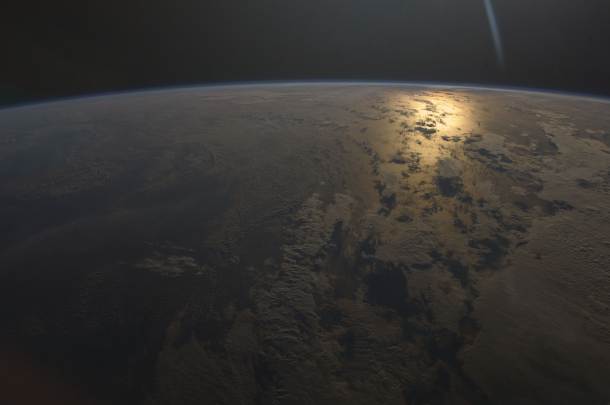
Coastal flooding from the planetary-scale “Kelvin Wave” is one climate concern of Congressman Huffman’s constituents. (Photo: Earth Science and Remote Sensing Unit, Lyndon B. Johnson Space Center, Wikimedia Commons, Public Domain)
DOERING: Now, I believe a part of this permitting bill fight that you're referring to is public lands. When it comes to the lands that all Americans hold as a public trust, what are your priorities with the Natural Resources Committee?
HUFFMAN: So, our public lands are an intergenerational trust. I mean, we've always understood them to be something that weren't just there for us to sort of extract and monetize and exploit to the maximum degree for the here and now. It was something that needed to be stewarded and passed on to people we'll never know in better shape than we found them. That entire trust has been broken by this administration. We have a Secretary of Interior who talks about our public lands like they're assets on a corporate balance sheet, like they can just be, sort of leveraged and given away and liquidated and monetized like you would a, a corporation in some sort of a private equity deal. That all has to change, and, and I think our opportunity in the next Congress will be to reset that trust.
DOERING: Now, one of the things that the Trump administration has proposed is this land swap with a private developer for parts of Yosemite National Park. What are some of the concerns that you have on this front as a congressman from California?
HUFFMAN: Yeah, this is the kind of thing you just don't do. Yosemite is one of our most sacred places, not the only one, but certainly a beloved part of our public land portfolio. And to simply give part of it away in order to facilitate the interest of a private developer, not to enhance the park, not to improve public access or anything else, but to just cut a deal, that's sort of the poster child of what's wrong with this administration. Nothing is sacred with these folks. Nothing about tribal lands, national monuments, our pristine oceans, any of these public trust resources that we are supposed to steward for future generations, they just see it all as a grift, as a chance to make some money and to dole out favors to their friends. So we're going to be digging into this. I think we'll stop it. This is so outrageous, and the backlash has been so loud, including from some Republicans, that I think we should be able to stop it. But it tells us a lot just the fact that they were even considering it.
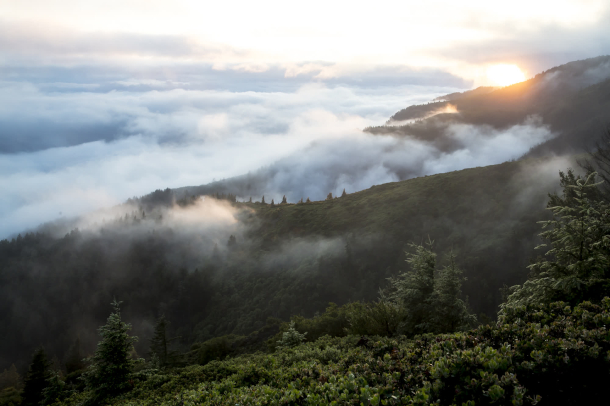
Headwaters Forest Reserve in California. Congressman Huffman says that public lands should not be exploited solely for monetary gain, and instead protected for future generations. (Photo: mypubliclands, Wikimedia Commons, Public Domain)
CURWOOD: So you now have subpoena power come sometime in January. What rocks do you want to turn over for the public to understand when it comes to natural resources for the United States?
HUFFMAN: Lots of rocks. We want to dig into these mineral deals where the administration has taken equity stakes in companies where members of Trump's inner circle just happen to have financial interests. We want to look at ethical lapses by senior members of this administration. We want to look into the very shady operations of the Freedom 250 entity and the way they hijacked America's 250th celebration, and the way they have reprogrammed funds that were supposed to go to national parks and other public lands into these other activities, and in some cases into Donald Trump's vanity projects, which are also on our agenda for oversight and investigation.
CURWOOD: You're not referring to the arch, are you?
HUFFMAN: One of several vanity projects, amazingly. That joy ride is going to stop.
CURWOOD: What power do you have in this lame duck situation? They have the White House. They have both parts of Congress. And if they put things on a fast track, they can jam things through. Yes? Or no?
HUFFMAN: Well, you're right. A lame duck is very fluid, and it is kind of hard to predict what happens and why. I think the fact that there was such an overwhelming mandate from voters for the Democrats makes it harder for them to really roll the Democrats in the lame duck. Democrats, I hope at least, are a little fortified and less willing to let themselves just be rolled, but we'll see. And you know there will be two months of chaos, and it's going to be a wild ride until we seat the next Congress. So, stay tuned. A lot of weird stuff can happen in a lame duck.
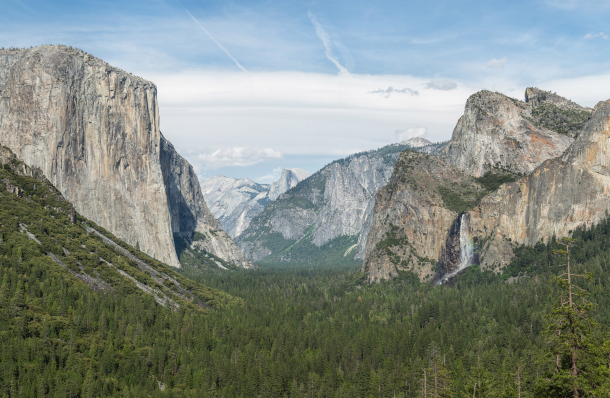
President Trump has threatened to allow private developers in parts of California’s famous Yosemite National Park. (Photo: Diliff, Wikimedia Commons, CC BY-SA 3.0)
DOERING: Now earlier this year, you introduced along with Chairman Westerman, this bipartisan Great American Outdoors Act 250. Tell us about why the bipartisan aspect is very important there and how that might help this move forward, and what's the current status?
HUFFMAN: That's a good example of something good that could happen in the lame duck, because there's overwhelming bipartisan support for the Great American Outdoors Act. This is a fund to tackle the deferred maintenance backlog on our public lands and, and especially at our national parks. And it's something that some members of the Republican Conference look at as an expenditure, something that we have to go find an offset for, and so they think that whatever it's going to cost, you will have to make a parallel cut in some social program or something. That's why the bill hasn't advanced at this point. But in a lame duck, we might be able to get past that objection. I don't think you have to offset or find cuts to pay for this because this is money we already owe. I regard this as a debt that we have incurred. It's, that's what deferred maintenance is, it's stuff you were supposed to have done all along, but you, you failed to do, and we are now catching up. So the idea that we would need to do cuts for what we were supposed to have been doing all along, I think, is, is just fundamentally flawed, and that that's the argument that we'll make, if we can find enough Republicans to get on board. Mr. Westerman and I are shoulder to shoulder in supporting this bill. The president has said he would sign it, so I think there's a chance.
DOERING: And remind us, please, because I believe this comes after the Great American Outdoors Act of 2020, which President Trump did sign.
HUFFMAN: Yeah.
DOERING: And there was a lot of bipartisan support for that bill.
HUFFMAN: There was, and he has said he'll sign this one too. So we've worked hard. We've negotiated a bill that doesn't have any partisan baggage. It's just a clean funding of this deferred maintenance obligation, the kind of basic governing work that Congress ought to be doing. So, I'll do my best to try to get that through the lame duck. If we don't, we'll make it one of our early priorities in the next Congress.
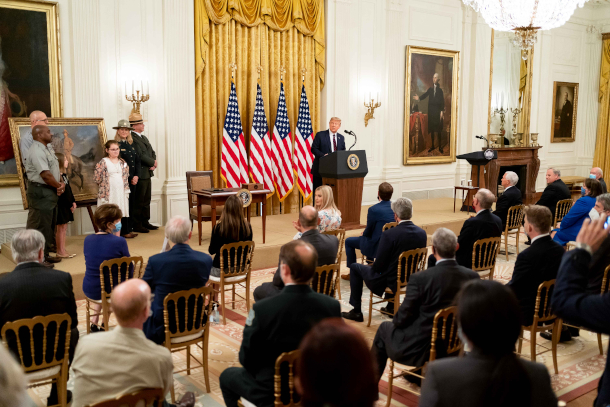
President Trump signs the Great American Outdoors Act in 2020. Earlier this year, Congressman Huffman and Chairman Bruce Westerman introduced another bipartisan bill, the Great American Outdoors Act 250, that they hope to pass during the lame duck session. (Photo: The White House from Washington, DC, Wikimedia Commons, Public Domain)
CURWOOD: We have just about run out of time, but before you go, I want to ask you to share your perspective as someone who's been involved with the question of the environment and climate for a long time. I believe you were an environmental lawyer before you became a member of Congress. So after decades in this space, how are you feeling today about the future of environmental protection and stewardship and the climate in the United States?
HUFFMAN: That's a great question. We've taken some hits, and I can't sugarcoat the amount of damage that's been incurred for the past two years. We have gone from leaning in to climate action and environmental protection and environmental justice to taking several steps backward and actually a scorched earth agenda that has attempted to not only roll back that progress but to kind of burn the bridge and make it harder to rebuild that progress. That's what we have to now start tackling. And I don't want to overpromise, but what I can say for sure is that the values and the agenda are going to get reset, and we're going to work like heck to begin repairing all of this damage and get us back in a forward posture on public lands protection, on clean water, clean air, on environmental justice, and, and on climate action.
CURWOOD: Jared Huffman is incoming chair of the House Natural Resources Committee, and represents California in its second district. Thanks for taking the time with us today.
HUFFMAN: Jenni, Steve, thanks so much for having me.
Links
Learn more about Congressman Jared Huffman
Read about the Democratic House Committee on Natural Resources
Living on Earth wants to hear from you!
Living on Earth
62 Calef Highway, Suite 212
Lee, NH 03861
Telephone: 617-287-4121
E-mail: comments@loe.org
Newsletter [Click here]
Donate to Living on Earth!
Living on Earth is an independent media program and relies entirely on contributions from listeners and institutions supporting public service. Please donate now to preserve an independent environmental voice.
NewsletterLiving on Earth offers a weekly delivery of the show's rundown to your mailbox. Sign up for our newsletter today!
 Sailors For The Sea: Be the change you want to sea.
 The Grantham Foundation for the Protection of the Environment: Committed to protecting and improving the health of the global environment.
 Contribute to Living on Earth and receive, as our gift to you, an archival print of one of Mark Seth Lender's extraordinary wildlife photographs. Follow the link to see Mark's current collection of photographs.
 Buy a signed copy of Mark Seth Lender's book Smeagull the Seagull & support Living on Earth
© Copyright World Media Foundation. All Rights Reserved
Home | Contact | RSS | Donate | Newsletter