

Blue Wave, Green Hope (Cont'd)
Air Date: Week of November 6, 2026
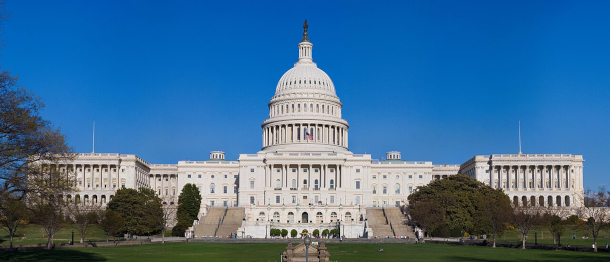
The United States Capitol building in Washington, D.C. A new Democratic-majority Congress will convene in early January 2027. (Photo: Noclip, Wikimedia Commons public domain)
Hosts Steve Curwood and Jenni Doering continue our roundtable discussion with Vernon Loeb, Marianne Lavelle, and Dan Gearino of Inside Climate News about voters’ frustration with high fuel prices and the opportunity for a Democratic-led Congress to now focus on clean energy to reduce energy costs. We talk about what voters expect the Democratic party to deliver in the final two years of the Trump presidency and beyond.
Transcript
DOERING: It’s Living on Earth, I’m Jenni Doering
CURWOOD: And I’m Steve Curwood.
We’re here with colleagues from our media partner Inside Climate News, unpacking the blockbuster win for Democrats in the midterm elections and what it could mean for environmental protection during President Trump’s final 2 years in office. So, Marianne, let’s drill down on how energy played with voters, what did we see here?
LAVELLE: Right, some of the polling before the election showed that voters were much more worried about Republican energy policies than they were about Democratic climate policies being costly. And this is after the last two years the Trump administration has been ringing that bell that the Democrats want to give you the costly Green Deal, but voters just were not buying it. They know what they're paying for energy, and they know that that's related to this fossil fuel energy policy of the administration.
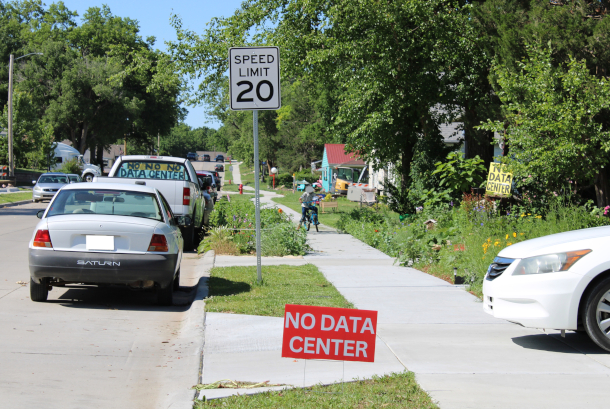
Anti-data center sentiment in a rural Kansas neighborhood. Opposition to data centers may be one bipartisan issue Democrats can leverage in Congress. (Photo: Catboy69, Wikimedia Commons, CC BY 4.0)
CURWOOD: With great profits for the fossil fuel industry through this campaign. I mean, underscored.
LAVELLE: It just so happened that they reported their profits last week, right before the election, and they're like triple what they were last year. And that's not because they're putting out a better product or anything. It's because purely the run-up in global prices.
LOEB: And Trump went on the campaign trail bragging about how great the oil industry profits were, and essentially saying, "I don't really care about people's concerns about pump prices. Isn't it great that all the money the oil industry is raking in?"
LAVELLE: What he said is this is money we're raking in as a country. But that's not how, how consumers experience it. It's really the oil companies that are raking in those profits, and their executives are the ones who have the most shares in those companies and who feel the benefits the most.
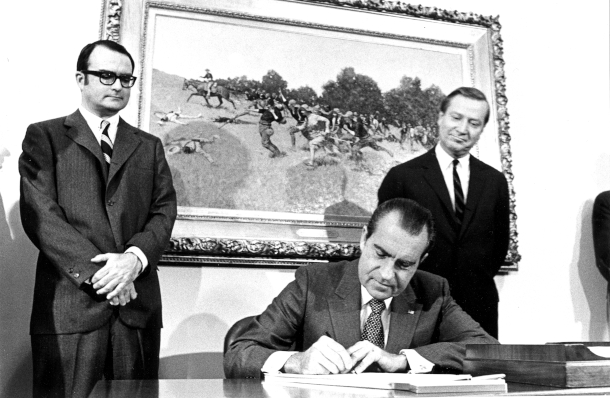
President Richard Nixon signs the Clean Air Act of 1970. Some energy experts note that some of the nation’s most significant environmental policy was passed with a Democratic Congress and a Republican president. (Photo: National Archives and Records Administration, Wikimedia Commons, Public Domain)
DOERING: So I mean, this is fascinating. Like, to what extent do you think Democrats now have the upper hand when it comes to issues like energy affordability, and what do they need to do to deliver on that in this Congress?
LAVELLE: Well, for the last 10 years at least, we've been in this incredibly polarized atmosphere where it's hard to imagine Democrats and Republicans working together on anything. But look at the way people voted, across the board in a bipartisan way, and the people they're sending to Washington know some of the voters were Republicans as well. They're all wanting the same thing, which is action on the out of control costs and the power that industries like the fossil fuel industry, like big tech, have over their lives. And so, I think what you're going to see is the Democrats trying to find some common ground with the Republicans who are now going to be there in the minority, on how they can address these issues that all of their voters said they cared about. I mean, one thing that comes to the top of the list is windfall profits taxes on the oil and gas industry as we were just talking about. What other industry has seen its profits, not its revenue, its profits, triple? And so there's so much that that money could be invested in to transition us away from this vulnerability that we have. The first ideas you're going to see are all going to be about affordability, and of course, the cheapest form of energy are the renewables, and that is the messaging we're going to see around what kind of legislation is going to be tried in the next Congress.
CURWOOD: So, in this tsunami for the Democrats, we've seen this huge switch from control away from the Republicans. But correct me if I'm wrong, but I think the electorate is mostly in the middle, mostly independent, and in many of these elections, the folks who really end up deciding what happens. I don't think there were a lot of defections from the hardcore Republicans this time around. What do the Democrats need to do now in this sector of protecting the environment and dealing with the climate emergency and and energy affordability? What do they need to do to keep that vast middle that, at the end of the day, elected them this time, and if they want to keep getting reelected, will need to show up next time?
LAVELLE: One of the interesting things is the moderate members of the Democratic Party up on the Hill already have gathered in this new Democrat coalition, and have organized, and talking about just these things, putting affordability front and center. And there also has been a lot of effort in the leadership to get the more centrist Democrats working with more left Democrats and seeing where their common ground is, so that the party doesn't have the inter-party fighting that has really made it hard for the Republicans to govern over the last few years. So I think it's a challenge, there's no question, but I think that people are going into this new Congress with a lot of positive vibes, so to speak. At least that's what the sense I'm getting from talking to people. They're not talking about what divides the Democrats, but what they can do together.
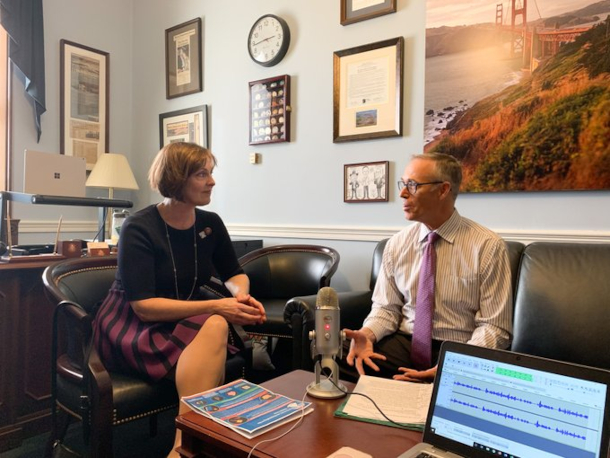
Kathy Castor, Democratic Representative for Florida’s District 14, sits with Jared Huffman (D-CA) back in 2020 on his podcast, “Off the Cuff.” Castor won her race in 2026 despite significant redistricting. Rep. Huffman is also a guest on our show this week. (Photo: United States Congress, Office of Jared Huffman, Wikimedia Commons, Public Domain)
CURWOOD: Vernon, talk to me about this.
LOEB: The last time the Democrats did pretty well in the midterms in 2018, they came back to Washington talking about the Green New Deal, and it turned into very quickly a culture war slogan that they got clubbed with over the head for the next two years. Now, they're not talking about the Green New Deal. They're not even talking about climate change. They're talking about data centers and affordability, and those are populist slogans, if you will, that play across both sides of the aisle very effectively. And so they've learned a powerful lesson there, and it's easy now to make the case for solar and wind as cheaper alternatives. With Iran in, in charge of the Strait of Hormuz and gas still sitting at $4.50 a gallon and diesel sitting at $6.30 a gallon, and so the Democrats rhetorically, I think, are in a much smarter, stronger tactical position now than they were in 2018.
CURWOOD: So, looking ahead, you know, the next two years, Mr. Trump is still president of the United States. How does this win stack up against dealing with him in the White House?
LAVELLE: One of the models I've heard some of the Democratic lawmakers talk about is the housing affordability bill that Congress passed that Trump did not want to sign. He actually wanted to put his voter bill in it, and Congress wouldn't do it. But it was a bipartisan bill, and it had just such strong support across the board, and he let it pass without his signature. He let it go into law without his signature. That's kind of the model for what they're looking to do: bills that are just so popular that Trump will either deal with them or will just back away from a fight that just doesn't look good for him or his legacy. But of course, Trump is mercurial, if nothing else, so we'll have to see. One of the energy experts that I talked to today pointed out that a lot of the big environmental legislation of our era, the National Environmental Policy Act, the Clean Air Act, passed with Democratic Congresses and a Republican president, and that divided government sometimes can work if both sides see a way to compromise.
DOERING: Yeah.
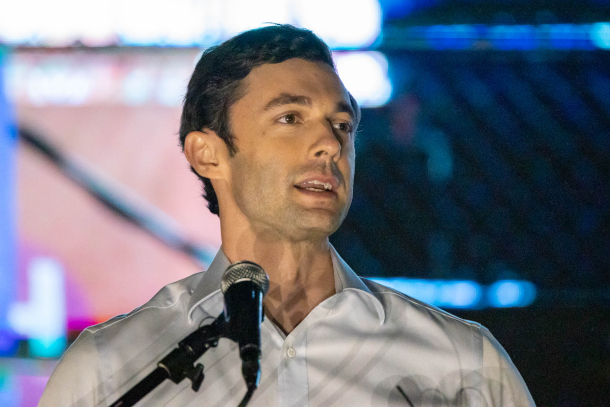
Jon Ossoff (D) has served as Senator for Georgia since 2021. Our guest Vernon Loeb suggests that young politicians like Ossoff could change the playing field for Democrats in the 2028 presidential election. (Photo: John Ramspott, Wikimedia Commons, CC BY 2.0)
CURWOOD: Vernon, you're thinking. I can see.
LOEB: Well, Trump sounded a sort of conciliatory note last night, saying, "Yeah, we'll work with Democrats. We'll figure out a way to do it." How much interest and energy he has left for legislating, he's never had much of a legislative agenda. He's bypassed Congress almost completely. How much energy he has for governing, it remains to be seen. Who knows what we're going to get from Trump in his last two years. A lot of people feel his health is sort of failing. His mental acuity clearly is not what it once was, so I think it's an unknown at this point, and it's also in my mind an unknown how Republicans now will react to him. He kept them in line amazingly well. They were really afraid of crossing him and crossing MAGA, but now he's a lame duck. Everybody's a free agent, and I think you're going to see a lot of Republicans starting to chart a more independent path away from Trump, thinking about their next election in the House two years from now. One of the most interesting things I heard last night was somebody quoting Lindsey Graham from 2015 when Trump came down the golden escalator, and right around that time, Lindsey Graham said, "If we support this man for president, he will destroy us. He will destroy the party, and he will destroy us all." And fast forward a decade, with Lindsey Graham's sister on the ballot, and she loses to a neophyte Democrat pediatrician.
LAVELLE: Because she was handpicked by Trump, and South Carolina voters were very upset at his intervention, and yeah, the irony is unbelievable.
LOEB: Yeah, and if you look at Trump's influence on the Senate races, you can argue that both Democratic seats in Georgia were the result of Trump picks a cycle ago. You can say that Talarico's victory over Paxton was attributable to Trump's support for Paxton. You've got Lindsey Graham's sister, and so Trump clearly gets an assist for the Democrats in about four or five Senate seats.
CURWOOD: Hey Dan, before we go, how can the Democrats keep support of middle America? Take advantage of, of the wins that they've had now to build up something solid there.
GEARINO: Well, to try to kind of unpack that, when's the last time Democrats had a night as good as this? And it wasn't a lot of these wave elections we've seen just in the last couple decades. You have to go way back. You have to go back to post-Watergate. So, who was elected out of the post-Watergate era in Iowa? Tom Harkin was one of those elected. He was one of the Watergate babies as they called them, and you saw this generation of a lot of them were in the Midwest. A lot of them were everywhere. You were winning in conservative areas. Oh wow, a Democrat won there? There were some really politically talented people who may not have won except for the political climate of that very precise moment. But once they got there, they stayed. And I can look at a couple of these people who won in the House and the Senate, and it'd be hard to imagine them losing when they run for reelection in two years or in six years, they're just political talents who happen to be running at the right time. And a key part of that is just listening to your constituents, realizing who you represent, and delivering for them. It is really not that complicated. I think there are names that were part of this election cycle that we are going to have as part of our lives for a very long time because they're good at politics, and that's in Democrat-leaning states, Republican-leaning states, swing states. So yeah, that's, that's kind of how you do it, I think.
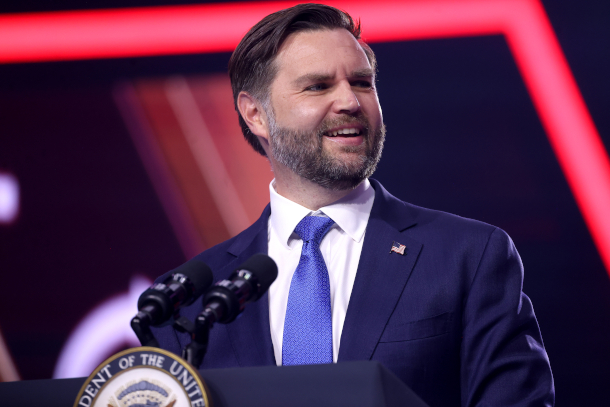
Vice President JD Vance is a likely candidate for Republicans in the 2028 Presidential race, Vernon Loeb suggests. (Photo: Gage Skidmore from Surprise, AZ, United States of America, Wikimedia Commons, CC BY-SA 4.0)
CURWOOD: All right, that then brings up the question: dare I ask about 2028?
LOEB: Well, like Dan was just saying, there's a lot of young talent out there in the Democratic field now. You've got Jon Ossoff, who's in his 40s. You've got Turek in Iowa. You've got Josh Shapiro in Pennsylvania. You have Andy Beshear in Kentucky. Got Mark Kelly in Arizona. You've got Gavin Newsom in California. I think all of those guys would fare well against, who-knows-who will be the Republican candidates. But if the MAGA holdovers are still there, I guess it would either be J.D. Vance or Marco Rubio. But I think the Democratic candidates stack up pretty well. And remember, the Senate wins pretty much guarantee the Democrats the Senate through the next presidential election. So you're going to have the presidential election with a Democratic Congress, and you've got Texas in place suddenly that completely changes the whole electoral map that the country has sort of played by for 30 or 40 years. You know, you had that group of swing states that the Democrats had to win. Suddenly, they're not so important anymore if the Democrats win Texas and all those electoral votes. So '28 is going to be, like unbelievably interesting.

Marianne Lavelle is the Washington Bureau Chief for our media partner, Inside Climate News . (Photo: Courtesy of Marianne Lavelle)
CURWOOD: All right, Dan, what do you think?
GEARINO: There's this fascinating inversion of the way this gets talked about, and it's just changed so much in the last year or so. There was a time not long ago when reasonable people would say the Democrats had no bench. You could probably go eight or nine deep with Democrats that would be plausible presidential candidates, and there are a few of them who won yesterday. And then you look at this rupturing of the kind of Trump base; it makes it so that all of a sudden they're the ones that don't have a very deep bench. It's like you've got J.D. Vance and who, you know who would be next Marco Rubio, and then okay, who's fifth or sixth up? And it's just wild, and it just kind of shows things change rapidly, you know. And if you fixate too much on the moment that you're in, you're gonna just go nuts, because things change quick. The piece I'm writing today, I'm trying to fit in this quote from, oh, the former Colorado Governor Bill Ritter, and he had this comment in an interview a couple weeks ago where he was talking about like the swinging screen door, and that the thing is the door hits you in the rear end. You know, basically there are ups and downs in political life, and that reversal can come quick. And I think that that's something on a day when Democrats are just celebrating, they can just see just in recent history how that can turn quick.

Dan Gearino is a clean energy reporter who writes for Inside Climate News, covering renewable energy and utilities. (Photo: Dan Gearino)
CURWOOD: Hey, before we go, of course we are objective journalists. We have views and responses, of course, but one of the dogs in this particular fight is our own profession: the ability to report the news and to function in a democracy with a free press that's enshrined in the Constitution. What does this win by the Democrats mean for press freedom in America, do you think?
LOEB: Well, I think it's important. You know, Trump has shown a willingness to go after the press, to file lawsuits, to intimidate, to throw reporters out of institutions that they have a right to cover, to decide who can come to the Pentagon, who can cover wars, who can go to the White House briefing room, and I think a democratic victory, taking the country back to the norms that we operated under in terms of government and the press for my entire career, which is like going on 50 years now, I think it's an important moment to kind of reestablish those norms, and I think it augurs well for press freedom going forward. The other big thing that, when you talk about press freedom, has really now become ownership of networks. You know, you've got Fox News, you've got CBS now in the hands of a billionaire family. You've got CNN, you know, in the hands of a conglomerate that's more friendly to Trump, and that's something that we really didn't have, you know, a generation ago. That kind of bifurcation, almost, of the mainstream media. So how that's going to play out really remains to be seen. But from my perspective, in terms of picking which reporters can go to the White House briefing room and which ones can't, I, I hope, you know, we're, we're moving to an era where that's not going to happen quite so easily.

Vernon Loeb is the Executive Editor of Inside Climate News. (Photo: Courtesy of Vernon Loeb)
DOERING: Well, we want to thank you, Vernon Loeb is Executive Editor of Inside Climate News. Thank you so much for being here.
LOEB: Sure, thanks for having me.
DOERING: And Marianne Lavelle, Washington Bureau Chief at ICN.
LAVELLE: Thanks, glad to be here.
DOERING: And Dan Gearino, clean energy reporter at ICN. Thank you all so much.
GEARINO: Yep, thank you.
LAVELLE: Thank you.
CURWOOD: And thanks to all three of you for coming and keeping the story going. And I'm looking forward to what's coming next.
Links
Inside Climate News | “Democrats’ Big Statehouse Wins Could Transform Climate and Energy Policy”
Inside Climate News | “Rural Charms Drew Residents to Taylor, Texas. Then Came the Data Centers.”
Inside Climate News | “Texas Continued Permitting Data Centers After Abbott’s Pause, Report Finds”
Living on Earth wants to hear from you!
Living on Earth
62 Calef Highway, Suite 212
Lee, NH 03861
Telephone: 617-287-4121
E-mail: comments@loe.org
Newsletter [Click here]
Donate to Living on Earth!
Living on Earth is an independent media program and relies entirely on contributions from listeners and institutions supporting public service. Please donate now to preserve an independent environmental voice.
NewsletterLiving on Earth offers a weekly delivery of the show's rundown to your mailbox. Sign up for our newsletter today!
 Sailors For The Sea: Be the change you want to sea.
 The Grantham Foundation for the Protection of the Environment: Committed to protecting and improving the health of the global environment.
 Contribute to Living on Earth and receive, as our gift to you, an archival print of one of Mark Seth Lender's extraordinary wildlife photographs. Follow the link to see Mark's current collection of photographs.
 Buy a signed copy of Mark Seth Lender's book Smeagull the Seagull & support Living on Earth
© Copyright World Media Foundation. All Rights Reserved
Home | Contact | RSS | Donate | Newsletter