

Blue Wave, Green Hope
Air Date: Week of November 6, 2026
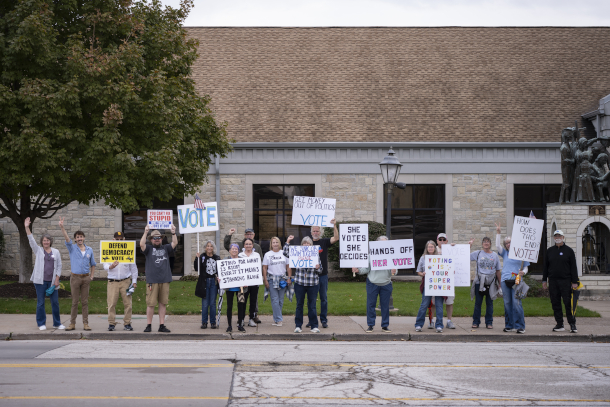
Democrats of Scott County, Iowa, marched to the polls at St. Anthony's Church in Davenport on the first day of in-person voting in the 2026 midterm elections. The midterms saw decisive Democratic victories across the Senate and House, flipping both chambers of the legislative branch. (Photo: Chris Bentley, Flickr, CC BY-NC-ND 4.0)
Though climate was not directly on the ballot in the midterm elections, high fuel prices and concerns about data centers boosted Democrats to a “blue tsunami.” And the new Democratic majority in both houses of Congress means Republican anti-environment measures like fossil fuel expansion and public land exploitation may be slowed down or even halted. Colleagues from our media partner Inside Climate News – Executive Editor Vernon Loeb, clean energy reporter Dan Gearino, and Washington Bureau Chief Marianne Lavelle -- join Hosts Steve Curwood and Jenni Doering to talk us through the results.
Transcript
DOERING: From PRX and the Jennifer and Ted Stanley Studios at the University of Massachusetts Boston, this is Living on Earth. I’m Jenni Doering
CURWOOD: And I’m Steve Curwood.
On November 3rd, millions of Americans repudiated the policies of Republican President Donald Trump and swept the Democrats back into power in both the House and Senate. The new majorities are the biggest switch in decades, and when the 120th United States Congress convenes in early January, depending on final vote tallies, Democrats will have at least 70 more members of the House and as many as ten more Senators than the GOP.
DOERING: President Trump is still in office for 2 more years, so Democrats are not guaranteed legislative victories, but they are expected to provide a check on the extraordinary expansion of executive power under Mr. Trump. And while Democrats said little directly about the climate emergency and the environment during their campaigns, the change of control means Republican anti-environment measures like fossil fuel expansion and public land exploitation may be slowed down or even halted.
CURWOOD: To talk us through what these results could mean for the climate and environment, Jenni and I are joined by our colleagues from our media partner Inside Climate News. Executive Editor Vernon Loeb is based in Philadelphia; clean energy reporter Dan Gearino is based in Columbus, Ohio; and Marianne Lavelle is ICN Washington Bureau Chief. Welcome back to Living on Earth, everyone!
GEARINO: Good to be here.
LAVELLE: Hello, good to be here.
CURWOOD: So we're talking the day after we got the results from the midterm elections, and I think it's fair to say that it was a heck of a night for Democrats, and it's been a busy day for all of us working on these stories. How do you feel about all of this? Let's start with Vernon.
LOEB: Well, I'm still processing what happened. Perhaps still in a bit of shock, really, at how dramatic these results are. I expected a pretty strong blue wave, but I can't say I anticipated a tsunami with winds in places like South Carolina and Kansas and Texas.
CURWOOD: And possibly even in Mississippi, what's going on?
LOEB: You know, it's a new day, and we're seeing a realignment, I guess, or perhaps it's the end of the Trump era. I don't know, it's too early to tell, but something big is happening.
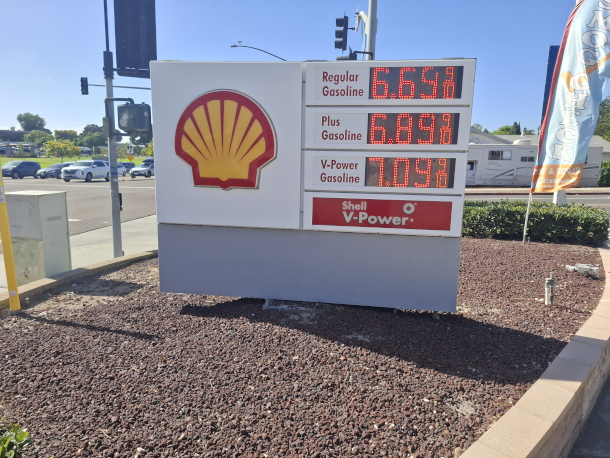
Gas price board in Chula Vista, CA, in September 2026. High fuel prices and general energy affordability were crucial concerns for many voters during the 2026 midterm elections, our guest Marianne Lavelle suggests. (Photo: Bnuuy, Wikimedia Commons, CC0 1.0)
DOERING: So, although climate change may not have been super present in terms of this campaign and the candidates and the way they were talking about it, how much of a role do you think that the climate emergency may have played in getting these voters out? Marianne?
LAVELLE: Yeah, well, when we look at the issues that voters really cared about, it's clear that the whole suite of climate policy issues was right beneath the surface. People were very, very angry at what had happened to their energy bills. Not only filling up their trucks and their gas tanks, but their utility bills. And they see the change that's going on. All of these data centers going up, this whole new industry being built up. At the same time, this war that no one asked for and that no one has control of has just shaken up the whole economy. And the reason is that we are really vulnerable because we're so stuck on fossil fuels, and it's pretty clear that the whole policy of the Trump administration has been to produce more fossil fuels and consume more, and really has taken steps to reduce clean energy, and reduce any move toward electric vehicles, and that all comes down to both price and security.
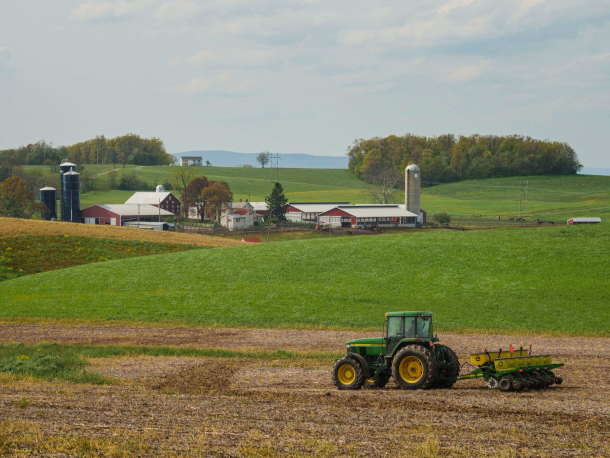
Our guest Dan Gearino suggests that many Midwestern farmers were alienated from the Republican party by high fossil fuel prices and the Trump administration’s tariff policies. (Photo: USDAgov, Wikimedia Commons, Public Domain)
CURWOOD: So, Dan, I want to ask you to comment for a moment on the middle of America. I think the people who do farming, either on a local level or industrial farming, really challenge tariffs, the price of fuel, the price of fertilizer, and they for years have been very conservative. And yet, I'm seeing a Democrat go to the Senate in Iowa. What about the middle of America? How did they respond? What role did they play in this tsunami change, and what do you think made the difference for them?
GEARINO: If you look at farmers and anyone connected to the agricultural economy, and you look at the things that they spend money on and the things that they kind of depend on to make a living, Trump administration policies have made it much more expensive for them to just exist and do business, and it has reduced some of their incomes and some of their income streams, through a combination of high fossil fuel prices and tariffs. So, if you wanted to alienate the heart of the Republican base, if you look at especially these midwestern states, Democrats will run up the score in the big metro areas, and then Republicans will win these impossibly high margins in rural areas. That's the kind of election paradigm we've become so used to. That just isn't what happened in this election. You saw Democrats doing better in formerly deep red rural areas, and it's just because of this profound dissatisfaction with U.S. policies, and you could see a direct connection between those policies and harming household finances. It's not always that direct as it has been these last couple years.
Meta’s Hyperion data center in Louisiana. Data centers were a central issue in the midterm elections of the neighboring state of Texas, where many Democrats campaigned against their expansion. (Photo: InvadingInvader, Wikimedia Commons, CC BY-SA 4.0)
DOERING: Now, I think we've already touched on the data center issue that was so important in this election, and Vernon, that seems to have had a big role in the turnout in Texas. Can you tell us about what happened there?
LOEB: Sure. You know, I've been saying since 2016, when I was managing editor at the Houston Chronicle, that Texas was going to turn blue, and it took a decade. But indeed, Texas has now turned blue. I think part of what we're seeing now is just the natural course of demographics in Texas, which happens to be a very, very diverse state, especially in the cities like Houston. But this year, there were two other factors that I think really produced this shocking, not only huge turnout among Democrats, but this flipping of a state that hasn't elected a Democrat statewide in three decades. First is Trump's immigration policies, which finally did the trick when it came to energizing Latino voters in Texas, a huge voting bloc in Texas. And in 2024, the Latinos swung to Trump. In this midterm, they swung back to the Democrats in dramatic fashion. That's number one, and then number two is this crazed development of data centers across Texas. I mean, Texas has sort of become the epicenter of data center development, partly due to its very laissez-faire approach to business regulation, which is like, come and open your business here, we don't have many regulations, and thus Elon Musk moved from California to Texas. We did a story last week about a town called Taylor, Texas, 17,000 people, 30 miles from Austin. It's a small town in Texas. Right now it's encircled by three data centers and a gigantic Samsung chip factory, and this constellation of industry in this town has completely changed the nature of life for the people who live there, and many of them were Trump kind of people. And this is happening all over the state of Texas. So you put immigration policies, you put data centers together, and you have this incredible turnout. And this came in the face of Elon Musk, new Texan Elon Musk, spending $160 million to support Ken Paxton's Senate candidacy, and Paxton got killed by Talarico, by James Talarico. A poll last week showed that 80% of Texans want a limit on the number of data centers, and they spoke loudly last night.
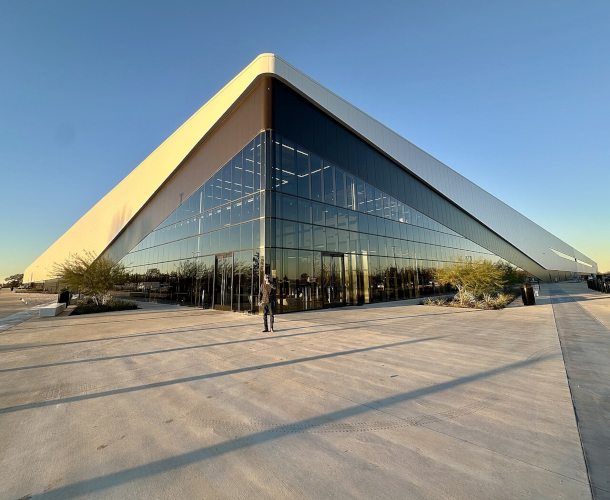
Starlink manufacturing facility in Bastrop, TX. SpaceX CEO Elon Musk contributed millions of dollars to Republican campaigns in Texas where a win for Democrats would create an unfavorable environment for his expanding businesses. (Photo: jurvetson, Wikimedia Commons, CC BY 2.0)
CURWOOD: What about the governor's race there?
LOEB: The governor's race is almost more shocking and surprising than Talarico's defeat of Paxton because Abbott was, this would have been his fourth term as governor. He was not considered a weak governor, and he was beat by kind of a nobody, an absolutely fine state lawmaker, but was not particularly well known before this campaign. You know, a year ago, Abbott was this huge booster of data centers. Couldn't get enough data centers, and then the politics changed, and he did a 360 earlier this year and started ordering audits on all data centers to slow them down. He ordered environmental regulators to do a permit review of all data centers. We did a piece a couple of weeks ago that actually showed they continued issuing permits despite this supposed moratorium, and Abbott immediately responded and told them to stop issuing permits. But it was all too little, too late. And in voters' mind, clearly, the Republicans are seen as the developers of data centers. And Gina Hinojosa campaigned on a data center moratorium.
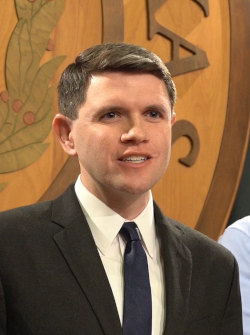
Democrat James Talarico is the Senator-elect for Texas. Talarico is outspoken against unregulated data center expansion in the state. (Photo: Antonioaesparza, Wikimedia Commons, CC BY-SA 4.0)
CURWOOD: Of course, the name Hinojosa didn't hurt her, did it, in this demographic?
LOEB: It did not. And she's from a traditional Texas Democratic family from the border, so she turned out to be, I think, a very strong candidate. As was Talarico. I mean, these are two really up-and-coming, impressive young Democrats in Texas, and you know, you look forward to '28, and you think of those electoral votes in Texas potentially going in the Democratic column. That changes everything in terms of national presidential politics in this country.
DOERING: And speaking of young, I mean, we saw a huge turnout of young voters across the country, and a big shift among them. What are the implications here for climate policy? Marianne?
LAVELLE: Right. It's so interesting because back in Trump's first term in 2018, the midterm of his first term, that was when the Green New Deal was born. The youth-led movement, Sunrise, kind of led this charge and really galvanized young voters, and that was very effective in its time. This year, when I talked to Sunrise Movement, they said it's clear that we have to change for the political environment we're in today, and we have to broaden the movement and focus on what's salient to young people. And for young people, they absolutely care about climate, but it's tied up with their other huge concerns about their futures. It's all tied up in their concerns about the economic climate that they'll be raising their own kids in, and so the concerns of young voters are really a big reason why they moved to Trump in 2024 because they were suffering economically, and Trump promised them relief, and that promise was just clearly broken. And what we saw last night was like a 38 point shift of young men away from the Republicans, which is just astounding, and young voters of color as well. Now it's time to make sure that the Democrats deliver on the promises to this generation.
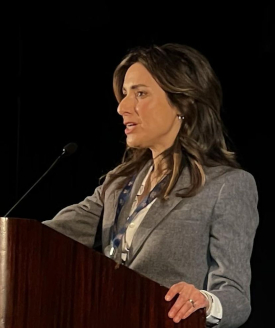
Democrat Gina Hinojosa is governor-elect of Texas. She pledged to enact an immediate moratorium on new data center approvals as part of her campaign. (Photo: RRC1701, Wikimedia Commons, CC0)
DOERING: So let's talk a little bit about the state level elections that we saw. Some of these big wins for Democrats in legislatures and governors, even some trifectas. Dan, you and I have chatted in recent weeks about what those trifectas might mean for clean energy at the state level, what were your reactions to what happened in these midterms?
GEARINO: It's kind of like this larger theme of the evening, which was if you looked at maybe the best case scenario for Democrats, and then you add like 20% to it. So going into this election, Democrats expected to get trifectas. A trifecta is having the governor and both chambers of the legislature. They expected to gain trifectas in Minnesota, in Wisconsin, and in Michigan. They thought the chances were pretty good, and then the real reach was Pennsylvania and Arizona. So they got all five of those. Arizona, they're still counting the votes, but if you look at where those races currently stand, it would be very difficult for them not to have a trifecta there once all the votes are counted. You also may add Alaska to that list once the votes are counted there, whenever that is. That's going to be a while. This is right at the very outer edge of expectations, maybe even beyond the outer edge of expectations. And so, why is a trifecta important? A governor can come in with an agenda to do something like have incentives for electric vehicles, maybe have a climate plan, have a plan to reduce emissions, and do a climate inventory. Maybe, I mean, you could just kind of go down a list in a state where one party controls the entirety of state government, you can pass those things, and you just have to look at other states that have done this. Look at Illinois, where electing Governor Pritzker with the Democratic legislature, my goodness! I mean, it made a huge difference. And you look at the legislation that came from Illinois, it was almost like that state just turned on a dime, and there's going to be a heck of a lot happening in all of those states. Wisconsin is one I'm keeping an eye on in particular.
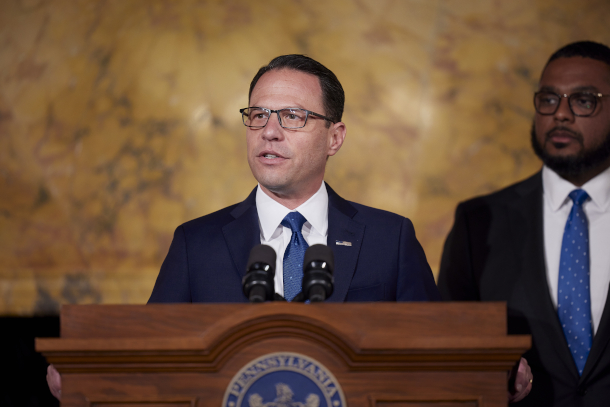
Josh Shapiro has been Pennsylvania’s Governor since 2023. Pennsylvania, the number two gas-producing state in America, gained a “trifecta” in the 2026 midterms, with the governorship and both state legislatures in the hands of Democrats for the first time in 30 years. (Photo: Governor Tom Wolf from Harrisburg, PA, Wikimedia Commons, CC BY 2.0)
LOEB: And if I could add, I mean Pennsylvania is, is a sea change almost on the scale of Texas. It's the number two gas producing state in America, and the Pennsylvania Senate has been in Republican hands since the mid 1990s, and suddenly you've got a pretty progressive, actually sort of a moderate but very successful Democratic governor, moderate on energy, progressive in most other ways, talking about running for president from Pennsylvania with both houses of the legislature for the first time in 30 years. Pretty amazing.
Links
Inside Climate News | “Democrats’ Big Statehouse Wins Could Transform Climate and Energy Policy”
Inside Climate News | “Rural Charms Drew Residents to Taylor, Texas. Then Came the Data Centers.”
Inside Climate News | “Texas Continued Permitting Data Centers After Abbott’s Pause, Report Finds”
Living on Earth wants to hear from you!
Living on Earth
62 Calef Highway, Suite 212
Lee, NH 03861
Telephone: 617-287-4121
E-mail: comments@loe.org
Newsletter [Click here]
Donate to Living on Earth!
Living on Earth is an independent media program and relies entirely on contributions from listeners and institutions supporting public service. Please donate now to preserve an independent environmental voice.
NewsletterLiving on Earth offers a weekly delivery of the show's rundown to your mailbox. Sign up for our newsletter today!
 Sailors For The Sea: Be the change you want to sea.
 The Grantham Foundation for the Protection of the Environment: Committed to protecting and improving the health of the global environment.
 Contribute to Living on Earth and receive, as our gift to you, an archival print of one of Mark Seth Lender's extraordinary wildlife photographs. Follow the link to see Mark's current collection of photographs.
 Buy a signed copy of Mark Seth Lender's book Smeagull the Seagull & support Living on Earth
© Copyright World Media Foundation. All Rights Reserved
Home | Contact | RSS | Donate | Newsletter