

Tiny Microbes in Tree Bark
Air Date: Week of September 25, 2026
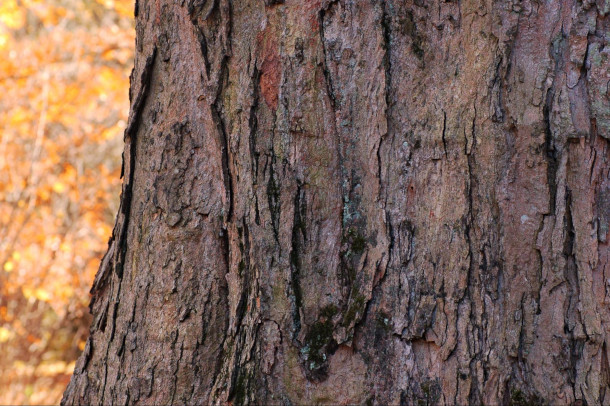
New research suggests that tree bark hosts millions of microbes that can both consume and produce methane, a powerful climate warming gas. (Photo: Derek Ramsey (Ram-Man), Wikimedia Commons, CC BY-SA 2.5)
In addition to storing carbon through photosynthesis, trees have another carbon cycle trick up their sleeve, or rather, bark, and it's been hiding in plain sight. Scientists recently discovered that tree bark hosts millions of microbes involved in consuming and producing methane, a powerful greenhouse gas. Biogeochemist and forest ecologist Jonathan Gewirtzman of Yale University, who was not part of the study published in the journal Science, has been studying the relationship between trees and microbes, and he spoke with Living on Earth’s Jenni Doering.
Transcript
BELTRAN: Thanks to photosynthesis trees absorb carbon dioxide and release oxygen.
So they play a vital role in regulating the carbon cycle by storing carbon in their wood, roots, and soil. But it turns out trees have another carbon cycle trick up their sleeve, or rather, bark, and it's been hiding in plain sight. Scientists recently discovered that tree bark hosts millions of microbes involved in consuming and producing methane, a powerful greenhouse gas. Biogeochemist and forest ecologist Jonathan Gewirtzman of Yale University has been studying the relationship between trees and microbes, and he spoke with Living on Earth’s Jenni Doering.
DOERING: So how does this discovery advance our knowledge about the relationship between trees and greenhouse gasses such as methane?
GEWIRTZMAN: So, this is some really exciting work that is adding to a building understanding that trees play a much more complicated and much more nuanced role in greenhouse gas cycling than we understood before, by hosting these large microbial ecosystems, both on and inside their tissues, and those microbes, those microbiomes are complicated and diverse and have their own processes that sort of add on or supplement to what the processes that are carried out by the trees themselves. And so those microbiomes do things like take up some forms of carbon and release other forms of carbon. Increasingly, we're understanding that they release things like methane or nitrous oxide under certain conditions but also capture methane and nitrous oxide under certain conditions. And so there are these really interesting, really complicated interactions that make tree microbiomes these active players in the global cycles of carbon and other greenhouse gasses.
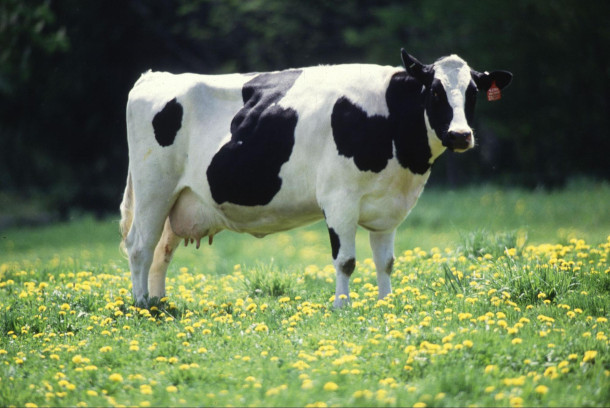
Methane is produced under high-water, low-oxygen, high-carbon conditions, like inside a cow’s stomach. Scientists believe the inside of some trees may create a similar environment. (Photo: Keith Weller/USDA, Wikimedia Commons, Public Domain)
DOERING: And by the way, what kinds of trees have these methane munching and producing microbes in their tree bark?
GEWIRTZMAN: It turns out that pretty much every tree seems to host a microbiome that does some amount of methane cycling. It's complicated. Some trees release more methane than they take up. Some take up more methane than they release. And for every tree, it's a balance of how much methane the tree transports from the soil to the atmosphere, how much it produces inside its own tissues, especially deep inside the wood and the inner tissues called heartwood, and how much methane is consumed on the outer tissues and especially the bark. So there are certain places, especially in the tropics, where we think that the conditions are right for trees to host high rates of methane consumption, and so that's been observed recently in, in a couple of places around the world, in Brazil, in Panama, now in Australia, but here in New England, the trees aren't cycling as much methane than in tropical systems. A lot of trees are actually releasing small amounts of methane, really small amounts of methane, but measurable amounts.
DOERING: What kinds of environmental conditions influence like whether these microbes are releasing or absorbing methane?
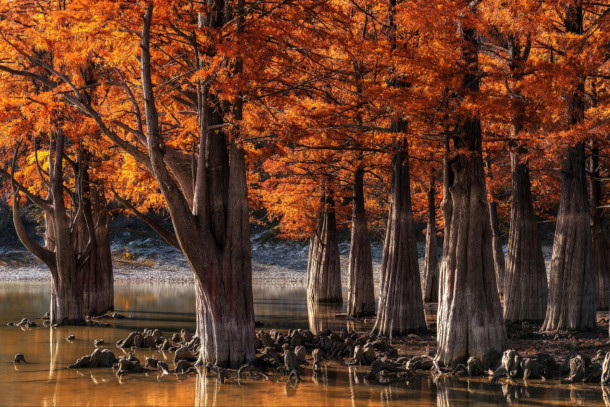
Some trees may fluctuate between producing and consuming methane, depending on the environment available to its microbiome at any given time. (Photo: HoroshilovAleksandr, Wikimedia Commons, CC BY-SA 4.0)
GEWIRTZMAN: Right, we're really just starting to understand the conditions that shape the way microbiomes form and the way that they function within trees. Even though there's been lots and lots of research on microbiomes of things like the human gut or soils or other environmental surfaces and areas around the world, we're only just starting to look inside trees. It's this sort of funny thing where there are these complicated ecosystems that have been kind of hiding in plain sight. That said, there are some things that we know that definitely influence things like methane production and consumption. Methane is produced in environments that are really high in water, high in carbon, and low in oxygen, and so historically we've thought that those kinds of conditions—high-water, low-oxygen, high-carbon—those exist in places like wetlands or landfills or even wastewater treatment, and even inside the gut of a cow. If you've heard about cows releasing methane, it's because their guts are full of water and carbon and not a lot of oxygen, and those are the conditions that methane-producing microbes like to live in. The conditions that methane-consuming microbes like to live in are sort of the opposite. It's where there's methane around, but where it's not too wet, and there's lots of oxygen available. And so, when we think about trees, when we think about deep inside a tree, like if you go into the very middle of a tree, it's pretty wet. It's full of water. It's far from the atmosphere, and so there, there's low oxygen, high water, lots of carbon in the wood, and that seems to be a place where tree microbes like to produce methane. And if you go to the outside of the tree, the outer tissues or the bark especially, there they're getting lots of nice air exposure. So there's oxygen around. There may be getting methane that's coming out of the tree, what's being produced in the inner tissues, or transported from the soil. And so they've got methane to eat. They've got oxygen from the atmosphere, and they're nice and happy there, munching up that methane.
DOERING: I guess you can see why these microbiomes developed. I mean, there's an energy source, methane. There's carbon in there. There's energy to consume, and so you can kind of see where if some microbes are producing methane, or there's methane coming from the swamp beneath, then you have some microbes in the tree bark that are going to consume that.
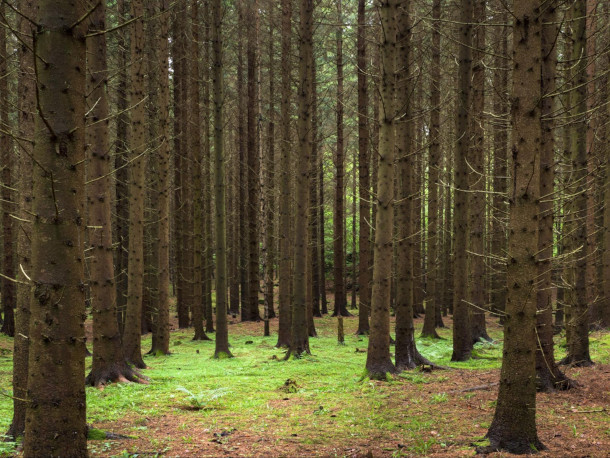
Alongside fossil fuel emissions reductions, harnessing natural ecosystems like methane-consuming forests could be another tool used to address climate change, says our guest Jonathan Gewirtzman. (Photo: W.carter, Wikimedia Commons, Public Domain)
GEWIRTZMAN: Exactly, and there's a lot of variation from one species to another. So some species have denser wood, some have wetter wood, some have drier wood, and there's also going to be variation over time. So one of the things that's really interesting about the work that this group in Australia did is they found that the conditions even inside the bark fluctuate over time. So depending on the weather and depending on the processes that the tree is carrying out. Sometimes that bark is transporting more oxygen. Sometimes it's transporting less. And so you can have these changing or fluctuating conditions that lead to the same tree switching from producer to consumer, just based on the substrates or the, the compounds that are available to the microbiome at any given time.
DOERING: That certainly seems like really useful information as we're thinking about you know climate solutions, which scientists have told us need to include landscapes, not just you know renewable energy and driving EVs things like that, but actually harnessing landscapes to be able to take up carbon from the atmosphere at a higher rate.

Jonathan Gewirtzman is a forest ecologist and biogeochemist at Yale University in New Haven, Connecticut. (Photo: Courtesy of Jonathan Gewirtzman)
GEWIRTZMAN: Yeah, that's totally right. So we all know that the most important solutions to climate change are curbing fossil fuel emissions, and nothing about the tree microbiome changes the fact that we need to, to cut fossil fuel emissions from things like energy and transportation. But we're increasingly recognizing that we need to think about natural systems as part of our portfolio of what we're managing, both to keep greenhouse gasses out of the atmosphere and maybe even to think about pulling what's in the atmosphere back out. If we're trying to get to negative emissions or we're trying to remove carbon or methane that's already in the atmosphere, then we can think about natural ecosystems being sort of one tool in our toolkit for how we might think about that. So we're at a really early stage of understanding these processes. So before we can think about using trees to remove atmospheric methane, first we need to understand some really basic things like which species are better at removing that methane, and which microbes are doing it, and what are the conditions that are beneficial for those microbes. So there's lots left to learn, but as we begin to understand all of those things, we can start to think about how can we prioritize planting or conserving or restoring the sorts of trees that are better for removing greenhouse gasses and using that in our portfolio of tools for addressing climate change.
DOERING: Well, the next time I go outside and hug a tree, I'm going to be thinking about all those microbes right underneath the bark.
GEWIRTZMAN: Totally. We already know that you know when you walk through a forest, there's an amazing amount of diversity and complexity, and I think this just adds even another layer on top of that. So I know when I go outside now, every time I look at a tree, I'm also thinking about the trillion microbes that live inside that tree and what might they all be doing.
BELTRAN: That’s Jonathan Gewirtzman, Yale University forest ecologist and biogeochemist, speaking with Living on Earth’s Jenni Doering.
Links
Science News | “Hidden Tree Bark Microbes Munch on Important Climate Gases”
Living on Earth wants to hear from you!
Living on Earth
62 Calef Highway, Suite 212
Lee, NH 03861
Telephone: 617-287-4121
E-mail: comments@loe.org
Newsletter [Click here]
Donate to Living on Earth!
Living on Earth is an independent media program and relies entirely on contributions from listeners and institutions supporting public service. Please donate now to preserve an independent environmental voice.
NewsletterLiving on Earth offers a weekly delivery of the show's rundown to your mailbox. Sign up for our newsletter today!
 Sailors For The Sea: Be the change you want to sea.
 The Grantham Foundation for the Protection of the Environment: Committed to protecting and improving the health of the global environment.
 Contribute to Living on Earth and receive, as our gift to you, an archival print of one of Mark Seth Lender's extraordinary wildlife photographs. Follow the link to see Mark's current collection of photographs.
 Buy a signed copy of Mark Seth Lender's book Smeagull the Seagull & support Living on Earth
© Copyright World Media Foundation. All Rights Reserved
Home | Contact | RSS | Donate | Newsletter