

12 Trillion Tons of Melted Ice
Air Date: Week of September 25, 2026
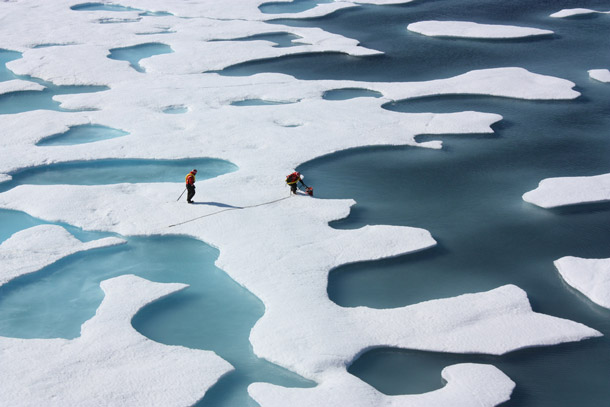
Warmer water and air creates ponds of melting Arctic ice. (Photo: NASA Goddard Space Flight Center, Flickr CC BY 2.0)
A recent study in the journal Scientific Data shows that since 1979, around 12.5 trillion tons of ice have melted from glaciers in Greenland and Antarctica -- enough to cover the entire US in 5 feet of ice. And the melting has been speeding up in the last two decades. Associated Press science writer Seth Borenstein and Host Aynsley O’Neill discuss the implications for future melting and global sea level rise.
Transcript
BELTRAN: It’s Living on Earth, I’m Paloma Beltran.
O’NEILL: And I’m Aynsley O’Neill.
As the planet gets warmer, melting glaciers are wreaking havoc in places like Nepal and Tibet. And on a larger scale huge ice sheets in Antarctica and Greenland are a massive driver behind sea level rise. A recent study in the journal Scientific Data shows that since 1979, around 12.5 trillion tons of ice have melted, just from glaciers in Greenland and Antarctica. This study compared the research of several dozen scientists, working from NASA and European Space Agency satellite data to measure the change in glacier volume over the past half-century. And the melting has been speeding up, especially in the last two decades. Seth Borenstein is a science writer at the Associated Press, and he joins me now for more. Seth, welcome back to Living on Earth!
BORENSTEIN: Thank you for having me.
O'NEILL: So, Seth, we're here to talk about a study in the journal Scientific Data published by Nature, which shows that over the last five decades or so, about 12.5 trillion tons of glacier ice have melted. Now, that's a pretty unfathomable number. So, what's a real-world comparison you could give us that would help put that 12.5 trillion tons into perspective?
BORENSTEIN: I asked a few ice scientists this. How much, if you took all that ice and covered the lower 48 states of the United States? And it would be about five feet thick of ice One of the scientists, the lead author of the paper, her way of putting it is a different one, and I'm not sure if it's easier to think of it this way. Think of a giant ice cube that's five and a half miles tall, five and a half miles wide, five and a half miles long. So that's another way of thinking it, but I think it might be easier to think of the United States covered in five feet of ice.
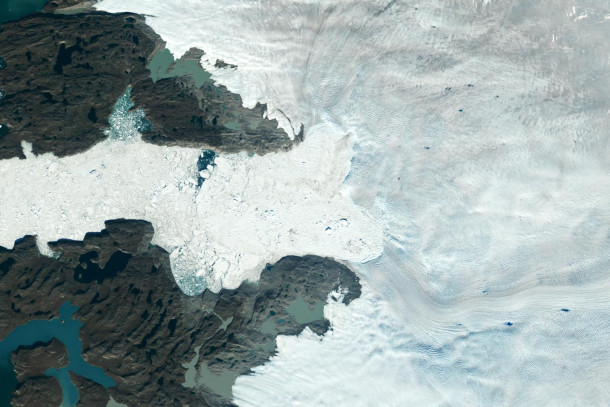
The Jakobshavn Glacier, on Greenland’s west coast, is one of the fastest melting glaciers in the world. (Photo: NASA/USGS, NASA.gov, Public Domain)
O'NEILL: And so, during this time period, how variable was the rate of the ice loss? To what extent was it acceleration and deceleration versus a more steady decline?
BORENSTEIN: And that's actually one of the best and most interesting parts of this new study. Previously, the studies went back to 1990, and that's about the time they started seeing the loss, slow loss in the 90s and the early 2000s, and then they saw a big acceleration in the 2010s. So by going back further, they could say this is not something that's always happened on Earth. Then, from 2020 to 2023, which is the last year they did the study for, mostly because of increased snowfall in both Greenland and Antarctica, the rate of ice loss decreased quite a bit. It decelerated, but the study stops in 2023. The researchers kept looking at the data not as deeply as they will later, but they said things went sort of back to the old ice loss in '24 and '25. So that was, they think, a blip of natural variation. And the reason was interesting is because only 16 percent of the ice loss comes from what you may think of normally when you think of melting ice, especially in Greenland and Antarctica. I think most people would say, "Hey, the air is warmer and it's melting from the top.” That's only 1/6 of the ice in both continents melting. Most of it is coming from the water below and the sides of the ice sheets, which are essentially water again, warmer water. The best way to think about that is, I happen to love iced coffee, being a New Englander at heart. So just the other day, I put a bunch of ice in my cup, then poured hot coffee in it, and within five minutes I had no ice. But I didn't pour hot air into it; I poured hot liquid. That's sort of what's happening to the ice sheets in Antarctica and Greenland.
O'NEILL: And so these ice sheets in Antarctica and Greenland are the largest that we have on the planet. So this ice loss is undoubtedly going to affect sea level rise. What does this study say about any of the previous ice loss and what that is meant for sea level rise now and in the future?
BORENSTEIN: So when you look at 12 and a half trillion tons of ice, it only comes down to one inch, or three centimeters of global sea level rise, and that sounds like such a small amount, which is so strange because here we're dealing with an unfathomably big number of 12 trillion, and it's even more unfathomable if you want to put it into gallons. Then we're into quadrillions of gallons, so probably shouldn't go there. So that's just this huge number, and then it comes down to one inch of sea level rise, and to the average person, an inch of sea level rise, eh, that doesn't sound like much, but the studies show that for every third of an inch, which is about a centimeter of sea level rise globally, we see two to three million people flooded. That's because so many people in the world live by the coast. Just a little increase in sea level rise, because if you remember, that's just the average level. When a storm comes, when it's a king tide or other unusual high tides. Then it's going up even higher. People who lived through Hurricane Sandy or Super Storm Sandy in New York, that was aided by sea level rise levels that were globally minuscule, but caused billions upon billions of dollars of damage in New York.
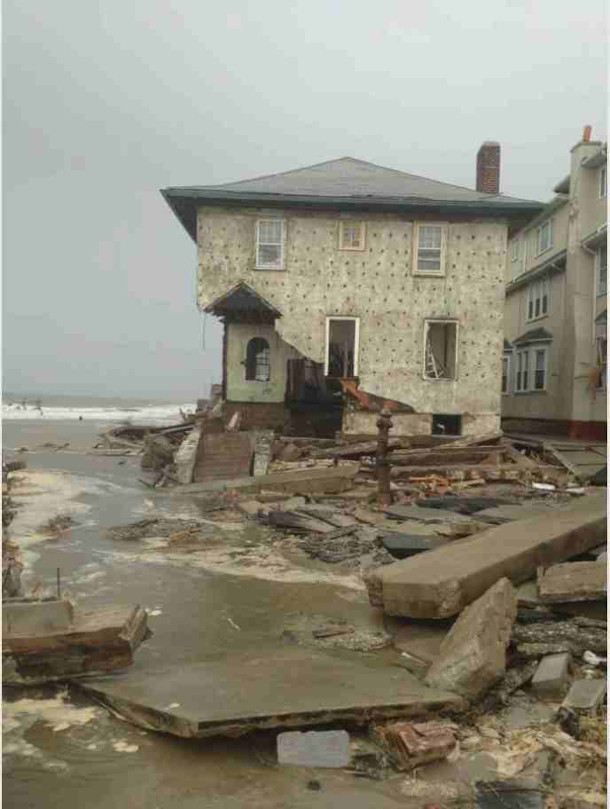
Sea level rise helped contribute to the devastating storm surge from Superstorm Sandy in 2012. Shown above is a house in Brooklyn, New York. (Photo: Proud Novice, Wikimedia Commons, CC BY-SA 3.0)
O'NEILL: Now, what have you heard about a potential tipping point when it comes to ice loss?
BORENSTEIN: So, since so much of this is on the ice sheets, there are glaciers, and much of this is glaciers retreating and water coming in and eating away at these glaciers, and that's what's concerning. So, for example, let's look at Antarctica, if you don't mind. In Antarctica, first off, it's really a story of two different continents. East Antarctica, the ice sheet is essentially growing. East Antarctica is colder. There's more snow, so for years it has grown. The theory is that it eventually starts to shrink, but East Antarctica, which is much bigger, is least stable. West Antarctica and the Arctic Peninsula are a whole different story. The ice there is shrinking. It's shrinking rapidly, especially on the peninsula. And in West Antarctica, there is a glacier called the Thwaites Glacier. You may have heard of this glacier. It often gets the nickname the Doomsday Glacier, which is a little over the top, but the reason it's been called the Doomsday Glacier is that it is sort of the cork on a bottle, and that cork is slowly being eaten away. And the fear is that once Thwaites completely loses its ice, then there's a whole section of glaciers behind it that just keep flowing and flowing, and that's sort of the tipping point concept that you get to a point where it is just irreversible. Now the scientists unfortunately don't know when that tipping point is, and there's a distinct possibility that we've passed it. We just don't know it, but the fear is that we are getting close to that point. But in Greenland, you have sort of the world's fastest shrinking glacier. It's called Jakobshavn. That glacier, it's losing up to 165 feet a day. That is, if you do the quick math, that's like eight feet an hour. I've been told that if you stand there long enough, you can actually see the ice sheet loss there. Now it's slowed down, especially during that slow period, but it has gone back up again.
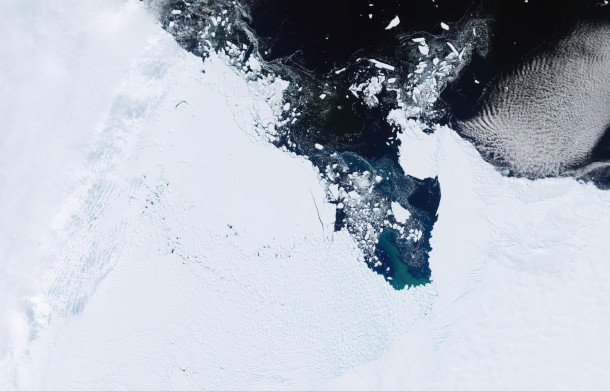
The Thwaites glacier in West Antarctica holds back an incredibly large amount of ice, so it acts almost like a cork in a bottle, that is so far preventing the ice on land behind it from melting into the ocean. (Photo: IMBIE, Imbie.org media pack photo)
O'NEILL: Well, so as we were talking about this timeline going forward is pretty uncertain. You know, this data is starting in 1979, and we can already look at the big difference from then to now, 12.5 trillion tons. So, what do we know about the next half century or so? Or rather, what are some of the concerns that the scientists you spoke with have shared with you?
BORENSTEIN: Well, their concerns is that this is accelerating, and if you look at the numbers, yeah, it is accelerating except for this little blip from 2020 to 2023, and even if it's not accelerating, there's an awful lot of ice there, and if all the ice sheets in the world melted, we're looking at 60 meters, 200 feet of sea level rise. That would be just absurd. It would reshape life on this Earth. That's not going to happen in our lifetime, the lifetime of our grandchildren or great-great-grandchildren even. Ice loss is a slow glacial process, and actually, in some ways, that's a problem because people look and say, "Eh, what's an inch of sea level rise?" It's sort of like a good-sized leak on a boat that you can't patch. You're definitely having trouble here, and the trend is not good, but you're not underwater yet.
O'NEILL: Now, in early September of this year, 2026, the United Nations released a report saying that global warming is soon to exceed the 1.5 degrees Celsius rise that they had looked to prevent during the Paris Agreement in 2015. What can you tell us about the ice loss in the context of that?

Seth Borenstein is a science writer with the Climate and Environment team at the Associated Press. (Photo: Courtesy of Seth Borenstein)
BORENSTEIN: As long as the air and the water keep warming, scientists figure the ice will keep melting. If warming stops or slows down and then stops, the theory is that in many cases, unfortunately, not all, the ice sheet loss will either slow or stop. There is some concern about tipping points that we don't know if we're at that point yet. The one other good thing to come out of this is 20, 30 years ago, when scientists were calculating sea level rise, they didn't take into account melting glaciers, melting ice sheets. It really did catch modelers of the future by surprise. This is no longer surprise. We know what's coming. Whether we do something about it, that's a different issue.
O'NEILL: Seth Borenstein is a science writer with the climate and environment team at the Associated Press. Seth, thank you so much for taking the time with me today.
BORENSTEIN: Thanks for having me.
Links
Living on Earth wants to hear from you!
Living on Earth
62 Calef Highway, Suite 212
Lee, NH 03861
Telephone: 617-287-4121
E-mail: comments@loe.org
Newsletter [Click here]
Donate to Living on Earth!
Living on Earth is an independent media program and relies entirely on contributions from listeners and institutions supporting public service. Please donate now to preserve an independent environmental voice.
NewsletterLiving on Earth offers a weekly delivery of the show's rundown to your mailbox. Sign up for our newsletter today!
 Sailors For The Sea: Be the change you want to sea.
 The Grantham Foundation for the Protection of the Environment: Committed to protecting and improving the health of the global environment.
 Contribute to Living on Earth and receive, as our gift to you, an archival print of one of Mark Seth Lender's extraordinary wildlife photographs. Follow the link to see Mark's current collection of photographs.
 Buy a signed copy of Mark Seth Lender's book Smeagull the Seagull & support Living on Earth
© Copyright World Media Foundation. All Rights Reserved
Home | Contact | RSS | Donate | Newsletter