

Climate Justice and Healing for Nepal
Air Date: Week of September 25, 2026

Recovering from a major disaster isn’t just economically challenging, but emotionally traumatic as well, Pandey says. Above, a border crossing between China and Nepal, destroyed by the August 26, 2026 flash flooding. (Photo: CCTV screenshot, Wikimedia Commons, Public Domain)
After the deadly floods in Nepal this August, researchers from the World Weather Attribution group rapidly assessed the event and concluded that climate change played a “very strong” role in the catastrophic glacial collapse. Tanuja Pandey, a climate justice activist and lawyer based in Kathmandu, Nepal, joins Host Paloma Beltran to discuss the human toll of the floods and the moral duty of the world to slow the climate crisis and help Nepal adapt.
Transcript
O’NEILL: It’s Living on Earth, I’m Aynsley O’Neill.
BELTRAN: And I’m Paloma Beltran.
In the weeks following the deadly floods in Nepal this August, researchers from the World Weather Attribution group rapidly assessed the event, and concluded that climate change played a “very strong” role in the catastrophe. Warmer weather melted ice, thawed permafrost, and increased rainfall, destabilizing the glacier before its collapse. Nepal estimates that damages from the floods could exceed $4 billion. That’s over a tenth of the country’s total GDP. For more on this, we turn now to Tanuja Pandey, a climate justice activist and lawyer based in Kathmandu, Nepal. Tanuja originally hails from Sudur Paschim, a region affected by the floods, and she is co-founder and Chair of Harin Nepal, an intersectional climate justice organization. Tanuja, welcome to Living on Earth!
PANDEY: Thank you for having me.
BELTRAN: So it's been nearly a month since devastating floods hit Nepal and Tibet due to glacial collapse in the Himalayas. Talk to us about what you've seen in the weeks since the disaster. You know, how are you and your community holding up?
PANDEY: You know, life after a flood is incredibly difficult, especially for those who have lost someone they love. The water may eventually recede, but the grief does not. And you know, imagine waking up every morning knowing that the person you share your room, your home, your meals, your life is no longer there. And some of the families are still waiting for their loved ones to be found, while others are trying to give a final farewell without having the chance to properly say goodbye. And then they are expected to, you know, rebuild their home, return to their work, and somehow continue with their lives. We often see the images of flood when the water is rising, but we don't see enough of what happens afterward. So it's quite traumatizing to see everything. And when we talk about flood, you know, we talk about the water, the death toll, the missing person. But for communities, the real story, you know, continues long after the water disappears. They are left rebuilding the homes and livelihoods, memories, dignity, and sometimes their entire sense of security. So, it is what Nepal is going through right now, and it's really traumatizing to see everything and to feel helpless because all we can give is sympathy at the moment, even though we want to help with everything we could.
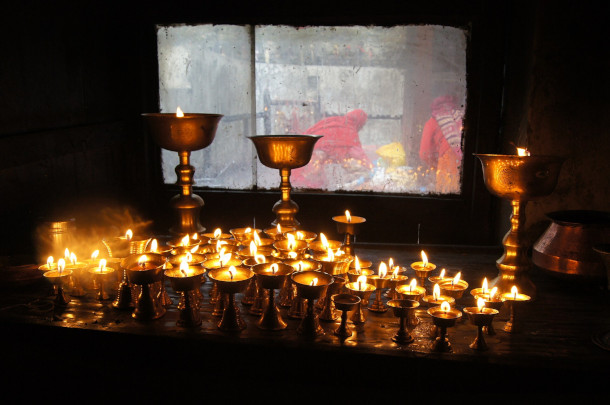
Nepal is a very religious country, Pandey says, and people often associate climate disasters with the actions of spiritual figures. Above, candles lit at Muktinath, an ancient Vishnu temple sacred to both Hindus and Buddhists, in Nepal. (Photo: Polyflux, Wikimedia Commons, CC BY-SA 4.0)
BELTRAN: And Tanuja, you visited the affected zones in Nepal. What did you see?
PANDEY: Yeah, you know, I saw the life fading away. I saw the children waiting for their parents. I saw the wife waiting for her husband, a mother waiting for their child, and I saw the entire community, you know, swept away. And the community, it was actually used to be one of the Indigenous land of Nepal, and the community who did nothing to contribute in climate change lost everything within second. And Nepal is one of the very religious country. It's a very sacred country. They worship nature. You know, even today, a lot of climatic disaster is related not to the anthropologic reason, but to the demonic factor in majority part of our country. People don't know what climate change actually is, and I saw people not praying this time, and it was quite heavy for us to see everything, and even heavy for us to talk about it now.
BELTRAN: I'm sure it is. And Nepal estimates that the recovery from the disaster will cost more than $4 billion. Please tell us, you know, what are the non-economic costs that the world should consider regarding this catastrophe that happened in Nepal?
PANDEY: Economic cost is important for everything, but we don't talk about the, you know, amount of anxiety the community had gone through, the amount of fear we have in our mind. You know, a lot of people in mountain communities who lives in downstream are migrating after that event because people are scared to live nearby the water resources, while in fact you know Nepal's historical settlement, traditional settlement has always been nearby the riverside, so it's quite hard to talk about it because we are giving up on our identity, our traditional way of living, just because few countries refuse to stick to their commitment.
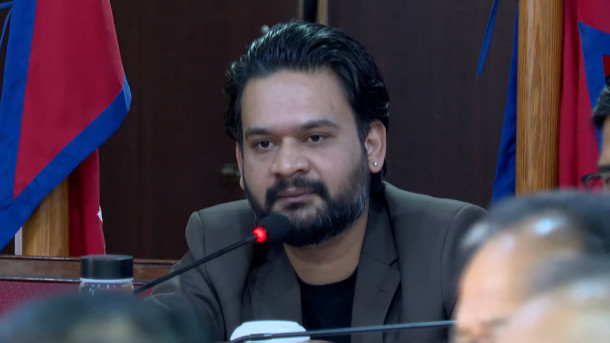
Nepal Prime Minister Balendra Shah has been outspoken about the country’s call for climate justice after the floods. (Photo: Metro News, Wikimedia Commons, CC BY 3.0)
BELTRAN: And in the days following the flood, Nepal's government wrote to the United Nations Fund for Responding to Loss and Damage, Nepal is requesting $20 million. That's the maximum amount a country can request, and Nepal framed the request in terms of climate justice rather than a request for aid. Tell us about that distinction.
PANDEY: See, the problem is that Nepal's climate story, you know, it often become internationally visible only after a disaster reaches a catastrophic death toll. But in fact, where we lose our people amounting to hundreds, and so on every year, it has become a new normal to us, and that creates a, you know, dangerous cycle. The world responds to the headline event rather than to underlying the accumulating loss and damage, and the factors that is causing the climate crisis at the first hand, and Nepal has done its part. We have restored our forests on an impressive scale, and we are rapidly moving toward clean energy. Even though people don't know what clean energy actually is, and we are promoting the electric mobility and you know implementing the climate adaptation plan at the local level, and we even we are going back to our traditional knowledge, Indigenous practices. Yet a country responsible for less than, you know 0.02% of global greenhouse gas emission is playing an even higher price for a crisis it did not create. Today, our Prime Minister Balendra Shah is leaving to General Assembly. We are not here to blame any nation, but demand what is rightfully ours, and we demand the solidarity and to seek the solution because at this moment we want international communities and polluters' country to stick to it.
BELTRAN: And from what I understand, Nepal has still not received any money from the UN fund. This UN pot of money is severely underfunded because wealthy nations have not contributed what they initially pledged. For example, the United States withdrew from the fund in 2025. What role do wealthier nations have to play in addressing this crisis?
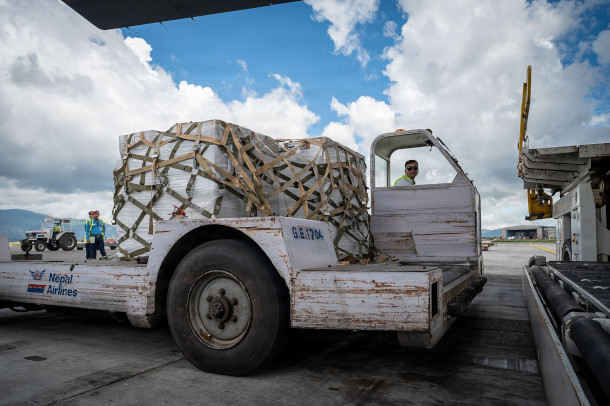
Pandey says wealthier nations have a responsibility to compensate low-emissions countries for climate disasters. Above, supplies from the U.S. Air Force are transported at an airport in Nepal in September 2026. (Photo: United States Air Force, Wikimedia Commons, Public Domain)
PANDEY: So to bounce back from this event like this, you know, we need money. You know, we could have saved our people if we had early warning system. You know, if we had good infrastructure, or if we had invested on preventing everything, so I think financial resources play a huge and most important role when it comes to adaptation. And all these polluters country are making the most out of fossils fuel industry, and all they are doing is they are increasing their wealth, but at the cost of that, country like Nepal are suffering, and it is just against the principle of, basic principle of environmental justice. So, to transitioning away from fossil fuel, it might not be easy for them to do it overnight, but they are in the position to compensate to the communities that are being affected by their actions.
BELTRAN: So, alongside other damages to infrastructure, Nepal estimates that 10% of the country's hydropower capacity was destroyed in the floods. How significant was that energy infrastructure to Nepal?
PANDEY: See, it's not the first time it's happening in Nepal. Even two years ago, we lost our major hydropower plants, and that's why you know we've been saying that no investment is good for Nepal if it is not sustainable or or if it is not green, because you're building hydro plants one day and another day it is being swept away by landslide and flood. So I think we need to re-evaluate all the project, especially the hydropower project we have in Nepal, because a lot of Indigenous community of Nepal actually they were telling the government, and they were asking the government to reevaluate everything because it didn't look sustainable to the community. And the way government sidelined all the Indigenous voices and proceed with the hydropower project, it turned a disaster to Nepal, and we have lost, in fact, we have lost a lot of people inside the hydropower tunnel. Still, thousands are missing. Thousand died inside. So, you know, we of course need development, but it's high time we should start, you know, talking and practicing about sustainable development rather than some colonial practices of development. If we try to build the big skyscraper in Nepal, it will not work here because our soil is not ready for it. We should redefine what development looks like to us, rather than just feeding ourselves the idea of development from the Global North.
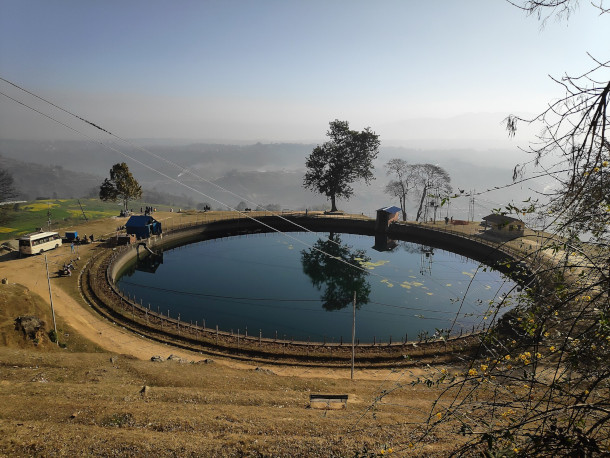
Pandey emphasizes that while Nepal needs development, it must do so in a way that is sustainable and community-oriented. Above is Pharping Hydropower Station reservoir, part of Nepal's first historic hydroelectric project. (Photo: Gaurav Dhwaj Khadka, Wikimedia Commons, CC BY-SA 4.0)
BELTRAN: You know, Tanuja, this moment feels like a turning point for many people. The floods in Nepal, the hottest summers on record, and the recent UN report warning about the trajectory of future warming. How, in your view, can we turn this moment into action?
PANDEY: You know, I think for Nepal, even though we have lost thousands of people, thousands are still missing. It's a very sad event. It's a very traumatizing event, but also it's a good opportunity for everyone to get united because what happened today with us could happen to anyone tomorrow. You know, it's not an isolated event. It is not something that will happen for the last time, you know. So we've been seeing the flood everywhere. We've been seeing it in Global South. We've been seeing the heat waves and other stuff in Global North. We need to hear the scientists what they are saying, and we need to actually act with the urgency, rather than you know denying the fact, because the clock is actually ticking and it does not wait for anyone. It didn't wait for Nepal and it will not wait for any other world. It will impact everyone eventually. So I believe that it's a fight of humanity as a whole.
BELTRAN: And Tanuja, what gives you hope?
PANDEY: You know, hope, hope is a very political thing to have, and it is something that does not really help you to survive, but also to thrive. Hope is a very powerful thing to have, and looking at young people confronting their leaders, looking at children trying to educate their parents on what is right and what is wrong in an individual capacity, looking into a grassroot mobilizer working tirelessly, looking at a journalist having a courage to cover issue that is quite hard and challenging for them to do so, and basically looking at humanity to save the humanity itself is something that gives me a hope.
BELTRAN: Tanuja Pandey is a climate justice activist and lawyer based in Nepal. She is a co-founder and chair of Harin Nepal, an intersectional climate justice organization. Tanuja, thanks so much for joining us.
PANDEY: Thank you. Thank you for having me.
Links
Living on Earth wants to hear from you!
Living on Earth
62 Calef Highway, Suite 212
Lee, NH 03861
Telephone: 617-287-4121
E-mail: comments@loe.org
Newsletter [Click here]
Donate to Living on Earth!
Living on Earth is an independent media program and relies entirely on contributions from listeners and institutions supporting public service. Please donate now to preserve an independent environmental voice.
NewsletterLiving on Earth offers a weekly delivery of the show's rundown to your mailbox. Sign up for our newsletter today!
 Sailors For The Sea: Be the change you want to sea.
 The Grantham Foundation for the Protection of the Environment: Committed to protecting and improving the health of the global environment.
 Contribute to Living on Earth and receive, as our gift to you, an archival print of one of Mark Seth Lender's extraordinary wildlife photographs. Follow the link to see Mark's current collection of photographs.
 Buy a signed copy of Mark Seth Lender's book Smeagull the Seagull & support Living on Earth
© Copyright World Media Foundation. All Rights Reserved
Home | Contact | RSS | Donate | Newsletter