

Leaders Meet Amid Climate Warnings
Air Date: Week of September 25, 2026
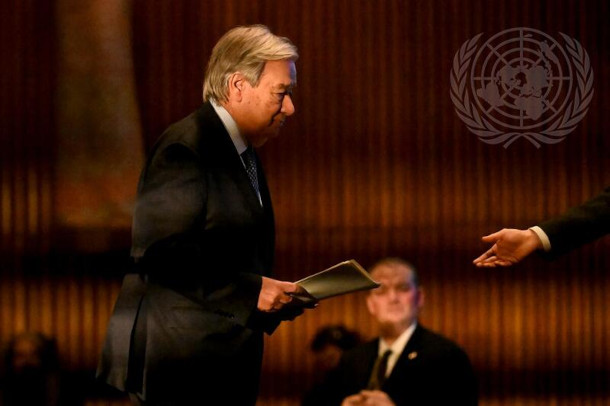
Secretary-General António Guterres addressed the High-level Meeting on Climate Action and the Just Transition on September 23, 2026, urging world leaders to set concrete timelines for phasing out fossil fuels and rapidly scaling up renewable energy. “Because the crisis is accelerating – but so are the solutions,” said Secretary-General in his opening remarks. (Photo: Laura Jarriel, UN Photo under Fair Use)
The 2026 United Nations Climate Summit and Climate Week, which just wrapped up in New York City, took place in the wake of a summer marked by deadly extreme heat, the Nepal flood disaster and a UN report on the inevitable “overshoot” of the 1.5 degree C warming goal. Vernon Loeb, the executive editor of our media partner, Inside Climate News, speaks with Host Aynsley O’Neill about the disjoint between urgent warnings and pleas for help from vulnerable nations, while countries like the US continue boosting fossil fuels -- amid the rapid growth and cost savings of renewable energy.
Transcript
BELTRAN: From PRX and the Jennifer and Ted Stanley Studios at the University of Massachusetts Boston, this is Living on Earth. I’m Paloma Beltran.
O’NEILL: And I’m Aynsley O’Neill.
The 2026 United Nations Climate Summit, alongside Climate Week, just wrapped up in New York City. The two events brought together private and public sector leaders to discuss the urgent challenges and opportunities on all things climate. These sessions took place in the wake of a summer marked by deadly extreme heat and a glacial collapse and flood in Nepal that killed thousands. One of the key speakers at the UN climate summit was the Minister of Foreign Affairs for Nepal, Shisir Khanal.
KHANAL: Let me recall a message by Secretary General, three years back, from the lap of Mount Everest, when he urged the world to stop the madness, he warned that Nepal's mountains are crying for help, and that global inaction risks catastrophe for millions downstream. The question before us is whether the international community truly heard this warning with sincerity, with conscience, and with resolve.
BELTRAN: Meaning, whether the world’s biggest polluters are willing to sharply reduce emissions of the planet warming gases that are causing the climate crisis. And willing to finance a “just transition” to renewable energy, and the costly recovery from disasters like the Nepal floods.
O’NEILL: Prime Minister of the Solomon Islands Matthew Whale reminded the world that while small island nations did not cause climate disruption, they are on the front lines of it, and what matters now is that the big emitters of the developed world correct course on both emissions and funding.
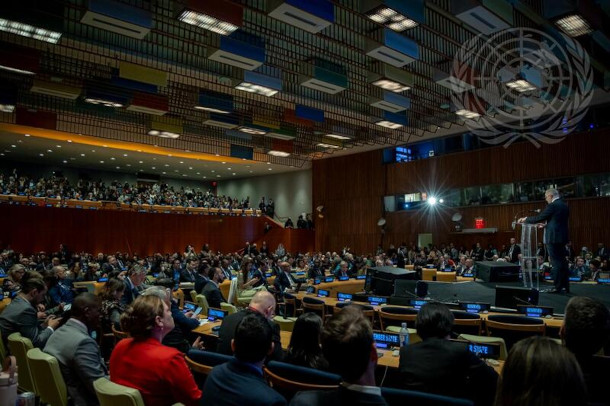
The United Nations High-level Meeting on Climate Action and the Just Transition met on September 23, 2026, joined by the annual NYC Climate Week. (Photo: Laura Jarriel, UN Photo under Fair Use)
WHALE: We don't want to guilt trip anybody, if it makes some feel better about making their contributions that it is charity, well, give it as charity. We don't think it's charity, but if it makes you feel better for it, give it as charity.
BELTRAN: And despite the growing costs of adapting to climate change, leaders highlighted the good news on the accelerating shift to green energy sources that are now cheaper than fossil fuels. Here’s Dr. Fatih Birol, the executive director of the International Energy Agency.
BIROL: Excellencies, many many years in the energy world, we had three choices in front of us. Shall I choose the most secure energy option? Shall I choose the most economic energy option? Or shall I choose the cleanest energy option? We have to make choices. We have to make trade-offs, but when we look at the world today, all of these three objectives are getting aligned, they are getting very, very close to each other.
O’NEILL: To help us think through both the devastation and the hope running through this year’s Climate Summit and Climate Week is Vernon Loeb, the executive editor of our media partner, Inside Climate News. Hi Vernon and welcome back to Living on Earth.
LOEB: Yeah, thanks so much. It's great to be here.
O'NEILL: And then UN had recently put out a report confirming that the Earth will exceed the 1.5 degrees Celsius warming that was outlined in the 2015 Paris Agreement. How did that news shape the conversation at this UN event?
LOEB: Yeah, that's really the sort of overarching context for this week's discussion in New York about climate change. The term the UN uses for that is overshoot. We are now looking at overshooting the goal of the Paris Agreement, which was to keep warming at 1.5 degrees Celsius. Overshoot means that, based on current emissions levels and current world policy, sometime in the next few years, global temperature averages are going to exceed 1.5 degrees Celsius for the first time, and that's a big deal. Every 10th of a point means more extreme weather, more calamity, more deaths from climate. So that's really the context kind of hanging over this week's deliberations in New York on climate, which I thought were really set by the two opening speeches: one by President Lula of Brazil and one by President Trump of the United States. Lula talked about the need for a rapid reduction of carbon emissions and a rapid transition to renewable energy. Trump talked about America's fossil fuel dominance and how that was the most important factor in global energy. He again denied climate and talked about how his administration had ended a global carbon tax on shipping and really mocked people who were concerned about climate change. This is how the high-level UN week opened with these two sort of dueling speeches.
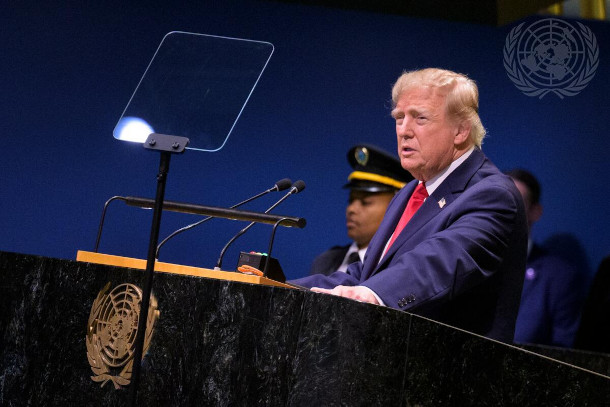
Donald Trump, President of the United States of America, addresses the general debate of the General Assembly’s eighty-first session on September 22, 2026. (Photo: Manuel Elías, UN Photo under Fair Use)
O'NEILL: Now, what did you hear from U.S. leaders and public figures who were speaking this week?
LOEB: There was obviously a lot of comment from U.S. leaders, not so much at the U.N. where the United States has sort of abdicated its leadership role and exited the process. But throughout events at Climate Week, you had U.S. leaders at all levels talking about renewables, talking about slowing down data center developments in their states. A lot of progress in this country and leadership in the United States now on climate comes at the state level and at the local level and not the federal level. You have a federal government that denies the importance of climate change and doesn't even really want to talk about climate change and in fact has removed the words climate change from the documents it produces. At the local level, of course, that isn't happening. And you know, in the U.S. you've got half the country is red states and half the country is blue states. And in red states, the legislatures and the governors pretty much follow Trump's lead, and remain focused on fossil fuels. And in the blue states, you still have state policies that are trying to reduce carbon emissions. You have state policies incentivizing the use of renewable energy. And so, at Climate Week, certainly people like Michelle Wu and Gavin Newsom were there talking about the continuing progress in their states toward the renewables transition, toward reducing carbon emissions. So it's a very kind of mixed bag when you talk about local leaders in the U.S., certainly, at Climate Week, you had far more blue state leaders here talking about the things they are doing to reduce emissions and to cope with climate, and the red state people were largely absent from, you know, the events of Climate Week.
O'NEILL: And now a huge theme of these discussions is, of course, global climate action. UN Secretary General Antonio Guterres reiterated his call for $300 billion in investments in developing countries to help them navigate the climate crisis. Where does the world stand on that goal?
LOEB: The world is nowhere close to that goal. The concept of a loss and damage fund to help developing nations was first discussed about five years ago at the Conference of the Parties, the COP meeting in Glasgow, and then the fund was formally created several years later at the COP in Egypt, and contributions right now from donator nations are something like 1% of what is needed on an annual basis to help the developing world cope with climate. So, as is the case with emissions, the contributions to this fund are just nowhere near the UN's goals and nowhere near where they need to be.
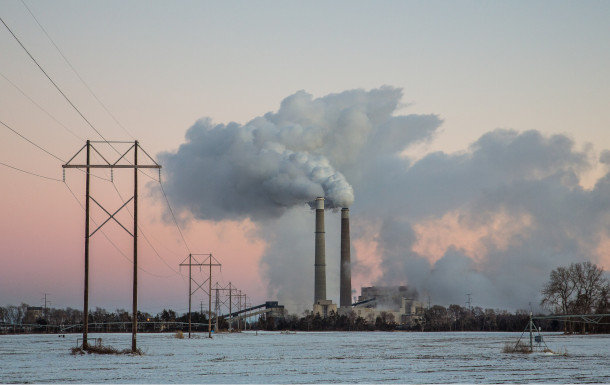
Minnesota’s largest coal-burning plant, the Sherburne County Generating Station, or Sherco, is undergoing a phased shutdown and transition to a renewable energy hub with solar and battery storage. A just transition is seen by many as a critical component to slowing the progress of climate disruption. (Photo by Tony Webster, Wikimedia Commons, CC BY-SA 2.0)
O'NEILL: Energy security was also a significant topic of discussion. Why is it gaining so much traction in the international community at this point in time?
LOEB: Well, I think probably that flows from the war in Iran, which has highlighted the world's continuing dependence on fossil fuels at a time when the flow of oil through the Strait of Hormuz is being held up by the war, by Trump's war with Iran. And another extreme aggregating factor right now comes from the war in Ukraine, where Ukraine has been attacking Russia's fossil fuel infrastructure, including its diesel-refining capacity, and this has made diesel prices escalate globally even faster than gasoline prices, and so, as the world desperately needs to begin reducing its carbon emissions, we're seeing its continued reliance on fossil fuels, you know, as a sort of dominant energy force on the planet.
O'NEILL: And how would you say that that situation is shaping climate efforts?
LOEB: Well, one of the points that UN Secretary General Antonio Guterres made in his remarks was that while we've overshot the warming goal of the Paris Agreement, we now have the tools to deal with emissions reduction, and that is renewable energy. I mean, the one bright spot really in global climate is that renewable energy continues to exceed all expectations in terms of growth and availability. And it's now clear, in a way that it wasn't really clear 20 or 25 years ago, that the world economy can be powered by renewable energy and not oil and gas and fossil fuels. So that's a big deal in terms of a global approach to climate. And it's very clear now that you know renewables are the cheapest and the fastest means of replacing fossil fuel.
O'NEILL: And now, as the U.S. government pulls back from climate action and indeed from even acknowledging the basic science, China's role in clean energy is growing. How much of a presence did China have at this UN climate summit?
LOEB: It wasn't a huge presence. President Xi did not even attend the proceedings in New York. He went directly to Washington for his meeting with President Trump. So China wasn't big in New York, but it's huge in the world of renewable energy. China is by far and away the world's leading renewables power. It produces, I think, 80 percent of the world’s solar panels. It's hugely dominant in battery technology and rare earth minerals. Its car industry is now exporting EVs all over the planet, and they are moving rapidly and radically toward renewable energy in China. While they're still building coal plants, they're phasing way back from coal and really accelerating the expansion of renewable energy. So China is the world leader now in renewable energy, by far.
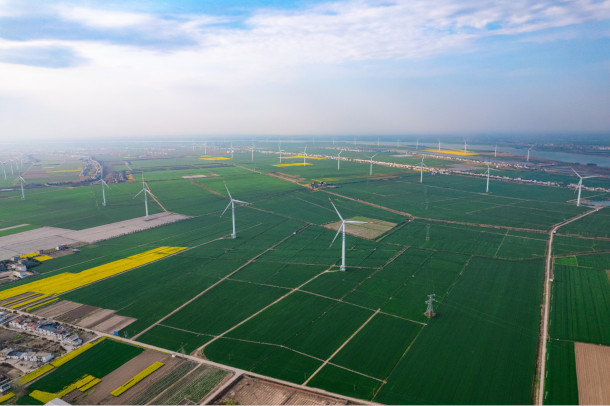
Expansive view of wind turbines rises above farmland in Jiujiang, China. China is the global leader in renewable energy, having installed more wind and solar capacity than the rest of the world combined. (Photo by jason hu, Pexels)
O'NEILL: How did the nations that are on the front lines of climate change seem to speak to the rest of the world, you know, especially the big polluters, about the level of urgency that's needed right now?
LOEB: Well, their level of urgency gets greater and greater, and they're bearing more and more of the brunt of climate change disasters. And so, again, with every COP, their level of urgency increases, and the level of action by the developed nations sort of stays the same, which is again led by the petrostates. Nothing really happens on fossil fuel phaseouts, and also in terms of aid for the developing world. As I said, contributions by the developed nations have been very, very disappointing. As I said, a mere fraction of really what's needed now to help developing worlds cope with climate.
O'NEILL: Well, you've been on the climate beat for most of your career, and you're still here, still standing strong. When international negotiations stall like this, what gives you hope? What keeps you going?
LOEB: Well, I guess at this point you really have to look to renewable energy and see that it is surpassing expectations in ways that are quite hopeful. In the U.S. even states like Texas show the strength of wind and solar power and battery storage. Great things are possible. I think China's focus on renewable energy is something that you have to feel good about. It's funny our relations with China are so fraught. Right now the big flashpoint with China is AI, and we haven't even talked about the enormous energy implications of AI. You know, are we going to power AI with oil and gas, with fossil fuels, or will we power AI with renewable energy?
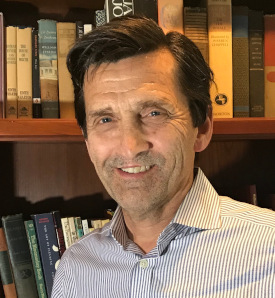
Vernon Loeb is Executive Editor for our media partner, Inside Climate News. (Photo: Courtesy of Vernon Loeb)
It's a constant struggle on the climate beat I think between pessimism and even doom, feelings of doom, you know, we're often accused of being doomers, and I don't think that's true. I think we try to be truth tellers, and I think we think it's important for people to know the truth about climate. But I think when you get into the truth about climate, you also see that it's not too late to turn around the global situation on climate. It's not too late to keep the world a livable place. It's not as livable as it was 50 years ago, and if we do nothing, it's not going to be nearly as livable 50 years from now as it is now. But I think there's still time to keep it livable for humanity, and certainly we can never give up on humanity, and we can never stop trying. I nonetheless continue to, to feel hopeful that change is possible. I mean, there are elections in in the U.S. in a month, and the outcome of those elections will mean a tremendous amount in terms of the country and the world's response to climate.
O'NEILL: Vernon Loeb is Executive Editor of our media partner Inside Climate News. As always, Vernon, thank you so much for taking the time with me today.
LOEB: Thanks for having me.
Links
Inside Climate News | “Competing Climate Visions Clash at UN General Assembly”
Inside Climate News | “What Happens When Earth Passes 1.5 Degrees of Warming?”
Original Audio for the segment above is at Living on Earth for September 18, 2026
Living on Earth wants to hear from you!
Living on Earth
62 Calef Highway, Suite 212
Lee, NH 03861
Telephone: 617-287-4121
E-mail: comments@loe.org
Newsletter [Click here]
Donate to Living on Earth!
Living on Earth is an independent media program and relies entirely on contributions from listeners and institutions supporting public service. Please donate now to preserve an independent environmental voice.
NewsletterLiving on Earth offers a weekly delivery of the show's rundown to your mailbox. Sign up for our newsletter today!
 Sailors For The Sea: Be the change you want to sea.
 The Grantham Foundation for the Protection of the Environment: Committed to protecting and improving the health of the global environment.
 Contribute to Living on Earth and receive, as our gift to you, an archival print of one of Mark Seth Lender's extraordinary wildlife photographs. Follow the link to see Mark's current collection of photographs.
 Buy a signed copy of Mark Seth Lender's book Smeagull the Seagull & support Living on Earth
© Copyright World Media Foundation. All Rights Reserved
Home | Contact | RSS | Donate | Newsletter