

The Indigenous Fight to Save Bristol Bay
Air Date: Week of May 1, 2026
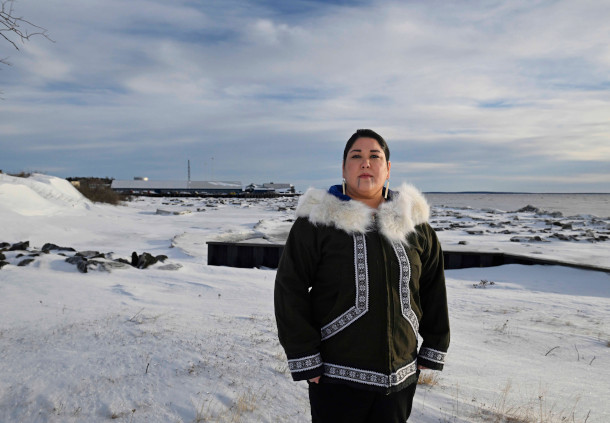
Alannah Acaq Hurley is a Yup'ik leader, executive director of the United Tribes of Bristol Bay, and winner of the 2026 Goldman Environmental Prize for North America. (Photo: Goldman Environmental Prize)
In 2001, a Canadian mining company proposed a massive gold and copper mine at the headwaters of pristine Bristol Bay, Alaska. Local Native Alaskans became concerned about how the mine could harm their plentiful sockeye salmon run, a cultural and economic lifeblood. Alannah Acaq Hurley, Executive Director of the United Tribes of Bristol Bay, helped lead the fight against the mine and was awarded the 2026 Goldman Environmental Prize for North America. Alannah Hurley joins Host Steve Curwood.
Transcript
CURWOOD: It’s Living on Earth, I’m Steve Curwood.
In 2001, a Canadian mining company proposed a massive gold and copper mine at the headwaters of Bristol Bay, a pristine water system on the coast of the Alaska Peninsula that’s home to the largest sockeye salmon run in the world. The salmon support a thriving ecosystem and are a cultural and economic lifeblood for native Alaskans, who have stewarded the land and water for thousands of years. And as the company moved ahead with plans to build the largest open pit mine in North America, those indigenous communities joined together to bring it to a halt. In 2023 they secured a rare “EPA veto” of the proposed Pebble Mine, and the 2026 Goldman Environmental Prize for North America recognizes an Indigenous leader in this fight.
HURLEY: My Yup'ik name is Acaq. My Irish name is Alannah Hurley, and I'm the Executive Director of the United Tribes of Bristol Bay.
CURWOOD: And what does Acaq mean?
HURLEY: Acaq is my great-grandmother's name.
CURWOOD: And congratulations on winning this Goldman Environmental Prize.
HURLEY: That's nice, thank you.
CURWOOD: So Alannah, before we start talking about your work protecting Bristol Bay, paint us a picture of the bay. What makes this such a special place?
HURLEY: Bristol Bay is a extremely special place. It has all the different types of terrain in all of Alaska, in one place. Where I live, at the mouth of the Nushagak and Wood River, we have everything from tundra and wetlands to mountains, freshwater lakes, freshwater rivers, the muddy waters of Nushagak Bay, the beautiful, crystal clear ocean waters as you go west towards Togiak and Twin Hills. It's really untouched, pristine beauty, all of Alaska's majesty in one place. It's so pristine you can still hunt and fish and pick berries and eat them straight from the land. You can drink right out of the lake and rivers. It's paradise.
CURWOOD: So Bristol Bay has huge environmental significance, but it's also important to many human communities. I had been told that it produces, what, more than $2 billion of annual revenue from Sockeye fishing alone. It's also an important food source and cultural site for Indigenous communities, First Alaskans. Talk to me about what the bay means to the people in the area.
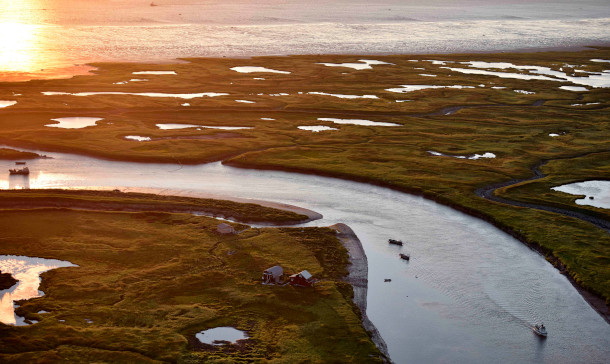
Nushagak Bay in Alaska is home to numerous commercial fishing boats and camps. (Photo: Misty Nielsen for the Goldman Environmental Prize)
HURLEY: So there are three different Indigenous groups in Bristol Bay, the Yup'ik people, the Dena'ina people, and the Alutiiq people. And our homeland, you know, has been stewarded by our people for thousands and thousands of years. They've taken care of this place and entrusted it to us. Our lands, our water, and everything that that entails, the salmon, the moose, the caribou, the bears, us, our freshwater fish, our berries, our plants, our medicines, we very much view it as all very connected. So anything that happens to our lands and waters happens to us. And so it is everything to us. It is the health of our people, physically, culturally, spiritually, it sustains us. It nourishes us. We're so blessed to be able to live in the ways that our ancestors have lived. That kind of foundation is really critical in understanding our perspective and wanting to protect our home.
CURWOOD: So in the year 2001 or so, the Northern Dynasty Minerals mining company proposed the development of what's called the Pebble Mine. It would have been the largest open-pit mine on the continent, one of the biggest, I guess, in the whole world. What would have been the environmental impact of such a project?
HURLEY: The environmental impact of the Pebble project would have been devastation. If you look at a map of Bristol Bay, there are two major river systems, the Nushagak and the Kvichak, and the Pebble Mine would be located at the connected headwaters of both. So you literally could not have picked a poorer location, and in my opinion, it's Creator's test to the people. What are you going to choose? But you could not have picked a worse location to put a low-grade acid-generating project that would have to store tens of billions of tons of toxic waste in perpetuity. That picture is not a question of, if something will happen, but when, especially in an earthquake-prone zone, and in a very interconnected, you know, hydrologically interconnected place, they're like the veins of the bay, like the body, everything is connected, all of that water is connected. And so our people, very early on, came out opposed to the project, because we knew that it would mean the utter devastation of our watershed, our fishery and our people.
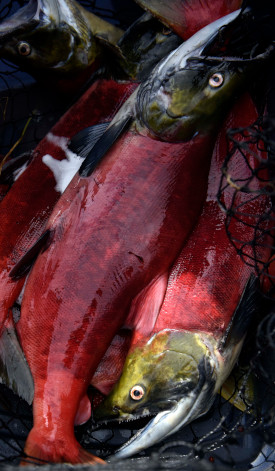
Bristol Bay boasts the world’s largest sockeye salmon run. The fish are crucial to the local ecosystem, indigenous culture, and economy. (Photo: Misty Nielsen for the Goldman Environmental Prize)
CURWOOD: Some say that there are literally hundreds of billions of dollars worth of copper and gold and other minerals in the area for the Pebble Mine. Sounds like a lot of money, but you didn't see this as good news for your community if this got developed.
HURLEY: No, we did not. Early on, before we learned about what type of ore it was, where it was located, what it would mean, what the tailings would mean, people were actually excited for some type of diversification of the economy. Because fisheries can be pretty volatile, and that's how a lot of people would survive in the cash economy as commercial fishermen as well. But it did not take long to learn about those things, the dangers and the threat and the risk that that would cause to our people, and very early on, the vast majority of Bristol Bay's people said, no, no way, this is not worth the risk. You cannot put a price tag on our water and what salmon mean to us as a people. This would be an existential threat to our ability to continue to be Indigenous people in this region, and we will not stop fighting until it is stopped.
CURWOOD: Now, correct me if I'm wrong, but my understanding of a lot of Alaskan politics means that at the state level, there wasn't a huge amount of pushback against this Pebble Mine proposal.
HURLEY: Yeah, our people's concerns were really falling on deaf ears at the state level. We saw the state rewrite our area management plan illegally, without proper input or public process or consultation with our tribes. We saw the governor at the time, really try and pave the way for a mining district, and we're still working to rectify some of those issues in that rewritten management plan to this day. And we're still having issues with the state government really pushing a project on Bristol Bay and Alaskans that they've proven for the last 20 years that they just do not support. And so because our concerns were falling on deaf ears at the state level, our tribal governments really saw the federal government as the place to put some energy, and that was where kind of the petition to the EPA came from, because the state was not listening. They were doing the exact opposite, to really grease the skids for the company to move forward.
CURWOOD: So how did the Environmental Protection Agency, the US Environmental Protection Agency, respond?
HURLEY: So the tribes petitioned in 2010 to prohibit all mines like Pebble within the Bristol Bay watershed. The EPA came back and said, we’re not going to act on a prohibition immediately under our authority under the Clean Water Act, but we are going to study Bristol Bay. We want to do an assessment. And we want to ask, is this place really unique, and what does this fishery mean to the state and people? If this type of development, large-scale hard rock mining, were to move forward, what kind of impact could that have on the waters and people? And so really trying to answer those two main questions, and so they took three years to do a bunch of studies. They were in a lot of different communities, there was a lot of peer review to answer those questions, and after that very long, drawn out assessment, they determined what our people had been saying all along. That this type of development would devastate the water and everyone who was sustained by that water, and so that was really the basis for their action that came later.
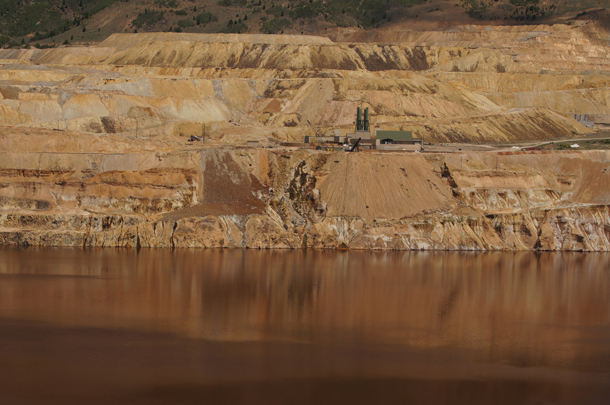
The Berkeley Pit is a former open pit sulfide-ore copper mine located in Butte, Montana that is now filled with heavily acidic water containing arsenic, cadmium, zinc, and sulfuric acid. It’s one of the largest Superfund sites. The proposed Pebble Mine would have resulted in an even larger pit lake with even more room for contaminated water. (Photo: Tjflex2, Flickr CC BY-NC-ND 2.0)
CURWOOD: At the end of the day, how did things turn out with the EPA?
HURLEY: So it was a bit of a roller coaster between the different administrations, but it's really a testament to the dedication of our people and our region, that regardless of the administration, regardless of winning and losing court cases, they did not give up. And so the EPA, in January of 2023, finalized protections to stop the project.
CURWOOD: What's the risk that Trump administration number two could reverse all of that?
HURLEY: There is very much still a risk that that could happen. The company, so Northern Dynasty, the state of Alaska and a few others, have challenged the EPA protections in court, which we anticipated they would. And so far, the Trump administration has continued to defend EPA's action in court, but that is ongoing litigation, and we're not putting all of our eggs in that basket with how unpredictable this administration has been in other arenas. So we're definitely remaining extremely vigilant. And we're continuing to defend the protections in court, and we also are working on legislation that would address the other 20 active mining claims throughout the watershed. Because while we've made great progress, unfortunately, Pebble isn't the only mining claim in the region, and so we're working really hard to put this type of development to bed for good, so that our kids aren't destined to fight project by project, now into eternity.
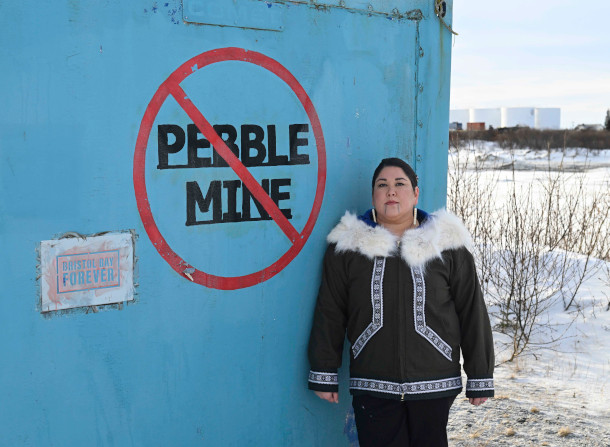
The proposed Pebble Mine project threatened the local waterways and endangered wildlife like the sockeye salmon. After a long fight, the U.S. EPA officially canceled the project in 2023. (Photo: Goldman Environmental Prize)
CURWOOD: You eventually became the Executive Director of the United Tribes of Bristol Bay. How important would you say tribal cooperation has been during this fight?
HURLEY: Tribal unity and cooperation has been absolutely critical. I think in any instance where a coalition is working to protect a place, having Indigenous people leading and centered at the effort is absolutely critical. Local people need to be at the forefront of these fights, and without that unity in the bay, there's no way we would be where we're at today.
CURWOOD: So you were involved in building that coalition, including Native Alaskans, but also other political constituencies, the commercial fisherpeople and such. Talk to me about that. What was it like to build a coalition like that?
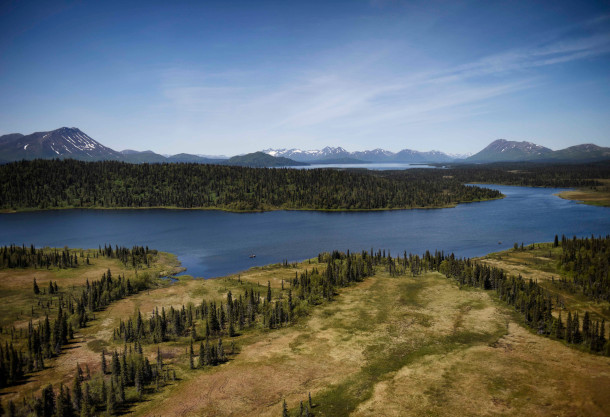
A landscape view near the village of Aleknagik, Alaska. As the executive director of the United Tribes of Bristol Bay, Alannah Acaq Hurley represented over a dozen federally recognized tribal nations and around 80% of the region’s population. (Photo: Misty Nielsen for the Goldman Environmental Prize)
HURLEY: In the case of United Tribes of Bristol Bay, it was really about centering and amplifying the tribal voice and really holding the government accountable for government to government consultation. And there was real unity in that. And I think anytime you're building coalition, it can be challenging. I mean, it's hard to get five people to agree to where you're going to go to dinner, let alone 15 tribal governments from different cultural backgrounds who historically didn't always get along, coming together to fight a common enemy for our continued existence as Indigenous people. That threat really brought us all together in ways that we had never seen before, and that also translated out to non-native groups, commercial fishermen, the conservation community, these aren't people who usually got along. We're used to fighting over fish, [LAUGHS] not working together to protect them, and so anytime you bring different groups together, there's going to be bumps in the road. At the end of the day, the connections between people, the relationships and the commitment to work through hard moments, and there were a lot of hard moments. [LAUGHS] And I think a commitment by especially non-native folks, to be in a respectful relationship with Native people and us having that requirement, like, if we are going to be partners, this is how we expect to engage, I think really helped lay the groundwork for a successful coalition. But like I said, that's never easy, it's never pretty, but it was really the people to people relationships, those kind of connections, held us together even in the hard times.
CURWOOD: Now you've spoken about your grandmother's influence and the values that propelled you through this journey. What lessons have you learned from that that have motivated you to keep going?
HURLEY: Yeah, my grandmother was Mancuaq, when I was raised with her in Clark's Point in Bristol Bay. And it's hard for me not to get emotional talking about her, because even now, even in all the different experiences in my life, and everything important, the most important things that have helped me navigate life in a way that has been good and, you know, really grounded in love and respect and kindness came from her. Also the ability to persevere when things are tough. She passed away in 2019. Sorry, I just gotta take a moment.
CURWOOD: Of course.
HURLEY: I obviously still miss her a lot. Just to continue, she provided me the foundation of values, of how to move forward and live in this world in a good way. And our people have had those teachings for centuries, timeless, timeless teachings of what it means to be a good, real human being on the planet. And that foundation has helped me in life in invaluable and countless ways, and it continues to do so every day.
CURWOOD: And by the way, Alannah, did you know your mother's grandmother?
HURLEY: I did not. She passed away before I was born. In true Yup'ik tradition, we, we name children after people who have passed in the practice that their spirit continues on in the person that takes their name.
CURWOOD: And to what extent have you felt that spirit, do you think?
HURLEY: If you ask my grandma, all the time, all the time. And I feel like I feel that spirit and her spirit with me, always, always, always. And I actually named my daughter Mancuaq, after my grandma. My daughter was born just shortly after my grandma passed, and I see, I see her in her every single day, feisty [LAUGHS] in all the good ways.
CURWOOD: [LAUGHS] Hey, what's in that mitochondria that you women pass along to your girl children?
HURLEY: [LAUGHS] Something special Steve, some magical stuff, for sure.
CURWOOD: What do you see the future of Bristol Bay to be? What does it look like in the future, do you think?
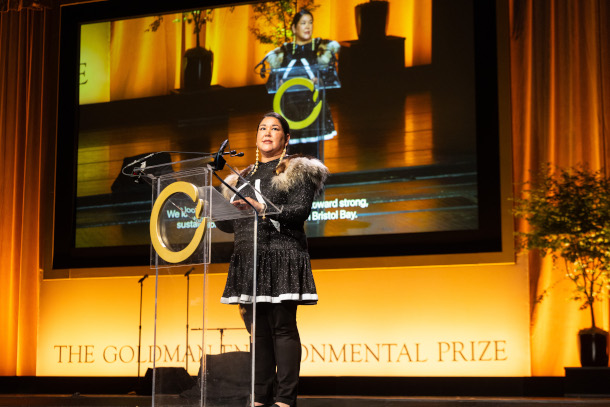
Alannah Acaq Hurley at the Goldman Environmental Prize award ceremony. (Photo: Goldman Environmental Prize)
HURLEY: The future of Bristol Bay is beautiful. We are still struggling with the impacts of colonization, but we have only begun our healing, our reclamation, our revitalization of who we are as Indigenous people, and we have been so lucky that even through all of that and all of those challenges, our people have been able to remember and retain and still pass on our values and way of life. And I'm just so excited. I feel like the potential to be a model of sustainability for the world led by Indigenous communities in modern society is boundless, and so I'm really excited and hopeful that our region can shift from having to put our energy in defense of our homelands, to now build, help build something beautiful and tackle some of the tough issues that we're facing.
CURWOOD: Alannah Hurley is the North American winner of the Goldman Environmental Prize this year and Executive Director of United Tribes of Bristol Bay in Alaska. Thanks so much for taking the time with us today.
HURLEY: Yeah, thank you so much for having me. I really appreciate it.
Links
Alannah Acaq Hurley profile at The Goldman Environmental Prize
The Goldman Environmental Prize
Watch The Goldman Environmental Prize video profile of Alannah Acaq Hurley
Living on Earth wants to hear from you!
Living on Earth
62 Calef Highway, Suite 212
Lee, NH 03861
Telephone: 617-287-4121
E-mail: comments@loe.org
Newsletter [Click here]
Donate to Living on Earth!
Living on Earth is an independent media program and relies entirely on contributions from listeners and institutions supporting public service. Please donate now to preserve an independent environmental voice.
NewsletterLiving on Earth offers a weekly delivery of the show's rundown to your mailbox. Sign up for our newsletter today!
 Sailors For The Sea: Be the change you want to sea.
 The Grantham Foundation for the Protection of the Environment: Committed to protecting and improving the health of the global environment.
 Contribute to Living on Earth and receive, as our gift to you, an archival print of one of Mark Seth Lender's extraordinary wildlife photographs. Follow the link to see Mark's current collection of photographs.
 Buy a signed copy of Mark Seth Lender's book Smeagull the Seagull & support Living on Earth
© Copyright World Media Foundation. All Rights Reserved
Home | Contact | RSS | Donate | Newsletter