

Glyphosate at the Supreme Court
Air Date: Week of May 1, 2026
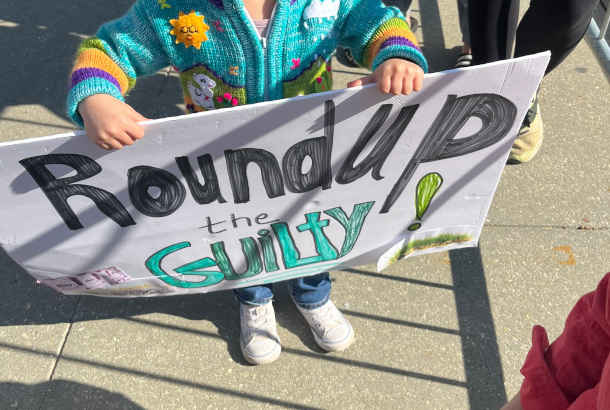
A toddler carries a sign that reads “Round up the Guilty” during the protests outside the U.S. Supreme Court on Apr 27, 2026 for the Monsanto Company v. Durnell hearings. (Photo: Carey Gillam)
The US Supreme Court recently heard oral arguments for Monsanto v. Durnell, a case about whether states can require warning labels on pesticides if the EPA does not. This stems from thousands of lawsuits against Roundup maker Monsanto, alleging that farmers and landscapers who developed cancer weren’t warned of the risks. Though the World Health organization has classified glyphosate, the key ingredient in Roundup, as “probably carcinogenic”, the EPA has not found glyphosate can cause cancer. Pat Parenteau is an emeritus professor at Vermont Law and Graduate School, discusses with Host Steve Curwood.
Transcript
CURWOOD: From PRX and the Jennifer and Ted Stanley Studios at the University of Massachusetts Boston, this is Living on Earth. I’m Steve Curwood.
Thirty years ago, commercial agriculture was revolutionized with the advent of soybeans genetically modified to be "roundup ready" which meant they could be sprayed with the weedkiller without being harmed. GMO seeds for corn soon followed and the industrial scale no-till farming it allowed in the following decades boosted US crop yields by some 50 percent or so. But the active ingredient in Roundup, glyphosate, has also grown controversy, with research suggesting it probably causes cancer. Monsanto, which developed Roundup, and is now owned by Bayer, has been the target of numerous lawsuits with some juries making multimillion dollar awards to farmers and landscapers who weren't warned of the cancer risks. But the EPA has not found glyphosate can cause cancer, and the US Supreme Court recently heard oral arguments for Monsanto v. Durnell. The Court will decide whether states can require warning labels on pesticides if the EPA does not. Pat Parenteau is an emeritus professor at Vermont Law and Graduate School and served as an EPA regional counsel under President Ronald Reagan. Welcome back to Living on Earth!
PARENTEAU: Thanks, Steve, it's very good to be with you.
CURWOOD: So talk to me about the background of this case. Why did the Supreme Court hear arguments on failure to warn claims under state laws, Missouri's state law, I believe?
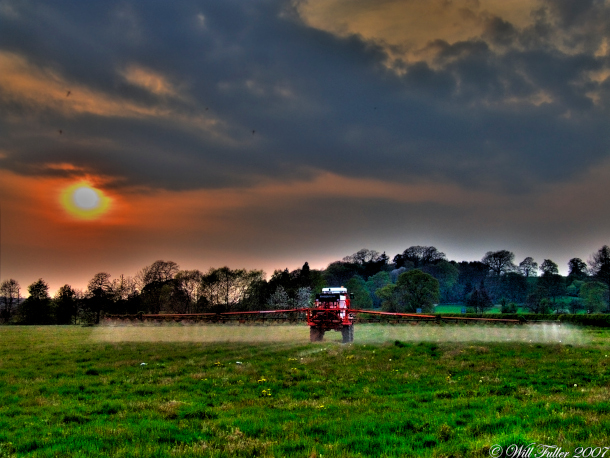
Herbicides like Monsanto’s (now Bayer’s) Roundup are often sprayed through tractors like the one pictured above. (Picture: Will Fuller, Flickr, CC BY-NC-ND 2.0)
PARENTEAU: That's right. It was a $1.25 million verdict that the jury in St Louis handed down in favor of the plaintiff in that case. So the law in question is FIFRA, the Federal Insecticide, Fungicide and Rodenticide Act, and it's a controversial statute in the sense that, unlike other environmental laws, this one has a specific requirement for a cost-benefit analysis. You know, you don't find that with the Clean Air Act, the Clean Water Act, the Superfund law, nor other laws, FIFRA is different. So Congress made a conscious decision that, you know, some of these pesticides that are key to what is considered crop production, they do come with risk. And so there's an explicit recognition that even though a product may pose health risks, unless those are, as the statute puts it, “unreasonable” risk, EPA can go ahead and register these chemicals, knowing that there are some risks, and not knowing what other risks that might emerge from them. So that's what makes this law particularly problematic, I think, to some of us, because it's an explicit recognition that economics can triumph over health concerns. And then you get to the question of labels. So when EPA registers a pesticide like glyphosate or Roundup under FIFRA, EPA also approves the label suggested by the company. That's another problem with this law is that the manufacturers are in control of everything. They're the ones that do the Health Studies and the risk studies, and EPA doesn't have independent means to do that for the thousands of chemicals that are coming onto the market every year. So they rely on industry telling the truth about what their product’s risk might involve. And then when it comes to the label, it's up to the companies to decide. What are they going to put on the label, in terms of warnings or in terms of use restrictions and so forth? So that's all determined by the companies as well. And then EPA does sign off on these labels. And then you come to the question of, does an EPA approval of a label that doesn't contain certain warnings, does that preempt the states from going further with requiring other forms of risk disclosure? That's where we are with this case.
CURWOOD: By the way Pat, to what extent do you think industry influenced this legislation and all the way these rules work?
PARENTEAU: Oh, of course they did. I mean, it's another case of capture, if you want to look at it that way and lots of scholarship has been written about how EPA and other regulatory agencies get captured by the industries they're trying to regulate, because the industries have all of the wherewithal and the knowledge, frankly, about their products, and EPA is constantly trying to play catch up or reacting to what the industry is proposing. So industry data, you know, garbage in, garbage out.
CURWOOD: So what are the plaintiffs from the state of Missouri arguing in this case?
PARENTEAU: So the plaintiffs are saying that, as a result of a World Health Organization study of glyphosate, the World Health Organization's concluded it is a probable human carcinogen. EPA has never found that glyphosate poses a cancer risk, and that's regardless of who's in the White House. I mean, that's Republican and Democrat administrations have basically said that we don't see conclusive evidence that glyphosate causes cancer, specifically non-Hodgkin’s lymphoma, is the particular brand, if you will, of cancer that has been linked to glyphosate. So you have this track record of EPA saying it's safe, basically, I mean, they don't come right out and say it's safe, but they say it is not a proven carcinogen. And then you have the state of Missouri saying that, based on the World Health Organization's studies and some others, we think that you should be including a warning on the label. And that's where you come into the preemption question. So you know, can the state of Missouri and a jury in Missouri, can they impose additional disclosure requirements beyond what EPA has approved? That's the nub of the issue before the Supreme Court.
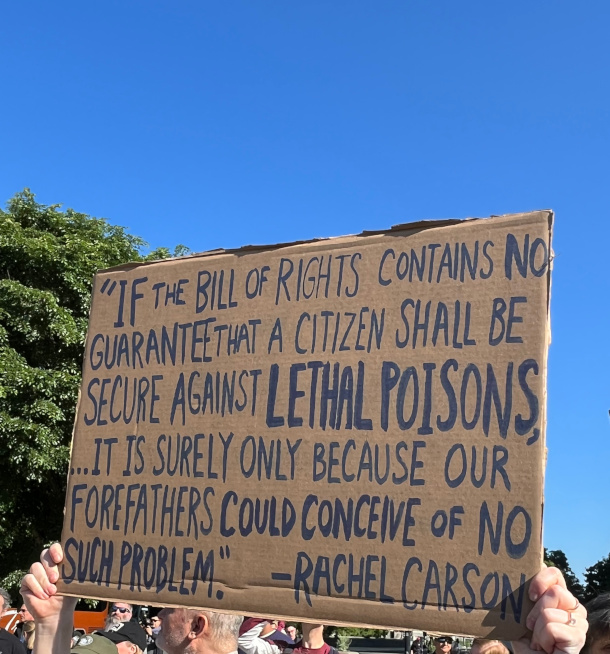
Pictured above is a sign carried by a protester outside the U.S. Supreme Court Apr 27, 2026 Monsanto Company v. Durnell hearings. (Photo: Carey Gillam)
CURWOOD: And this particular plaintiff said that he had not been warned of the risks of using this chemical, and it is, in fact, from his perspective, a dangerous chemical. And I believe, Pat, to what extent did this plaintiff argue originally, that some of the research conducted by the companies involved here, involved people who have fraudulent records?
PARENTEAU: Yeah, he did allege a fraud. The jury did not find in his favor on that count, but they certainly found in favor of the requirement to disclose the cancer risk, and this individual was applying roundup to fields in the city of St Louis on a daily, almost basis. You know, fighting weeds is a never-ending problem, right? So he said that some of Monsanto's advertising in Missouri actually encourage people to apply roundup in their shorts and T shirts when it got really hot in the summer and of course, that's what this guy did for years, and then he did develop non-Hodgkin’s lymphoma. He didn't die from it, thankfully but, you know, cancer is never a fun thing. So yeah, that's what the jury found is that these requirements complement FIFRA, they don't conflict with FIFRA. And the Court of Appeals in Missouri likewise said that there's no real conflict here between compliance with what the jury in this case found, and also Missouri law requiring disclosure of these kinds of risks and what FIFRA requires. In fact, they are mutually reinforcing. That's what the courts in Missouri found.
CURWOOD: So what's at stake in this case here?
PARENTEAU: What's at stake is that there are 100,000 lawsuits. Just think about that for a minute: 100,000 lawsuits claiming that Bayer has to disclose the cancer risk of glyphosate, right? So, I mean, this is unprecedented, frankly, in terms of toxic tort litigation, this is the largest number ever. So you're talking billions and billions of dollars. Literally, you're talking about putting Bayer out of business perhaps, if all of these cases went to verdict. The truth is that the track record of these lawsuits is mixed, okay? So some states have actually enacted laws to shield Bayer and other manufacturers of pesticides from liability. There have been different state court verdicts, some that went against Bayer and Monsanto, and some that didn't, some that went in their favor. So and now there's a split among the US Courts of Appeal over this question of, can states impose additional disclosure requirements beyond what EPA has required, right? So you know, that's why the Supreme Court took it. There is definitely a split in the circuit courts. There needs to be a resolution one way or the other, of to what extent do states have some authority to impose additional disclosure requirements, or is it truly the case that it's just whatever EPA decides? And of course, that means whoever is in charge of EPA at any particular moment in time, right? So that's kind of where we are, and we can talk some more about what happened at the argument.
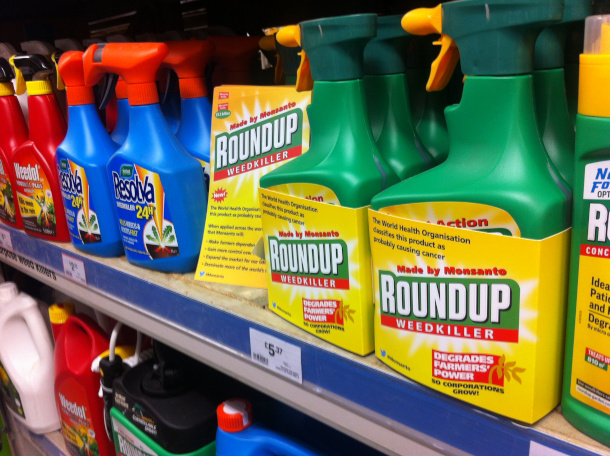
In the United Kingdom in 2016, activists labeled bottles of Monsanto's Roundup weedkiller in garden centers and DIY shops with critiques of Monsanto. Now Monsanto has generally stopped direct sales to consumers, with Roundup only available for farmers. The United States case Monsanto Company v. Durnell addresses whether the Federal Insecticide, Fungicide and Rodenticide Act (FIFRA) preempts state-level failure-to-warn lawsuits regarding cancer risks on Roundup labels. (Photo: Global justice Flickr, CC BY 2.0)
CURWOOD: What did happen at the argument Pat?
PARENTEAU: So what do they say, reading the Supreme Court oral argument is like reading chicken entrails? But the point is that there were tough questions on both sides, and they were coming from the full spectrum of the court. This time it wasn't just totally dominated by the conservative justices. Justice Gorsuch was expressing extreme skepticism about Bayer's arguments that once EPA has approved a label, that's it. And he was saying, you mean even, and the Chief Justice said the same thing, you mean even if a state discovers through a scientific analysis that a product definitely does pose a serious health risk, you mean that states are powerless to do anything about that? So there was that line of argument, but then you had, surprisingly, justice Kavanaugh and Justice Kagan both saying, yeah, but what about the goal in FIFRA of uniformity, right? Don't we want a uniform requirement for what has to be disclosed on these labels? And if you have a patchwork, one state saying this, another state saying that, how does that further Congress's goal of uniformity? So the bottom line is, this is a real split decision. I think this could likely come down to a five-four kind of outcome, and it's not clear exactly how far the court might go in prohibiting states from imposing these additional disclosure requirements, because there's an earlier Supreme Court decision, Bates versus Dow Chemical, which basically said, as long as the state laws are consistent with FIFRA, that is to say, they don't go beyond FIFRA, or they don't conflict with what FIFRA requires, then there's no real problem with preemption, right? So it could be that the court either comes down in favor of the plaintiffs in this case, or if it doesn't, it carves out at least some role for the states under certain circumstances, let's say, for example, a state says, well, you're misbranding your product here. You're not disclosing recent evidence of potential harm, right? So if you couch it as a misbranding kind of problem, then the states have some latitude, some authority, to say, well, you've got to be more careful and not mislead people about what the potential dangers are. So it's hard to say how it's going to come down, but you know, given this Court's track record of sort of siding with industry in these closed cases, it's cause for significant concern, because if the court says that these failure to warn cases can no longer be brought, that is going to have an incredible impact on holding companies accountable to these risks and the disclosure requirements and basically slamming the courthouse doors shut on people that could have and probably do have legitimate claims.
CURWOOD: What about the other side here, Pat? You suggest that this may be an existential threat to Bayer, if the court finds against them, there's just so much money at stake here. So to what extent is the court perhaps considering whether or not Bayer and the company that had acquired Monsanto as a subsidiary will survive? How important is that to them?
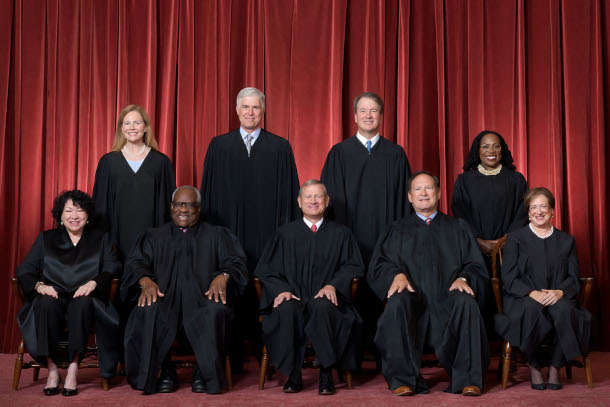
The current U.S. Supreme Court. Seated, from left: Justices Sonia Sotomayor, Clarence Thomas, Chief Justice John G. Roberts, Jr., and Justices Samuel A. Alito and Elena Kagan. Standing, from left: Justices Amy Coney Barrett, Neil M. Gorsuch, Brett M. Kavanaugh, and Ketanji Brown Jackson. (Photo: Fred Schilling, Wikimedia Commons, Public Domain)
PARENTEAU: Yeah, I think that is an important inquiry, certainly for, I would say, all the justices, but particularly for the conservative justices, the idea that these claims about the cancer risk, the court can't adjudicate that question. They can't decide, does glyphosate create a carcinogenic risk or not? All they can do is say, if these 100,000 cases proceed to verdicts like some of the verdicts that are being handed down, these companies will be put out of business and a vital resource, well, you remember President Trump issued an executive order invoking the Defense Production Act and declaring that glyphosate is a national security matter. So that is also, I think, probably factoring into the court's deliberations on this is, it isn't just a matter of do individual plaintiffs have a right to go to court, it's a question of whether a company providing a vital resource that the President believes is a national security matter would be put out of business. So yeah, I mean lots of different high-level issues swirling around a case like this. It looks narrow, but when you back up and look at it from a larger perspective, it has really profound implications.
CURWOOD: Pat Parenteau is an emeritus professor at Vermont law and graduate school. Pat, always so good to have you on.
PARENTEAU: Thanks Steve, pleasure to be with you.
Links
Learn more about Pat Parenteau
Civil Eats | “Supreme Court Considers Pesticide Warnings, as MAHA Rallies”
Listen to the Monsanto Company v. Durnell oral arguments from Apr 27, 2026
SCOTUSBLOG | “Justices Debate Who Gets to Decide That Pesticide Labels Need a Cancer Warning”
The New Lede | "US judge calls proposed Bayer Roundup settlement a “filthy” deal"
Living on Earth wants to hear from you!
Living on Earth
62 Calef Highway, Suite 212
Lee, NH 03861
Telephone: 617-287-4121
E-mail: comments@loe.org
Newsletter [Click here]
Donate to Living on Earth!
Living on Earth is an independent media program and relies entirely on contributions from listeners and institutions supporting public service. Please donate now to preserve an independent environmental voice.
NewsletterLiving on Earth offers a weekly delivery of the show's rundown to your mailbox. Sign up for our newsletter today!
 Sailors For The Sea: Be the change you want to sea.
 The Grantham Foundation for the Protection of the Environment: Committed to protecting and improving the health of the global environment.
 Contribute to Living on Earth and receive, as our gift to you, an archival print of one of Mark Seth Lender's extraordinary wildlife photographs. Follow the link to see Mark's current collection of photographs.
 Buy a signed copy of Mark Seth Lender's book Smeagull the Seagull & support Living on Earth
© Copyright World Media Foundation. All Rights Reserved
Home | Contact | RSS | Donate | Newsletter