

A Woolly Rhino DNA Discovery
Air Date: Week of March 27, 2026
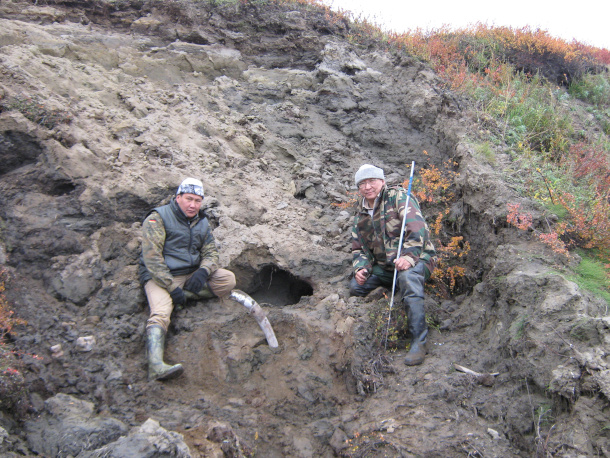
The woolly rhino DNA was discovered in the stomach of a mummified wolf puppy found in this piece of permafrost in the Russian village of Tumat. Pictured above is a coauthor of the paper, Sergey Fedorov (right) and a local colleague. (Photo: Sergey Fedorov, courtesy of J. Camilo Chacón-Duque)
A recent discovery is giving us insights into the last days of the woolly rhinoceros in Siberia before it went extinct some 14,000 years ago. Researchers studied the DNA of a well-preserved piece of woolly rhino meat that was the last meal of a wolf pup. Study coauthor Camilo Chacón-Duque, a bioinformatician at Uppsala Universitet, speaks with Host Jenni Doering.
Transcript
CURWOOD: Thanks to rare remnants of ancient life scattered in the Earth, which we humans dig up, we’ve been able to piece together some of the past of this planet. And one recent discovery is giving us insights into the last days of the woolly rhinoceros in Siberia before it went extinct some 14,000 years ago.
DOERING: Woolly rhinos looked a lot like modern white rhinos, except of course with a thick shaggy coat. The climate they evolved for was a much colder Ice Age world, so like woolly mammoths, woolly rhinos needed that coat to stay warm.
CURWOOD: And they apparently went extinct when the planet was going through some abrupt climate gyrations towards the end of the Ice Age. The woolly rhino sample that is the focus of this latest discovery was the last meal of a wolf pup.
DOERING: And it was so well-preserved that an international team of researchers was able to extract and analyze this rhino’s DNA. Here to speak with us is coauthor of the study Camilo Chacón-Duque, a bioinformatician at Uppsala University in Sweden. Welcome to Living on Earth!
CHAĆON-DUQUE: Hello, Jenni, thank you for inviting me.
DOERING: So I understand that you found this woolly rhino DNA in the belly of a mummified wolf puppy. Can you tell me the story of this ancient pup?
CHAĆON-DUQUE: It all starts in 2011 when some local people that were exploring the permafrost around a village called Tumat in northeast Siberia, found this very unusual mummy. They really didn't know what it was, so they called a team of paleontologists, including one of the coauthors of the study. And then they went to the site. They did all the characterization of the site. They took the specimen to the museum, and they define it was wolf puppy. There's been a lot of studies on this puppy, and actually another puppy that was found in the same site a few years after that, and they found out that they were two female cubs, two female puppies. They were around seven to nine weeks old, and they probably died because the den where they lived collapsed, so they died quite quickly. And since the environment was so cold, they pretty much froze immediately.

J. Camilo Chacón-Duque is one of the researchers on a recent paper describing how scientists pulled DNA from an extinct species called the woolly rhinoceros. The results have implications for how species go extinct today. (Photo: Natalia Romagosa, courtesy of J. Camilo Chacón-Duque)
DOERING: I guess that immediate collapse and dying pretty quickly helped preserve this ancient DNA. So how did your team manage to extract this DNA from the puppy's stomach?
CHAĆON-DUQUE: Okay, this is where my colleagues at the Center for Paleogenetics in Stockholm come to the picture. Basically, these colleagues from Siberia and other countries that were working on this specimen, they found this piece of meat inside the stomach of this puppy. And it was very surprising to them to see the level of preservation of it because it even had some fur still attached to it. They look pretty much like non-digested. And they were suspecting it could be a cave lion, just based on the color of the fur. And they knew that someone in our center was working with cave lions. So, they sent this sample for some sort of DNA identification because they also knew that in our center, people specializes on getting DNA out of these like challenging samples from the permafrost. And then this colleague managed to get a small amount of DNA good enough to make a species identification. And then when he was running the data analysis, he realized he was not a cave lion. It was actually a woolly rhinoceros. And that's where, sort of all the story with the sample starts for us.
DOERING: What actually makes this discovery special and exciting for you?
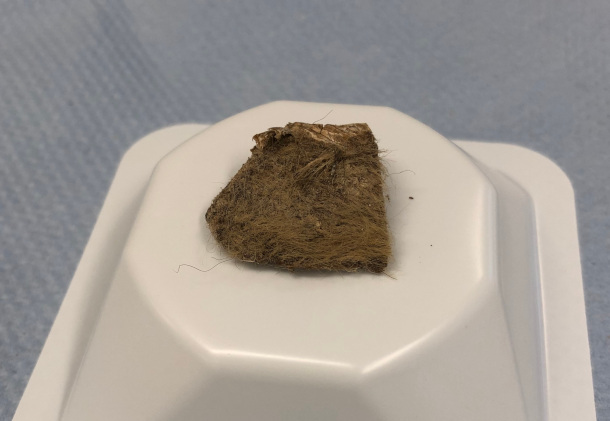
The researchers were astounded by the intact nature of the woolly rhino tissue found inside the stomach of the wolf puppy. Note that the small cut marks are from the DNA sampling done at the Centre for Palaeogenetics in Stockholm. (Photo: Love Dalén, courtesy of J. Camilo Chacón-Duque)
CHAĆON-DUQUE: It's actually, to our understanding, the first time that we can get such a high resolution on the genetic code of an organism from such an unusual and challenging sample. So then being able to get this very detailed picture of its genetic background profile is amazing. Also, the fact that this individual dates back to very close to the extinction of the species. So basically, the species disappear from the fossil record around that time, like some 400 years after the time where this specific individual existed. So it meant for us that we got very, very close to the final extinction event of the species. We could have not done that with just a regular fossil.
DOERING: That's really lucky, how close in time this appears to be to when the species actually seems to have gone extinct.
CHAĆON-DUQUE: Yes, that's something very striking for us. And the other thing that we found fascinating is in terms of genetic diversity, in terms of different signs of potential, like genetic decline, comparing this individual to other two individuals far back in the past, one of them, 19,000 years ago and the other one almost 50,000 years ago, is that they were pretty much the same in terms of diversity, so that probably they were somehow stable through tens of thousands of years before they disappear. So whatever happened happened in those last 400 years.
DOERING: What did it feel like when you realized that you were able to actually piece this together?
CHAĆON-DUQUE: This is probably one of the most fun and challenging projects I've ever worked with. And it feels lucky, even though it's a lot of hard work, so there's nothing of luck in that actually. But it just feels such a privilege to be able to access this sample, to be able to have found a piece of meat inside of an animal that was so beautifully preserved that ended up also having this possibility of getting those take a peek into the history of another species, into the life history of probably the last existing members of another species. That just feels like something that you will never even dream of.
DOERING: So Camilo, what do we know about what caused the extinction of the woolly rhino maybe 14,000 or so years ago?
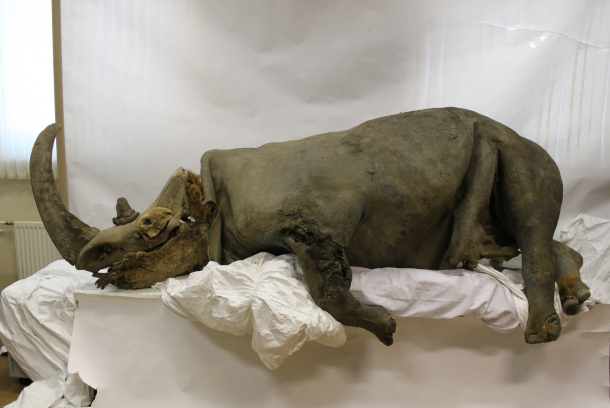
This research built off of previous work done on other preserved woolly rhinos, including this one residing in Yakutsk, Russia. (Photo: Mammoth Museum of North-Eastern Federal University, courtesy of J. Camilo Chacón-Duque)
CHAĆON-DUQUE: Okay, that's pretty interesting question. And there was a big climate change event happening around the same time that the species disappeared, like a warming event, and this tell us that climate change must have been one of the main, or the main cause of extinction. Obviously, we cannot rule out that there were other things influencing like humans, but climate change probably played a main role.
DOERING: We humans are pretty good, unfortunately, at helping species along towards extinction, and right now, experts say that we're currently facing a mass extinction crisis. Some call it the sixth mass extinction. So what can research about previous extinctions teach us about what's happening to species today?
CHAĆON-DUQUE: What we know from a few extinct species for which we have genetic information, such as the woolly rhinoceros or the woolly mammoths, is that it seems that they were stable for long periods of time, even though they declined in population at different points, but then after that, they will have long periods of stability. I mean, this probably tells us that, as many researchers have been finding out on recent species and species that are still alive, it’s a fast process. So, we really need to do more to protect the environment, to stop destroying things, to allow animals to keep their habitats and to deal with the environment changes. If we don't stop destroying their habitats, there won't be ways in which we could help them.
DOERING: Camilo Chacón-Duque is a bioinformatician at Uppsala University. Thank you so much, Camilo.
CHAĆON-DUQUE: Thank you, Jenni for having me here. It was a pleasure to be here.
Links
Explore more of Camilo Chacón-Duque’s work.
Read the original research paper about the woolly rhino DNA discovery.
Living on Earth wants to hear from you!
Living on Earth
62 Calef Highway, Suite 212
Lee, NH 03861
Telephone: 617-287-4121
E-mail: comments@loe.org
Newsletter [Click here]
Donate to Living on Earth!
Living on Earth is an independent media program and relies entirely on contributions from listeners and institutions supporting public service. Please donate now to preserve an independent environmental voice.
NewsletterLiving on Earth offers a weekly delivery of the show's rundown to your mailbox. Sign up for our newsletter today!
 Sailors For The Sea: Be the change you want to sea.
 The Grantham Foundation for the Protection of the Environment: Committed to protecting and improving the health of the global environment.
 Contribute to Living on Earth and receive, as our gift to you, an archival print of one of Mark Seth Lender's extraordinary wildlife photographs. Follow the link to see Mark's current collection of photographs.
 Buy a signed copy of Mark Seth Lender's book Smeagull the Seagull & support Living on Earth
© Copyright World Media Foundation. All Rights Reserved
Home | Contact | RSS | Donate | Newsletter