

Climate Resilience Grants Resume
Air Date: Week of March 27, 2026
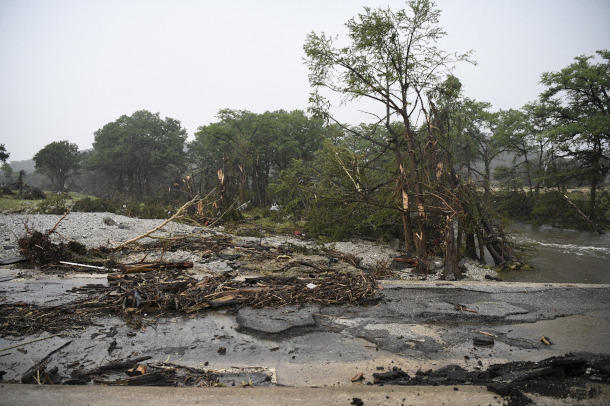
Devastation from the July 4, 2025 floods in Central Texas. FEMA’S decision to cut the Building Resilient Infrastructure and Communities Program (BRIC) stopped nearly 700 disaster preparedness projects across the United States. (Photo: World Central Kitchen, Wikimedia Commons, CC BY 4.0)
A federal judge recently issued an enforcement order mandating the release of funds from FEMA's Building Resilient Infrastructure and Communities or BRIC program, which the Trump administration had stalled. Alice Hill, a senior fellow at the Council on Foreign Relations, and the former senior Resiliency Director on the National Security Council for President Obama, discusses with Host Steve Curwood why money spent to protect critical infrastructure from disasters like storms, floods and wildfires pays for itself many times over.
Transcript
DOERING: From PRX and the Jennifer and Ted Stanley studios at the University of Massachusetts, Boston. This is Living on Earth. I'm Jenni Doering.
CURWOOD: And I'm Steve Curwood. In its rush to cut budgets and slash programs considered too progressive by the second Trump administration, a fair amount of chaos has resulted, and a prime example is resiliency funding for states to help save lives and disaster expense. An exasperated federal judge in Massachusetts, Richard Stearns, recently issued an enforcement order mandating the release of funds from FEMA's Building Resilient Infrastructure and Communities or BRIC program.
DOERING: This money is of the ounce of prevention is worth a pound of cure variety to avoid spending many billions of dollars needed to clean up after climate related disasters such as storms, floods and wildfires, but it was abruptly terminated in the middle of a $4 billion grant cycle in April of 2025 upending budgets in 22 states.
CURWOOD: FEMA claimed BRIC was rife with "waste, fraud and abuse, and politicized" code words commonly used by the Trump administration to block what it considers woke climate action. Joining us is Alice Hill, a senior fellow at the Council on Foreign Relations, and the former senior Resiliency Director on the National Security Council for President Obama. Welcome back to Living on Earth.
HILL: Thanks for having me, my pleasure.
CURWOOD: So what is the Building Resilient Infrastructure and Communities Program, or BRIC?
HILL: It's a very important program. It focuses on reducing damage before disaster strikes. So typically, our model has been post disaster we'll try to clean up and fix things, but if you invest ahead of time, you can greatly reduce the damage. BRIC is a program passed by Congress in 2018 that was the largest pre-disaster mitigation program ever offered by the federal government. Substantial money involved, and it was designed to help Americans better survive in a world with worsening extremes.
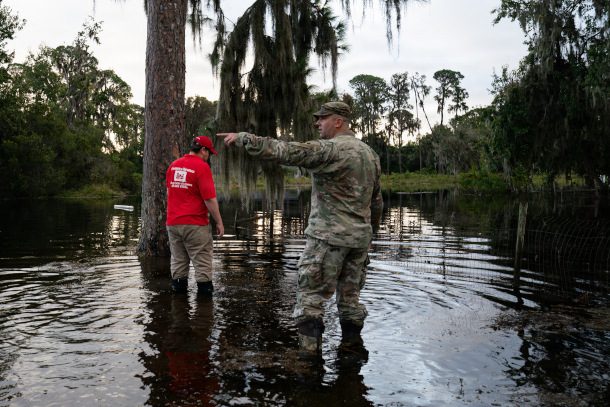
Pictured above is U.S. Army Corps of Engineers (USACE) Jacksonville District Deputy Commander Maj. Matthew Westcott (right) and his liaison officer (Jake Edwards, left), responding to flood impacted communities in Lake County Florida. Florida was one of the many states impacted by FEMA’s cut to the BRIC program. (Photo: US Army photo, Brigida I. Sanchez, Wikimedia Commons, Public Domain)
CURWOOD: How much did the program cost back then, and how much money do you think it saved?
HILL: Well, the program costs somewhere close to 6% a year of all the money that the federal government spends on disaster or up to 6 percent. So years it's been in force since 2018 federal government has spent about $4.5 billion on the programs. The savings, you have to look further back, but over the last several decades, according to 22 states plus the District of Columbia that sued FEMA to get the program going again, the program and other similar programs have saved the federal government taxpayers $150 billion in a couple of decades. That's a lot of savings. And just to show you how significant this could be, cost-benefit analysis shows that, on average, every dollar that the federal government spends on reducing disasters before they strike saves $6 in recovery costs. But if you look at something like building codes for every $1, $11 and then if you get the culverts, making just your culverts wider so they can have more flood waters pass through, II'm told by an Army Corps of Engineer leader that it can be $25 for every dollar you spend. So there's huge payoff. And this is in the interest of all of us. It means the federal government isn't on the hook when disaster strikes for as much to help communities bounce back and get back to business.
CURWOOD: So let's say that I was representing a state or a community and was concerned about the lack of these funds. What would I be saying that my community, my state would need? How would it help the state mitigate a storm or a earthquake or something like that?
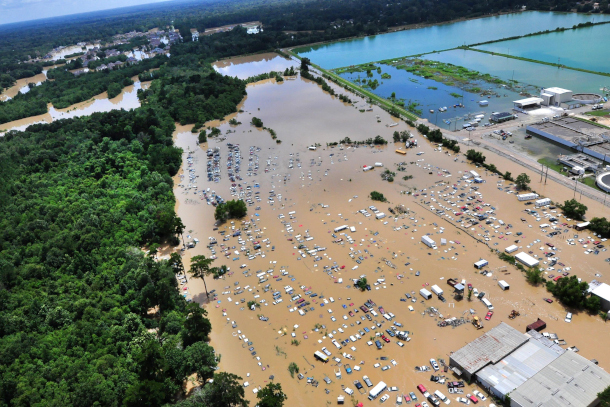
Pictured above is a view from an MH-65 Dolphin helicopter showing flooding and devastation in Baton Rouge, LA on Aug. 15, 2016. (Photo: Melissa Leake, Coast Guard, Wikimedia Commons, CC BY 2.0)
HILL: Well, the BRIC program gave out funds for all kinds of projects. So let's say you have wildfire. It could be for brush clearance. You've mentioned storms. It could be for widening the culverts. It could be for doing a sea wall. It could be for elevating a hospital so that critical infrastructure doesn't get flooded, like we saw in Sandy and the hospitals went dark and we were evacuating people down darkened stairwells because the generators were in the basement. It can be utility hardening so you don't have a substation flooded out during a storm, also something that happened during Sandy and it can be just to make sure that the pumps work for a city like New Orleans in extreme rainfall, it's important that those pumps keep moving the water out of the city to keep the city safe. So all kinds of investments in actual projects, but it also could be used for building codes, and building codes are one of the most important ways to have resilience. So FEMA, under President Biden, had put great emphasis on building codes and then the enforcement of building codes to help local communities have better building practices, so they had stronger buildings. The roof is screwed down, for example, and doesn't blow off in a storm, or the structure is elevated, or there's ceiling of the roof so water doesn't penetrate.
CURWOOD: So please describe for me some of the communities across the United States that benefited from the BRIC program when it was in operations. What projects are we talking about?
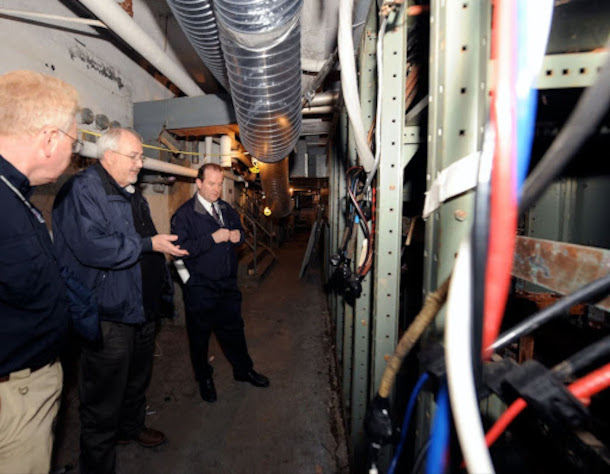
After Hurricane Sandy in 2012, then-FEMA administrator Craig Fugate (center) speaks about mitigation steps to Coney Island Hospital, which was badly damaged during the storm with seawater flooding its basement and emergency room. To his left is FEMA Federal Coordinating Officer Michael Byrne, and to his right is Coney Island Hospital Director of Facilities, Daniel Collins. (Photo: National Archives at College Park - Still Pictures, Wikimedia Commons, Public Domain)
HILL: Well, we've had some projects, very important projects in New York, for example, and New York has been a leader in resilience. So lower Manhattan had a $50 million grant to reduce flooding and integrate flood protection into public spaces so it could improve waterfront access, and then those public spaces would also absorb rainfall because there was more green space. In California the emphasis is not all climate worsened events. In California, there was an emphasis on seismic retrofit. So to make sure the hospitals, if there's a big quake could continue to operate very, very important to have your health care system secure in the course of an event. Detroit has had chronic basement flooding, and then, because there's basement flooding, the sewers overflow and that it's just a health risk and just a foul event, and they received $20 million to install new sewer mains. In Greenville, North Carolina there were efforts to address repeat flooding from hurricanes, helping various households with reducing flooding. So we've seen a spread of projects across the United States. I will say, when the program was first started, early on, there were some problems with richer, more affluent communities being able to access these funds, and poor, more vulnerable communities less able to present the kind of proposals that won awards of money.
CURWOOD: What's going on right now in terms of distributing this money? Now that a judge has said to the Trump administration, “Nope, you've got to reinstate this program.”
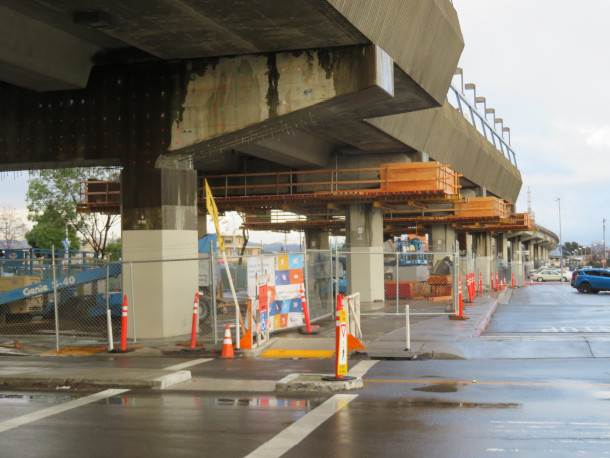
Shown above is seismic refit work, to protect infrastructure from potential earthquakes, being done at Fruitvale station in Oakland, CA in March 2018. (Photo: Pi.1415926535, CC BY-SA 3.0, Wikimedia Commons)
HILL: Well, it's really interesting how this unfolded. Judge Stearns issues his permanent injunction in December 2025 basically saying, “FEMA, you got it wrong, you cannot stop this program on your own, you need to get going again.” They don't do much. So the states come in and file a motion to enforce the order that the judge had issued, and the judge, on March 6, issues an order and says “FEMA's told me they've been really busy, but that's not good enough, they have to do more.” And he sets forth a whole list of things that FEMA needs to do in the next few weeks, like unfreeze the funds and give mandatory status updates and issue a notice of funding. So he's tightened the leash very dramatically, and he's going to oversee the implementation of the order. Well before the time limit has run, FEMA issues a press release just days before the order that the judge has entered is coming into effect, makes no mention of the order and says, “Oh, we are now embracing mitigation, if it's done right,” and they state that they will now go ahead and operate the BRIC program. I found it really interesting that there was complete omission of the legal action, and then they say bluntly in the press release, “When done correctly, mitigation activities save lives and reduce the cost of future disasters.” Well, that was true before the lawsuit was filed, and it's true after but now they are re-engaging on the BRIC program. It remains to be seen. I imagine there'll be further litigation to make sure that FEMA is doing what the judge has ordered it to do.
CURWOOD: So environmental and science programs have been cut across the board by the Trump administration. What do you think the reopening of the Building Resilience, Infrastructure and Communities Program says about how the courts are reacting to this administration?
The Building Resilient Infrastructure and Communities Program, or BRIC, is a pre-disaster mitigation program passed in 2018, and administered by FEMA. (Photo: Andy Feliciotti, Unsplash, Unsplash License)
HILL: The courts have put the brakes on some Trump actions. They have made it clear that they expect their orders to be followed, and they have expressed frustration when the orders are not followed or as we saw here in this instance, a flip-flopping of positions. And once you get into the courtroom, a judge will often look to pinning down one side or the other as to what their actual position is, so that the case can move forward. So we see greater assertion by the judges of authority to make sure that the Trump administration moves forward and does what it says it's going to do. I was a former prosecutor. I was a former assistant United States attorney, and one of the things as an assistant United States attorney, I benefited from the assumption that when I spoke for the federal government, that the federal government was speaking truthfully, so there was some deference to me by the judges from the court. I think that's been eroded because so many Trump lawyers have not been able to state a firm position of the government, and have not followed through in making sure that the government complies with orders. So there has been an erosion of that presumption that the prosecutor is doing their job properly.
CURWOOD: What are some of the areas across the US that are in desperate need of these climate and other natural disaster resiliency programs?
HILL: Well, another effort that was undertaken in recent years is to identify particular communities, looking at census tracts that are highly vulnerable to disasters, but also economically vulnerable, and they created these community Disaster Resilience Zones, CDRZ, and BRIC was now tied to that program to make sure that applicants from those areas were benefited by BRIC, so that it wasn't just affluent communities with more planners, more consultants that ended up with the funds, but instead, these communities in these zones of vulnerability and hazard would end up with adequate funding to help their projects. Many of these are rural communities, and the cost benefit analysis isn't as strong because you have fewer people than you do, say, in lower Manhattan, that benefit from the project, but they still need help. So that it was a major effort under the Biden administration to get some kind of analysis to better share the proceeds of BRIC.

Alice Hill is a senior fellow for energy and the environment at the Council on Foreign Relations, an independent think tank and publisher. During the Obama administration, Hill served as special assistant to the President and senior director for resilience policy on the National Security Council, where she led the development of policy addressing national security and climate change. (Photo: Alice Hill)
CURWOOD: When you were working with the National Security Council about emergency preparedness and the prospect of disasters, gave you insight as to where we stand. So let me ask you this, where does the US stand on climate and natural disaster preparedness?
HILL: The US is not particularly well prepared. We are very wealthy country, and we do have a lot of systems and assets in place, but we are at a juncture right now where FEMA, under President Trump, is pulling back from supporting the states and telling the states, “No, you need to be the folks that are ready when disaster strikes.” That's a political decision, I think you can argue either side of that. But at this moment, we have a system of states dependent on the federal government to purchase fire trucks, for example, to train their police officers, their firefighters, what have you and instead, all of a sudden, that money is no longer there, the training is no longer available, and these states are scrambling to figure out how in their budgets they're going to cover the deficits that were created by the pullback of funds. More broadly, we do not have a national adaptation or resilience strategy. So we are not like the Netherlands, China, France, doing iterations of our adaptation plans to be better prepared for events that can crush us and crush communities. We just are still debating whether climate change is occurring, whether it's woke. The Trump administration has called a disastrous ideology in our national security strategy, so we aren't putting front and center the concern that these events are going to be bigger than what we've ever experienced. So we need to adjust how we get ready for them.
CURWOOD: Alice Hill is the senior fellow for Energy and the Environment at the Council on Foreign Relations. Thank you so much for taking the time with us today.
HILL: Oh, thank you. What a pleasure.
Links
The New York Times | "FEMA to Relaunch Climate Resiliency Grants, Complying With Court Order"
AP News | “FEMA Will Resume Major Grant Program After Yearlong Hiatus, Following a Court Order”
FEMA | “FEMA Announces $1 Billion in Federal Funding to Help States Mitigate Impact of Disasters”
Living on Earth wants to hear from you!
Living on Earth
62 Calef Highway, Suite 212
Lee, NH 03861
Telephone: 617-287-4121
E-mail: comments@loe.org
Newsletter [Click here]
Donate to Living on Earth!
Living on Earth is an independent media program and relies entirely on contributions from listeners and institutions supporting public service. Please donate now to preserve an independent environmental voice.
NewsletterLiving on Earth offers a weekly delivery of the show's rundown to your mailbox. Sign up for our newsletter today!
 Sailors For The Sea: Be the change you want to sea.
 The Grantham Foundation for the Protection of the Environment: Committed to protecting and improving the health of the global environment.
 Contribute to Living on Earth and receive, as our gift to you, an archival print of one of Mark Seth Lender's extraordinary wildlife photographs. Follow the link to see Mark's current collection of photographs.
 Buy a signed copy of Mark Seth Lender's book Smeagull the Seagull & support Living on Earth
© Copyright World Media Foundation. All Rights Reserved
Home | Contact | RSS | Donate | Newsletter