

An Indigenous Bison Harvest
Air Date: Week of January 9, 2026
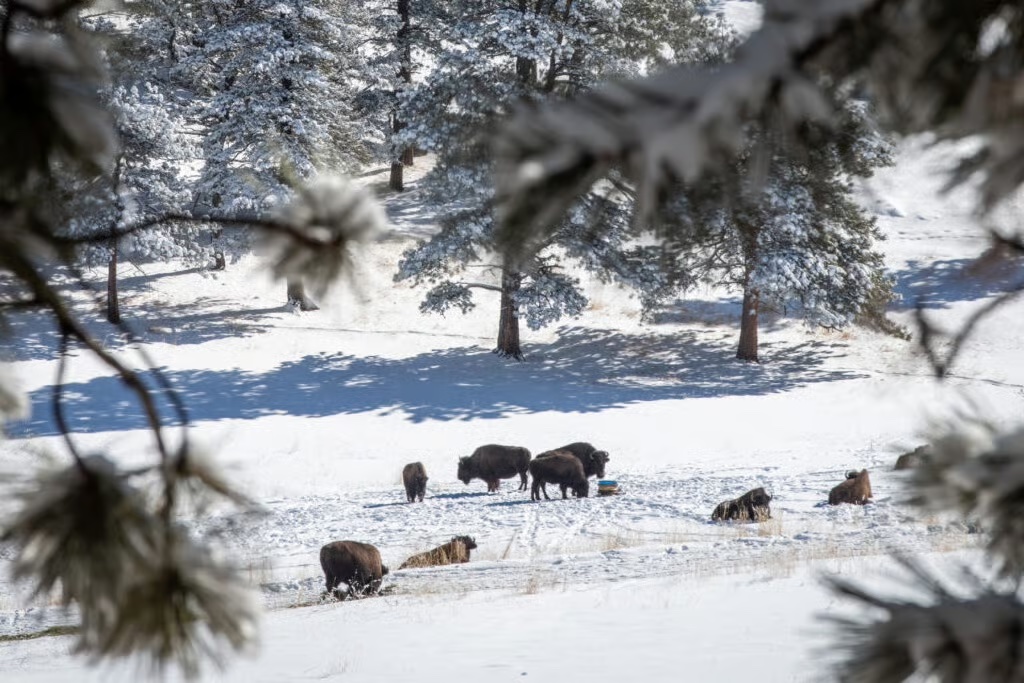
Buffalo herds were managed like Zoo animals in Denver for decades. It’s only been a few years since the city agreed to transfer any excess bison to local tribes so they can exercise their traditions. (Photo: Hart Van Denburg, Colorado Public Radio)
Efforts to bring back bison are helping to revive Indigenous culture on lands across the US West. And as Colorado Public Radio’s Sam Brasch reports, this revival is taking place right in the city of Denver.
Transcript
O’NEILL: Efforts to bring back bison, those huge grazers that once roamed the prairies in vast herds, are helping to revive Indigenous culture on lands across the US West. And this revival is taking place right in the city of Denver, which bought a handful of bison more than a century ago to display as a wild west novelty for tourists. Now, the herd has a new role – helping Denver’s Indigenous residents connect with their heritage. Colorado Public Radio’s Sam Brasch reports.
[SOUNDS OF SOMEONE SPEAKING IN A NATIVE LANGUAGE]
BRASCH: It’s a cool, clear morning when Lewis TallBull welcomes a crowd to Daniels Park, an area on a ridge south of Denver, overlooking the city’s skyline.
TALLBULL: I’d like to say good morning to each and every one of you. It’s good to see you.
BRASCH: TallBull is a member of the Cheyenne and Arapaho tribes. He wears a flowing black shirt and moccasins. A fenced area nearby holds half of the city’s roughly 70 bison — known as buffalo in Native communities. For the last seven years, the city has allowed the TallBull Memorial Council — a group founded by Lewis’s grandfather — to slaughter one of those bison each fall.
TALLBULL: A young warrior's gonna lose his life today. But in that way, he's gonna provide life.
[SOUNDS OF PEOPLE WALKING]
BRASCH: After a ceremony, TallBull leads the crowd to the edge of the fence.
[SOUNDS OF GATE OPENING]
BRASCH: He takes a handful of men through a gate, towards a corral holding a 600-pound bull. We watch one of them steady a rifle. And then…
[GUNSHOT AND WAR CRY CHORUS SOUNDS]
BRASCH: The bison collapses to the ground. These kinds of ritual harvests are common on reservations. Many tribes keep bison to help restore the species — a species white settlers nearly exterminated because it sustained indigenous people.
Modern herds again provide a reliable food source. During the recent government shutdown, for example, some tribal governments slaughtered bison to make up for the loss of federal food benefits.
[SOUNDS OF PEOPLE CHATTING]
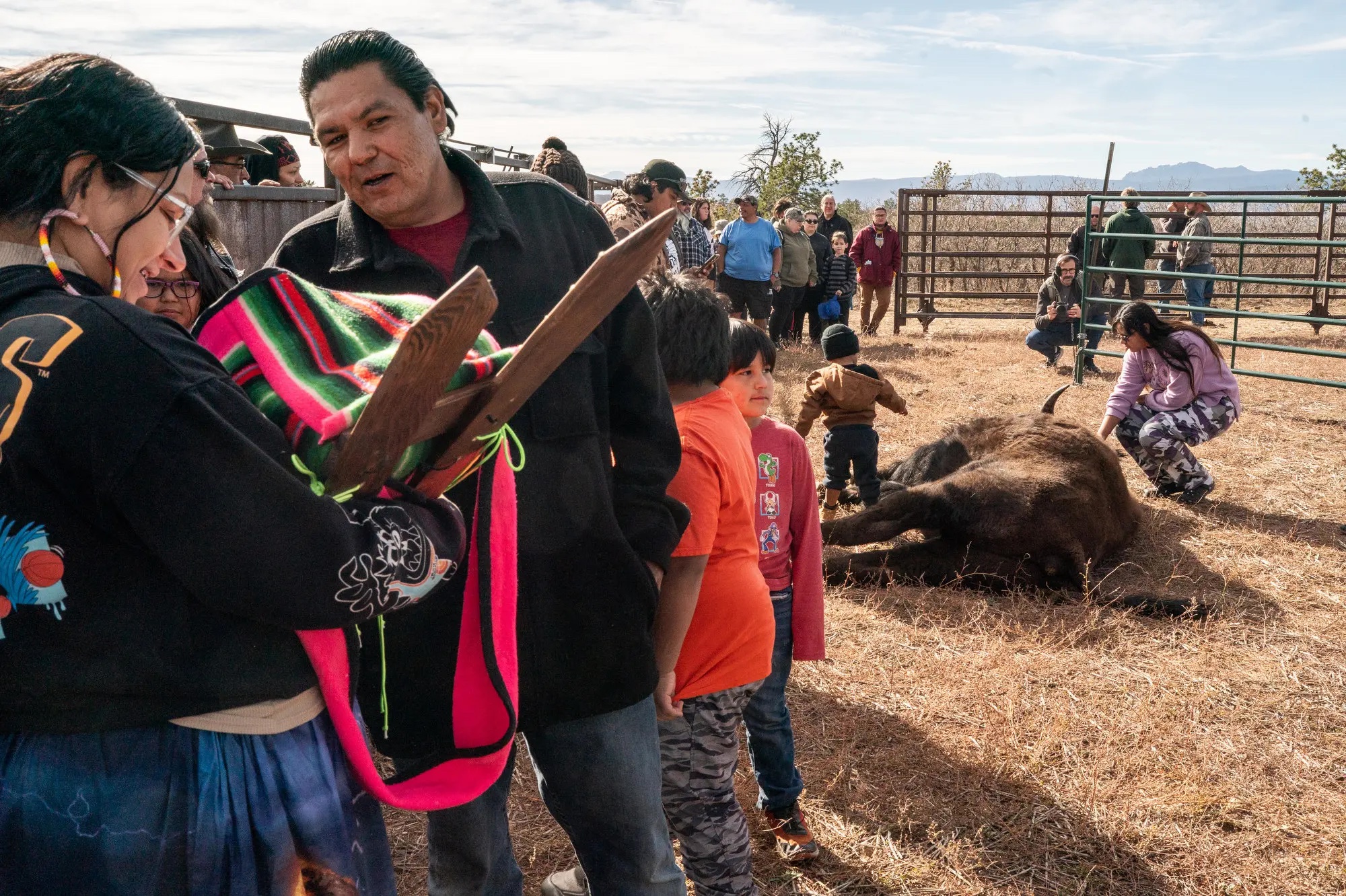
Bison are a big part of Native identity in the region. Tribes historically hunted the animals for meat, nutritional supplements, and ceremonial objects. (Photo: Hart Van Denburg, Colorado Public Radio)
TALLBULL: Us Indians who are forced to live in the city, we don't have anything like that.
BRASCH: Even though census data, it shows nearly three quarters of American Indians live in urban areas.
TALLBULL: That's what we're doing is, we're bringing these traditional ways and these bison harvest that only happen on reservations to the inner city, urban communities.
BRASCH: It’s a mission few cities can help with. Ryan Phillian manages the Daniels Park herd as a ranger with Denver Mountain Parks. He watches from a distance as elders pay their respect to the bison and a dance group begins to perform.
[SOUNDS OF DRUM PERFORMANCE]
PHILLIAN: This is uh, by far the biggest event that we’ve had down here and every year it seems to be getting bigger and bigger.
BRASCH: Originally kept as zoo animals, Denver moved its bison to mountain parks in the early 20th century. The grazing space is limited, though, so the city historically held an annual bison sale.
[SOUNDS OF DRUM PERFORMANCE]
PHILLIAN: ….where we would auction off our calves every single year. Uh, and you could have come out and bought a baby bison.
BRASCH: The city began to shift its management strategies by donating a bison per year to the TallBull Memorial Council. Three years later, they ended the auctions all together, opting to instead donate excess animals to tribal nations and continue holding these harvest events.
[SOUNDS OF A FRONT-LOADER]
BRASCH: Native organizers want to make these events as traditional as possible, but right now it still involves some modern equipment. A front-loader arrives to carry the buffalo to a butchering area. Once it’s laid on a tarp, another circle forms to watch participants take it apart.
MAN: Yeah, you guys can move in closer if you want.
BRASCH: The process will take six to eight hours, yielding enough meat for more than 150 people plus a skull for ceremonies and nutritional supplements made from ground organs. It’s an experience nine-year-old Malcolm Sanchez doesn’t want to miss.
[SOUNDS OF DRUM PERFORMANCE]
SANCHEZ: I think I might get in, get in on that. Um, cutting that bison.
BRASCH: You, you think you, you can do it?
SANCHEZ: I’ve cut things before.
BRASCH: And he’s not grossed out by the gory scene in front of us. He’s pumped for the meat.
SANCHEZ: My mom like makes this soup thing, right? She puts in bison, onions, and then she lets that, like, cook inside of a slow cooker and it’s so good.

Every year the TallBull Memorial Council in Denver organizes a ceremonial buffalo hunt, slaughtering an animal donated from Daniels Park. (Photo: Hart Van Denburg, Colorado Public Radio)
BRASCH: Sanchez says those meals make him proud to be Native, even though his family isn’t linked to a single tribe.
SANCHEZ: The only tribe I know I’m like part of is the Puebloan tribe. I don’t know the rest of ‘em because my family’s like a big mix.
BRASCH: That’s common in Denver — a city known as a crossroads for different Native people. TallBull is grateful the city has recognized its bison can help strengthen that community.
[SOUNDS OF PEOPLE CHATTING]
TALLBULL: Reestablishing our identity as Indian people, one percent each day is good enough. So this, this right here is a huge step for us and I think there’s only more to come.
BRASCH: He hopes to someday organize multiple harvests every year. That way, he says, more residents can affirm their Native ties, and Denver’s bison can recall their own heritage. Not as curious emblems of the Old West — but as food and cultural sustenance for Native people.
O’NEILL: That story by Sam Brasch comes to us from Colorado Public Radio.
Links
Find this story on the Colorado Public Radio website
See more photos of the ceremonial buffalo hunt
Learn more about the history and importance of bison for Native tribes
Living on Earth wants to hear from you!
Living on Earth
62 Calef Highway, Suite 212
Lee, NH 03861
Telephone: 617-287-4121
E-mail: comments@loe.org
Newsletter [Click here]
Donate to Living on Earth!
Living on Earth is an independent media program and relies entirely on contributions from listeners and institutions supporting public service. Please donate now to preserve an independent environmental voice.
NewsletterLiving on Earth offers a weekly delivery of the show's rundown to your mailbox. Sign up for our newsletter today!
 Sailors For The Sea: Be the change you want to sea.
 The Grantham Foundation for the Protection of the Environment: Committed to protecting and improving the health of the global environment.
 Contribute to Living on Earth and receive, as our gift to you, an archival print of one of Mark Seth Lender's extraordinary wildlife photographs. Follow the link to see Mark's current collection of photographs.
 Buy a signed copy of Mark Seth Lender's book Smeagull the Seagull & support Living on Earth
© Copyright World Media Foundation. All Rights Reserved
Home | Contact | RSS | Donate | Newsletter