

August 21, 2026
Air Date: August 21, 2026
FULL SHOW
SEGMENTS
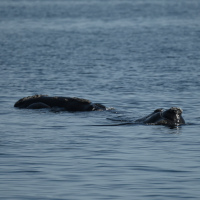
Baby Right Whales Bring Hope
View the page for this story
North Atlantic Right Whales were once so thoroughly hunted they nearly went extinct. When hunting these mammals was outlawed, they slowly started to bounce back, but today these Right whales are dealing with newer deadly threats, such as fishing gear entanglement and warming in the Gulf of Maine. So, it’s a relief to advocates to have a successful calving season like this year with 23 new calves, the most since 2009. Amy Warren, the Scientific Program Officer at the New England Aquarium, spoke with Host Aynsley O’Neill. (11:25)
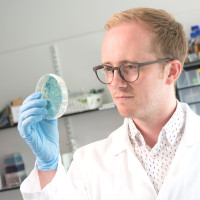
Tylenol Upcycled From Plastic
View the page for this story
Scientists in the UK were able to use genetically modified bacteria to turn plastic bottles into the common pain reliever acetaminophen, also known as paracetamol and Tylenol. Lead researcher Stephen Wallace, a Professor of Chemical Biotechnology at the University of Edinburgh, speaks with Host Jenni Doering about the potential applications of this biotech breakthrough. (08:41)

Major National Climate Victory in S. Korea
View the page for this story
The recipient of the 2026 Goldman Environmental Prize for Asia is South Korean activist Borim Kim. She and her organization, Youth 4 Climate Action, sued the South Korean government on the grounds that it was putting future generations at risk. And in August of 2024, they won at the South Korean Constitutional Court, making this case the first successful youth-driven climate litigation in Asia. Borim Kim joins Host Aynsley O’Neill to discuss this historic decision. (10:21)
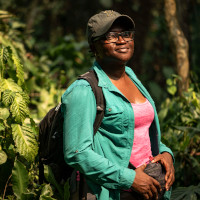
Community-Led Wildfire Prevention in Africa
View the page for this story
Nigerian conservation ecologist Iroro Tanshi rediscovered the short-tailed roundleaf bat in 2016, after decades when it was believed extinct in the region. The species is still critically endangered, with habitat loss from wildfires as one of its top threats. So Iroro joined with local groups to start a community-led program to develop safer field burning practices and wildfire fighting strategies. Iroro Tanshi is the recipient of the 2026 Goldman Environmental Prize for Africa and talks with Host Jenni Doering. (16:43)
Show Credits and Funders
Show Transcript
260821 Transcript
HOSTS: Aynsley O'Neill and Jenni Doering
GUESTS: Amy Warren, Stephen Wallace, Borim Kim, Iroro Tanshi
[THEME]
DOERING: From PRX – this is Living on Earth.
[THEME]
DOERING: I'm Jenni Doering.
O'NEILL: And I'm Aynsley O'Neill.
Some good news for the troubled North Atlantic Right Whale.
WARREN: This year we saw 23 right whale calves born, and that is the fourth highest calf count we've ever recorded, and the highest calf count since 2009. That's very promising. That's to us maybe a sign that they are a little bit healthier.
DOERING: Also, a biotech breakthrough turns plastic waste into Tylenol.
WALLACE: So by taking this technology and programming bacteria, we not only defossilize the manufacture of this worldwide essential medication in a way that doesn't release climate emissions, but we also clean up plastic waste from the environment at the same time.
DOERING: Those stories and more, this week on Living on Earth. Stick around!
[NEWSBREAK MUSIC: Boards Of Canada “Zoetrope” from “In A Beautiful Place Out In The Country” (Warp Records 2000)]
[THEME]
Baby Right Whales Bring Hope
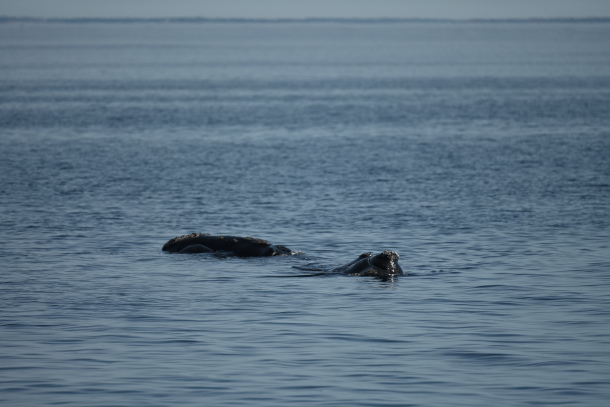
Shown above are a North Atlantic right whale mother, Bermuda (#3780), and her calf. (Photo: New England Aquarium, taken under NOAA Permit #25739-01)
DOERING: From PRX and the Jennifer and Ted Stanley Studios at the University of Massachusetts Boston, this is an encore edition of Living on Earth. I’m Jenni Doering.
O'NEILL: And I’m Aynsley O’Neill.
North Atlantic right whales were once so thoroughly hunted they nearly went extinct. In fact, they were called right whales because they were considered the “right” ones to hunt, as they lived close to the shore and floated on the surface once killed. When hunting these mammals was outlawed, they slowly started to bounce back, but today right whales are dealing with new deadly threats from humans. So, it’s a relief to have a successful calving season like this year, with 23 new calves, the most since 2009. Amy Warren is the Scientific Program Officer at the New England Aquarium and she joins me now. Amy, welcome to Living on Earth!
WARREN: Hi, thanks for having me.
O'NEILL: Tell me a little bit about your role there at the New England Aquarium. How closely do you work with our subject here, right whales?
WARREN: So, one of the things that my team does primarily is that we manage the North Atlantic Right Whale Identification Catalog, so any and all photograph sightings of right whales that happen anywhere in the North Atlantic come into our team, and we're responsible for putting those into the catalog, incorporating photos and all the data that goes with it. And so now we have this catalog that has over 800 individuals, so like all of time. The catalog goes back to 1935. So, any whale we've ever identified is in this catalog, living or dead. So, we get anywhere from 3000 to 5000 sightings a year with hundreds of thousands, really millions of photos, and so it's a lot of time and effort, but then kind of zooming in a bit, I do also get to do field work, so I'll be on boats in different areas where right whales are feeding. For example, in the month of April, I was just on the water six days when we see, you know, a bunch of whales every day, we're out there, and then in the summertime I get to go offshore on research cruises, and those usually two weeks where we're living on the boat for two weeks, we're out and we're, again, seeing whales every day.
O'NEILL: Well, so Amy, you're the perfect person for this. If somebody has never seen one of these right whales, not even a photo, how can we help visualize them? What makes these whales identifiable? What helps them stand out?
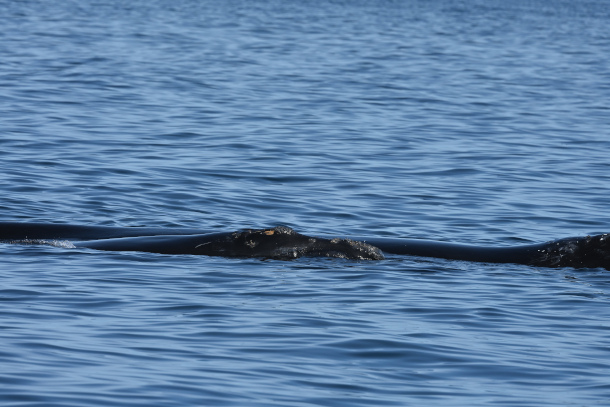
The 2025-2026 North Atlantic right whale calving season, which runs from mid-November to mid-April, saw 23 calves born, the largest number seen since 2009. Bocce’s calf, mom in the background (#3860). (Photo: New England Aquarium, taken under NOAA Permit #25739-01)
WARREN: A lot of people know humpback whales, so I think it's sometimes easiest to start with them. And right whales are similar in some ways to people who don't know them in size. They're actually a little bit bigger, a little bit heavier, 50 feet long, 50 tons, but what's unique about right whales is they have these white patches on their head, they're called callosities, and they're actually collections of whale lice, so they're actually small...
O'NEILL: Lice?
WARREN: ... white whale lice…
O’NEILL: Wow!
WARREN: …that congregate on these rough patches of skin on the whale's head, yeah, something that they're born with, and they're all kind of always in different patterns for each whale, and yeah, the whale lice like to congregate on those rough patches. It sounds bad, I know we don't have the best connotation with lice, but in this case it's perfectly fine. They're just kind of feeding off of the dead skin. It's more like a spa day, if we think about it, it's really just, it works for the lice, and it doesn't bother the whales. But the reason why we actually appreciate the lice in this case is that the lice are white and the whale's skin is black, so these rough patches without the lice would basically blend in with the skin, you wouldn't see them, but with the contrast of the white versus the black, it basically makes these like shapes and patterns, and each whale has really unique patterns on its head, and this is why we can identify them.
O'NEILL: And so, these North Atlantic right whales, they are critically endangered. I think estimates have their population at under 400 total. How much do we know about why these population numbers are so small, and how do they compare to maybe the populations in the past?
WARREN: It's actually interesting. We don't know what the populations used to be, because they were decimated so long ago. So, right whales were protected in 1932 from whaling internationally, but at the time no one can really say for sure, but the they're thinking that the population of right whales was maybe between 20 and 50.
O'NEILL: Oh my goodness,
WARREN: no extra zeros, no 1000s ...
O'NEILL: Yeah!
WARREN: ... 20 to 50, maybe...
O'NEILL: Double digits is bad!
WARREN: Yes, exactly. So their population actually did start to increase because they were no longer targeted, and this again, this is like, think of like 1930s to like 1980s but then jumping to kind of the 80s, 90s, 2000s you know, into now technology has gotten better, fishing gear has gotten stronger, it's gone further offshore, boats are bigger, boats are faster, and so all these new uses of the ocean by us have made it more dangerous for whales. So, the original decimation came from whaling. Then they came back up, and then their increase slowed again once kind of technology caught up to where they were. Add in climate change, you know, is now their food is moving, and so yes, we're part of that, but it's bigger than us. So, as their food has started shifting, it's bringing right whales into new areas, and that can bring them into areas that they have not been before and areas that are not ready for them. So, there's a lot of time and research that went on between, like, the 1980s and the early 2000s in that they like kind of discovered where whales were feeding regularly, they established these like hot spots or these habitats for them and were able to put protections in; either removing ships completely or slowing ships down, removing some of the fishing gear out of the water. In some areas, both up in the Bay of Fundy in Boston, they moved shipping lanes to go around these whale feeding areas, and so a lot of those things were helping. But as the food started shifting, the whales started shifting with them, and then whales started showing up into new places where those protections weren't there, because they didn't need to be there, and so that's kind of where we've been in recent years.
O'NEILL: And as I understand it, the problem isn't only with the whales themselves dying, but there's also an issue with the birth rates overall. How right is that?
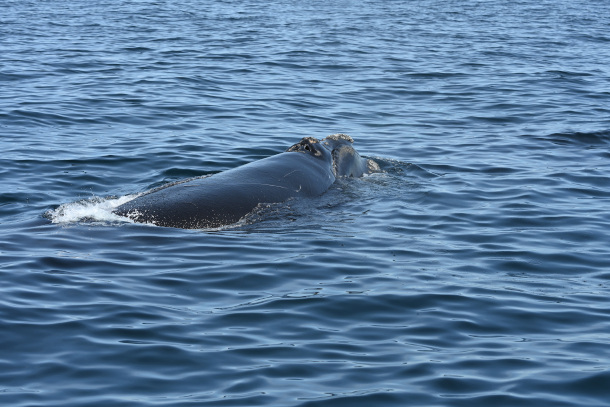
In the last decade, North Atlantic right whale mothers have gone as many as 10 years between birthing calves, but in the 2025-2026 season, several mothers had given birth only a few years prior. Shown above is Echo’s (#2642) calf. (Photo: New England Aquarium, taken under NOAA Permit #25739-01)
WARREN: Yeah, so there's a lot going into it, and it overall comes down to the health of the population, but also the health of each individual whale. So, you know, if whales aren't healthy, they're not going to be able to give birth, and when we say a whale isn't healthy, that could be for a number of reasons. It could be because they're not finding enough food, it could be that a whale was hit by a boat and it survived, but it has this injury that now its body is kind of like fighting back from.
O'NEILL: And so, tell us about this year, though, in the numbers, what did this calving season mean for the North Atlantic right whale?
WARREN: So, this year we saw 23 right whale calves born, and that is the fourth highest calf count we've ever recorded, and the highest calf count since 2009. So, that is great. One good year isn't going to save a species. We need lots of good years, and we recently had a lot of bad years, like low numbers. We had a year zero calves, a year of only like five, and so one good year kind of just makes up for a few bad years. But it's hopeful, it's good. We love to see it. We're seeing that a lot of these females were giving birth more often. So, like a healthy right whale, we think, can give birth every three to four years. But in the last, like, decade or so, we were seeing females wait 10 years between subsequent calves, potentially because it was taking them that much longer to get back to, like, a healthy weight, a healthy status before they were ready to get pregnant again. But this year we are seeing a lot of whales three, four, five, six years between calves. That's very promising. That's to us maybe a sign that they are a little bit healthier.
O'NEILL: What would need to happen for these whales to reach healthier population numbers?
WARREN: We need years and years of these very high calf counts, and years and years with no whales dying from human-caused injuries, which is a very tall order. But also, we need all of these calves to survive into adulthood, too. It was two years ago where 5 of the 20 calves born were not with us anymore by three months in, and then you know this year, just in January, we had two juveniles die from human causes, so you know they weren't even adults yet, so they couldn't even help add to the population, so that's another part of it too, that all these 23 calves born, the chances of all of them making it into adulthood... pretty low.
O'NEILL: Amy, what do you think is important for people to keep in mind when they see this headline about, oh, great year for the North Atlantic right whale?
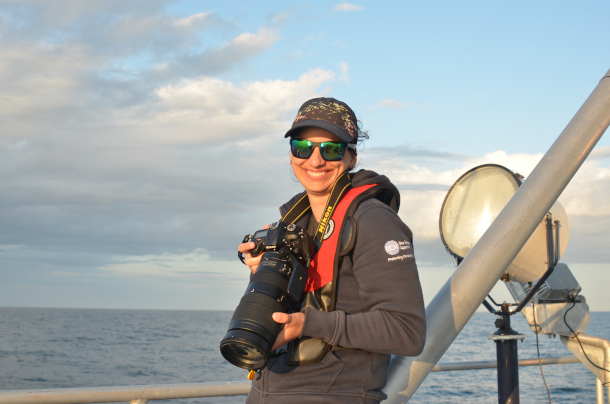
Amy Warren is a Scientific Program Officer at the New England Aquarium. (Photo: Courtesy of Amy Warren)
WARREN: I know we like to talk about numbers a lot, right? We like to talk about the population number, we like to talk about the calf numbers, but in general, I think it's important to take a step back and look at the status of the population, just 20 whales here and 10 whales there, like in the grand scheme of things, that doesn't matter as much of the population, whether it's healthy or not, whether it's doing well, and like are there things that we could do to be helping them more, and I think over the years we have established a lot of management mitigation measures that do seem to be working, and especially giving a year with some positive news, I hope that can just be incentive to keep going, like don't stop, don't fall back thinking we fixed everything, it's not that simple.
O'NEILL: Amy, what is it that these whales mean to you?
WARREN: Oh, what do they mean to me? I've always loved whales since I was a kid. So, part of it was there was just this early love for the ocean and whales and dolphins, and I just thought those creatures were so interesting. And I can't tell you how many times I've been on the water, how many trips I've done over the years, but like, it never gets old. Like, the excitement of seeing a whale does not change, and I think to go really specifically into right whales, the fact that we know so much about a wild population that lives across the North Atlantic, we know these whales individually, a lot of them have names that we've given them, we know when they were born. We know, like, who their siblings are. We know their parents and their grandparents. We know how many calves they've had. We just have all these, like, really unique stories. And I think, because we know each and every one of these whales, like, we do kind of create these personal connections with them, and you know, not to anthropomorphize them at all, but you know, you do start to see a little bit of personality, like some whales do certain behaviors a lot, and some whales don't do those behaviors at all, and some whales only show up in this one area and are never seen anywhere else, or vice versa. So, just to see that individuality, I think is really interesting, and it's relatable. I think that's another part of it too, like, yes, they're very different. They live in the ocean, but they are mammals. They give birth to young, you know, they take care of them, they live long lives, you know. It's just.. it's relatable.
O'NEILL: Amy Warren is the Scientific Program Officer at the New England Aquarium. Amy, thank you so much for taking the time with me today.
WARREN: Thanks for having me. It was great to be here.
Related links:
- CBS News Boston | ““Hopeful” Sign for Right Whales: Critically Endangered Species Sees Highest Number of Births Since 2009”
- Read more about North Atlantic right whales at the New England Aquarium website
- National Oceanic and Atmospheric Administration Fisheries Division information about North Atlantic Right Whales
- Amy Warren’s profile at the New England Aquarium website
[MUSIC: Basil Poledouris “Main Title” on FREE WILLY – ORIGINAL MOTION PICTURES SOUNDTRACK, SONY BMG MUSIC ENTERTAINMENT]
DOERING: Just ahead, South Korean activists secure a climate victory. Stay tuned to Living on Earth!
ANNOUNCER: Support for Living on Earth comes from Hansjörg Wyss in honor of Rosamund Stone Zander. Celebrated painter, environmentalist, and author of The Art of Possibility, who inspired others to see the profound interconnectedness of all living things, and to act with courage and creativity on behalf of our planet. Support also comes from Sailors for the Sea and Oceana. Helping boaters race clean, sail green and protect the seas they love. More information at SailorsForTheSea.org.
[CUTAWAY MUSIC: Kapono Beamer, “Pua Mae'ole” on Pana Aloha (Hawaiian Heartbeat), by Kapono Beamer, Kapono Beamer Enterprises, Ltd]
Tylenol Upcycled From Plastic
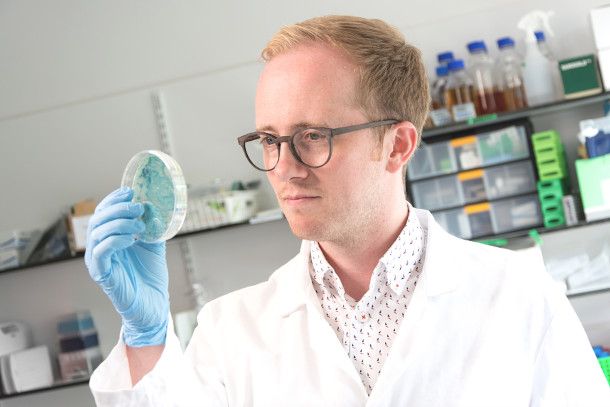
The strain of E. coli bacteria used in Dr. Wallace’s study is different from the strain that causes human disease. In fact, by genetically engineering it, Dr. Wallace’s team was able to use it to turn plastic waste into acetaminophen. (Photo: The University of Edinburgh)
O'NEILL: It’s Living on Earth, I’m Aynsley O’Neill.
DOERING: And I’m Jenni Doering.
As the planet becomes overwhelmed by plastic waste, some researchers are using creative chemistry and biology to come up with potential solutions. Scientists in the UK published a paper in the journal Nature Chemistry in 2025 describing how they turned plastic bottles into the common pain reliever Tylenol, also known as acetaminophen or paracetamol. Their tiny comrades in this remarkable transformation were genetically modified E. coli bacteria. Every plastic bottle could be turned into two acetaminophen pills. What’s more, one of the genes that enabled those bacteria to make Tylenol came from mushrooms! Thanks to advances in DNA editing technology researchers were able to insert this mushroom gene into the bacterial genome. With us today is Stephen Wallace, the lead author on the paper and a Professor of Chemical Biotechnology at the University of Edinburgh. Hi Stephen and welcome to Living on Earth!
WALLACE: Hey, Jenni, thanks for having me.
DOERING: So you feed E. coli plastic. Well, there's a long process, but you feed E. coli plastic, it eventually produces Tylenol. What is left over from that process? I mean, you know, usually chemistry and biology aren't 100% efficient.
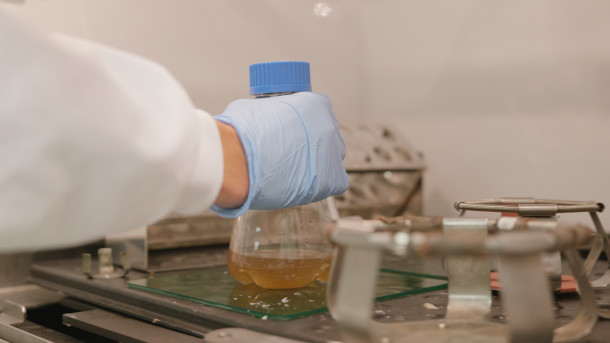
Here Dr. Wallace monitors the growth of the bacteria. He’ll eventually feed the bacteria a soup of broken down PET plastic, a common form of plastic used in bottles and food packaging. (Photo: The University of Edinburgh)
WALLACE: Yeah, exactly. So first of all, we have to take the plastic. And we took a waste plastic bottle, in this example, just one that we that we found on the streets on the way to lab one morning, and we deconstruct that or depolymerize that using established chemical methods, which basically take the polymer and release its chemical monomers, or the building blocks of that polymer. And those building blocks for polyethylene terephthalate, or PET plastic, which is the plastic we focused the study on, is two molecules. The first is called terephthalic acids, and the second is called ethylene glycol. And there are very many different uses for ethylene glycol in the industry. And we focus, in this instance, on the use of terephthalic acid, that other monomer that comes from deconstructed plastic. So it creates sort of like a plastic soup, if you like, which we then feed to the bacterium. And they take one part of that and transform that into Tylenol, but they leave that ethylene glycol alone. So that is one of the other things that comes from the process that can be used in other sort of industrial situations.
DOERING: And by the way, you mentioned this like P-E-T, PET plastic. What kind of plastic is that?
WALLACE: So PET is probably one of the most widespread plastics that's used throughout modern day society. It's a very rigid, very durable synthetic material that's used to make things like plastic bottles or sort of the films you get on top of salads and sandwiches and in the supermarkets. It's designed to be very robust, but because of that reason, when it's either sent to a landfill or it's unfortunately sometimes ends up in the environment or in the ocean, it's very resistant to degradation, and that's what causes it to accumulate and causes all those pollution issues that we widely associate with the plastic waste crisis currently.
DOERING: So let's zoom out to the bigger picture. A lot of pharmaceuticals actually come from fossil fuels, which is part of why this process is even possible. But just how much of our medicine comes from fossil fuels?
WALLACE: Yeah, this is something that absolutely fascinates me, and has been a really interesting point that's come from this research. I think just it really astounds me as a scientist, that people don't realize that the majority of the medication they take every day comes from fossil fuels. It's a refined petrochemical. It's the exact same material that you put in your car. I think it's 60 to 70% of all of the medication that we rely on to treat disease currently are reliant on this natural feedstock, fossil fuels. And the real issue with that is two things. The first is fossil fuels are not a limitless resource from which we can make these medications from. In fact, they're running out at quite an alarming rate, and the industrial processes that we use to transform fossil fuels into modern day medications are hugely polluting into the environment. So by taking this technology and programming bacteria to do this in a much more sort of milder, much greener way, much more eco friendly way, we not only defossilize the manufacture of this worldwide essential medication in a way that doesn't damage the environment or release climate emissions, but we also clean up plastic waste from the environment at the same time.
DOERING: By the way, why use biology and not just chemistry to do this?
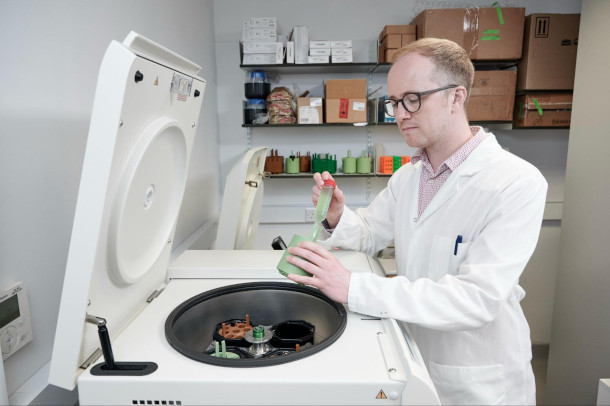
Though the process isn’t nearly ready for an industrial scale production, Dr. Wallace hopes that in the future consumers will have the opportunity to buy acetaminophen not derived from fossil fuels but rather from plastic waste. (Photo: The University of Edinburgh)
WALLACE: Yeah, that's a really interesting question, actually. Certainly, to depolymerize plastic, you can use chemistry to do that. You can also use biology, but typically, bio-based processes operate at very low temperatures. They operate in very sort of mild water-based reactions. Whereas chemical methods, you typically need much more energy input to heat these reactions up. They tend to use, you know, petrochemical based solvents as well, to try and help these reactions go faster, and catalysts as well. So I think the bio-based processes are on the whole a lot milder and use a lot less energy, and are better for the environment themselves. But to make paracetamol from or Tylenol from plastic bottles, you cannot do that. It's impossible using chemistry alone, and it has to be done using biology.
DOERING: And by the way, paracetamol is just a different name for acetaminophen, or Tylenol. Is that right?
WALLACE: Yeah, of course. Sorry, it's my Britishism. That's absolutely the brand's name that which we sell acetaminophen under. It's the same as Tylenol. Absolutely.
DOERING: I'm going to play devil's advocate for a second. This research isn't nearly advanced enough to be scaled up anytime soon. So you know, how optimistic should we be that one day, most of our acetaminophen, our Tylenol, comes from plastic bottles?
WALLACE: Yeah, that's a really great question, actually. And I think it's really important to emphasize, we're an academic discovery lab. This is a very early stage project, a very early discovery proof of concept project that has shown that this is actually feasible. The next steps for this is absolutely to try and see whether we can scale this up to make really large quantities of paracetamol from existing plastic waste. And we're working with industry, both in the UK and the world around the world now to try and see whether this could be commercially feasible in the future.
DOERING: So, what's next for you as a researcher?
WALLACE: Yeah, this, this project has been wonderful, and it's been a real labor of love for many, many years up to this point, but it really does feel like the starting point for both this and the wider field of engineering biology. Because, you know, if we can program bacteria using this technology to turn plastic waste into Tylenol, imagine what else we can do, right? But more broadly than that, waste is just carbon, and microbes love carbon, so we've been examining all different types of weird and wonderful wastes and thinking, okay, you know, how can we program biology to turn this into something that's a bit more exciting than simply landfill or waste that goes to incineration? We published a piece of work a couple of months ago where we examined fatberg waste from the sewers in London. And these are sort of greasy deposits that block the sewers underground. And we did a chemical analysis of these, and it turns out they're really rich in organic small molecules, so tons and tons of carbon, literally. So we designed some bacteria that could eat these fatbergs from the sewers and turn them into fragrance compounds that you could wear. And we're currently working with a Swiss fragrance manufacturer to try and see whether we can take sewer waste and turn them into fragrances that you will buy potentially in the future. So this idea of waste is just carbon and biology can be engineered to turn that into a whole variety of different products. It really does feel like this is the sort of creative beginning of something really quite exciting.
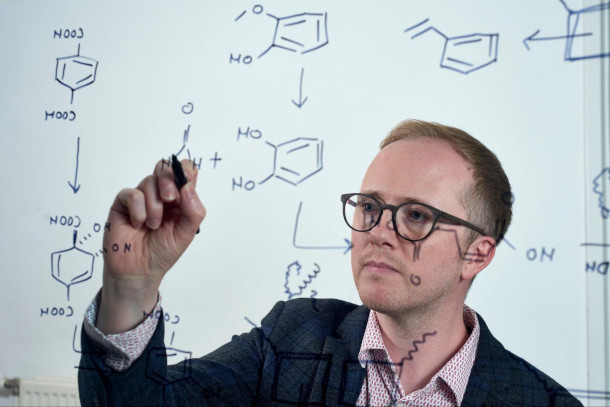
The vast majority of our waste is simply carbon molecules. And since microorganisms love carbon, Dr. Wallace envisions a future where we could use microbes to turn a whole range of wastes into new products rather than relying on our dwindling fossil fuel reserves. (Photo: The University of Edinburgh)
DOERING: Wow. My head is spinning at the transformation that, that, that is quite some upcycling there of fatberg waste to perfume.
WALLACE: Yeah, exactly. So would you, would you wear perfume that came from fatberg waste?
DOERING: I'd have to smell it first. But hey, it's, it's just carbon, right?
WALLACE: It's just carbon. Exactly. If we can wear perfume that comes from oil, or if we can take medicine that comes from oil, why not from fatbergs? Why not from plastic bottles? Absolutely.
DOERING: Stephen Wallace is the lead author on the paper and a Professor of chemical biotechnology at the University of Edinburgh in the UK. Thank you so much, Dr. Wallace.
WALLACE: Thank you, Jenni, it's been a pleasure to be here. Thanks.
Related links:
- Read Dr. Stephen Wallace’s original study
- Learn more about Professor Wallace
- Discover other surprising products made from fossil fuels
[MUSIC: Lifelike, “Nightwalk” on Nightwalk EP, Anjunadeep]
Major National Climate Victory in S. Korea

Borim Kim is the founder of Youth 4 Climate Action and winner of the 2026 Goldman Environmental Prize for Asia. Here she stands in front of the Taean Coal Power Plant, one of the largest coal power plants in the world. (Photo: Goldman Environmental Prize)
O'NEILL: Every year the Goldman Environmental Prize honors one person from each of the world’s six inhabited regions, and we turn now to the 2026 winner for Asia. Activist Borim Kim and her organization, Youth 4 Climate Action, sued the South Korean government on the grounds that its inadequate climate policies were putting the rights of future generations at risk. And in August of 2024, they won a historic decision at the South Korean Constitutional Court, making this case the first successful youth-driven climate litigation in Asia. Borim Kim joins us now. Welcome to Living on Earth, Borim, and congratulations on this Goldman Environmental Prize!
KIM: Annyeonghaseyo.
O'NEILL: So Borim, you grew up in Seoul, which is the capital of South Korea and one of the most densely populated cities in the world. Tell us how this shaped your understanding of environmental issues.
KIM (TRANSLATED): So yes, I was born and raised in Seoul, which is a very densely populated city, and I think I grew up thinking that I need to do something to protect the Earth or protect the environment on an individual level, rather than thinking of climate as a crisis. So I was practicing things like a vegetarian diet or trying to reduce waste. However, that all changed in 2018 when there was a terrible heat wave that came about in Korea. And at that time, I was living in a very old house, and I felt that the heat wave was a great threat to my existence. And the government was just telling the people to stay inside for their safety, however, I felt that that was not safe for us. So I started then to think of the climate crisis as a more existential threat than something that I could just respond to on my own, on an individual level. I saw that it was directly related to our human rights and recognize the government's responsibility in having to protect its own citizens.

Borim believes that youth are essential in the fight against climate change partly because they will suffer the most from its impacts. Above, a Y4CA-led rally in support of increased climate litigation. (Photo: Youngmin Kim for the Goldman Environmental Prize)
O'NEILL: Well so you founded this group, Youth 4 Climate Action, which organizes and engages young people in the fight for climate solutions. When you organized this lawsuit against the South Korean government, what inspired that decision?
KIM (TRANSLATED): I think after that extreme heat wave in 2018, more and more people started to realize that the climate crisis is an actual threat to our lives. And at the same time, there were more scientific reports that came out speaking to the seriousness of the climate crisis. So more and more people understood the gravity of the situation. And when I was campaigning with my group to ask for change from policymakers, it was a very difficult process, and we tried to emphasize that the climate crisis is directly related to our own lives and our existence, and demanded change as first parties living with this crisis. And we recognize that the youth's voice is a fundamental voice, not only because they will have to live in the future and they will feel more of the effects of the climate crisis, but because also we can show them the long term accumulation of dangers that we have to be faced with. So we organized a super strike in Korea in line with the global climate strike. However, the actual change that came about from these actions were very minimal. Politicians would say, oh, we're doing this for the children, and want to take pictures with us, but it was just a photo op. So we realized that pleading to policymakers to protect our own lives was not enough, and in looking for alternative ways, we thought of this idea of a climate litigation being brought to the Constitutional Court.

Borim’s team brought their case to the Korean Constitutional Court, pictured above, when it became clear that their organized strikes were not resulting in any action. (Photo: Goldman Environmental Prize)
O'NEILL: And in 2024, the courts ruled with you. They agreed that the climate policy from the government was unconstitutional. Can you take us back to that day and how you felt when the decision was made?
KIM (TRANSLATED): Awaiting the decision from the constitutional court comes with no definite deadline. We were just waiting and waiting. So when the day came and we were told that there would be a decision made on that day, I was very, very nervous, but it wasn't a total win, because on some of the claims that we brought forth, it was decided that it was not unconstitutional. For example, the decision said that the existing policy for climate crisis might be insufficient, but it is still in place, so that, in itself, is not unconstitutional. However, the part that we rejoiced was that there is no pathway to reduce emissions on the long term, between 2031 and 2049. And that is a failure to protect the environmental rights of its citizens. And that was the part that was deemed unconstitutional. So I had a lot of mixed feelings. It was not pure joy. And I was inside the courtroom with my colleagues, and I can't describe the exact emotion that I felt in that moment, but we were all crying. We saw that the Korean government recognizes that anybody should be able to be protected in the face of the climate crisis, and the decision was a checkpoint that confirmed the Korean government's responsibility to protect its citizens. So when I heard that ruling and thought about the meaning of it more, I realized that the fight or the response against the climate crisis will not go backward from this moment on, at least.
O'NEILL: And so we are about two years out now from that ruling. So what do you think about South Korea's climate actions since then? What kind of changes have been made, but what else is there still left to do, as well?

Though Y4CA won their case in 2024, the fight to implement these policies in South Korea is far from over. Above, protestors gathered on the first anniversary of the climate ruling. The signs roughly translate to phrases like “We have rights”, “Rights for all”, and “Climate change is the country’s responsibility”. (Photo: Youngmin Kim for the Goldman Environmental Prize)
KIM (TRANSLATED): Since the decision, the National Assembly was tasked to prepare a path forward for 2031 to 2049 to reduce emissions, recognizing that the response to climate crisis is a basic right for the people. And actually, the National Assembly was tasked to come up with improved legislation reflecting that decision by February 28 in 2026. However, the deadline came and passed, and the legislation did not come about, so we have had to continue to demand a more aggressive action from policymakers. However, what is hopeful to me is in that process, the National Assembly has opened up the discussion as a public deliberation, and in that forum, civil society got to deliberate how much emissions to reduce and by when, are we going to take a more short term aggressive action right now, or are we going to make it a long term plan and let future generations also deal with the responsibility. The result of the public deliberations came about on April 13, and civil society decided that it is our responsibility to take more aggressive actions right now on the historical emissions that South Korea has contributed. So based on that result, the National Assembly, I believe, is in preparation processes to reflect that into legislation.
O'NEILL: And from your perspective, what is the role of your country of South Korea in addressing climate change on a global level?

Borim Kim at the Goldman Environmental Prize award ceremony. (Photo: Goldman Environmental Prize)
KIM (TRANSLATED): So within South Korea, I believe that the government has the responsibility to protect the basic rights of its people, but globally, I think it can contribute in several different ways. Korea actually experienced very fast growth based on fossil fuels and greenhouse gas emissions. So it does have to take responsibility on the past emissions. Not only that, it also exports coal power plants to countries in Southeast Asia, but when the country or the government decides to do these things, it has to recognize that it impacts the lives of those who are most vulnerable to the climate crisis. And I think from the constitutional court case, this was the first of its kind in Asia. So I believe that any kind of climate action that comes out after this will be a more progressive one, more aggressive one, and I know that Korea's decisions on the climate crisis will not go backwards from here. That is also my hope. And I know that there are other litigations in other countries in Asia, and I hope to network with them and be in solidarity with them, so that the decisions that come forward are even better ones that the ones that came out from Korea.
O'NEILL: Borim Kim is the winner of the 2026 Goldman prize for Asia. Borim, thank you so much for taking the time with me today, gamsahamnida.
KIM: Gamsahamnida.
Related links:
- Borim Kim’s profile at The Goldman Environmental Prize
- The Goldman Environmental Prize
- Learn more about Youth 4 Climate Action
[MUSIC: Australian Pop Quartet, “Golden from Kpop Demon Hunters (Acoustic Instrumental Version)” on Acoustic Kpop Demon Hunters, Rush Records]
DOERING: After the break, celebrating the Africa winner of this year's Goldman Environmental Prize. Keep listening to Living on Earth!
ANNOUNCER: Support for Living on Earth comes from the Waverley Street Foundation, working to cultivate a healing planet with community-led programs for better food, healthy farmlands, and smarter building, energy and businesses.
[CUTAWAY MUSIC: Jean Atauje, “Zampona Andina-Improvisacion” at Jean Atauje’s website]
Community-Led Wildfire Prevention in Africa
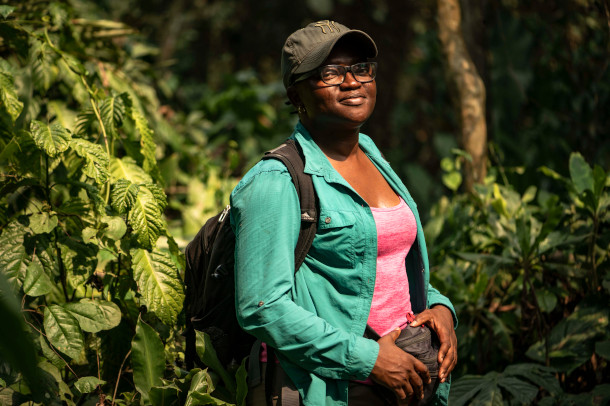
Iroro Tanshi is a Nigerian conservation ecologist and winner of the 2026 Goldman Environmental Prize for Africa. (Photo: Etinosa Yvonne for Goldman Environmental Prize)
O'NEILL: It's Living on Earth, I'm Aynsley O'Neill.
DOERING: And I'm Jenni Doering.
Nigeria’s Afi Mountain Wildlife Sanctuary is home to many endangered species, like gorillas, rockfowl, and one tiny bat that was believed to be extinct in the region for nearly half a century. Wildlife ecologist Iroro Tanshi rediscovered the short-tailed roundleaf bat back in 2016, but the species is still critically endangered, with habitat loss as one of its top threats. So Iroro joined with local groups to start a community-led program to protect the forest, and her efforts have been recognized with a 2026 Goldman Environmental Prize for Africa. Iroro Tanshi joins me now – welcome to Living on Earth and congratulations!
TANSHI: Thank you very much. I'm very pleased to be here.
DOERING: Iroro, when you spotted this roost of short-tailed roundleaf bats, it had been nearly five decades since they were last spotted in Nigeria. How did you feel in that moment?
TANSHI: It was just an absolutely incredible feeling, and because I was in the field by myself with local field assistants. It was kind of hard to translate it to them, so I basically said to them, our lives are about to change. Because they've been talking about how, you know, you have to come back and do more research. And I'll be like, well, I don't have money. I'm just a poor PhD student. But when we found that, I was like, our lives are about to change. We're about to come back to this forest, many, many, many, many times. And I'm actually very pleased to say we have now built a field station at that site, and we're going to keep studying bats and other cool species in that forest, because finding this rare bat just makes this a really, truly special place.
DOERING: Wow. And by the way, these tiny little guys, they're pretty darn cute. What do they look like?
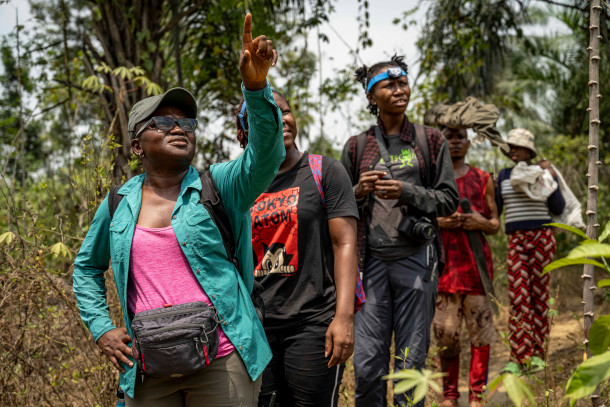
Iroro Tanshi (front) shows her team how to set bat traps in Odukpani, Cross River State, Nigeria. (Photo: Etinosa Yvonne for Goldman Environmental Prize)
TANSHI: That is one of my favorite questions. They look like a golf ball. So if you were going into a cave trying to look for them, they'd just be on a wall. They look like the size of a golf ball. But if they were to start flying, they would look like, you know, about 10 inches wing to wing. And they've got these sort of round point on their nose, so it's kind of like a button, you know, because bats are cuddly too. So if you fed them, they kind of become your friend, in a sense, for that short amount of time you have them. And so it almost feels like you could just, you know, poke them in the nose, you know, like, pop!
DOERING: Boop!
TANSHI: Boop, you know. So they're really cute like that, and they don't really like to be disturbed. So if you have a species that likes open spaces, you don't need to worry about that species. But if you have a species that doesn't like to be disturbed and needs protection for that matter, then what you're dealing with is a species that then saves other species, because that's what this bat's doing. We sort of started working to protect its habitat and, and that just meant we were saving habitat for the bat, but not only the bat, for lots of other species.
DOERING: Now, of course, when you rediscovered these endangered bats, the work didn't stop there. Tell us when your concern for these animals' safety became urgent.
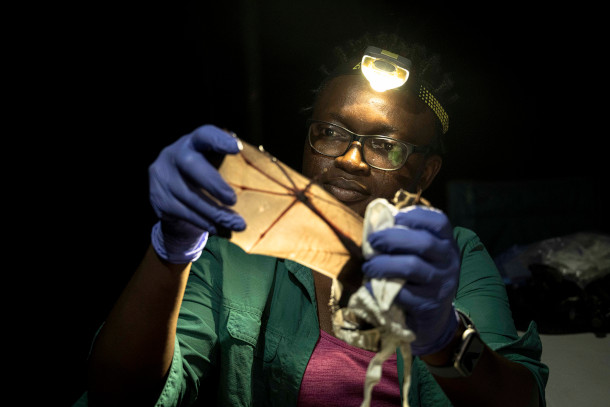
Iroro Tanshi holds up a short-tailed roundleaf bat for data collection. (Photo: Etinosa Yvonne for the Goldman Environmental Prize)
TANSHI: It was a rollercoaster that we experienced. One day we were celebrating the bat that we discovered. Eight days later, we were running for our lives from a wildfire that destroyed 50% of the bat's habitat.
DOERING: Oh, my.
TANSHI: So in terms of urgency, it was an instant moment, just realization that this is it. We gotta do something, you know? Okay, to be honest, when we ran from the forest fire, during that time of running from the forest fire with all of our bags and all of our gear and expensive equipment, my most important concern was to make sure everybody got to the village safe, because we were running down the mountain. It's not safe to be running down the mountain. But then as soon as we got back, when we looked back and took a photo of what the scene looked like, it was a huge conflagration. And in that moment, we knew, we've got to do something, but we thought it was going to be a small fire, you know, a couple of days. No, it burned for three weeks. Three weeks, you look on the map, and you're looking at 50% of the forest gone to fires.
DOERING: Gosh.
TANSHI: So it was an instant situation of just realizing that this is an urgent thing. It wasn't, it didn't take time, you know, we were like, we've got to act now, you know? So we started talking to community members. Initially, there was this sort of aah, no one's going to listen to you. But guess what? These guys, they also want to put out wildfires because it affects their farms too. There were people who were getting thrown into poverty because their whole farm has been burned, their whole family, their whole livelihood is gone. And so that urgency was that exact night when it happened, because we just discovered the species, and we were running for our lives and realizing this huge conflagration was just happening. If we didn't stop it, we won't be able to really speak confidently about any effort to save the species. And that will be a real shame to humanity, losing the species.
DOERING: So you mentioned, you know local people, they also wanted to help stop these wildfires. And fire had been used for a while, for a long time, for burning crops on the farms, but now it's like really getting out of control. What is going on now with fire in these communities and what has changed?
TANSHI: I like the word change. I like that you sort of landed on change, because when we started talking with local communities. They had all the answers. They were like, you know, we have a cultural way of burning, so it doesn't, you know, get out of hand. You know, we burn certain a time of the year. We burn at so and so time of the day, you know, early in the morning and stuff like that. They already had the data in their minds. It wasn't statistically written anywhere. It wasn't due to any kind of measurements that were taken but people had ideas about how to reduce wildfires and how to maintain their cropland with some fire, but safely and stuff like that. So responsible use of fires. But we kind of debated a lot of things during this almost three-hour session, and this elderly woman just stood up at one point and said, you know what all this talk is really because we don't really know the best time to burn anymore. We can no longer predict the best time to burn, if you could just tell us the best time to burn. And we thought, oh, that's interesting. Because without even knowing climate change, she basically said, in her lifetime, the weather patterns have changed. The rainfall patterns have changed. So without knowing climate change, she was describing climate change to us, and that was very touching to me, especially as a very young PhD student who didn't realize that local people have the answers, you know? So all we had to do was to say, beyond the big problem of the fire, how do you break down the different components of it? So they said to us, well, everything's all over the place. So we said, well, that's a problem that technology can fix. We can basically collect data from weather stations and predict when to burn. And that's because, you know, there are systems, especially here in the US, that would rely on weather data and tell people the best time to use a campfire, for example. That we immediately said to our people on the ground in the village and said, Look, we can use this system. And they got on top of it. In fact, it's now part of their local law that if the sign says this is a good day to burn, then that's fine. If it's not a good day to burn, you're not expected to burn, and indeed, you will pay a fine to the local community leadership. And that's kind of where it really all started. We just sort of took it away, was very much a co-managed system, co-designed system. And when I say 'co', I'm really exaggerating how much of an input we were making. We were really just providing a coordination support. They were telling us this is what we need. We need to be able to respond to fires when they happen effectively. Let me tell you how they used to respond to fires. They'll use branches, you know, cut a branch and beat the fire down, or, you know, run with a bucket from, you know, however far away that stream was. So it wasn't very effective. So they're trying to put our fires, they're trying to predict, but it's not quite working. So it was very much a coordination that we did, and they just basically set us up. And that I find to be an incredible story onto itself.
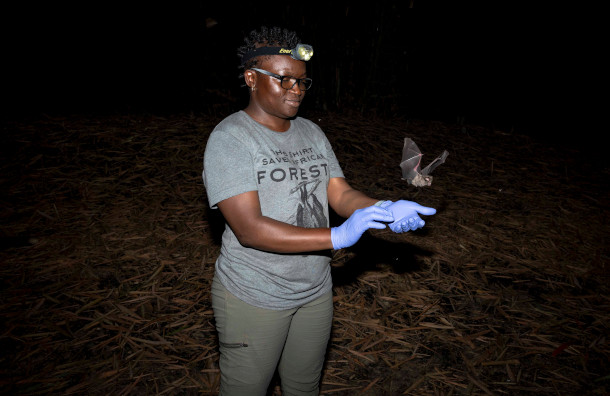
Iroro releasing a bat after data collection in Odukpani, Cross River State. (Photo: Etinosa Yvonne for the Goldman Environmental Prize)
DOERING: And so in addition to the tracking weather and the, I guess, the moisture content of the forest in real time and getting that information to the community, how else did you use technology to help these people prevent and fight wildfires?
TANSHI: Well, I gotta tell you, there's a there's a really nice manual technology. So technology is not always data driven, okay, it's not always like numbers. So there is a backpack that you can fill with water, five gallons, about 20 liters of water, and it's got a high-powered hose connected to it. And that high powered hose you can safely carry that up a mountain or across long distances on the ground in the farms and put out fires when they happen.
DOERING: Wow.
TANSHI: Because remember, these are systems where the water source is a river. Okay? So you have to travel, you know, long distances to get to it, depending on where it is. If you're lucky, you're right next to the river, that's fine. But in most cases, you're not close to a river. So that technology of having a backpack and a high-powered hose, that was an important technology on the response side of this whole system. There's something else that I have to point out, I'm sure your, your listeners will enjoy, is when we make our risk predictions, we let the local people know, and the chief forest guardian will put that sign up on the sign post. But there's also another communication mechanism we use, just in case. You know, they're not able to either go to the sign today. Maybe their farm is in one direction, but the sign is in the other direction. Local communities in this area, in Cross River in Nigeria, they have what's called a town crier, so someone who goes around in the morning, you know, very early in the morning, just before it's bright, at dawn, and they hit a gong very loudly, and they basically, kind of almost wake you up. So if you're in a village at that time, at 6am, you hear a very loud gong that says, you know, hello, hello, everybody. This is a red fire day. Do not use fires on your farm. That is human technology, right there, you know? So when we say technology, some of it's data driven, some of it is just reapplication of, you know, existing tools, as it were, and it always makes a difference, because it's really about solving that problem at a small level, and it builds up to solving this big problem of making sure that fires do not progress from farms to forests.
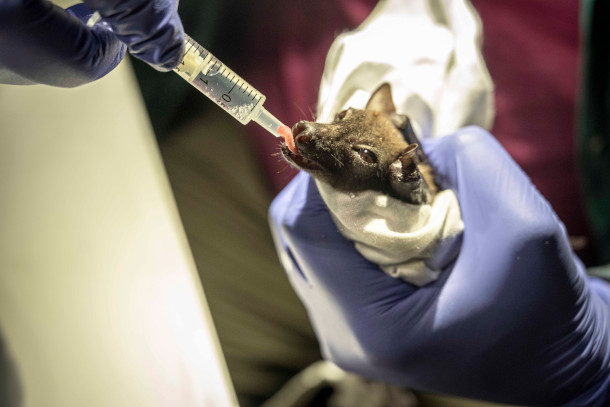
Iroro feeds an Angolan soft-furred bat with a dropper. (Photo: Etinosa Yvonne for the Goldman Environmental Prize)
DOERING: It sounds like the town crier, you know the "hear ye, hear ye", that we've heard about.
TANSHI: Hear ye, yes!
DOERING: And that is technology that works in the local community. That's a human societal technology that is appropriate for a village.
TANSHI: Exactly! A village that does not have cell service.
DOERING: Mmhmm.
TANSHI: Yes, if people don't have cell service, and in fact, you wouldn't believe this, but because it's a mountain range, well, I guess you would, because you're a radio program, you would understand radio waves bounce around a lot in this sort of mountain landscape. So using radio can be quite tricky. And in fact, some of the radio that comes from the city doesn't always get here because they are cut off. So if you're generating radio, it has to be, you know, on the ground there. So in any case, the most effective technique is what the community is already using. And we just got in there and said, well, let's get the town criers to speak. And in fact, it was one of the community people who said, well, we have to get the town criers to tell people. I was like, yeah, I agree, completely.
DOERING: So how successful has this zero-wildfire campaign been and what's the current status of the Afi Mountain Wildlife Sanctuary?
TANSHI: Oh, that's such a great question, because I've got news.
DOERING: Wonderful!
TANSHI: We just closed fire season at Afi Mountain this year, and it's the fifth year in a row when we've had zero wildfires in the forest - zero.
DOERING: Amazing.
TANSHI: That is down from annual fires of, say, five to maybe 30 fires happening in a year in the park. But for the past five years, it's been down to zero, and we've been jubilating. Our teams have been, you know, just excited and everyone's happy in the village. You know, it's like we're all really just pleased to not have to deal with wildfires. So the whole program has suddenly saved Afi Mountain Wildlife Sanctuary from fires. And you can look at the map, you go from 2016 and you know multiple years before that, lots and lots of fire counts within the park to a park where it's completely zero. So the map, we've got this slide show where we show how the fires have sort of dwindled across the years. And it's incredible. It's just incredible. We're really proud of it.
DOERING: And of course, that's good for the people and their farms and homes, and good for the bats.
TANSHI: Absolutely, absolutely. It's great for bats. We're finding more and more individuals of our species, primarily when you're trapping in the forest, but we're also seeing more bat species at this site as well.
DOERING: So Iroro, what do you hope is the future of this system that you've helped to create, and what do you want people to learn from your success?
TANSHI: Oh, I like that so much. First of all, I want to say it's been an incredible effort. You know, across work from our team members, our government partners, our community partners, you know, the community leaders who enforce the law, without any input from us, we just ask them, did you enforce it? Yes? Okay, good. All of those people, this has been the effort of so many people. So I'm really, truly grateful for that, that we sort of created a movement on the ground around one protected area. We started another protected area in Nigeria, so protecting two places from wildfires now. Now on top of that, because we've seen how successful this has been and we've talked with colleagues across Africa, in fact, some places in Southeast Asia, we've got colleagues who would like to test this at our site. And we're like, well, we've got the answers. So we're actually just now launching a program that is pantropical, and it will help people to adopt parts of this program that we've been successful with on their own forest patches around the world. So we're taking this thing global, is what I'm trying to say. So I'm really, I'm incredibly proud of what we've done. I'm incredibly grateful for all the people who've supported us at this point. It's just been an incredible movement. And I want people to get the point that on the one hand, one or two people can make a difference if you push for it, but also local people, especially forest people, they are the custodians. They're the people you want to be talking to. They're the ones who have the solutions. They may not know the exact terms in the modern technology world that we live in today. But come on, you can always translate whatever they say. If they say, we can no longer predict, that's what the problem is. If they say, we just need to know when to burn, that's what the solution is. You know, you've got to go translate that solution to whatever new ways the modern world interprets these things. So it's just incredible that we've been able to do this. And we want people to see that they too in their own ways and their own community can make a difference. Just find your community. Find your village to support you, but find the community people who will take that action with you and just take it away, because the world needs people like that who have a fire in the belly. In our case, our fire was started by fire. There you go. You know who just take it away and rest assured that people will work with you.

Iroro Tanshi at the Goldman Environmental Prize award ceremony. (Photo: Goldman Environmental Prize)
DOERING: Iroro Tanshi is the winner of the 2026 Goldman Environmental Prize for Africa. Thank you so much for joining me, Iroro. It's been a real pleasure.
TANSHI: Thank you. I really enjoyed this conversation.
Related links:
- Iroro Tanshi’s website
- Iroro Tanshi’s profile at The Goldman Environmental Prize
- The Goldman Environmental Prize
- Learn more about the short-tailed roundleaf bat on Wikipedia
[MUSIC: The Folks, “Wild Mountain” Single, Kap Kap]
O'NEILL: Living on Earth is produced by the World Media Foundation. Our crew includes Naomi Arenberg, Paloma Beltran, Mia DiLorenzo, Abby Edgecumbe, Swayam Gagneja, Mark Kausch, Mark Seth Lender, Don Lyman, Ashanti Mclean, Nhung Nguyen, Sophia Pandelidis, Jake Rego, Andrew Skerritt, Bella Smith, and El Wilson.
DOERING: Tom Tiger engineered our show. Allison Lirish Dean composed our themes. You can hear us anytime at L-O-E dot org, Apple Podcasts and YouTube Music, and like us please, on our Facebook page, Living on Earth. Find us on Instagram, Threads and BlueSky at living on earth radio. And we always welcome your feedback at comments at loe.org.
Steve Curwood is our Executive Producer. I’m Jenni Doering
O'NEILL: And I’m Aynsley O’Neill. Thanks for listening!
ANNOUNCER: Funding for Living on Earth comes from you, our listeners, and from the University of Massachusetts, Boston, in association with its School for the Environment, developing the next generation of environmental leaders. And from the Grantham Foundation for the protection of the environment, supporting strategic communications and collaboration in solving the world’s most pressing environmental problems.
ANNOUNCER 2: PRX.
Living on Earth wants to hear from you!
Living on Earth
62 Calef Highway, Suite 212
Lee, NH 03861
Telephone: 617-287-4121
E-mail: comments@loe.org
Newsletter [Click here]
Donate to Living on Earth!
Living on Earth is an independent media program and relies entirely on contributions from listeners and institutions supporting public service. Please donate now to preserve an independent environmental voice.
NewsletterLiving on Earth offers a weekly delivery of the show's rundown to your mailbox. Sign up for our newsletter today!
 Sailors For The Sea: Be the change you want to sea.
 The Grantham Foundation for the Protection of the Environment: Committed to protecting and improving the health of the global environment.
 Contribute to Living on Earth and receive, as our gift to you, an archival print of one of Mark Seth Lender's extraordinary wildlife photographs. Follow the link to see Mark's current collection of photographs.
 Buy a signed copy of Mark Seth Lender's book Smeagull the Seagull & support Living on Earth
© Copyright World Media Foundation. All Rights Reserved
Home | Contact | RSS | Donate | Newsletter