

August 7, 2026
Air Date: August 7, 2026
FULL SHOW
SEGMENTS
A Cemetery Buzzing with Bees
View the page for this story
While honeybees get most of the buzz, most bees don’t produce honey, and most don’t even live in colonies. Instead, they’re solitary bees who build individual nests. These are the type of bees that Bryan Danforth studies as a professor of entomology at Cornell University. He speaks with Host Paloma Beltran about his paper detailing an astonishing finding of several million solitary bees in a cemetery in Ithaca, New York. (11:05)
BirdNote®: Bee Hummingbird
/ Mary McCannView the page for this story
The smallest bird in the world is a hummingbird found only in Cuba that lays eggs the size of a coffee bean. And as BirdNote®’s Mary McCann explains, they’re so small they’re often mistaken for bees. (01:39)
Bluetooth Butterfly Tracking
View the page for this story
Monarch butterflies can travel thousands of miles each year between Mexico and North America in an epic relay race of multiple generations. And thanks to new technology, our phones and other Bluetooth devices can now tell us what paths these brave little insects take on this journey. Dan Fagin, who teaches environmental journalism at NYU and is writing a book about monarchs, talks with Host Steve Curwood about the tiny trackers and what it’s like to be among millions of monarchs where they overwinter in Mexico. (15:06)
How Flowers Made Our World
View the page for this story
Summer flowers like black-eyed Susans, hibiscus, sunflowers and coneflowers fill gardens and parks with color and fragrance, but flowers are more than their beauty. They’re some of the oldest beings on Earth, and they played a large role in shaping the natural world as we know it. David George Haskell is an author and biologist whose 2026 book is How Flowers Made Our World: The Story of Nature’s Revolutionaries, and he joined Living on Earth’s Steve Curwood. (16:02)
"Anthropocene Pastoral"
View the page for this story
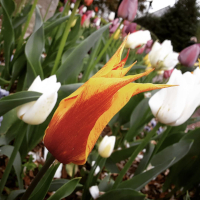
In her poems, Catherine Pierce grapples with unfolding climate disaster and reflects on finding beauty amidst the ecological disarray of the Anthropocene. Here she reads her poem “Anthropocene Pastoral” from her 2020 collection Danger Days. (01:48)
Show Credits and Funders
Show Transcript
260807 Transcript
HOSTS: Steve Curwood & Paloma Beltran
GUESTS: Bryan Danforth, Dan Fagin, David George Haskell, Catherine Pierce
REPORTERS: Mary McCann
[THEME]
CURWOOD: From PRX this is Living on Earth
[THEME]
I’m Steve Curwood.
BELTRAN: And I’m Paloma Beltran.
Researchers find an astonishing abundance of bees in a cemetery.
DANFORTH: What does 5.6 million bees look like? It looks like 270 honeybee colonies – imagine what that looks like, a whole lot of white boxes scattered across the landscape. It’s also equivalent to 4 times the population of Manhattan, the human population of Manhattan.
CURWOOD: Also, flowers can be sweet smelling pleasures as well as ingenious ‘revolutionaries’ who remade the ecological world as we know it.
HASKELL: We often dismiss flowers as merely ornamental. They're pretty, but not powerful. They're beautiful, but not in charge. And in this book, I want to sort of reframe that and put flowers back at the center of the story of how our modern world came to be.
CURWOOD: That and more, this week on Living on Earth, stick around!
[NEWSBREAK MUSIC: Boards Of Canada “Zoetrope” from “In A Beautiful Place Out In The Country” (Warp Records 2000)]
[THEME]
A Cemetery Buzzing with Bees
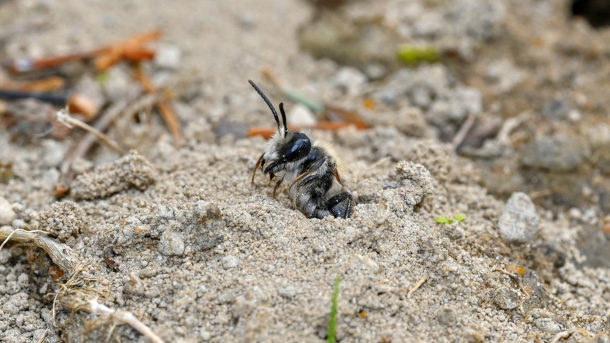
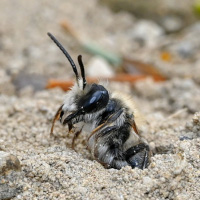
Though many of us might assume that bees always live in hives, most species of bees are solitary, and many of those live underground. Above is Adrena regularis, also known as the regular mining bee. Bryan Danforth and his team at Cornell studied a large aggregation of these solitary bees at a local cemetery. (Photo: Bryan Danforth)
BELTRAN: From PRX and the Jennifer and Ted Stanley Studios at the University of Massachusetts Boston, this is an encore edition of Living on Earth. I’m Steve Curwood.
BELTRAN: And I’m Paloma Beltran.
As a celebration of summer pleasures, today’s show is all about flowers and pollinators, including bees. Now, many of us know the famous image of Winnie the Pooh holding onto a balloon, reaching his paw into a hive full of honeybees. But most bees don’t produce honey, and most don’t even live in colonies. Instead, they’re solitary bees who build individual nests. These are the type of bees that Bryan Danforth studies as a professor of entomology at Cornell University. His most recent paper details an astonishing finding of several million solitary bees in a graveyard in Ithaca, New York. Bryan Danforth joins me now to discuss – Welcome to Living on Earth!
DANFORTH: Thanks very much, Paloma.
BELTRAN: So, when I picture bees, the first thing that comes to mind is a buzzing hive. But you study solitary bees. How common are these solitary bees compared to social bees?
DANFORTH: Yeah, that is the image I think many people have of a bee. You imagine a colony, you imagine a honey bee, or a bumblebee, a queen, thousands of workers, aggressive stinging. The bees that I work on, the solitary bees, are much more docile. These are bees in which each female builds her own nest, provisions her brood cells with pollen and nectar, lays her own eggs, defends her nest from enemies, parasites, and predators, and then leaves her offspring to the next generation. So, the image of a social bee is quite different from the kind of solitary bees that we work on. So, we know that there are 21,000 described bee species on Earth, and that's probably an underestimate. You know, there may be 30,000 bees total. Of those 21,000 described bee species, 77% of them are solitary, 13% of them are brood parasites of those solitary bees, and then about 10% are social. So the social bees comprise a pretty small slice of that 21,000 total species. The vast majority are these solitary bees.
BELTRAN: And you note in your study that solitary bees are important for pollination, but just how important are they?
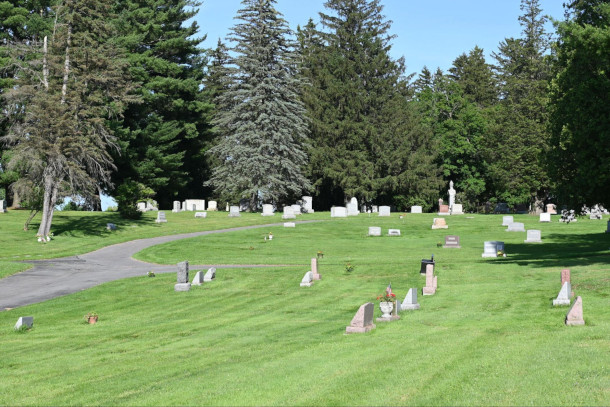
Bryan Danforth’s study took place at East Lawn Cemetery, located in Ithaca, NY. Danforth suspects that cemeteries serve as biodiversity hotspots for ground nesting bees. (Photo: Bryan Danforth)
DANFORTH: It really depends on the crop. I'll give you a few examples. So, in squash and pumpkin, for example, there is a single solitary bee species called Peponapis pruinosa, which is a narrow host plant specialist on squash and pumpkin, and those are very effective pollinators. They are early morning bees, so they get out before any of the other wild or managed bees, visit squash and pumpkin, and they're doing most of the squash and pumpkin pollination. We did a lot of work on the role of wild bees as apple pollinators in New York because New York is a big producer of apples. It's... we're the second largest producer of apples in the country, and for about a decade my lab studied the role of wild bees as crop pollinators and apples. So this is something I know really well, and we were able to document 120 wild bee species visiting apples in New York state, that's about a quarter of the total number of bees in New York state, so a big slice of New York pollinators are actually visiting apple, and through the work of Mia Park, a graduate student at the time, we determined that the solitary bees are actually more effective on a per visit basis as pollinators. So, when they visit a flower, they deposit more pollen grains, and they're also more abundant in many apple orchards. So, for the apples that I worked on, the wild bees are actually more important than honey bees, but there are certain crops that are really highly dependent on managed pollinators. So, I would say the answer to your question is, it really depends on the crop, but for the crops that I have worked on, the wild bees are very, very important, and they're doing all this work for free, by the way. These are not bees that you have to manage or you have to pay for. They're just out there in the environment doing their job.
BELTRAN: Wow, amazing. So your study was conducted at a cemetery in Ithaca, New York. How did your team choose this location for your research?
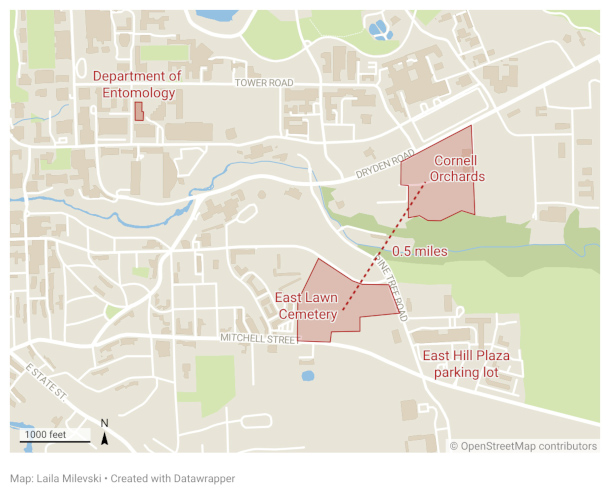
The team decided to study the bees in the cemetery when a colleague happened to see a cloud of them as she was walking from the East Hill Plaza parking lot to campus. (Image: Lalia Milevski, Created with Datawrapper)
DANFORTH: So, it turns out that the cemetery is just right off the edge of the Cornell campus, so we don't have to go very far to study these bees. But it really was just a random event. My technician at the time had the habit of parking her car at East Hill Plaza, the shopping center out there on the east side of campus, and on her way into work, she walked through the East Lawn Cemetery. And she did this in the spring of, I think it was 2022, and discovered that there were tons of bees over the lawn, clouds of bees flying over the surface of the cemetery. And she collected a few of these bees, brought them into the lab, and we immediately identified them as Andrena regularis, a solitary bee that we'd studied as an apple pollinator. We knew it was a fairly common bee in New York, but we didn't really know where it nested, and we certainly didn't know how large the nesting aggregations were. So this discovery allowed us then to dig into, no pun intended, dig into the biology of this bee. So we then did a follow-up study in 2023 where we used emergence traps to capture bees emerging from the soil at the very start of the season, and that allowed us to track the number of bees emerging over time, the sex ratio of the bees, the parasites emerging along with the host, and we were able to come up with this population estimate of 5.6 million bees.
BELTRAN: Wow, that's a huge number. How surprising was that number to you?
DANFORTH: So it was very surprising to me, although I will say that I would not at all be surprised if there were larger bee aggregations out there. It just turns out that this is the largest one that's ever been reported in the literature. And I'll put that number in perspective. So, what does 5.6 million bees look like? It looks like 270 honey bee colonies. Imagine what that looks like, a whole lot of white boxes scattered across the landscape. It's also equivalent to four times the population of Manhattan, the human population of Manhattan.
BELTRAN: Wow.
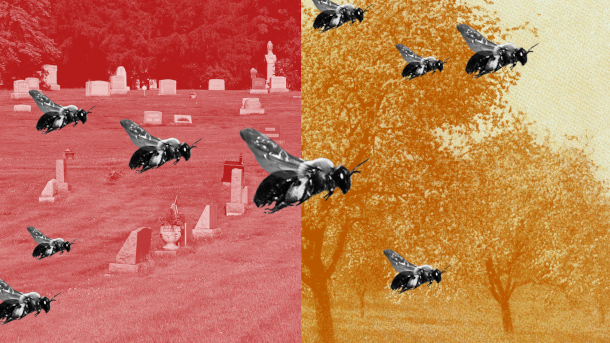
Solitary bees are crucial to the pollination of many crops, including the species of apples that grow in New York. (Photo: Lalia Milevski)
DANFORTH: It's a large number. Yes, there are a lot of bees.
BELTRAN: What were the conditions in this cemetery that led to such a high concentration of bees?
DANFORTH: We think that it's related to the soil texture. Ground nesting bees, just like humans, like to dig in soil that's kind of maintains its consistency, so the cemetery soil is what's called sandy loam. It's a very nice soil texture for digging, and we think that that's one of the reasons that these bees are particularly abundant at that site. And many cemeteries across the landscape in the eastern United States were sited on these sandy loam soils because you could dig a six foot deep hole with a shovel in sandy loam soil, and this was before the advent of the backhoe. So, we think that there is really something unique about that sort of soil texture, and now we're expanding our studies to look at other cemeteries around New York and see whether they have that kind of soil and whether they also host large numbers of solitary bees.
BELTRAN: And part of your study analyzed parasite rates among bees. Talk to me about the parasites. What do they look like, and how do they affect the bees?
DANFORTH: Yeah, so we focused on the most common parasite of Andrena regularis, which just turns out to be another bee. It's called Nomada imbricata. It's the nomad bee. We call them brood parasites, or you could call them cuckoo bees. They are very adept at sneaking into the nest of their host, laying an egg in the brood cell, and hiding that egg in the wall of the brood cell, and then leaving, so the adult would leave. Meanwhile, the host bee continues to provision her brood cell, she lays her own egg, she closes up the brood cell, and then she's done with that brood cell. She will never go back into that brood cell. Meanwhile, the nomad bee egg hatches. It crawls across the pollen provisions. It kills the host egg or larva, and then it consumes the pollen and nectar that was gathered by the host, so it's a very devious strategy. It's very much like a cuckoo bird. It's a very common strategy in bees. As I said, about 13% of bee species are brood parasites, and they specialize on individual species or individual groups of bees as their particular host. And I should point out that these brood parasitic bees are really quite different looking from your normal bee. They're not hairy. They are very wasp-like. They're yellow and black. They're heavily armored. They live their life kind of just skulking around the nest site, you know, because they don't actually build a nest. They don't need to collect pollen and nectar for their offspring, so they're kind of drifters around the nest site. And then when they see the opportunity, they dive into a nest. So, if you see wasp-like creatures flying low over the ground in an area where there are bees nesting, those might be brood parasites.
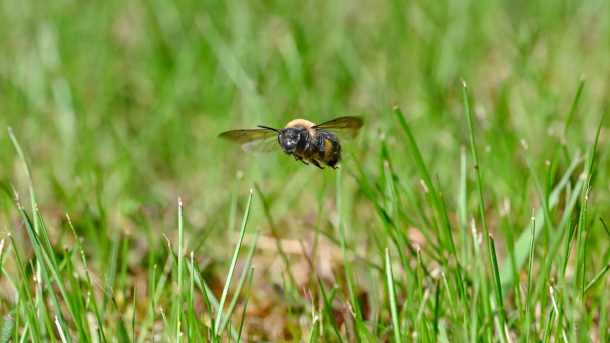
Adrena regularis is far less aggressive than many species of social bees. Each mother lays her own eggs underground and provides them with pollen. (Photo: Bryan Danforth)
BELTRAN: So, you ended your study by discussing how cemeteries could be important for preserving biodiversity. Why do you think that is?
DANFORTH: It turns out that there's a reasonable literature on this. A number of studies have been done in Europe, looking at the fauna and flora of older inner-city cemeteries in cities like Berlin, and it turns out that these cemeteries can host rare plants. They can host rare birds, rare salamanders, so cemeteries, I think, turn out to be these underappreciated biodiversity preserves, and that's because they're undisturbed. So, once the cemetery is established, and most cemeteries are at least 200 to 300 years old, even in the eastern US, so these sites become preserves. They're no longer undergoing change. There's no building. There's no construction going on. And then, in addition, there's low pesticide use in those cemeteries. So, I really think that our study, but also some previous work done in Europe, suggests that cemeteries are these underappreciated refuges for biodiversity.
BELTRAN: You know, what are the broader implications of your research in the cemetery regarding bees?
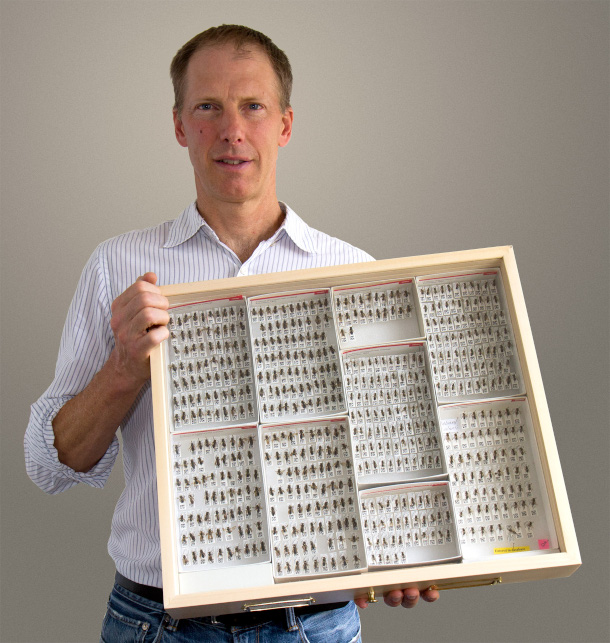
Bryan Danforth is a professor of entomology at Cornell University. (Photo: Courtesy of Cornell Media Relations)
DANFORTH: So, I think the real take home from our study at the East Lawn Cemetery is that nest sites are incredibly important conservation priorities, and that we need to be identifying these nest sites, protecting them, and educating people about their value. So, as a result of that, we started a project called Project GNB, or Project Ground Nesting Bee. It's a community science project. We run it through the iNaturalist platform. And we would like backyard naturalists, birders, people out for a walk with their dog to upload observations of nesting sites, if they see them, of these bees, so that we can map across the landscape where these nesting aggregations occur, and therefore protect them. That's, I think, the main take home from our study.
BELTRAN: Bryan Danforth is a professor of entomology at Cornell University. Bryan, thank you so much for joining us.
DANFORTH: Thanks very much, Paloma. It's been a pleasure.
Related links:
- Read Bryan Danforth’s original research paper
- Get involved with Project Ground-Nesting Bee
- About Bryan Danforth
BirdNote®: Bee Hummingbird
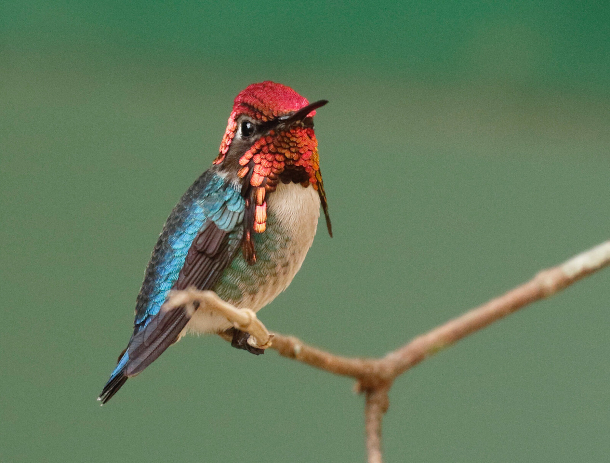
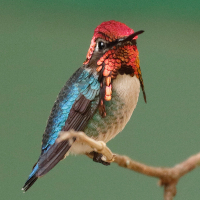
A male bee hummingbird with his striking red head (Photo: Dave Curtis, CC)
[BIRDNOTE THEME]
CURWOOD: You might need to squint to see the Bee Hummingbird, which is found only in Cuba.
BirdNote’s Mary McCann has more.
BirdNote® Bee Hummingbird
[The AfroCuban Allstars - “Distinto Diferente”]
Would you like to see the world’s smallest bird? Then you’ll need to travel to Cuba.
Once on the island, your best bet for tracking down the tiny wonder is to visit a forest edge hung heavily with vines and bromeliads. There, hovering at the flowers — if you squint hard enough — you’ll find the Bee Hummingbird.
(https://macaulaylibrary.org/audio/121909)
The Bee Hummingbird, which is found only in Cuba, is an absolute miniature, even among hummingbirds. It measures a mere two and a quarter inches long. Bee Hummingbirds are often mistaken for bees. They weigh less than two grams — less than a dime. That’s half the weight of our backyard hummers, like the Ruby-throated or Rufous. The female builds a nest barely an inch across. Her eggs are about the size of a coffee bean.
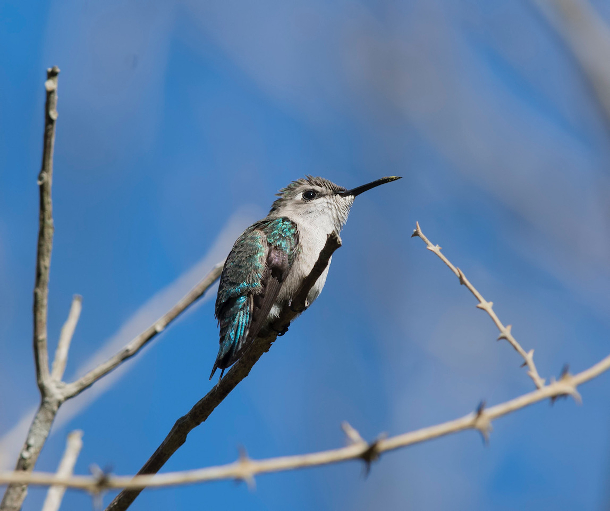
A female bee hummingbird (Photo: Patty McGann, CC)
(https://macaulaylibrary.org/audio/121909)
In flight, the Bee Hummingbird’s tiny wings beat 80 times a second. And during a courtship flight, they beat up to 200 times per second! The male’s entire head and throat shine in fiery pinkish-red, and blazing red feathers point like spikes down the sides of the breast.
A sight to behold!
Written by Bob Sundstrom . Bird sounds provided by The Macaulay Library of Natural Sounds at the Cornell Lab of Ornithology, Ithaca, New York. 121909 recorded by Gregory F Budney. BirdNote’s theme music was composed and played by Nancy Rumbel and John Kessler. Producer: John Kessler Managing Producer: Jason Saul Associate Producer: Ellen Blackstone © 2017 Tune In to Nature.org September 2018/2019 Narrator: Mary McCann
CURWOOD: For photos buzz on over to the Living on Earth website, LOE dot ORG.
Related link:
Find this story and more on the BirdNote® website
[MUSIC: Afro-Cuban All Stars, “Variaciones sobre un tema desconocido” on Distinto, diferente, World Circuit Limited]
BELTRAN: Just ahead, tracking the three-thousand-mile journey of a small but mighty butterfly. Stay tuned to Living on Earth!
ANNOUNCER: Support for Living on Earth comes from the Waverley Street Foundation, working to cultivate a healing planet with community-led programs for better food, healthy farmlands, and smarter building, energy and businesses.
[CUTAWAY MUSIC: Afro-Cuban All Stars, “Variaciones sobre un tema desconocido” on Distinto, diferente, World Circuit Limited]
Bluetooth Butterfly Tracking
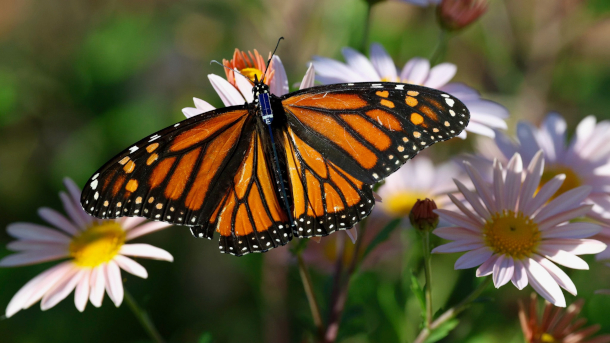
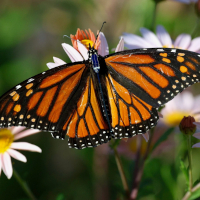
Tags from Cellular Tracking Technologies of Cape May, New Jersey, allow scientists and butterfly enthusiasts to follow the journey of monarch butterflies as they fly south for the winter. (Photo: Sheldon Blackshire)
BELTRAN: It’s Living on Earth, I’m Paloma Beltran.
CURWOOD: And I’m Steve Curwood.
The amazing Monarch butterfly is as beautiful as it is mysterious. Every year successive generations of monarchs take part in an epic relay, with each generation playing a different but vital role. Monarch butterflies that hatch in the spring and early summer live fast and die young at only two to six weeks. But those that emerge in late summer can survive six to nine months. That’s long enough to migrate thousands of miles south for the winter and start the return north the following spring to breed.
The precise paths these brave little insects take to get from the U.S. and Canada to their winter colonies in Mexico have long eluded scientists and butterfly enthusiasts. But thanks to new technology, our phones and other Bluetooth devices can now tell us where these tiny creatures are traveling. Joining us now is Dan Fagin, who teaches environmental journalism at NYU and is writing a book about monarchs.
Dan, welcome back to Living on Earth!
FAGIN: Thanks, Steve, nice to talk to you.
CURWOOD: And great to talk to you. Hey, let's talk monarch butterflies. Monarchs have this fascinating migration pattern. Several generations they fly north, and then one generation to get all the way back to the tropics. Please talk to me about the new way to track them.
FAGIN: Yeah, something really kind of amazing has happened to monarch science. And you know, monarch butterflies are this beloved butterfly that scientists have been studying intently, really, since the 1940s and you know, the most intriguing thing about them, they have a lot of intriguing habits, but the most intriguing thing, Steve, as you mentioned, is this amazing migration that they do, multiple generations, thousands of miles. And for a long time, people have been trying to understand where monarchs go and how they get there. And for many, many years, the only way that they could do that was by using paper tags or sticker tags. The Holy Grail forever in monarch science has been to develop some kind of radio tagging, which can work for bigger animals, but to figure out a way to make a tag so small that we can actually track the entire journey of a monarch butterfly. And sure enough, after all these years, a startup company called Cellular Tracking Technologies based in Cape May, New Jersey, figured out a way to do it, and now we know where these monarchs are actually going and how they get there.
CURWOOD: So what are some of the surprising places that monarch butterflies go?
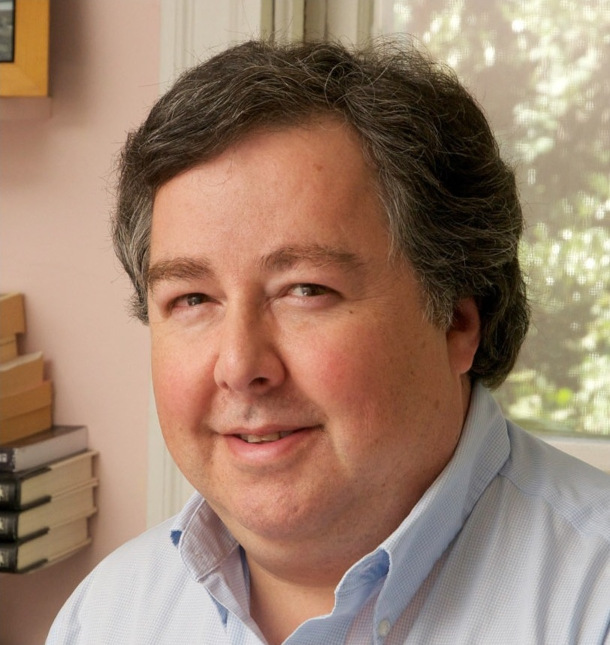
Dan Fagin, director of New York University’s Science, Health and Environmental Reporting Program and the author of the Pulitzer Prize winning Toms River, is writing a book about monarch butterflies. (Photo: Dan Fagin)
FAGIN: Maybe the most amazing thing about how this technology works is that a monarch pings, they register if they pass within a couple hundred feet of any kind of device equipped with Bluetooth, whether that person realizes it or not, if their Bluetooth is turned on, they are helping with this data collection. So we can now see, Steve, that if a monarch is over the ocean and passes near a boat that has a cellular device turned onto Bluetooth, they will ping. And sure enough, some of these monarch tracks, which, by the way, people can see for themselves by downloading the app, pass over oceans, deserts, all kinds of unexpected places.
CURWOOD: Let me understand this for sure, the monarch tracking device transmits in Bluetooth, and anyone gets that signal, you have to have the app to get the signal? Where is the signal going?
FAGIN: No, anyone can contribute to the data set, whether they realize they're doing it or not. Their device will ping and the data will go back to the central data depository that will show up as one detection along the route. Anyone can see where these tagged monarchs are going by downloading the app and looking. That's not about detecting the presence of monarchs. That's about looking at the data that's already been collected.
CURWOOD: Talk to me for a moment more about the technology. I mean, how much does a monarch butterfly weigh and how much does this tracking device weigh? I imagine the numbers are small in both cases, huh?
FAGIN: Yeah, really small. The way I like to analogize it is, a butterfly weighs about as much as half of a raisin, so it's very light, and the tags themselves are much lighter, still, little more than 10 percent of the body weight of the monarch, which is sort of like three uncooked grains of rice riding on half of a raisin.
CURWOOD: So Dan, what are we learning about the monarchs by tracking them? What are we learning about them through this tracking?
FAGIN: Yeah, a lot of things. You know, the monarch, you know, for reasons that we can talk about, is in trouble. We know that their populations are declining, especially the migratory population, they face all kinds of problems. So it's really important to figure out, well, how do we know what are the most popular routes that they take? And so we can think about how to help them in those particular places, and now we have a better idea about that, and after another few years of radio tagging, we'll have a better idea still. And another thing, Steve, is we can tell how affected by weather they are, because you can watch what happens to one of these monarchs when a big cold front comes by or there's a storm, and we can now see in real time that these monarchs are getting blown way off course. So now we know that weather is a very, very big deal for these guys. That they're stronger than we think, but they're not strong enough to resist a huge storm. But the flip side of that is they have these fantastic navigational abilities.
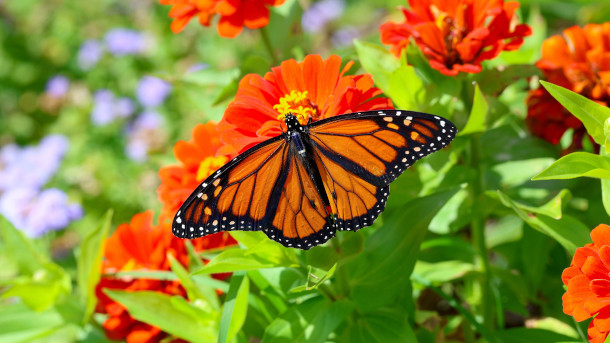
Tracking devices are about 10 percent of the weight of the monarch butterfly, the equivalent of three uncooked grains of rice on half a raisin, according to Dan Fagin, who is writing a book about monarch butterflies. (Photo: Sheldon Blackshire)
CURWOOD: How do they navigate? How do they know where they're going?
FAGIN: Yeah, it's really quite amazing, Steve. Over millions of years, they've evolved two different biocompasses, and they need two, because one of them tracks the sun is sort of anchored to the sun, but that's a problem when it's cloudy out. So they also have another biocompass that is attuned to the Earth's magnetic field. And you know, there's so many amazing things about this that they have these abilities at all. But what's especially amazing is that the sun compass actually compensates for the sun's journey across the sky, at least as we perceive it. We're the ones who are moving, not the sun, but as we perceive it. That could be a real problem for monarchs. If they just track the sun, they would constantly go off course. But this bio compass they have adjusts for this. It's called the time compensated sun compass, and it's quite miraculous. A few other insects have them too.
CURWOOD: Uh huh. Wait a second, you're telling me that monarchs can tell time essentially.
FAGIN: Yeah, they can. They can. You know, they they have a much more naturalistic way of doing it. They don't look at digits, but yeah, they adjust based on where the sun is and where south, or sometimes southwest, is their general journey direction in the fall. And they adjust for that all day long, and it keeps them going. So even when they're blown way off course, by these storms, they can adjust and get back on track, and this new data shows us this.
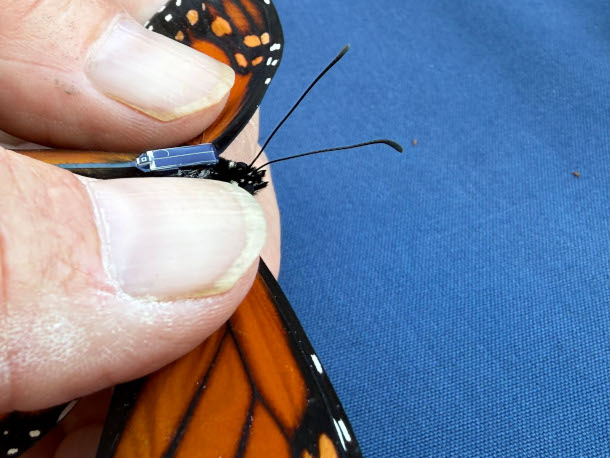
Digital tags on monarch butterflies ping off Bluetooth devices and send back data to scientists to map the path of monarch butterflies as they journey south for the winter. Data has shown that cold fronts and storms blow monarchs off course, but their navigational skills help them reach their overwintering place. (Photo: Courtesy of Cape May Point Arts and Science Center)
CURWOOD: So talking about the southern journey that single generation monarch might make, say from eastern Canada all the way to Mexico, I'm guessing most of them don't make it all the way. So how is climate disruption and loss of habitat making things harder for them? What's the survival rate?
FAGIN: Some people think that, you know, less than 5 percent of the monarchs that start the journey in September actually make it through the winter and then reproduce successfully in the early spring. That it's less than 5 percent. Some people think it's a little higher than that. That it might be, you know, more like 10 or 15 percent. These new tags will help us figure that out, once we get a nice, big, robust data set. But they face so many potential risks along the journey, and really at every stage of their year-long multi-generational life cycle. Climate change is an obvious one, because climate change creates problems for them at every stage of their yearly journey. They definitely when they're migrating in the fall, they need access to nectar plants, or they'll never make it. They need to fortify themselves along the way, and climate change is wreaking some havoc with where and when these plants are available in the fall and also in the spring, when they're moving north and they need nectar plants, again. In Mexico, climate change is creating all sorts of problems for them. They have a very narrow temperature range that they are comfortable with and that means that for winter, that's why they migrate in the first place. And for winter, they need to find a place that's not too cold and not too hot. And it turns out that's a few Mexican mountaintops, typically around 10 or 11,000 feet high. And the problem is that as the climate gets warmer and moisture patterns change and drier, the monarch colonies on these mountains keep moving up, and essentially they're going to run out of mountainside. It's going to get too warm, and they're already, I can see, just from my own journeys, the trips I've taken down there over the last 10 years, we can see the monarchs moving up the mountain and, and they're running out of mountain. So that's a problem. There's also problem that things are getting much drier all along their journey, including in Mexico, and that has caused all kinds of disease problems in Mexico. Beetles, beetle infestations are a really big problem on their overwintering grounds. So this is a problem. And honestly, Steve, you know, climate change is only one of the big issues that they face. There are other critical problems too.
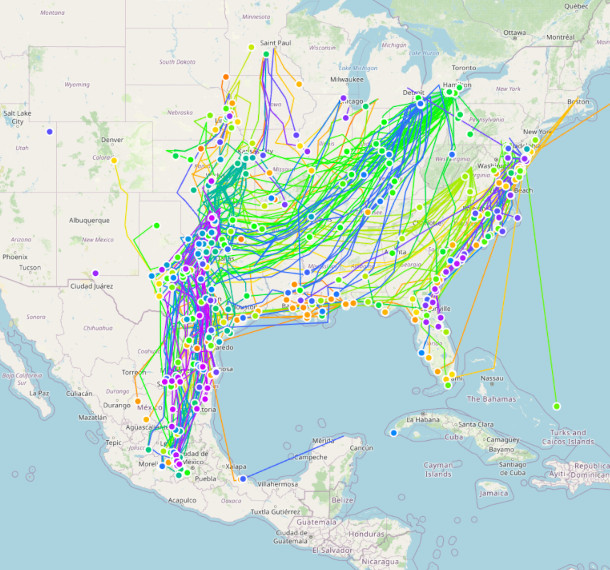
As tagged monarch butterflies travel south for the winter, they ping off Bluetooth devices such as cellphones, which send the data to scientists tracking the monarchs’ journey. The data set shows where the monarchs are located at a point in time. (Photo: Project Monarch Collaboration)
CURWOOD: Yeah, I imagine we use a lot of chemicals that aren't good for insects.
FAGIN: Yeah.
CURWOOD: And I imagine that the habitat is not exactly expanding.
FAGIN: Yeah, that's definitely true. There's a lot of recent research about neonic pesticides, neonicotinoid pesticides, that suggest they're a real problem for monarchs as well as other insects, but the biggest problem that affects them during the summertime is that monarchs coevolved with milkweed plants. They will only lay eggs on milkweeds. And it turns out that in their main summer breeding grounds, which is the upper Midwest, it coincides with the Corn Belt, with the huge corn and soybean raising areas of the Midwest. And anybody can tell you who is familiar with farming in the Midwest, something has changed fundamentally with the way that corn and soybeans are raised over the last 25 years, and that is the rise of genetically engineered seeds that are resistant to herbicides, which means that you can use a lot more herbicide, Roundup, Glyphosate is the most famous one on your crops, and that has wiped out the most important refuges of milkweeds in the upper Midwest. There's still milkweed in the Upper Midwest, but there's so much less than there used to be. And this is a big problem for monarchs.
CURWOOD: Now you've visited the tropical or perhaps subtropical monarch butterfly colonies. Talk to me about this experience. What is it like?
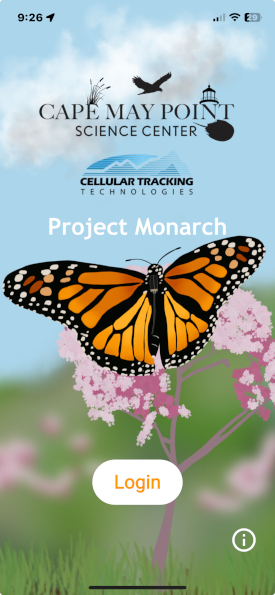
The Project Monarch Butterfly App allows users to see the path taken by monarch butterflies as they fly south. (Screenshot: Andrew Skerritt)
FAGIN: There's really no phenomenon quite like it on Earth. You go to these very isolated locations, in Michoacán and the State of Mexico, where there have been overwintering colonies most years, and you're already pretty high elevation. And then you start walking even higher in these park areas, and you're walking up the mountain, and you start to see more and more monarchs. And then after, you know, another half hour, 40 minutes, depending on where you are, you're hiking and hiking, you're getting tired, and then all of a sudden, you just see teeming hordes of Monarch butterflies circling overhead and in the fir trees, by the millions. It's just impossible to describe how many there are.
CURWOOD: So Dan, tell us about your interest in monarch butterflies. Where did the fascination begin?
FAGIN: Well, I think it was two different things. After I finished my last book, you know, I was very proud of that book, but it was about an emotionally difficult topic, children with cancer, and I wanted to do something different, and I was really just starting to realize that this concept of a human dominated planet is even bigger than climate change itself. Climate change is just one manifestation of this bigger question of humans essentially taking control of the future of this planet. We're living in uncontrolled experiments, and we don't know how it will end. So I was really interested in that. And then right about that same time, I had read stories about monarchs, and a neighbor was raising monarchs, and I just started to learn more. And then we decided, hey, let's put some milkweeds on the front lawn. And we waited and waited, and then monarch showed up. And it was amazing. It was such an enchanting, amazing thing. And so on a very human level, my wife and I really loved it. But it also got us thinking about, what exactly are we doing here? Are we creating? Is this a natural environment? Not really. We're creating an environment that's optimized for this species. And to me, that is a really interesting thing to think about, because it's really the future that we will all face, and our footprint is all over this planet, and there's no going back. And so as an environmental journalist, this is really the central question, and that is, what are we going to do with our power? So this is a Pottery Barn situation. We broke it and we own it, right? You break it, you buy it, and, and, and we own this planet. And so the question is, can we manage it in a way that meets human needs and also maximizes biodiversity? This is a, you know, a big question that our kids and our grandkids are going to face in all sorts of different ways. And as an environmental journalist, I want to encourage that conversation.
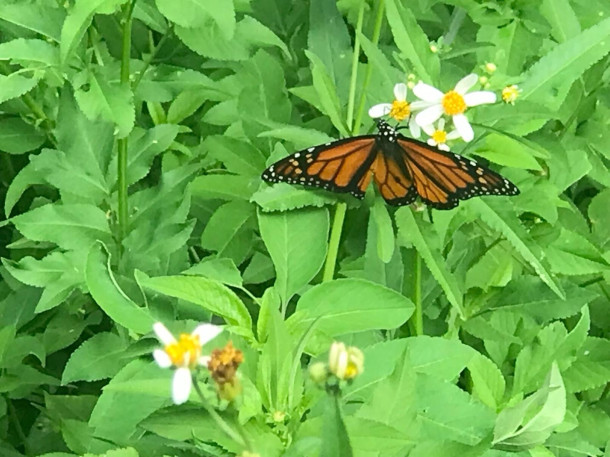
Each fall monarch butterflies fatten up on roadside weeds ahead of their migration south. A monarch feasts on flowers along the road in Tallahassee, Florida, which is on the path toward the Gulf of Mexico. (Photo: Andrew Skerritt)
CURWOOD: Pulitzer Prize winner Dan Fagin is a journalism professor at New York University, where he directs the Science, Health and Environmental reporting program, and he's working on a book about monarch butterflies that both he and his editor are waiting anxiously for. Dan Fagin, thanks so much for taking the time with us today.
FAGIN: It was a pleasure talking to you, Steve.
Related links:
- Dan Fagin’s Website
- Cellular Tracking Technologies | “Revolutionary Tracking Study Follows Monarch Butterflies from Canada to Mexico Using Groundbreaking Technology and Continent-wide Collaboration”
- Find the Project Monarch Science App on the Apple Store
- Monarch Butterfly Biosphere Reserve
[MUSIC: Jacob Shea, Sara Barone, Bastille, “Monarch Butterflies” on Planet Earth III (Original Television Soundtrack)]
BELTRAN: If you enjoy the stories you hear on Living on Earth, sign up for our free, weekly newsletter.
You’ll get special access to show highlights and early notification about upcoming live virtual events, plus exclusive letters from our staff.
So don’t miss out! Subscribe at the Living on Earth website, loe dot org. That’s loe dot org.
[MUSIC: Jacob Shea, Sara Barone, Bastille, “Monarch Butterflies” on Planet Earth III (Original Television Soundtrack)]
BELTRAN: Coming up, where there are pollinators there are flowers – and they’re much more than just nice to look at or smell. Keep listening to Living on Earth!
ANNOUNCER: Support for Living on Earth comes from Hansjörg Wyss in honor of Rosamund Stone Zander. Celebrated painter, environmentalist, and author of The Art of Possibility, who inspired others to see the profound interconnectedness of all living things, and to act with courage and creativity on behalf of our planet. Support also comes from Sailors for the Sea and Oceana. Helping boaters race clean, sail green and protect the seas they love. More information at SailorsForTheSea.org.
[CUTAWAY MUSIC: Ruby Braff, “I Got Rhythm” on Ruby Braff (The Concord Jazz Heritage Series), by George Gershwin/Ira Gershwin, Concord Records]
How Flowers Made Our World
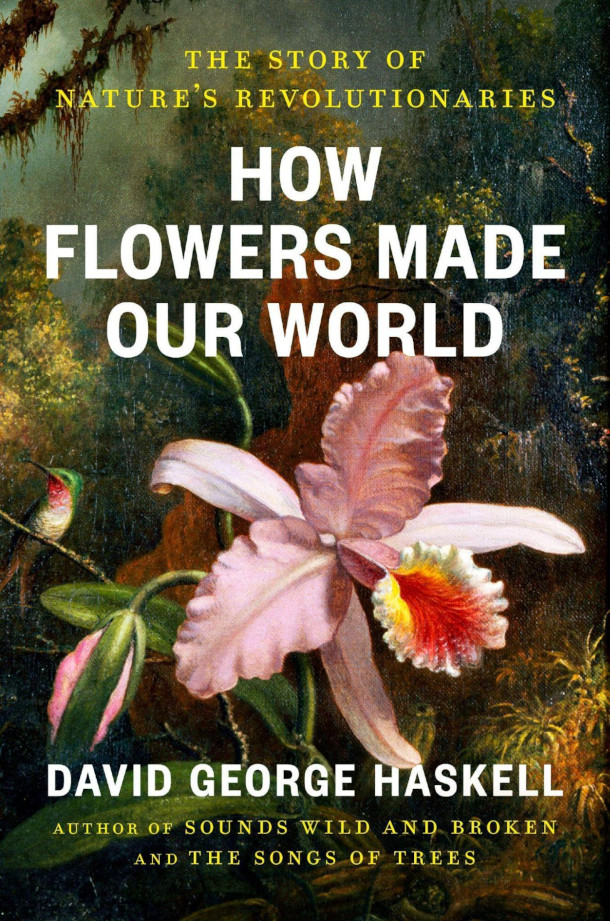
David George Haskell’s 2026 book, How Flowers Made Our World: The Story of Nature’s Revolutionaries (Photo: Courtesy of David George Haskell)
BELTRAN: It’s Living on Earth, I’m Paloma Beltran.
CURWOOD: And I’m Steve Curwood. In the northern hemisphere summer, flowers like black-eyed Susans, hibiscus, sunflowers and coneflowers fill gardens and parks with color and fragrance. But flowers are more than their beauty. They’re actually some of the oldest beings on Earth, and they played a large role in shaping the natural world as we know it. David George Haskell is an author and biologist and his 2026 book is How Flowers Made Our World: The Story of Nature’s Revolutionaries. David welcome to Living on Earth!
CURWOOD: The title of your book refers to flowers as revolutionaries. Okay, what are you talking about? What's the revolution started by flowering plants? How exactly did they make our world, as you say?
HASKELL: Yes, the title sounds a little preposterous, but I really mean it. When flowers appeared on this planet, they swiftly transformed the nature of the planet and built most of the major habitats that we have with us today. Think about rainforests and prairies, they are built by flowering plants. And they catalyze the evolution of all sorts of major groups of animals, bees, butterflies, grazing mammals, and even the origin of our own species, Homo sapiens. And so they did make the ecological world as we know it, and yet, and yet, we often dismiss flowers as merely ornamental. They're pretty, but not powerful. They're beautiful, but not in charge. And in this book, I want to sort of reframe that and put flowers back at the center of the story of how our modern world came to be.
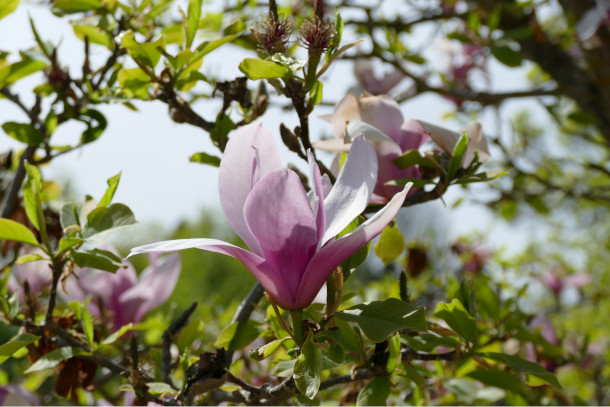
The magnolia has both male and female reproductive parts, making it an ideal pit stop for pollinators, who can pick up and drop off pollen in one stop. (Photo: Kritzolina, Wikimedia Commons, CC BY-SA 4.0)
CURWOOD: So, having pollination, having sexual reproduction, means that plants can change, adapt, evolve. What is the genetic aspect of all of this? At one point in your book, you point out that flowers sometimes have more sets of genes than we do.
HASKELL: Yeah, so the beauty of flowers, the extra motherhood of flowers, these are things that we can see. Underneath the surface, there are innovations that we can't see without modern genetics, and this is one of the revolutions that's happened just in the last 10, 20 years, is that we now understand that flowering plants go through what I think of as genetic storms, where they massively increase the number of chromosomes, they double all the chromosomes, or triple all the chromosomes inside their cells, which honestly is quite excessive. You don't need four or six copies of every chromosome to run a plant, but what those doublings do is that they mean that two of the chromosomes can do the work of running the plant, and the other two or four are free to explore, it's like a cross between a rave and a corporate brainstorming retreat. The usual rules of life have sort of loosened up a little bit, so those genes on those chromosomes can mutate and explore new ways of doing photosynthesis, new ways of growing petals, producing aromas, massively increasing genetic diversity, which is the raw material of evolution, of adaptation, of resilience, and then after this big party of exploration, natural selection kicks in and trims the genome back, keeping the good ideas, keeping the good innovations, and throwing out the rest. Now other organisms go through this kind of doubling, but it's especially prevalent in flowering plants, because they have quite flexible development, so they can tolerate a certain amount of genetic shenanigans as they're developing and growing in a way that, say, a mammalian cell could not. By repeatedly going through these genetic storms, flowering plants have given themselves these boosts of genetic diversity that have helped them, particularly in times of environmental calamity, like when a meteorite strikes the earth. These storms have been particularly important.
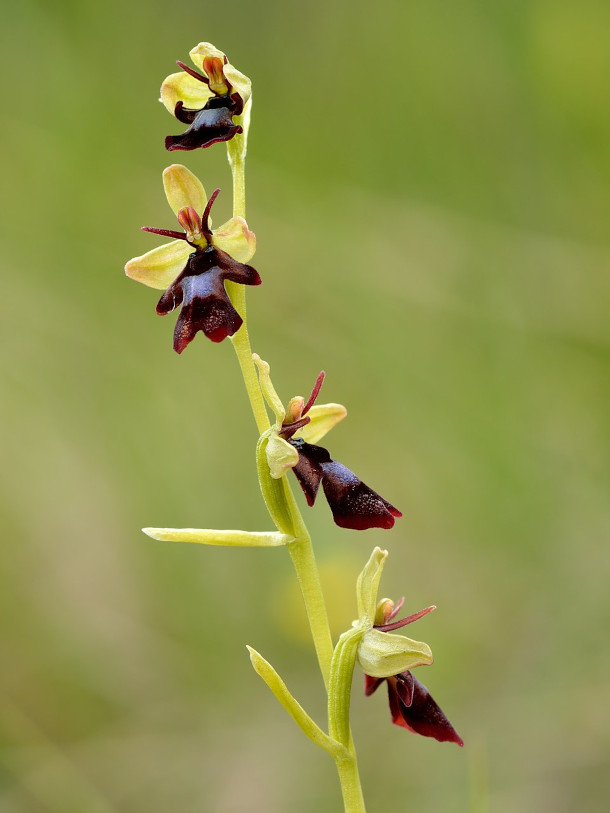
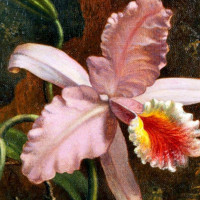
Fly orchids are sexual deceivers. They evolved to look like female wasps so that male wasps will land on them and spread their pollen. (Photo: Ivar Leidus, Wikimedia Commons, CC BY-SA 4.0)
CURWOOD: So, you spent a fair amount of your time talking about magnolias in this book. What's so instructive about the magnolia?
HASKELL: So, I start with the magnolia plant, and part of the reason for that, indeed, they're beautiful. I just love their aroma. It's like diving into a different sort of mental space to smell the magnolia flower, but magnolias also are portals into deep time, because their overall structure, a bowl of petals with both male and female sexual parts within it, welcoming all kinds of different pollinators, is very little change in nearly 100 million years. So they're biologically bisexual in the same flower, which is very efficient, because then any little insect that arrives can both bring pollen and take pollen away. And to this day 90% of flowers still keep with that old formula for success of having male and female in the same bloom.
CURWOOD: So at one point in your book, you call out Henry David Thoreau, saying that his call for self-reliance is, well, it's rather problematic in the case of flowers. What do you mean?
HASKELL: Yeah, so I mean, of course, he was a beautiful writer and had lots of great, insightful things to say, but his call to sort of go it alone, to go out into the cabin and live by the labor of his hands alone, A: was a lie, because his sisters and his mother were cooking for him and doing his laundry, and so forth. So it was a sort of fiction that he was spinning there in his writing. And B: in terms of biology, it really doesn't work. There is no species that has been able to go it alone and succeed, and what flowering plants do is give us a time-tested example over 100 million years of success through cooperation, success through building new relationships, primarily with pollinators and fruit disperses, but also below ground with fungi and microbes, extending those pre-existing partnerships. So the Thoreau way of thinking, this sort of notion that the self is the fundamental unit of innovation and of progress, I think doesn't really hold up in biology, and flowers are an extraordinary example of that.
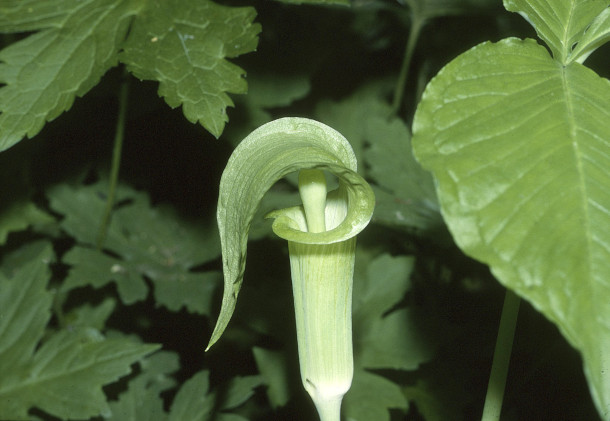
Another deceiving flower is Jack-in-the-pulpit, or Arisaema triphyllum, which traps and kills its pollinator. (Photo: Robert H. Mohlenbrock, Wikimedia Commons, Public Domain)
CURWOOD: So these plants aren't always nice to the rest of the ecosphere, I mean, what about deception and trickery by plants that are seeking pollination and the substrate that they sometimes use?
HASKELL: Absolutely, so I've emphasized cooperation, and indeed, most interactions between flowers and their pollinators are cooperative. They both, the pollinator gets some nectar and pollen to eat, and the plant gets pollinated. But there are delicious dark threads running through this, and as is true in all sorts of stories of evolution, conflict and cooperation are in creative tension with one another, and orchids are great examples of this. So many orchids pretend that they have food to provide nectar and pollen to feed the insects, but really they have none. The storefront says we're full, but once the insect goes into the store, there's no reward there. So the insect is being duped. But it gets worse, because some orchids are sexual deceivers. They look and smell just like female wasps, and so the male wasps embrace the orchid flower, thinking that they're going to mate with a female of their own species, but they're just wasting their time. Instead, they get a dab of orchid pollen on the back of their head, and they fly on into another flower. And then others, like Jack and Jill-in-the-pulpit, a common plant in much of the eastern United States, actually kills its pollinator. There are male flowers that flies fly into it and pick up pollen, but when they enter a female flower, there's no exit hole, and the little flies die inside the plant. So, this, for me, is a suggestion that we should put the brakes on allegorizing nature too much. Nature is not a moral guide, or if we want it to be, we're going to be finding a sort of Baskin-Robbins of different flavors to choose from.
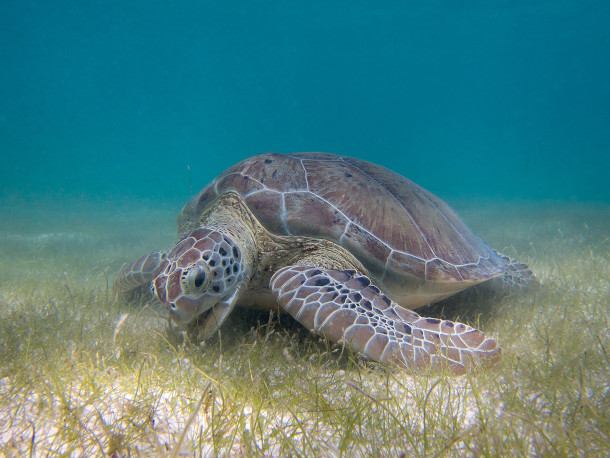
Many organisms depend on flowering plants to survive, such as the green sea turtle, which grazes primarily on sea grass. (Photo: P. Lindgren Wikimedia Commons, CC BY-SA 3.0)
CURWOOD: So we as humans, you say, owe our very existence to the evolution of one family of flowering plants. Tell me, what is so powerful about grasses?
HASKELL: Yes, I mean, many of us don't even think of grasses as flowers, but if you've got allergies, you know very well that grasses do indeed produce flowers. And grasses are a fairly late arrival on the scene. They evolved after many other groups of flowering plants, and what they did was create new habitats like savannas and prairies and the steppes, very productive habitats. They did so mostly by encouraging fire and later grazing animals. And our ancestors, say 10 million years ago, were happy primates living up in the trees of tropical forests, and then I don't know why some of them had this idea of leaving that quite pleasant life, but they moved out of the forests into grasslands to become bipedal primates, walking on two legs, either eating grasses or eating animals, like wildebeest, that were eating the grasses. So, without grasslands, our ancestors would still be up in the trees, as most other of our primate cousins are. So, both millions of years ago, in the evolution of our pre-human ancestors, grasslands were critically important, and, in fact, the main catalytic stimulus for the evolution of our species, and then in the present day, wheat, maize, and rice form two thirds of the calories we eat. So even today, we are grass apes, and we should be putting grasses on the altars of our places of worship to thank our original ecological creators. I mean, I'd encourage listeners actually to use the zoom on your cell phone camera to look at some of the native grasses that we have here in North America and around the world. And when you look close, the flowers are incredibly beautiful, particularly when they set seed, they're like these architectures made out of silvery strands and all kinds of different shades of brown. It's just absolutely gorgeous.
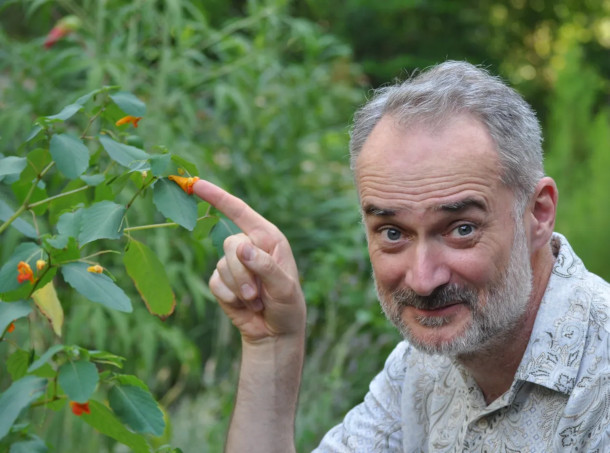
Author David George Haskell (above) invites listeners to dive into the world of flowers by observing them through all the senses. (Photo: Katherine Lehman)
CURWOOD: By the way, speaking of grasses, I was somewhat startled by your section about sea grasses, and your assertion that they're so extremely important and really not understood. So, why are they so important?
HASKELL: So, sea grass is a kind of flowering plant that blooms underwater, extraordinary creatures, right? And they have special pollen grains that are designed to catch the ocean currents and spin back down into the sea grass meadow. Sea grasses grow wherever there is mud or sand extending out into the shallows of the ocean, so they ring many continents. They form the nurseries for many fish and shellfish and invertebrates, so they're really important for biodiversity. They're also incredible storehouses for carbon. A seagrass meadow can store per acre, per year, more carbon than the richest forest on earth, sometimes 30 to 50 times more carbon. So they're great climate champions, they're biodiversity champions, but you know they don't look particularly impressive, right? They don't look as impressive as an old growth forest or a rain forest, and yet they're a vital part of the ecosystem. In the 20th century, they declined by up to 7% per year globally, and the good thing is now there are some incredibly successful restoration projects that are bringing back these seagrass meadows back to some of their former glory, and also weaving awareness of even the existence of sea grass back into human consciousness, and also it's a reminder that the revolutionary power of flowers wasn't just limited to the terrestrial world, they also revolutionized the oceans. Green sea turtles, for example, feed mostly on seagrass meadows. So, without seagrass, there'd be no charismatic marine reptiles swimming around, let alone all the fish and other creatures that depend on them.
CURWOOD: Much of the operation of flowers is done with aroma, with fragrance. What do you suppose that says about us as a species, and how important smell is, even for humans, let alone the animals that can smell flowers as part of their quest for pollination?
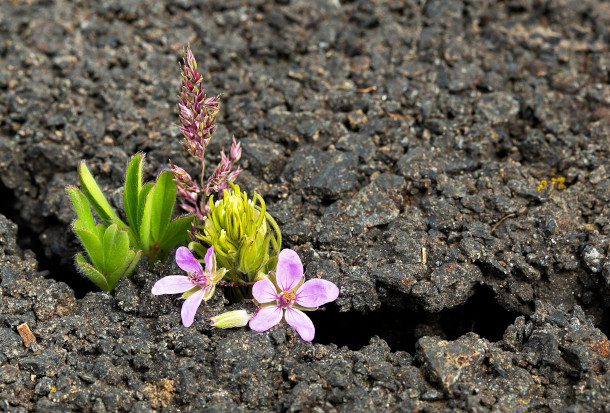
Haskell says his favorite flowers are the ones that grow in the cracks of his driveway. (Photo: Sheila Sund, Wikimedia Commons, CC BY 2.0)
HASKELL: Well, I think smell is one of the most important senses in humans, and the sense of smell goes directly to the parts of our brain associated with memory and emotion, so smell is this way of connecting in a deeply emotional way to the living world, which I think is why we like floral aftershave, perfumes, floral scented candles, is that it's a way of becoming chimeric beings. I express my individuality myself paradoxically by hybridizing my aroma with that of a flower, which to me is a beautiful enactment of what flowers do for the rest of the ecosystem, which is draw unlikely species together into partnerships. So, in my book, I repeatedly emphasize the aromas of flowers, because it's a delight that we can find in just in the middle of the city, smelling flowers that are growing in parks or in department stores through floral perfumes. And reconnecting with aroma brings us back to our senses and brings us back to the present moment, because it's an experience of the moment that you hold onto in memory, but you can't carry with you, say, the way you take a photograph with it with your cell phone. So ephemerality is especially precious to me.
CURWOOD: You invited us to play with flowers at the end of your book. What's one way to play with them?
HASKELL: So the end of the book, I really wanted to encourage people to get hands on and senses on with flowers. It's wonderful to read about flowers, and I hope people find some interesting florid tales in the book, but the book ends deliberately with flowers' power to draw us out of ourselves into relationships, so making floral perfume in your own kitchen. The simplest is just to sit with a flower and use your imagination and senses to get into the flower's world. To whom is the flower speaking? What aromas is this flower producing? How did the flower get here? What role do humans have in this flower's well-being? This is essentially a floral meditation, and we all need a little bit more flower power in our lives right now. And so I'd encourage listeners just to take 15 minutes this week to sit with a flower, open your curiosity, unself yourself into the flower's world and see where that curiosity and sensory connection will lead you.
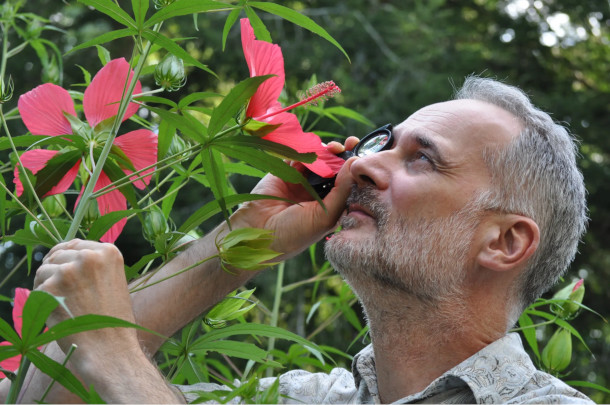
David George Haskell is an Atlanta-based author and biologist. (Photo: Katherine Lehman)
CURWOOD: Probably the first thing I'll do is sneeze, and then, right?
HASKELL: [LAUGHS] the sneezing is part of the sensory connection.
CURWOOD: David, why are flowers so important to humans in your view? Maybe you would read a section from your book about that.
HASKELL: Yeah, so I can read from page 255, this is the afterward on floral beauty and joy. When we take pleasure in a flower, we reclaim our inheritance as animals in a world made by flowers. Sensual indulgence and enjoyment of floral beauty are not frivolities, flowers give us embodied experiences of the creativity and vitality that drive the grand narrative of life on earth. Floral delight is deep, earthy beauty.
CURWOOD: Before we go, David, you can tell me. What's your favorite flower?
HASKELL: My favorite flower are the tiny little weeds that grow up in the cracks in my driveway. I've got a very old cracked driveway in Atlanta, and there are a dozen different species of weed that grow from all around the world, and I admire and love those plants so much for their resilience and for the way that they launch beauty out of these unexpected places, and to me that's embodied hope. Given half a chance, the floral world can remake the world, and we can cooperate with them. And so, in the springtime, I literally lie down in my driveway with a little hand lens and look at these tiny little blooms that we often dismiss as mere weeds. But in fact, these are our kin, and they're our creators, and I really, they lift my spirits, and I look forward to their emergence in the cracks in the driveway every single year.
CYRWOOD: David George Haskell is a writer, biologist, and adjunct professor at Emory University in Atlanta. His book is called How Flowers Made Our World: The Story of Nature's Revolutionaries. Thank you so much for taking the time today!
HASKELL: Thank you Steve and I wish you and all the listeners manby good floral encounters this year.
Related links:
- Purchase How Flowers Made Our World and support Living on Earth and independent booksellers
- Learn more about David George Haskell
[MUSIC: Monplaisir, “Hélice” on Bonjour from Paris, Nantes and Montreal, CC0 1.0 Universal License, 2016]
"Anthropocene Pastoral"
Poet Catherine Pierce confronts the climate emergency head-on in her work, and even finds beauty within it. (Photo: Catherine Pierce)
BELTRAN: Flowers made our world – and we are remaking it, and them, in the age of the Anthropocene. Here’s Catherine Pierce, former Poet Laureate of Mississippi, with a poem titled, “Anthropocene Pastoral.”
PIERCE: In the beginning, the ending was beautiful.
Early spring everywhere, the trees furred
pink and white, lawns the sharp green
that meant new. The sky so blue it looked
manufactured. Robins. We’d heard
the cherry blossoms wouldn’t blossom
this year, but what was one epic blooming
when even the desert was an explosion
of verbena? When bobcats slinked through
primroses. When coyotes slept deep in orange
poppies. One New Year’s Day we woke
to daffodils, wisteria, onion grass wafting
through the open windows. Near the end,
we were eyeletted. We were cottoned.
We were sundressed and barefoot. At least
it’s starting gentle, we said. An absurd comfort,
we knew, a placebo. But we were built like that.
Built to say at least. Built to reach for the heat
of skin on skin even when we were already hot,
built to love the purpling desert in the twilight,
built to marvel over the pink bursting dogwoods,
to hold tight to every pleasure even as we
rocked together toward the graying, even as
we held each other, warmth to warmth,
and said sorry, I’m sorry, I’m so sorry while petals
sifted softly to the ground all around us.
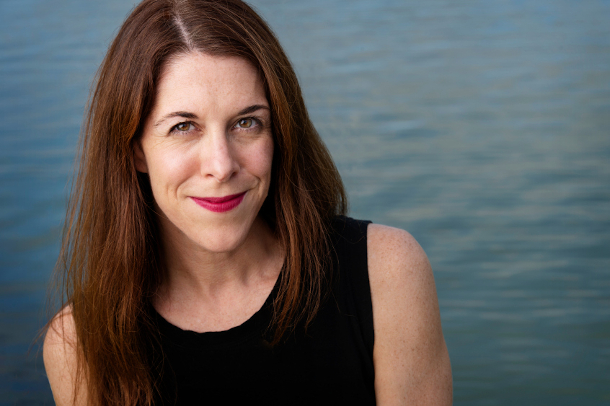
Catherine Pierce is the author of four books of poems including Danger Days and The Tornado Is the World and was previously professor of English and co-director of the creative writing program at Mississippi State University. (Photo: Megan Bean / Mississippi State University)
BELTRAN: That’s Catherine Pierce, former Poet Laureate of Mississippi, reading her poem “Anthropocene Pastoral”, from her 2020 collection Danger Days.
Related link:
Catherine Pierce’s poetry and more
[MUSIC: The Mount Vernon Virtuosi Cello Gang/Amit Peled, Medley: “Hallelujah/What a Wonderful World” on Around the World in Five Cellos, by Leonard Cohen/ Bob Thiele and George David Weissin, live at Baltimore’s Creative Alliance.]
CURWOOD: Living on Earth is produced by the World Media Foundation. Our crew includes Naomi Arenberg, Mia DiLorenzo, Jenni Doering, Abby Edgecumbe, Swayam Gagneja, Mark Kausch, Mark Seth Lender, Don Lyman, Ashanti Mclean, Nhung Nguyen, Aynsley O’Neill, Sophia Pandelidis, Jake Rego, Andrew Skerritt, Bella Smith, and El Wilson.
BELTRAN: Tom Tiger engineered our show. Allison Lirish Dean composed our themes. You can hear us anytime at L-O-E dot org, Apple Podcasts and YouTube Music, and like us please, on our Facebook page, Living on Earth. Find us on Instagram, Threads and BlueSky at living on earth radio. And we always welcome your feedback at comments at loe.org.
I’m Paloma Beltran.
CURWOOD: And I’m Steve Curwood. Thanks for listening!
Living on Earth wants to hear from you!
Living on Earth
62 Calef Highway, Suite 212
Lee, NH 03861
Telephone: 617-287-4121
E-mail: comments@loe.org
Newsletter [Click here]
Donate to Living on Earth!
Living on Earth is an independent media program and relies entirely on contributions from listeners and institutions supporting public service. Please donate now to preserve an independent environmental voice.
NewsletterLiving on Earth offers a weekly delivery of the show's rundown to your mailbox. Sign up for our newsletter today!
 Sailors For The Sea: Be the change you want to sea.
 The Grantham Foundation for the Protection of the Environment: Committed to protecting and improving the health of the global environment.
 Contribute to Living on Earth and receive, as our gift to you, an archival print of one of Mark Seth Lender's extraordinary wildlife photographs. Follow the link to see Mark's current collection of photographs.
 Buy a signed copy of Mark Seth Lender's book Smeagull the Seagull & support Living on Earth
© Copyright World Media Foundation. All Rights Reserved
Home | Contact | RSS | Donate | Newsletter