

A Guardian and A Thief
Air Date: Week of October 16, 2026
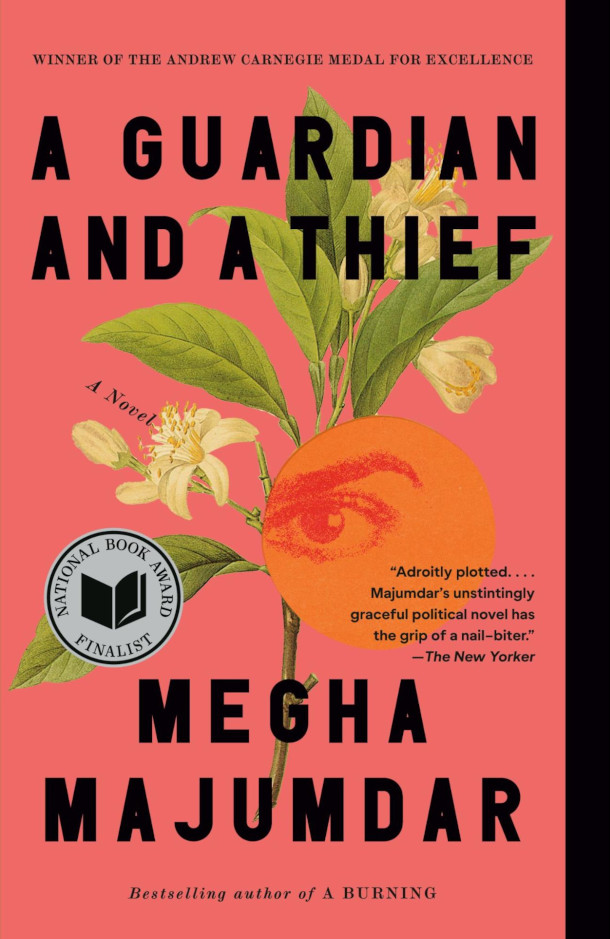
A Guardian and A Thief by Megha Majumdar. (Photo: Cover Image Courtesy of Knopf)
In her award-winning novel A Guardian and a Thief, Megha Majumdar places her characters in the near future in a climate-changed Kolkata, India, where she grew up. Megha Majumdar joins Host Aynsley O’Neill to discuss how the climate crisis may present the kinds of difficult moral choices her characters grapple with.
Transcript
O’NEILL: Sometimes facts and figures simply don’t cut it when it comes to translating the human realities of the climate crisis. But stories, including fiction, are one way we can bridge that gap. In her novel A Guardian and a Thief, Megha Majumdar places her characters in a climate-changed world set in the near future. A Guardian and a Thief is Megha’s second novel and earned her several awards, including the 2026 Andrew Carnegie Medal for Excellence in Fiction. Megha Majumdar lives in New York City and she joins me now. Welcome to Living on Earth, Megha!
MAJUMDAR: Thank you so much for having me.
O'NEILL: So, in this novel, A Guardian and a Thief, it takes place in the near future in Kolkata, India, where you were born. Give us a sense of the novel version of this place. What is it like in the city where your characters live?
MAJUMDAR: In the near-future Kolkata, where this novel is set, I imagine a city which is really devastated by the effects of climate change. So there is extreme heat, for instance. People might have to wear cooling garments when they go outside, and there are protesters agitating for the right to shade from the sun. There is also a severe shortage of food. So when you go to the markets, you don't see your familiar fruit and vegetables. Instead, you see cricket protein, you see algae for sale, and it's a world which springs from a foundation of what has been predicted. Kolkata is my hometown, and it's one of the cities in the world which is very vulnerable to climate change, and I imagine what daily life in that situation might look like.
O'NEILL: Well, how close is that situation to the current reality in Kolkata?
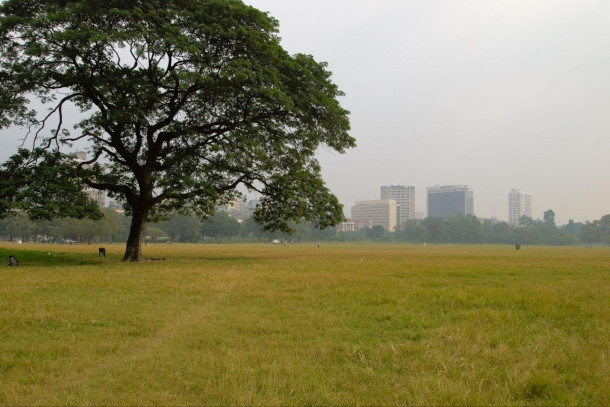
A Guardian and a Thief takes place in a near-future Kolkata, India, in which society has been deeply affected by climate change. (Photo: Vyacheslav Argenberg, Wikimedia Commons, CC BY 4.0)
MAJUMDAR: Oh, it's very far. You know, Kolkata does have problems with frequent flooding, drainage issues, and things like that. But it's a very robust city where you get everything, and all the systems are pretty much working. So it's a prediction which has been made for you know in some reports around 2100, but I was thinking about a future which is partly recognizable as ours, you know. So there are still families living in neighborhoods, and you know, with the same responsibilities, and thinking about immigration, and thinking about what to have for lunch, so with the kind of recognizable anchors in our world, I was thinking about what it looks like if some of the vital details are very different.
O'NEILL: And now, without giving too much away, give us just a taste of who your two main characters are: Ma and Boomba.
MAJUMDAR: Ma is a mother. She runs a shelter for new residents to the city, and she is a woman who is very focused on her two-year-old toddler and her elderly father. Her husband has moved away to Michigan, so she is really responsible in Kolkata for taking care of these two people that she loves. She believes herself to be a decent person, a good person, but the book is very interested in following what happens when she finds herself in a crisis, and she has to make very difficult moral choices. And on the other side, Boomba is a young man from a village which is close to Kolkata. He comes to the city looking for a foothold. He wants to be able to find an opening in the city such that he can bring his family over, and the person that he absolutely loves the most in his family is his younger brother, a small child as well. And of course, this young man, Boomba is a person of few resources. He has a much closer understanding of struggle than perhaps Ma does. So, in many ways, the clash between them is a clash of circumstances and of social classes and resources. Ma, who is middle class, lives in a really comfortable house, has the resources to apply for a U.S. visa and get it, is preparing to move to Michigan. Her approach to what migration looks like and what her pathway looks like is completely different from that of Boomba, who is much more desperate and has to be much more creative with how he forges a path forward.
O'NEILL: And now, so many of the reasons why we see these characters needing to battle with these moral choices is due to, as we mentioned, the climate crisis, the situation that they find themselves in. Why were you drawn to centering your book on the climate crisis?
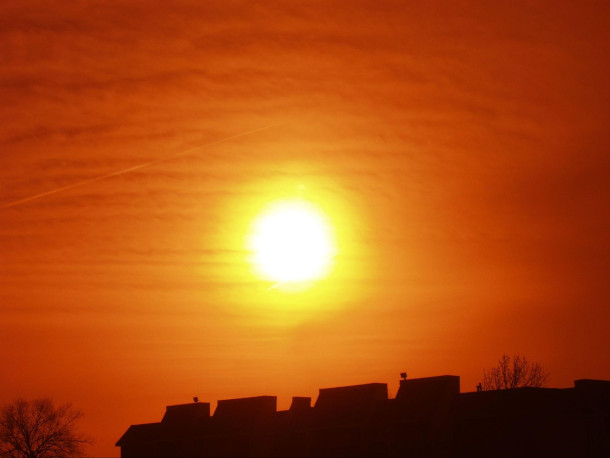
Extreme heat is ever-present in the lives of the characters in A Guardian and a Thief. (Photo: Janice Waltzer, Flickr, CC BY 2.0)
MAJUMDAR: I am very interested in how the climate crisis might bring us to very difficult moral choices. I think the question of how to be an ethical self in a time of difficulty, in a time of scarcity, is very interesting to me. I mean, it's the question that I'm kind of obsessed with, is: how can anybody be a moral person in our current world, where we are really caught among systems that are much bigger than us? Sometimes it feels like the choices we make are very limited in the impact they can have, and yet we have plenty of freedom and plenty of space to do the right thing often. And I think something like the climate crisis, in which we will see things like agriculture, water supply, change. So all of these things that we take for granted, like having clean water to drink that's freely available, going to the shops and finding, you know, pretty much the fruits and vegetables and grains you're looking for. All of that will change, I think, and I'm very interested in how, in that new sense of scarcity, we might be forced to draw lines between the people we love and care for and the people who are now outsiders, and where will we draw that line? How will this scarcity really destabilize our sense of who we are as decent people, as good people? Will it force us to become something different? I think the climate crisis has ramifications not just for the external environment of our planet, but I think it has ramifications also for who we are in our most interior self.
O'NEILL: I feel like a lot of readers will naturally be inclined to go, "Oh well, I would never do that. I would never make that decision." But you really build these characters out in such a way where you understand where they're coming from every time, and you're forced to confront, well, what would I do in that situation? And I think that's really one of the best qualities of this writing is to make you as a reader, consider how you would act in such a situation.
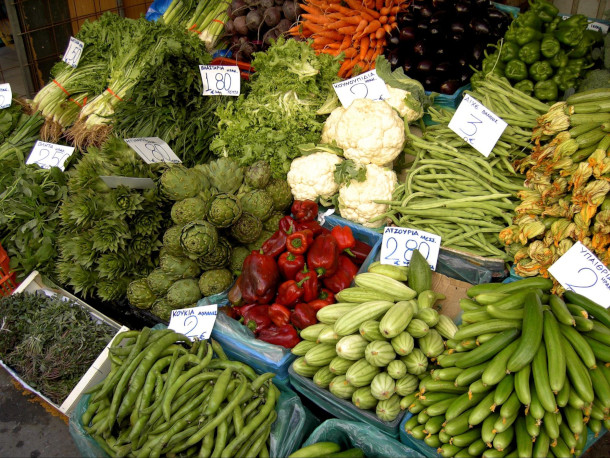
A fresh vegetable market, like this one in Crete, is almost non-existent in the imagined future of Kolkata. (Photo: Hans Hillewaert, Wikimedia Commons, CC BY-SA 4.0)
MAJUMDAR: Thank you. I hope so. I think that's part of the project of fiction is to encourage a reader to identify so closely with the characters that you really feel their troubles, you feel their worries and fears, and you feel the enormity of their love and their care and their wishes, and I think it can be slightly uncomfortable for a reader to think about, well, would I do that? You know, would I steal fruit from a child? Would I break into somebody's house? And for many of us, I think, as you're saying, the answer is, oh, of course not. But I do wonder if the things that are true in a time of abundance, in a time of relative comfort, will remain true in a time of crisis.
[MUSIC: Kolkata Twilight]
O’NEILL: We’re speaking with Megha Majumdar, author of A Guardian and a Thief, and we’ll be right back after the break with more. Keep listening to Living on Earth!
ANNOUNCER: Support for Living on Earth comes from Hansjörg Wyss in honor of Rosamund Stone Zander. Celebrated painter, environmentalist, and author of The Art of Possibility, who inspired others to see the profound interconnectedness of all living things, and to act with courage and creativity on behalf of our planet. Support also comes from Sailors for the Sea and Oceana. Helping boaters race clean, sail green and protect the seas they love. More information at sailorsforthesea.org.
[CUTAWAY MUSIC: Kolkata Twilight]
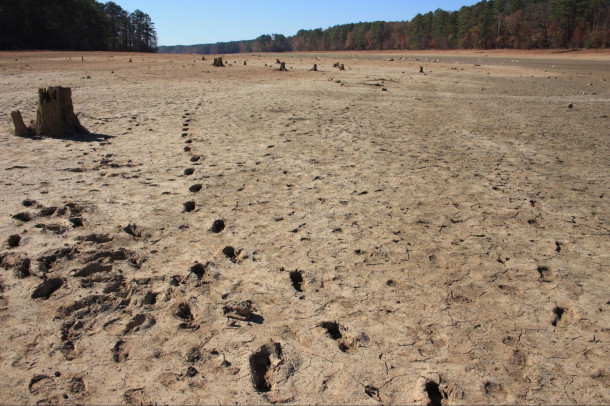
Author Megha Majumdar says she is interested in the kind of moral choices we will face as individuals in a climate-changed world. (Photo: Alabama Extension, Flickr, public domain)
BELTRAN: It’s Living on Earth, I’m Paloma Beltran.
O’NEILL: And I’m Aynsley O’Neill.
Let’s get back to my conversation with Megha Majumdar, whose 2025 novel A Guardian and a Thief is set in a near-future Kolkata, India devastated by climate impacts.
O'NEILL: And now, your book also explores the idea of climate refugee as an official immigration status. Tell us a little bit how you decided to bring immigration policy into your novel, and what the future of climate displacement looks like to you?
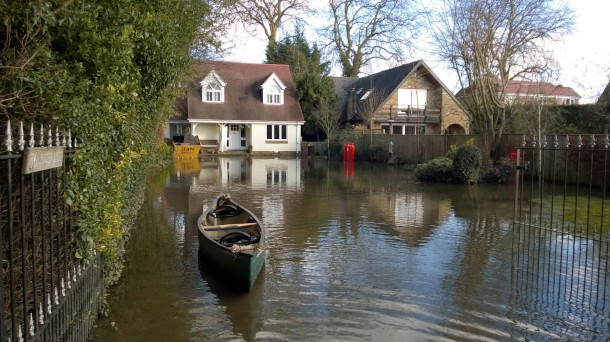
Author Megha Majumdar imagines a world where climate disaster becomes so common that it is woven into the fabric of everyday life. The above photo shows flooding in Hythe End, in England. Flooding is increasingly likely as the climate crisis progresses. (Photo: Richard, Flickr, CC BY-NC 2.0)
MAJUMDAR: Well, I am an immigrant to the U.S. I grew up in Kolkata in India, and so I think for many families in Kolkata that I saw around me, migration was a fairly common fact of life. Everybody had children moving away, and I think that that kind of migration will only continue to be more prevalent, more urgent, as some of the places in the global south are hit very hard by the effects of climate change. You know, I think that we have already seen conflict in the world where the guise of it is kind of ethnic conflict or some other form of conflict. I remember reading about the conflict in Darfur, which was quite a while ago now. Then I remember reading that at the root of that conflict, one of the things that could be traced was actually the spreading of the desert and lack of water. So what presented itself as a conflict between groups of people was actually rooted in environmental causes, and I think that this kind of conflict will perhaps become more common in the future, and people will seek to flee. But I think that in my novel, I was interested in placing the vastness of that conversation in the lives of one family and seeing how they are affected by it.
O'NEILL: And now some characters in your novel, such as Dadu, do not want to leave the city, despite the deteriorating conditions. What can characters like these tell us about the human realities of climate migration?
MAJUMDAR: Yeah, I think one of the simple narratives of migration might be that it's a pure motivation. You want to leave and you want to go somewhere else where you'll have a safer life, a better future. But anybody who has migrated knows that it is not like that at all. It is a very different, very complex reality, and there is a big part, I think, of any migrant's life and thought and reflection, where they do not want to leave; they want to stay. So Dadu, the grandfather in this novel, is a character who is very hesitant to move away to Michigan. He wants to stay in Kolkata because that is the place he knows. That is where he has friends. That is where he feels most known by others, and he is afraid of having to integrate himself into a different community, having to learn different social subtexts, so for him migration is very much bound up with a sense of grief and a sense of loss, and he's only doing it for his daughter and his grandchild. He understands the importance of this move, and at the same time, the wound of migration is very real, and he anticipates how cutting it will be to move.
O'NEILL: Something that's quite striking throughout the novel are really visceral descriptions of food that appear again and again. The food insecurity is driving so much of your character's actions. Tell us a little bit more about that.

A traditional fish dish from Kolkata called Shorshe Ilish. A Guardian and a Thief includes many visceral descriptions of food in a food-scarce world. (Photo: Sm faysal, Wikimedia Commons, CC BY-SA 4.0)
MAJUMDAR: Well, one of the roots of this novel is that I am from a family where we really care about food, and so I have grown up knowing that food has a very important emotional texture. Having dinner together is not just about putting nutrition in your body, but it's a place for the family to come together. It plays a really important role in social gatherings and in the bonds between people. Offering food is a sign of hospitality and kindness. So food has really vibrant emotional and social functions, and I was interested in bringing in the beauty of that a little bit. So talking about the foods that people love, like cauliflower or fish or oranges. I wanted to have some of the joy and delight of that present in the book, and at the same time, I also wanted to explore what happens when it's taken away, and you can no longer freely offer food to a guest, or you have to really look through a heap of discarded food to find something. So the joy of it and what happens when it's taken away were two really important focuses of this book.
O'NEILL: Now, of course, oftentimes when we are talking about the climate crisis, we talk about the extreme events: violent hurricanes, wildfires, floods--very large, very dramatic, and in the novel we of course have the extreme heat. But I feel like we view so much of it through almost a quieter desperation, this everyday struggle to find the next meal. What inspired you to focus on this perspective?
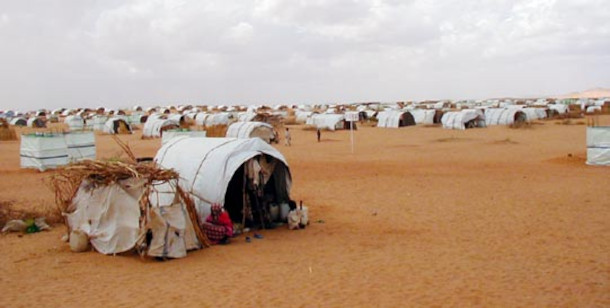
A refugee camp in Darfur, 2004. Our guest, Megha Majumdar, points out that many conflicts around the world stem from diminishing resources, a situation which will only worsen as climate change advances. (Photo: Sean Woo, general counsel to Sen. Brownback, or John Scandling, chief of staff to Rep. Wolf, per description on p. 11 of the report, Wikimedia Commons, public domain)
MAJUMDAR: That's a great question. Thank you for asking it. I guess I was very interested in how the texture of daily life can change in climate crisis. So now I think we are maybe more familiar with a rhythm where there is a big disaster. There is a huge level of destruction, and we slowly recover from that. We rebuild. But in the future there may well be a different rhythm where these crises are so frequent and so much more severe that they kind of seep into what daily life looks like. There isn't the destruction and recovery kind of cycle, but more a familiarity with well, the electricity always goes out because the grid is overburdened, or there is always, you know, this part of the city which is flooded because the storms are so frequent and the drainage is so poor. So we might see a slight shift in how we think about crisis, how we think about disaster, and I think it's that acceptance of maybe a new normal, a new state of urgency which stays. In that, I think people will learn to examine their own behavior and their own motivations differently.
O'NEILL: And now I would argue that perhaps not just the strongest theme, but one of the strongest motivators in A Guardian and a Thief would be family and parental life. How do you feel like the novel was influenced by your own experience there?
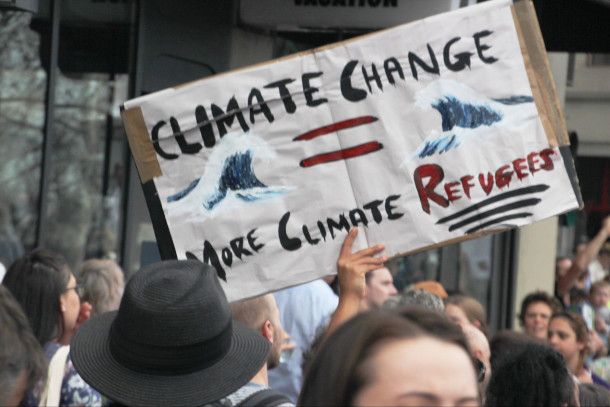
A sign from the Melbourne, Australia global climate strike in 2019. A prominent theme in A Guardian and a Thief is climate migration. (Photo: Takver from Australia, Wikimedia Commons, CC BY-SA 2.0)
MAJUMDAR: The novel completely changed after I became a parent. I have two small kids now, and for a long time, I worked on a novel which had a completely different main character. It was focused on an adolescent and her relationship with her grandparents in this kind of ruined city in crisis, but it wasn't working. I worked on this novel for several years before I realized that it simply wasn't working. Something about it was not true, wasn't resonant. And then I had my first child, and it made me so interested in the mother of this adolescent character that I had been trying to write. I became so interested in the ferocity of a mother's love, and I became very interested in thinking through what it means to confront that love. If you are forced to parent your child through a frightening crisis, what of your moral center would you perhaps give up? That became a question that really called to me, and it completely changed the shape of the book.
O'NEILL: Megha, in this novel, there are moments of despair and moments of hope, all woven together. Now, I don't want to give anything away about the plot, and especially not the ending. But I do want to ask: To what extent are you personally able to maintain a sense of optimism about the future?
MAJUMDAR: I feel very hopeful. You know, I think that our planet has weathered so many crises in the past. There have been so many moments of great alarm and danger, and remember when, I don't know if you remember, but when I was a child, we read so much about the ozone layer and the hole in the ozone layer, and turns out that cooperation among different countries coming together and do something about patching the hole in the ozone layer, it worked, and that's why we don't hear about the hole in the ozone layer anymore. Is because it was solved through international cooperation, and so I I feel very hopeful. I feel very aware that even though there is this grim future kind of looking at us, there are so many dire predictions, I think that there are also so many people who are thinking very deeply about solutions. They are thinking very deeply about how to move forward, not just with urgency, but with a sense of joy and a sense of beauty and a sense of real intent and purpose. So I am very hopeful.
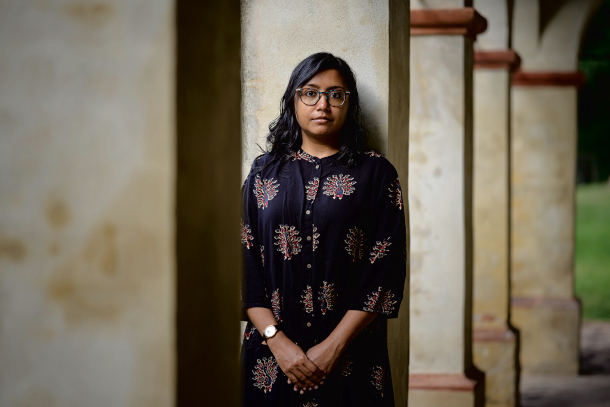
Megha Majumdar is the author of A Guardian and A Thief and A Burning. (Photo: © Marco Giugliarelli)
O'NEILL: Megha Majumdar is the author of the novel A Guardian and a Thief. Megha, thank you so much for joining me today.
MAJUMDAR: Thank you so much, Aynsley. Thank you for your beautiful, thoughtful questions. This was a real pleasure.
Links
Learn more about Megha Majumdar
Purchase your copy of A Guardian and A Thief and support Living on Earth and independent booksellers
Living on Earth wants to hear from you!
Living on Earth
62 Calef Highway, Suite 212
Lee, NH 03861
Telephone: 617-287-4121
E-mail: comments@loe.org
Newsletter [Click here]
Donate to Living on Earth!
Living on Earth is an independent media program and relies entirely on contributions from listeners and institutions supporting public service. Please donate now to preserve an independent environmental voice.
NewsletterLiving on Earth offers a weekly delivery of the show's rundown to your mailbox. Sign up for our newsletter today!
 Sailors For The Sea: Be the change you want to sea.
 The Grantham Foundation for the Protection of the Environment: Committed to protecting and improving the health of the global environment.
 Contribute to Living on Earth and receive, as our gift to you, an archival print of one of Mark Seth Lender's extraordinary wildlife photographs. Follow the link to see Mark's current collection of photographs.
 Buy a signed copy of Mark Seth Lender's book Smeagull the Seagull & support Living on Earth
© Copyright World Media Foundation. All Rights Reserved
Home | Contact | RSS | Donate | Newsletter