

Toad in the Desert
Air Date: Week of September 4, 2026
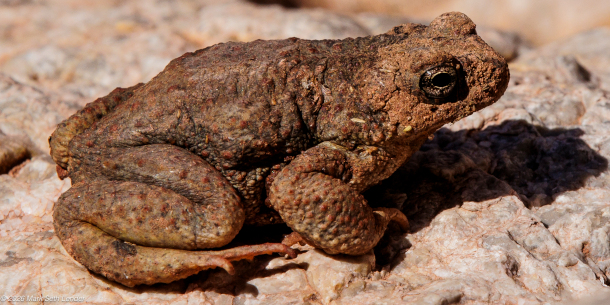
The Red Spotted Toad, spotted by Living on Earth’s Explorer-in-Residence Mark Seth Lender. (Photo: Mark Seth Lender)
In parts of the Chihuahuan desert in New Mexico, the landscape can sometimes appear entirely still. Or at least until a red-spotted toad hops into view, as Living on Earth Explorer in Residence Mark Seth Lender tells it.
Transcript
CURWOOD: In parts of the Chihuahuan desert in New Mexico, the landscape can sometimes appear entirely still. Or at least until a red-spotted toad hops into view, as Living on Earth Explorer in Residence Mark Seth Lender tells it.
Toad in the Desert
Sevilleta National Wildlife Refuge
© 2026 Mark Seth Lender
All Rights Reserved
LENDER: The arroyo cuts through and through, into the red earth, winding and turning till it finds the living stone. Chert, blue-gray, flinty and pockmarked, and very old.
Sometimes the water in the arroyo runs fast, carves fast; Sometimes smooth and slow. And at the lowest point the polished sluice that results as the stream pours over the stone from drop pool to drop pool. It is quiet down at the bottom, here between the narrow walls. Even the stream, swift though shallow can hardly be heard. Nothing moves. No desert birds and nothing earthbound. Nothing at all. Until the red-spotted toad appears. Toad could be him could be her. The one consistent discriminating feature is the
throat. Dark patch, male, no patch, female. Except toad is muddy; and I can’t tell.
He(She) hops laboriously across the incline of chert, reaching the steep slabs of light colored sandstone, rests. Climbs. Rests. And carries on.
Toads live on dry land, even here in the Chihuahuan Desert where it is very very dry. A mud drenched toad is therefore odd, though not as odd as what lies in the stream. Underwater, in line with the current several hundred small black worms are attached to the sluice. Wetted, the chert beneath them looks white. The worms stand out. Unmistakable that they are alive and not some feature of the stone.
Muddy toads. Worms in water.
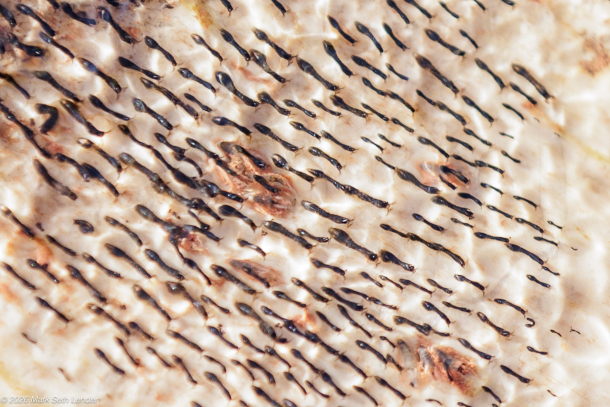
Captured here are Red Spotted Toad tadpoles. If you look closely, you can see their feet! (Photo: Mark Seth Lender)
Strange…
That night, reviewing my photographs I realize the worms are not jet black but alternating dark and transparent segments. And that the tail end, has feet. Two small pink feet. At the other end the beginnings of eyes, the place where gills will
sprout and behind the incipient gills a translucent pouch that will become the body. Worms do not have feet, eyes, gills. The apparent absence of frogs and the presence of a red-spotted toad argues for the brief aquatic stage of a toad. And the worms that are not worms are becoming tadpoles. He(She) is Her, not him. They were her eggs and will be her progeny.
Red-spotted toads will live on.
CURWOOD: That’s Living on Earth Explorer in Residence Mark Seth Lender. For photos of that mama red-spotted toad, hop on over to our website, loe.org.
Links
Visit Mark Seth Lender's website
Learn more about Friends of Sevilleta National Wildlife Refuge
Living on Earth wants to hear from you!
Living on Earth
62 Calef Highway, Suite 212
Lee, NH 03861
Telephone: 617-287-4121
E-mail: comments@loe.org
Newsletter [Click here]
Donate to Living on Earth!
Living on Earth is an independent media program and relies entirely on contributions from listeners and institutions supporting public service. Please donate now to preserve an independent environmental voice.
NewsletterLiving on Earth offers a weekly delivery of the show's rundown to your mailbox. Sign up for our newsletter today!
 Sailors For The Sea: Be the change you want to sea.
 The Grantham Foundation for the Protection of the Environment: Committed to protecting and improving the health of the global environment.
 Contribute to Living on Earth and receive, as our gift to you, an archival print of one of Mark Seth Lender's extraordinary wildlife photographs. Follow the link to see Mark's current collection of photographs.
 Buy a signed copy of Mark Seth Lender's book Smeagull the Seagull & support Living on Earth
© Copyright World Media Foundation. All Rights Reserved
Home | Contact | RSS | Donate | Newsletter