

Smog and Sunshine--CA's Cleaner Air
Air Date: Week of July 24, 2026
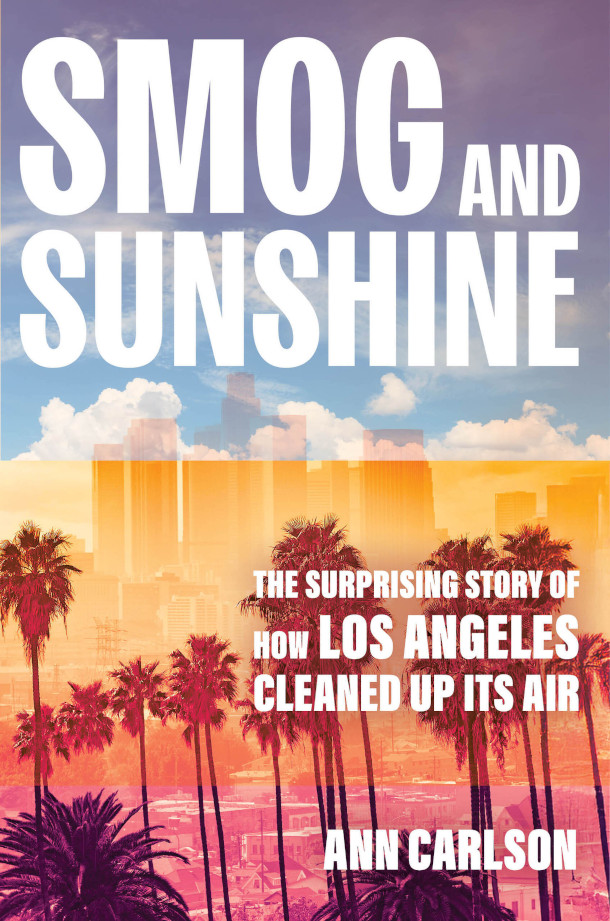
Ann Carlson’s latest book is Smog and Sunshine: The Surprising Story of How Los Angeles Cleaned Up Its Air. (Photo: University of California Press, Courtesy of Ann Carlson)
Decades ago, the Los Angeles basin was often cloaked in a thick blanket of choking smog, but today the skies are comparatively clear. This striking improvement was no accident and is a testament to how scientists, government, and engaged citizens can work together to solve difficult environmental problems. UCLA Environmental Law Professor Ann Carlson reflects on that success as described in her 2026 book, Smog and Sunshine: The Surprising Story of How Los Angeles Cleaned Up Its Air.
Transcript
CURWOOD: The Midwest and Northeast US have been plagued by wildfire smoke, from fires in Canada and Minnesota that bring apocalyptic skies, and unhealthy and hazardous air quality. And while for many this dirty air can feel like a new normal, worsened by the climate crisis, it’s déjà vu for those who remember what Southern California used to be like. Decades ago, the Los Angeles basin was often cloaked in a thick blanket of choking smog, but today the skies are comparatively clear. This striking improvement was no accident and is a testament to how scientists, government, and engaged citizens can work together to solve difficult environmental problems. One of these key players was Ann Carlson, a Professor of Environmental Law at UCLA. She also served as the Acting Administrator and Chief Counsel of the National Highway Traffic Safety Administration under President Biden. Her 2026 book is Smog and Sunshine: The Surprising Story of How Los Angeles Cleaned Up Its Air, and she joins us now from the city of angels. Hi, Professor Carlson and welcome back to Living on Earth!
CARLSON: Thanks. It's great to be here.
CURWOOD: Great to see you. Let's talk about Los Angeles for a moment. Explain to us how Southern California's gift of sunshine, which is what Los Angeles was known for, promote photochemical smog.
CARLSON: Sunshine is one of our great assets, but it also turns out to be one of the big culprits in our problems with air pollution, and I should be clear that our problems with air pollution are not done. It's just that our air is vastly cleaner than it used to be. But here's what happens. When hydrocarbons and other chemicals are emitted from things like cars and trucks and the smokestacks of factories, they interact with sunshine, and when they interact with sunshine, that actually creates ozone, and ozone pollution is the most persistent problem that Southern California has faced. And it was one of the big problems, though by no means the only big problem that was causing the terrible air quality that we experienced, really starting in the 1940s and all the way into the 2000s.
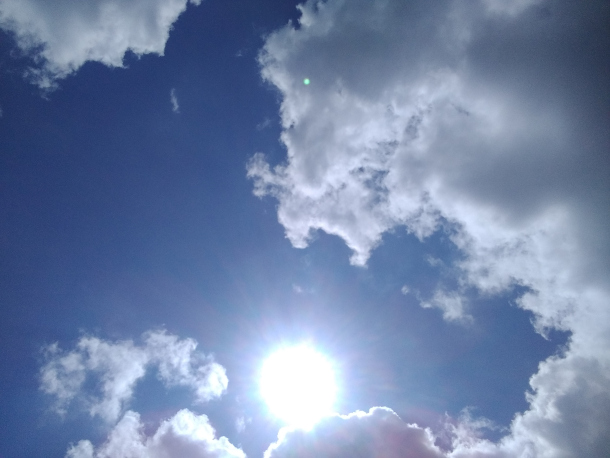
Ironically, Southern California’s sunny weather contributes to its air pollution problems because sunlight interacts with pollutants to create ground level ozone. (Photo: Path slopu, Wikimedia Commons, CC BY-SA 4.0)
CURWOOD: So when the sun is stronger, it can make the pollution stronger, huh?
CARLSON: Yeah, it's a combination both of the sun and heat. So that's actually a problem with climate change: as temperatures increase, ozone pollution increases. And so, one challenge that Southern California is going to face as we continue to work on making our air as clean as possible is higher temperatures as a result of climate change.
CURWOOD: Now, for those of us who haven't been able to visit Los Angeles over the years, just how much has LA cleaned up its air? I mean, give me some numbers, please.
CARLSON: I will give you some numbers. I will start with visibility because that is what people used to see when they came into Southern California. You could just associate Los Angeles with the word smog and with visions of terrible air quality. So we used to measure visibility days. In the 1960s, 1970s, well into the 1980s, we had days where you could not see more than three miles for more than half the year. Three miles may sound pretty far, but that is not very far when you're talking about visibility. Today, it is commonplace to be able to see islands off the coast of Southern California that are 25 miles away to see the San Gabriel Mountains. Many people didn't know there were mountains in Southern California, so visibility is one really good measure. Another, and the one I think that is really the most dramatic, is what has happened with lead in our air. We used to drive vehicles that were reliant on having lead in gasoline. It also was a terrible, poisonous pollutant, and it came out of the tailpipes of vehicles and dispersed into the air, but then also landed on the surface of the ground. And kids would touch playground equipment. They'd breathe in terrible air. They'd put their hands into their mouths as kids are wont to do, and they had lead levels in their blood in the 1970 that are 1,000% higher than what kids in Flint, Michigan experienced during the worst water crisis. We had air pollution concentrations of lead that were 50 times higher than they are today. We were all breathing poison, and that poison was doing terrible things to us, to our brains, to our lungs, to our overall health.
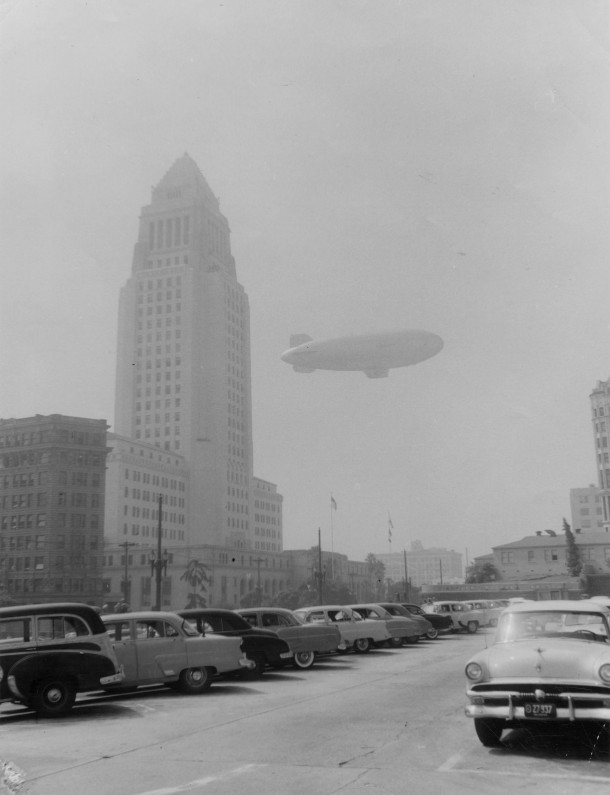
A Navy blimp flies past LA City Hall-— an iconic structure shown in many movies— on one of many smoggy days in 1954. (Photo: 1954, Herald Examiner Collection)
CURWOOD: And by the way, lead has been linked to delinquency and crime and antisocial behavior. To what extent do you think getting rid of lead out of the air of Los Angeles improved the social situation there: less crime, less tension, less violence.
CARLSON: There's a lot of evidence to suggest that the removal of lead has reduced delinquent behavior, violent behavior in youth, and one of the things that we've seen is youth crime rates have dramatically plummeted. It's hard to know exactly what causes those declines, but it can't have been good for brain health and for behavior to be exposed to lead at levels that today we consider toxic.
CURWOOD: Now, an interesting part of your book — actually, the whole thing is interesting — but my attention was drawn to the various roles of different levels of government that were brought to bear on the question of cleaner air. So, take a moment, please, to talk me through how Los Angeles local government, the state of California, and the federal government collaborated — I guess sometimes they butted heads — to clean up the LA air.
CARLSON: We start with the lowest level of government, that is Los Angeles County, which was really the first jurisdiction in the world to systematically try to tackle air pollution, and that included having a monitoring system that began to measure what people were breathing. But Los Angeles had some jurisdictional limitations. It couldn't, for complicated reasons, regulate what came out of cars. So it went after a bunch of sources first. It went after what we call stationary sources, so that's power plants and coal-fired power plants and chemical facilities and oil refineries, but it didn't really have the legal authority to force technological change so that automobiles would be cleaner. That's where the state of California stepped in. Starting in 1960, the state began to regulate what comes out of the tailpipes of cars and actually what evaporates more generally from vehicles. It's not all out of the tailpipe.
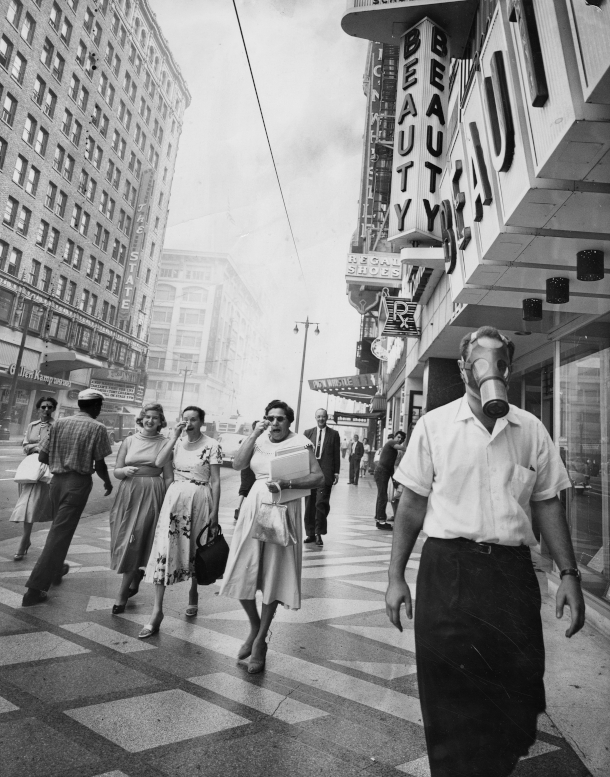
A smog attack in downtown Los Angeles. Before the city was able to regulate air pollution via a mix of local, state, and federal regulations, it was often hard to breathe outside. (Photo: 1958, Herald Examiner Collection)
But, the state started to run up against opposition from the auto industry, in part because other states wanted to do what California was doing. New York was actually about to adopt even stronger standards than California because urban areas around the country were beginning to experience the same kind of smog. So the federal government stepped in. This was actually before it stepped in to regulate really dramatically, but the first thing it did was prevent all states from regulating air pollution except California from mobile sources, from vehicles, cars, trucks, etc. California has its own special authority to regulate. That's an authority that continues to today. Although I will say it's also under attack. And then finally, in 1970, Congress passed the Clean Air Act, arguably, maybe not even arguably, the most powerful environmental statute ever adopted, has done more to protect public health from environmental harms than probably any other statute, but it didn't do so on its own. It actually regulated but also tasked the states with continuing to regulate, and again, California had this very special authority. So California would set standards that were stronger than the federal standards in order to tackle the smog in Southern California.
CURWOOD: It's interesting that California has this carve out, this special position, when it comes to regulating air pollution. Except sometimes, seems to me in your book you point out that the federal government is pushing California to act. So when it comes to air pollution, what is the relationship between California and the federal government?
CARLSON: Let me start by saying that California has been an extraordinary leader on air pollution. So, for example, the catalytic converter was first really required by standards that the state of California set, even as the federal government was backing off, but there's no question that federal law has played a really important role in pushing California to act, not just by giving it special authority, but by setting standards that the state has to meet. And when the Clean Air Act first passed in 1970, the standards were so stringent that Southern California and the California agency that actually had responsibility for Southern California air refused to issue a plan that was required under federal law to show how Southern California would come into compliance with federal law.
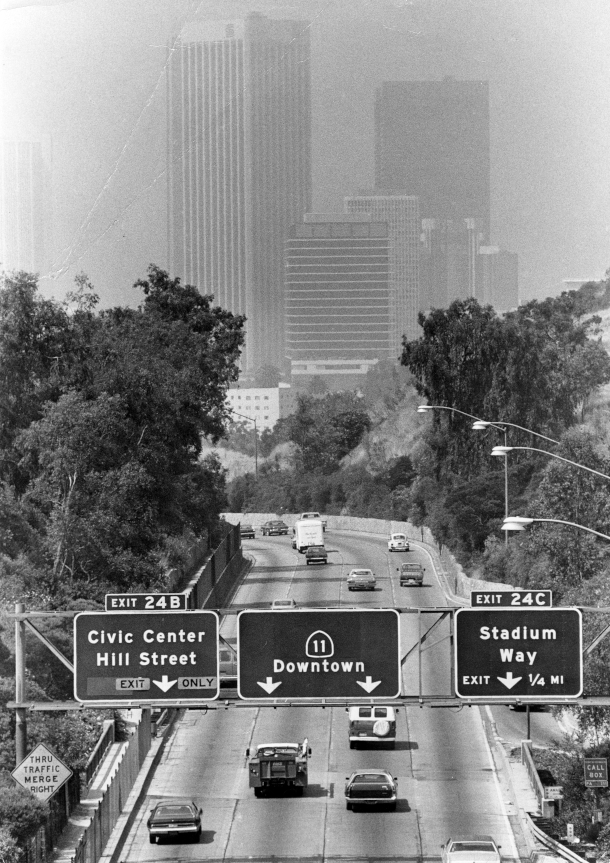
Downtown LA buildings are obscured by smog, nine years after passage of the Clean Air Act. Cleaning up Southern California’s air was a decades long project, and it still isn’t over. (Photo: 1979, Herald Examiner Collection)
That's because probably the only way to do so would be to ban driving, and no one wanted to take on that political risk. And so it was the federal government actually pushed by environmental lawyers that led the federal Environmental Protection Agency to propose a plan for Southern California that would, in fact, have banned driving. It didn't go anywhere, but it kept the pressure on Southern California to continue to take steps to clean up its air. There are other examples of that. California was very reluctant to impose a really effective smog check program. That's the program where you have to go in and get your car tested to make sure that your smog equipment is working, and it was a big political battle that involved a lot of small service stations that were providing that service, but maybe not doing so in the most effective way. And the federal government came in and really pressured the state to get much more effective in making sure that existing vehicles on the road were actually not polluting the air more than the equipment would allow.
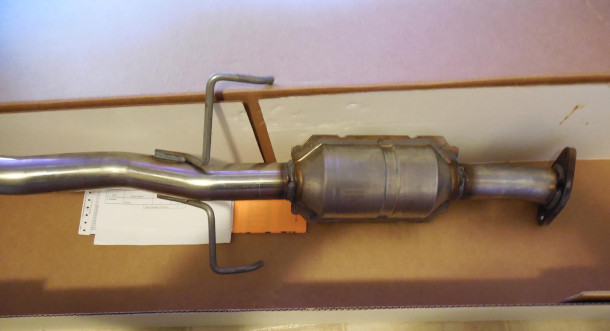
Thanks to air pollution standards pushing the auto industry, we now have inventions like the catalytic converter which reduce the emissions that come out of cars. (Photo: Kim2480, Wikimedia Commons, CC BY-SA 3.0)
[MUSIC: Cali Surf]
CURWOOD: We’re speaking with Ann Carlson, UCLA environmental law professor and author of Smog and Sunshine: The Surprising Story of How Los Angeles Cleaned Up Its Air. We’ll be back with more right after this break. Keep listening to Living on Earth!
ANNOUNCER: Support for Living on Earth comes from the estate of Rosamund Stone Zander: celebrated painter, environmentalist, and author of The Art of Possibility , who inspired others to see the profound interconnectedness of all living things, and to act with courage and creativity on behalf of our planet. Support also comes from Sailors for the Sea and Oceana. Helping boaters race clean, sail green and protect the seas they love. More information at sailorsforthesea.org.
[CUTAWAY MUSIC: Jack Johnson, Hermanos Gutiérrez “Green Board” on SURFILMUSIC (Soundtrack & 4-Tracks), Jack Johnson]
CURWOOD: It’s Living on Earth, I’m Steve Curwood.
Let’s get back to our conversation with Ann Carlson, Shirley Shapiro Professor of Environmental Law at UCLA and author of Smog and Sunshine: The Surprising Story of How Los Angeles Cleaned Up Its Air.
CURWOOD: So your book covers literally decades of history, but I want to turn to something that's going on right now about this dynamic between California and the federal government. As we're speaking, California is now suing the federal government as the Trump administration attempts to repeal California's waiver ability. What arguments are each side making, and where does that case stand right now?
CARLSON: The Trump administration has actually taken several steps to try to curtail California's power. One of those steps was to have Congress use this obscure statute called the Congressional Review Act to repeal three separate waivers that California has to get permission from the federal government to regulate emissions from cars and trucks, and it basically did away with three of those waivers that are aimed both at greenhouse gasses that cause climate change, but also at conventional pollutants. Even though the Trump administration typically couches it in terms of climate change, this is also really important for California to continue to improve the quality of the air, both in Southern California and in Central California. That case is currently being litigated, so we don't know exactly what's going to happen. We just learned that EPA is going after more waivers. These are older waivers that California has again for cleaning up its cars and also for going after lawn equipment, which turns out to be a big polluter. So, the arguments on the side of the Trump administration are, I guess, I would say twofold. One is anti-regulatory; it's too expensive. We don't want to impose these costs. And I suppose there's an argument about wanting uniform standards across the country. Although, of course, Congress gave California the special power, so that defies the congressional mandate that California actually have this authority. The arguments on the side of California is that it does have the special authority and it needs this authority because both the Central Valley and Southern California are still out of compliance with two federal standards. And, frankly, if you cannot eliminate emissions from the transportation sector, Southern California simply cannot meet the federal standards. So California has got a strong argument that it both has the legal authority and also the need to come into compliance with federal standards.
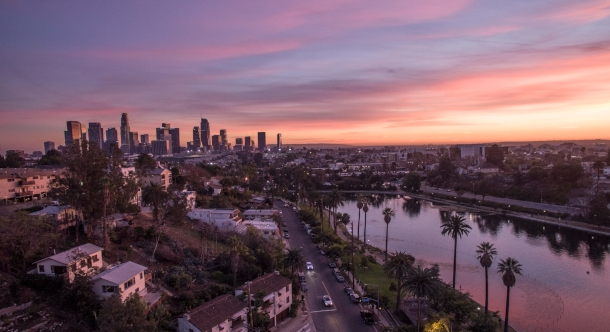
Even with ongoing challenges, thanks to extensive regulation at all levels of government, the air in much of the Los Angeles area is safe to breathe on most days. (Photo: Adoramassey, Wikimedia Commons, CC BY-SA 4.0)
CURWOOD: Let's talk about the history of California's impact on the EV industry. Back in the '90s, the California Air Resources Board, you call it CARB, tried to mandate that car manufacturers create zero-emission vehicles. General Motors responded by manufacturing some of the earliest electric vehicles called EV1, but you know, by some time in the 2000s they had crushed the program as well as the cars. What do you think led to the collapse of that effort?
CARLSON: Well, sometimes regulations are too stringent. And it's not frequently the case, but in the case of the very early electric vehicles, the technology wasn't quite there yet. Battery life wasn't long enough. The ranges wasn't long enough, and it was expensive. And the state, actually to its credit, worked with the auto industry to modify the regulations in a way that would make them achievable. They didn't work in the immediate term, so auto manufacturers were not capable, or at least claimed, and were spending a lot of money trying to meet the standards, but weren't capable of meeting the standards. So the state relaxed them, but what it did do is push technology. And one of the really important parts of the story of Southern California cleaning up its air is how much California regulations have led to technology that would not have been invented but for those regulations. So we started to see things like the invention of the hybrid engine, and those technological advances were often the result of California pushing the envelope on regulation. Let me just say one more thing about it, which is that I think one of the brilliant moves that Congress made in designating California as what I've sometimes called a super regulator, where it has its special authority, is California can experiment. And we often talk about states as the laboratory of democracy. California has been our laboratory of democracy for automotive technology that improves our air quality. Sometimes that hasn't worked, but when it does work, it allows the rest of the country to follow suit and follow California's technology. And when it doesn't work, the rest of the country hasn't actually engaged in the same regulatory efforts, and they can really learn from the California experience.
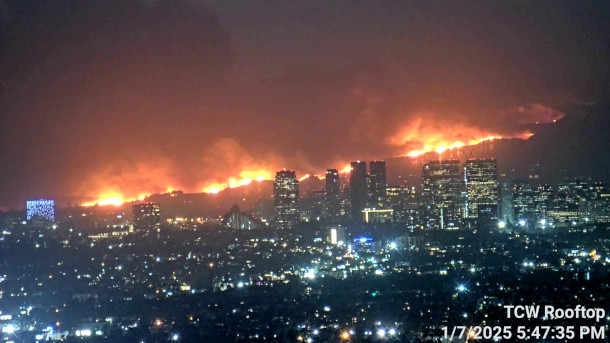
The climate crisis increases the risk of wildfires, such as those that hit the Los Angeles area in 2025, which then worsens air quality around the country, including in Southern California. (Photo: Toastt21, Wikimedia Commons, CC BY-SA 4.0)
CURWOOD: The fossil fuel industry and others in business have gone after scientists and environmental advocates and regulators like yourself. You had the top job on an acting basis at the National Highway Traffic Safety Administration. You were their top lawyer at one point under the Biden administration, and I understand that they didn't make life particularly easy for you there. What happened?
CARLSON: They did not. I should say that I'm just one of many people over many many years, and that's part of the story in the book: is scientists and others being attacked by industries that stood to be regulated, so I was one of many. And I was nominated by the President to serve as the administrator of the National Highway Traffic Safety Administration, and my nomination drew the ire of the oil and gas industry. They called me a radical environmentalist, said I was, you know, a climate crazy, said I didn't care about safety, which is one of the central missions of NHTSA, and that I only cared about imposing heavy burdens on consumers and on industry. The oil industry was very supportive of Senator Ted Cruz, who was the ranking member of the committee who had jurisdiction over my nomination. He led the opposition to my nomination. I ultimately ended up withdrawing my name because it was pretty clear that even though I might get through committee, he could hold me on the Senate floor and not let my nomination through. Once I withdrew my name, I was then reappointed as the Acting Administrator by the President, and that led to Senator Cruz introducing an amendment in the Senate to dock my pay to zero. That amendment was argued on the Senate floor. Thankfully, it failed. I don't think President Biden would have let it go through anyway. But it was quite a personal and intense attack. As you said, you know, it wasn't a fun experience. I think it's designed to try to deter people from going into federal service who care about the environment, who are committed to environmental protection. I would not wish that process on anybody, I have to say, after going through it, but I'm also very very happy and proud to have served in that role.
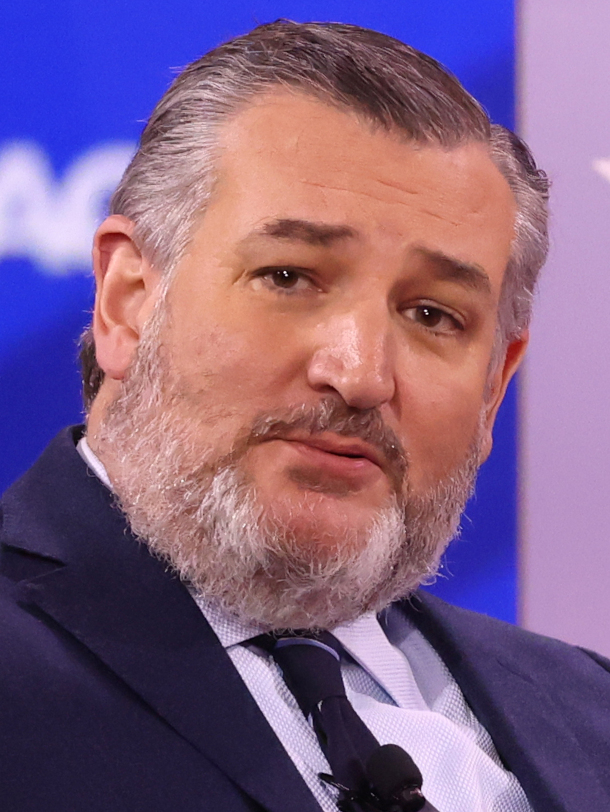
Senator Ted Cruz (R-TX) opposed Ann Carlson’s nomination for acting administrator of the National Highway Traffic Safety Administration. (Photo: Gage Skidmore, Wikimedia Commons, CC BY-SA 2.0)
CURWOOD: Professor, you argue in the book that we can learn a lot about how to tackle climate disruption, climate change, by looking at the L.A. air pollution story and the success that you've had. You haven't ended the problem, but it's certainly on a much different scale. So, what are the key lessons there?
CARLSON: One key lesson I think is that individuals really matter in the fight. And I think the book shows how important certain individuals have been across a host of different professions in maintaining pressure on government, in serving in government, in telling the story as journalists did. The LA Times was extraordinarily important in early days in keeping pressure on the government to do something about air pollution. Scientists make big contributions. All of that is true with respect to climate change. A second lesson is that fossil fuels, when we burn them, cause air pollution, and they also cause greenhouse gasses to accumulate in the atmosphere, and those greenhouse gasses create climate change. And so we know how to regulate those sources. We've done it in the past. We can continue to do so. There are some differences, and I think it's important to acknowledge those differences. One difference is that climate change is a global problem. That both makes the challenge more difficult and also, in some respects, gives us more options. So we know right now that the federal government is retreating from doing anything on climate change. At the same time, China is going gangbusters in developing clean technology, and that technology can spread around the globe. And then the final thing I'll say is that air pollution is much more visible than climate pollution. The effects of climate change come in strange ways, where we get a heat wave, so that in Boston today, it's over 90 degrees. Europe is experiencing heat waves like they've never experienced, increased hurricanes, etc. And people don't always associate those events with what's coming out of the tailpipes of cars or what's being emitted by industry. That's not true with air pollution. You could see it. If there's black smoke coming out of a car, you know it's not good to breathe. That makes the political question harder, but there are a lot of important lessons we can draw from how successful we've been in cleaning up our air.
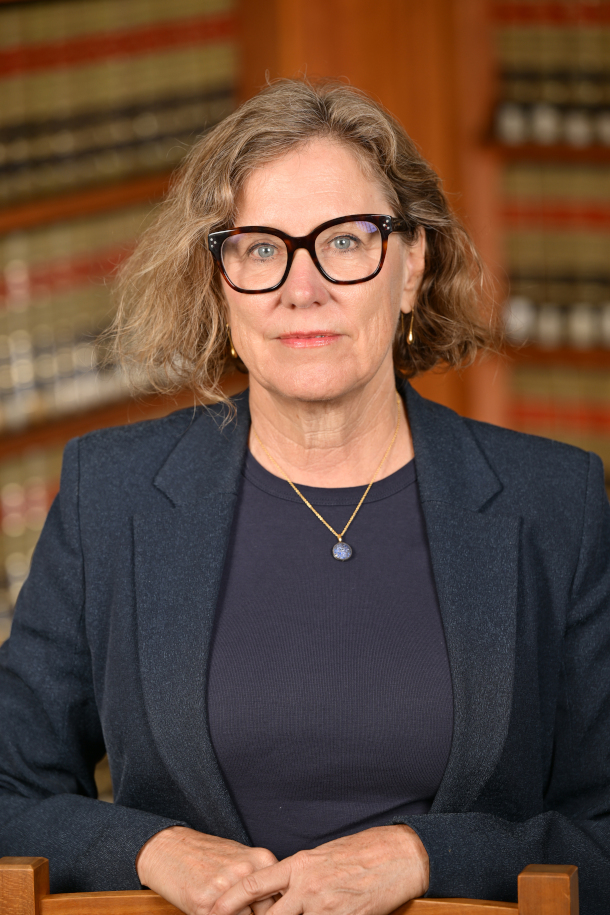
Ann Carlson is the Shirley Shapiro Professor of Environmental Law at UCLA School of Law. She previously served as the acting administrator and chief counsel of the National Highway Traffic Safety Administration under the Biden administration. (Photo: Todd Cheney Photography)
CURWOOD: So I'm looking for the silver lining or the hope that you have around this. You know, as things warm up, it's actually making ground level ozone levels worse. In Los Angeles, you've had these historic wildfires associated with a hotter planet, and the United States today is certainly not a leader in the climate space, is it? So, the situation does not seem super wonderful. In fact, it seems pretty dire. Professor Carlson, what keeps you in this fight?
CARLSON: So, a few things keep me in this fight. One is we have to keep fighting. We can't... you can't just give up. And the less we do, the worse climate change is. The more we do, the more we can mitigate the worst effects of it, even though it's already occurring and we cannot avoid climate change at this point. Second, is we've made some extraordinary accomplishments on the climate side. So, green energy is cheap and abundant, and it's spreading around the world. So most new energy installations are solar and wind. We're now able to store energy from those sources in batteries. Electric vehicles in China are both high quality and affordable. Battery life has been extended. Battery range has been extended dramatically. So the same forces that led to the technological changes that led to cleaner air have been at work over the past several decades, and the United States can't stop that, and the rest of the globe is behaving differently than we are. So the technological changes that have come as a result of government incentives, government regulation, are moving us in the right direction. It's just that we have already put so much in the atmosphere that we're going to need to figure out how do we actually sequester emissions. What can we do to really slow the horrible kinds of consequences that we're seeing? There's a lot to be worried about, but that worry should get us to continue to fight to make our environment better.
CURWOOD: Ann Carlson is the author of Smog and Sunshine: The Surprising Story of How Los Angeles Cleaned Up Its Air. Thank you so much for taking the time with us, Professor Carlson.
CARLSON: Yeah, it was great to be here. It was great conversation. I really appreciated your questions.
CURWOOD: We reached out to the office of Texas Republican Senator Ted Cruz for comment but did not hear back before this broadcast went to air.
Links
Living on Earth wants to hear from you!
Living on Earth
62 Calef Highway, Suite 212
Lee, NH 03861
Telephone: 617-287-4121
E-mail: comments@loe.org
Newsletter [Click here]
Donate to Living on Earth!
Living on Earth is an independent media program and relies entirely on contributions from listeners and institutions supporting public service. Please donate now to preserve an independent environmental voice.
NewsletterLiving on Earth offers a weekly delivery of the show's rundown to your mailbox. Sign up for our newsletter today!
 Sailors For The Sea: Be the change you want to sea.
 The Grantham Foundation for the Protection of the Environment: Committed to protecting and improving the health of the global environment.
 Contribute to Living on Earth and receive, as our gift to you, an archival print of one of Mark Seth Lender's extraordinary wildlife photographs. Follow the link to see Mark's current collection of photographs.
 Buy a signed copy of Mark Seth Lender's book Smeagull the Seagull & support Living on Earth
© Copyright World Media Foundation. All Rights Reserved
Home | Contact | RSS | Donate | Newsletter