

Climate Change Speeding Up
Air Date: Week of July 24, 2026
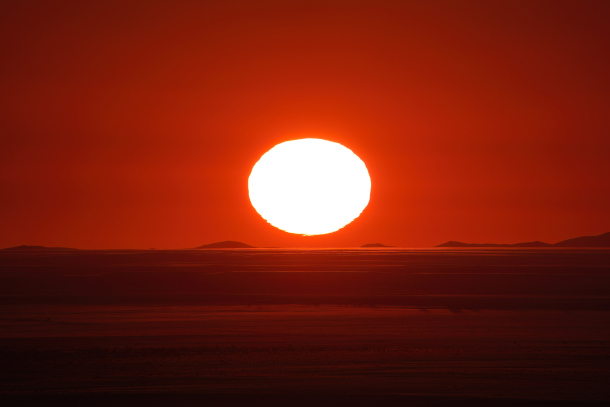
The growing imbalance between Earth retaining the sun’s energy and emitting it back into space results in the acceleration of global surface temperatures. (Photo: Giles Laurent, Wikimedia Commons, CC BY-SA 4.0)
Current climate change has been well underway for decades, but the rate of that change is now going up so fast that people are noticing things like tornados and extreme heat waves are occurring in places where they have rarely been seen before. Dr. Jennifer Francis, a senior atmospheric scientist at the Woodwell Climate Research Center, joins Host Steve Curwood to explain how greenhouse gases from burning fossil fuels, the loss of reflective ice and snow, and other changes are increasingly causing the Earth to retain extra heat energy from the Sun.
Transcript
CURWOOD: From PRX and the Jennifer and Ted Stanley Studios at the University of Massachusetts Boston, this is Living on Earth. I’m Steve Curwood.
It is indeed getting worse and worse. That's what science is telling us as concerns rise about the growing spate of extreme weather events and their likely links to global warming and climate disruption. Current climate change has been well underway for decades, but the rate of that change is now going up so fast that people are noticing things like tornados and extreme heat waves are occurring in places where they have rarely been seen before. To help us understand what is going on, we turn now to Dr. Jennifer Francis, a senior atmospheric scientist at the Woodwell Climate Research Center in Falmouth, Massachusetts. Jennifer, welcome back to Living on Earth!
FRANCIS: Great to be back. Thank you.
CURWOOD: As a scientist, what's your perception of any change in the rate of warming that's going on now? Some feel that gee, things seem to be accelerating. What's your perception?
FRANCIS: Yeah, I think it is definitely showing signs of accelerating, and there's a pretty good explanation for that. We're seeing more energy being retained by the Earth than we used to. So there's energy coming in from the Sun, and there's energy being emitted in a different format, a different form of energy, and the balance of those two things is what determines the Earth's temperature. So what we're seeing is now a growing imbalance between those two things. There's more energy being absorbed from the sun, and that is leading to a buildup of heat in the climate system, which we detect as the increasing temperature of the Earth. So there's very good reason to believe the observations that show this increasing temperature.
CURWOOD: Now, to what extent is this increase in temperature related to all the intense weather we seem to be seeing now? There's storms. There seem to be wildfires. There are heat waves. There are tornadoes. How related is this to this pickup in the speed of climatic warming, do you think?
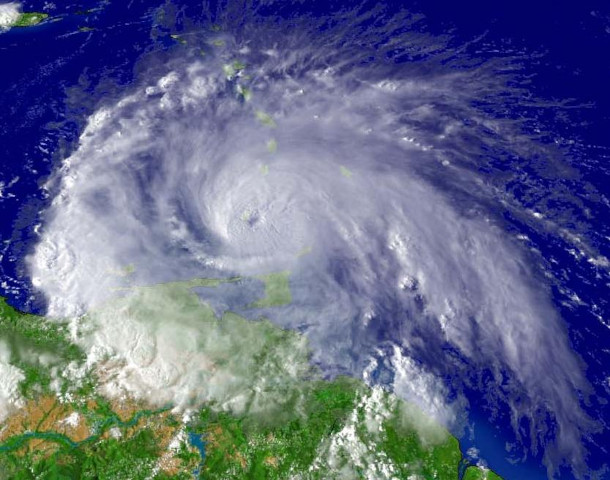
There is a direct correlation between warmer ocean surface temperatures and more intense weather events like hurricanes. (Photo: NOAA, Wikimedia Commons, public domain)
FRANCIS: 100% — we have more energy in the system now. The ocean is much warmer. 90% of the heat trapped by all these greenhouse gasses, carbon pollution that we've been putting into the atmosphere for decades now, mostly by burning fossil fuels. Those heat-trapping gasses are mostly putting heat into the ocean, about 90% of it, and that is energy. It's energy to fuel storms. It's energy to increase evaporation from land, which dries out the soils, leads to drought. It's changing the distribution or the pattern of ocean temperatures, which affects the winds. It affects the jet stream. It affects how weather patterns move, and that extra moisture that's being evaporated from land and ocean goes into the air, and it is a very important feedback in the climate system because that moisture does three things. First of all, water vapor is also a greenhouse gas that traps even more heat. So it adds to the heat being trapped by carbon dioxide and methane and the other greenhouse gasses that we hear about all the time. That moisture is also the source of energy for all types of storms: hurricanes, tornadoes, thunderstorms, nor'easters, you name it. That water vapor in the atmosphere, when it condenses back into a liquid form, releases a lot of heat into the air, and that is literally what drives storms. And that extra water vapor also supplies more moisture for storms when they do develop, and that is a very clear, bold line connected back to the warming atmosphere, the warming oceans, the increasing evaporation, and this extra water vapor we now have in the atmosphere.
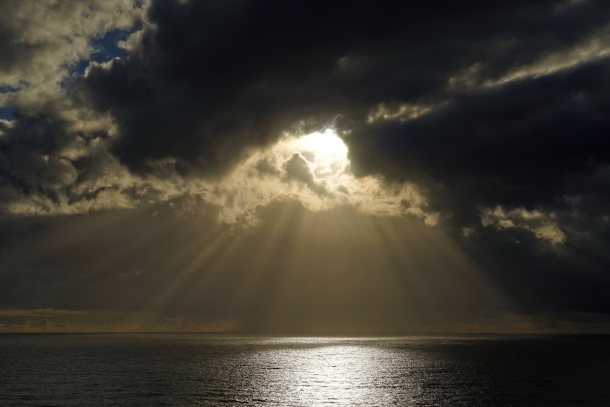
Earth’s albedo depends on the types of surfaces or atmospheric features that sunlight interacts with including clouds, oceans, and air particles. More dark surfaces mean a lower albedo with more heat retention. (Photo: bigwavephoto, Wikimedia Commons, CC BY-SA 4.0)
CURWOOD: So the Earth has a wide range of systems and functions that help keep it in balance. We're getting out of balance apparently with this energy budget, one of those mechanisms is albedo — that is, the Earth's reflectivity in various places. Where does that term fit in in terms of discussion of the climate and climate change and this accelerating warming that we're experiencing now?
FRANCIS: Yeah, I think we need to really simplify the story because it's a very complicated one, but I think it can be told relatively simply. So let's start with the incoming energy. This is the energy that we get from the sun. So, as this sunshine is coming into the Earth, first it is reflected, and that's this term albedo is just a fancier word for reflection. A lot of things can happen to that solar energy as it comes in. First, it might hit some high clouds, and those clouds are very white. They're very good at reflecting solar energy, so some of it gets reflected by the clouds. Some of it gets reflected by dust in the air, and that dust can, or aerosols, as it sometimes is called, it can be dust from blowing off of agricultural land or deserts. It can be chemical particles that come from our burning of fossil fuels, create sulfur dioxide, which then turns into sulfate particles, which are very reflective too, and it can even be particles of salt that get evaporated and blown up from the ocean surface. So there's a lot of different kinds of particles in the air. Some of them are more reflective than others, but they also might send some of that energy right back to outer space. And then finally, some of it gets to the ground. Then, depending on what the surface is made out of, more or less of that sunshine is going to also get reflected. So, if it hits the ocean, almost all of it gets absorbed into the ocean. If it hits snow or ice, most of it is going to get reflected back to outer space. And if it's something in between, like agricultural land or forest, those have different amounts of reflectivity. So all of these factors come into play in determining how much of the sun's energy is going to actually enter the climate system and heat it, or get reflected right back to outer space and do nothing at all.
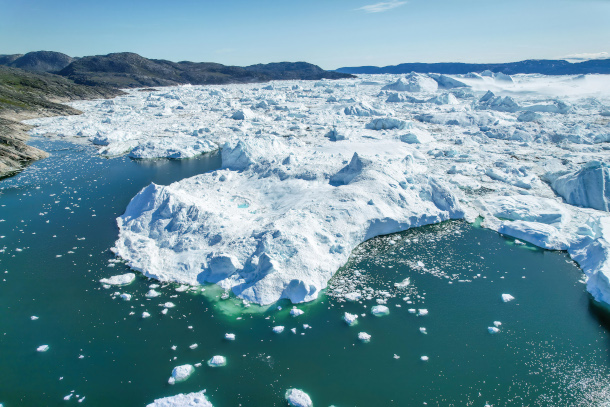
The bright white surface of snow and ice gives them a high albedo, so they reflect most incoming sunlight back into space. (Photo: Giles Laurent, Wikimedia Commons, CC BY-SA 4.0)
CURWOOD: Okay, so that's all about the incoming energy. What's going on about the outgoing energy, Dr. Francis?
FRANCIS: Right. So because the Earth is a lot cooler than the Sun, cooler objects emit what we call long wave or infrared energy, and the amount of energy that an object emits is completely related to its temperature. So hotter things emit more, cold things emit less. So when we think about the Earth, there's a lot of things on the surface in the air that emit this long wave energy. So starting at the bottom, we can look at different surfaces on Earth and their temperature. So, if we look at a an area of the ocean that's warmer than, say, another area, it's going to emit more of this long wave energy upward. As it goes up through the atmosphere, greenhouse gases, these gasses that we talk about trapping heat, also are emitters of this long wave energy, but they do trap some of it. So it's hard for that energy being emitted from the surface to get out because of greenhouse gasses. And because we've been adding to this layer of greenhouse gasses, it's making it even harder for that energy to escape to outer space, so that is the main reason why the Earth is heating up. So we're lucky now because we have a satellite sensor called CERES, and CERES was designed to measure both the Earth's albedo and also measure how much of this longwave energy is being emitted, and so we've got a very good measurement now without having to worry about, you know, what kind of clouds they are or what the surface is. It does a bulk measurement of these two components, and those two components are what we know as the Earth's energy balance, and this is what we see: that imbalance increasing, mostly because the Earth is getting darker, the albedo is going down, and so more of that sun's energy is getting absorbed into the system.
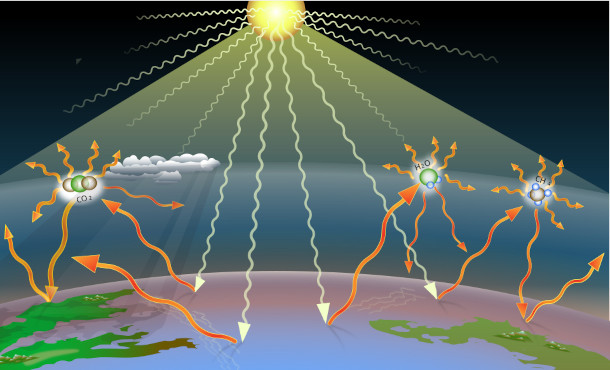
The accumulation of greenhouse gases in the atmosphere is making it more difficult for longwave energy to escape to space. (Photo: Aloosenecktie, Wikimedia Commons, CC BY-SA 4.0)
CURWOOD: So, what we're noticing over these recent months, even recent years, this increasing warming is related to a change, obviously, in the energy. What is speeding it up? Seems to be moving faster. What seems to be speeding things up?
FRANCIS: It's speeding up because the Earth is getting darker faster, and there are a number of things that are contributing to that. Some of the biggest ones and easiest ones to measure are we've lost almost half of the sea ice floating on the Arctic Ocean in the last 40 years, and that is a huge amount of really bright white real estate that is now gone. And especially during the time when the sun is shining up there, spring, summer, and fall, and so much more of the sun's energy is going into the ocean in high latitudes because of that loss of sea ice. We're also seeing about the same amount of spring snow cover disappearing during the spring. So this is on land, and that snow cover is also very very bright. And so by losing so much of that spring snow cover, right when the sun is coming up to be its strongest of the season, a lot more of that sun's energy is going into the land. So this is warming up the soils earlier in the spring. It's drying those soils out faster, and leading to kind of a jump start on the summer warming season, and leading to a big warming happening during that part of the year, and also setting the stage for drought and wildfires and some of those changes that we're observing. So, those are two of the main things that are going on. But we're also noticing that we've been cleaning up the atmosphere, which is a good thing. We've been reducing pollution coming from smokestacks, those sulfate particles that I talked about that start as sulfur dioxide, which is one of the gasses that comes out when we burn fossil fuels to make electricity, for example, and we're also cleaning up the smokestacks on ships. So the ships are out in the ocean, spewing out these particles where they have been over time. And by cleaning up their emissions, we're actually making the atmosphere less reflective. We're reducing the albedo because there are fewer of these bright particles in the air, and that's also contributing to the dimming of the Earth or the darkening of the Earth, we just have less pollution in the air, which is a good thing for the most part. But it is making us warm faster.
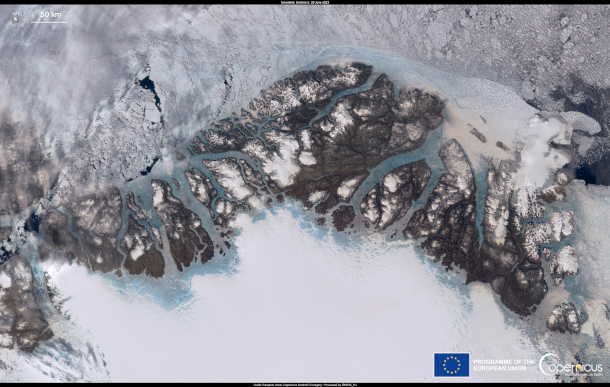
As temperatures continue to warm, the amount of sea ice is declining, exposing dark surfaces. This results in more heat absorption. (Photo: European Union, Copernicus Sentinel-2 imagery, Wikimedia Commons, Copernicus Sentinel data 2023)
[MUSIC: Dead Horizon]
CURWOOD: Just ahead, we continue our chat with Jennifer Francis, senior scientist at the Woodwell Climate Research Center. Stay tuned to Living on Earth!
ANNOUNCER: Support for Living on Earth comes from the Waverley Street Foundation, working to cultivate a healing planet with community-led programs for better food, healthy farmlands, and smarter building, energy and businesses.
[CUTAWAY MUSIC: Bela Fleck, “The Over Grown Waltz” on The Bluegrass Sessions: Tales From The Acoustic Planet, Vol.2]
CURWOOD: It’s Living on Earth, I’m Steve Curwood.
Still with us is Jennifer Francis, senior scientist at the Woodwell Climate Research Center, talking about the increasing pace of climate disruption.
CURWOOD: By the way, some of your own research points to the effect of this loss of Arctic ice and some regional weather things. I believe that you talk about how that has changed the jet stream, which can make things feel even more extreme in this time of warming. Talk to me more about that, if you could.
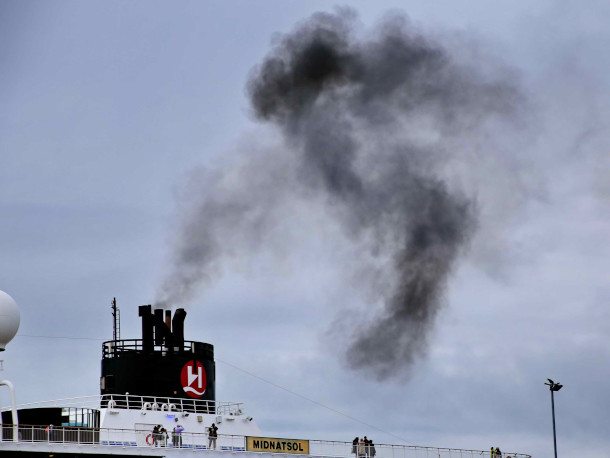
Stricter air pollution regulations have led to a decrease in sulphate particles, or “aerosols” that come from ships or power plants. Cleaning up these harmful reflective particles both means lowering Earth’s albedo and protecting public health. (Mark König, Wikimedia Commons, CC BY-SA 4.0)
FRANCIS: Yeah, the basic idea is that the Arctic we know is quite cold, certainly much colder than the areas farther south, and that temperature difference between the Arctic and the areas south of it is what drives the winds of the jet stream. So the bigger that temperature difference is, the stronger the winds of the jet stream are. And when the jet stream is strong, the north-south undulations that it takes as it travels around the northern hemisphere tend to be smaller. And that's important because those undulations are what create the high pressure areas and low pressure areas that we experience down here on the surface. So high pressure tends to be nice weather, low pressure tends to be our storms. So when the jet stream is strong, those high pressure and low pressure areas tend to move relatively quickly, say across the United States. And the way we sense that is you know the weather changes every couple of days. However, because the Arctic is now warming three to four times faster than the globe as a whole, a big part of that is the loss of sea ice and snow. That means that temperature difference between the Arctic and areas farther south is getting smaller too, and as that temperature difference gets smaller, there's less force driving the west to east winds of the jet stream. When the jet stream gets weak, we tend to see it take these bigger north south swings as it travels around the northern hemisphere. Those meanders that we were just talking about that create the high pressure and low pressure areas. When those waves are big, they tend to move much more slowly from west to east. So that means the weather that those waves in the jet stream are creating is also moving more slowly from west to east. And the way we experience that is then we have much more persistent conditions that are dry, say, or more stormy conditions that last longer, heat domes that last longer. I mean, that's been happening in spades this year, both in the United States and also in Europe. So basically, the idea is, as we're warming the Arctic so fast, because of all these extra heat-trapping gasses in the atmosphere, melting all that sea ice, we're reducing that temperature difference, which is slowing down those west winds of the jet stream, leading to larger north-south swings that move more slowly, that make our weather more persistent.
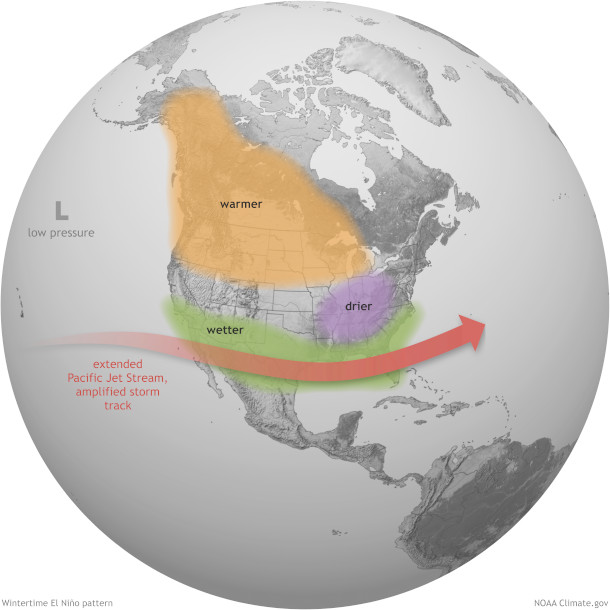
Rising global temperatures are disrupting the temperature differential between the Arctic and areas further south, resulting in a weaker jet stream. (Photo: NOAAClimategov, Wikimedia Commons, public domain)
CURWOOD: All the things you've been talking about make me feel that this is not good news for life on this planet, us humans, and of course all the other creatures as well, and that even if greenhouse gas emissions were to level off or even decline in the near term, the surface temperature here on Earth could continue to rise at an accelerating rate? Why would that be?
FRANCIS: So, if we can reduce our emissions of these heat-trapping gasses enough to level off the concentration of them in the atmosphere, so they're not increasing anymore, we can slow down the warming of the Earth by quite a lot, we can't stop it, but we can certainly slow it down. Part of the problem is the ocean has already absorbed so much that it's going to take quite a long time, decades, for that heat to eventually get into the air and then be emitted to outer space as that long wave energy. So it will take time, but I think if we can manage to either keep the amounts of these heat-trapping gasses constant — I mean, we're still increasing them quite fast, so we've got a ways to go — and if we can turn them around, we can actually slow down the warming. I don't think we can stop the warming, and we certainly can't stop sea level rise. We can't stop the glaciers from melting or the Greenland ice sheet from melting at this point. But we can slow things down. So I think the acceleration that we're observing now could be stopped.
CURWOOD: By the way, some people say, "Well, there's a technological solution possible here." What about geoengineering? What about figuring out some way to use modern technology to get rid of this extra heat? Maybe injecting particles in the atmosphere, that sort of thing. What do you think about that?
Jennifer Francis points out that the Earth’s energy balance is capable of continuing its natural system functions without the introduction of geoengineering. (Photo: Misha Reme, Wikimedia Commons, CC BY-SA 4.0)
FRANCIS: So we have already at our disposal a lot of different ways to treating this disease of global warming. They include stop burning fossil fuels or cut back drastically, stop cutting down forests, stop removing wetlands and mangroves. Those things are going to treat the underlying disease, which is the production of these heat-trapping gasses that we've been putting into the air, and then there are band-aids that you can put on this cancer, if you will. I see geoengineering as an expensive band-aid that does not treat the underlying disease. If everything went really well, it might buy us a little time, but it's super expensive and very untested in terms of the inadvertent consequences that could and almost certainly will happen if we were to go ahead with a global scale geoengineering project. We don't know how it's gonna work in terms of changing weather patterns in ways that we don't understand yet, and there are a whole host of other issues associated with geoengineering in addition to the very high cost. And then there's the whole governance concept. You know, who says where you're going to do it? When you're going to do it? Who's responsible for extreme events that happen that seem to be connected to that? Who's to blame? Who's going to pay for the reparations? I mean, there's so many big question marks associated with just another way that we are messing with Mother Nature, if you will.
CURWOOD: Before you go, anything more you'd like to say?

Jennifer Francis PhD i is a senior atmospheric scientist at the Woodwell Climate Research Center. (Photo: Courtesy of Jennifer Francis)
FRANCIS: So, you know, we've talked about a lot of pretty grim stuff. I mean, there's a lot of reason to worry about where this future is going in terms of the climate system, but I also see a lot of reason to be hopeful. I look around at my own community and all of the effort that's going into both preparing our community for the extreme weather to come and sea level rise and storms and so forth, but also we've done a lot to shift our community to renewable energy, and I see that happening in many areas. I see states putting in incredible incentive programs to help communities shift away from a fossil fuel economy, but I also talk to young people a lot, and I feel incredible energy coming out of them for dealing with some of these big problems that they're stepping into as they become adults. Of course, one of them is the climate crisis, and they are all fired up about going into all sorts of careers that will help address this crisis. And it's not just becoming a scientist. It's engineers. It's lawyers. It's artists. It's musicians. Everybody has a talent that can be put to work to helping make this situation better as we go forward. So that gives me a lot of hope. It gets me out of bed every morning.
CURWOOD: Jennifer Francis is a senior atmospheric scientist at the Woodwell Climate Research Center. Thanks so much for taking the time with us today.
FRANCIS: Thank you too.
Links
Woodwell Climate Research Center | “Extreme Weather and Climate Change”
The Economist | “The Rate at Which Earth Is Absorbing Energy Is Alarming Scientists
Living on Earth wants to hear from you!
Living on Earth
62 Calef Highway, Suite 212
Lee, NH 03861
Telephone: 617-287-4121
E-mail: comments@loe.org
Newsletter [Click here]
Donate to Living on Earth!
Living on Earth is an independent media program and relies entirely on contributions from listeners and institutions supporting public service. Please donate now to preserve an independent environmental voice.
NewsletterLiving on Earth offers a weekly delivery of the show's rundown to your mailbox. Sign up for our newsletter today!
 Sailors For The Sea: Be the change you want to sea.
 The Grantham Foundation for the Protection of the Environment: Committed to protecting and improving the health of the global environment.
 Contribute to Living on Earth and receive, as our gift to you, an archival print of one of Mark Seth Lender's extraordinary wildlife photographs. Follow the link to see Mark's current collection of photographs.
 Buy a signed copy of Mark Seth Lender's book Smeagull the Seagull & support Living on Earth
© Copyright World Media Foundation. All Rights Reserved
Home | Contact | RSS | Donate | Newsletter