

How Flowers Made Our World
Air Date: Week of June 19, 2026
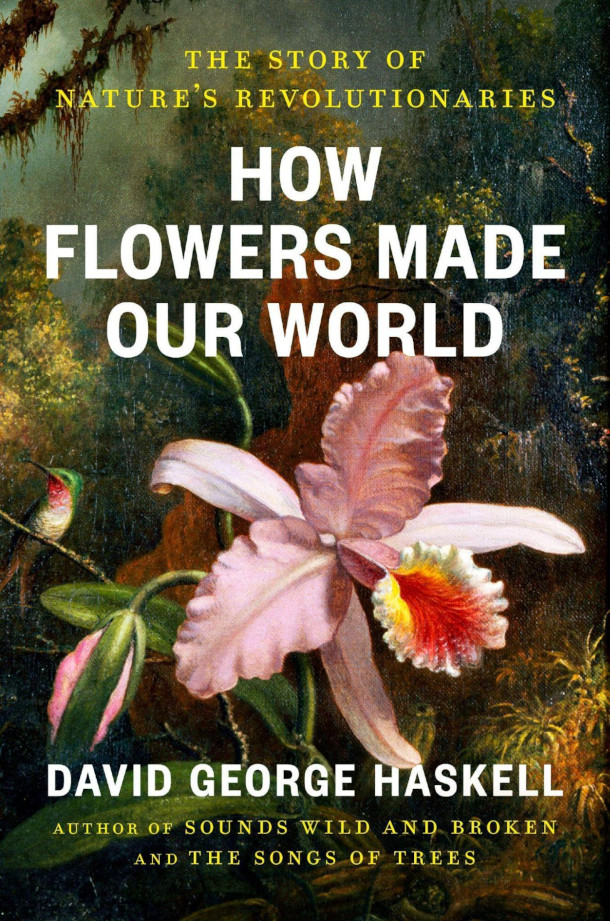
David George Haskell’s 2026 book, How Flowers Made Our World: The Story of Nature’s Revolutionaries (Photo: Courtesy of David George Haskell)
Lush peonies, delicate hydrangeas, and vibrant roses burst into bloom in early summer, filling gardens and parks with color and fragrance. But flowers are more than their beauty. They’re some of the oldest beings on Earth, and they played a large role in shaping the natural world as we know it. David George Haskell is an author and biologist whose 2026 book is How Flowers Made Our World: The Story of Nature’s Revolutionaries, and he joined Living on Earth’s Steve Curwood.
Transcript
BELTRAN: It’s Living on Earth, I’m Paloma Beltran.
DOERING: And I’m Jenni Doering.
Early summer is peak flower season across the Northern hemisphere. Lush peonies, delicate hydrangeas, and vibrant roses burst into bloom, filling gardens and parks with color and fragrance. But flowers are more than their beauty. They’re actually some of the oldest beings on Earth, and they played a large role in shaping the natural world as we know it. David George Haskell is an author and biologist whose latest book is How Flowers Made Our World: The Story of Nature’s Revolutionaries, and he joined Living on Earth’s Steve Curwood.
CURWOOD: The title of your book refers to flowers as revolutionaries. Okay, what are you talking about? What's the revolution started by flowering plants? How exactly did they make our world, as you say?
HASKELL: Yes, the title sounds a little preposterous, but I really mean it. When flowers appeared on this planet, they swiftly transformed the nature of the planet and built most of the major habitats that we have with us today. Think about rainforests and prairies, they are built by flowering plants. And they catalyze the evolution of all sorts of major groups of animals, bees, butterflies, grazing mammals, and even the origin of our own species, Homo sapiens. And so they did make the ecological world as we know it, and yet, and yet, we often dismiss flowers as merely ornamental. They're pretty, but not powerful. They're beautiful, but not in charge. And in this book, I want to sort of reframe that and put flowers back at the center of the story of how our modern world came to be.
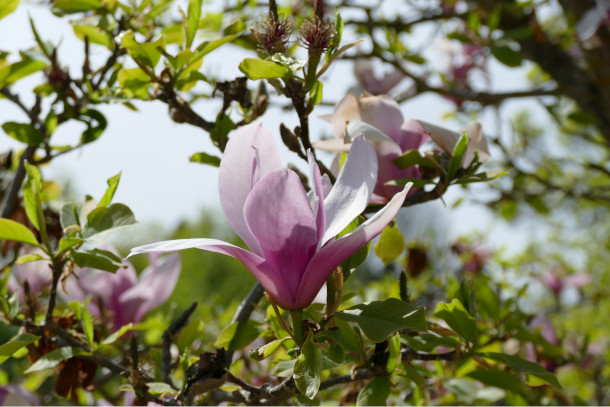
The magnolia has both male and female reproductive parts, making it an ideal pit stop for pollinators, who can pick up and drop off pollen in one stop. (Photo: Kritzolina, Wikimedia Commons, CC BY-SA 4.0)
CURWOOD: So, having pollination, having sexual reproduction, means that plants can change, adapt, evolve. What is the genetic aspect of all of this? At one point in your book, you point out that flowers sometimes have more sets of genes than we do.
HASKELL: Yeah, so the beauty of flowers, the extra motherhood of flowers, these are things that we can see. Underneath the surface, there are innovations that we can't see without modern genetics, and this is one of the revolutions that's happened just in the last 10, 20 years, is that we now understand that flowering plants go through what I think of as genetic storms, where they massively increase the number of chromosomes, they double all the chromosomes, or triple all the chromosomes inside their cells, which honestly is quite excessive. You don't need four or six copies of every chromosome to run a plant, but what those doublings do is that they mean that two of the chromosomes can do the work of running the plant, and the other two or four are free to explore, it's like a cross between a rave and a corporate brainstorming retreat. The usual rules of life have sort of loosened up a little bit, so those genes on those chromosomes can mutate and explore new ways of doing photosynthesis, new ways of growing petals, producing aromas, massively increasing genetic diversity, which is the raw material of evolution, of adaptation, of resilience, and then after this big party of exploration, natural selection kicks in and trims the genome back, keeping the good ideas, keeping the good innovations, and throwing out the rest. Now other organisms go through this kind of doubling, but it's especially prevalent in flowering plants, because they have quite flexible development, so they can tolerate a certain amount of genetic shenanigans as they're developing and growing in a way that, say, a mammalian cell could not. By repeatedly going through these genetic storms, flowering plants have given themselves these boosts of genetic diversity that have helped them, particularly in times of environmental calamity, like when a meteorite strikes the earth. These storms have been particularly important.
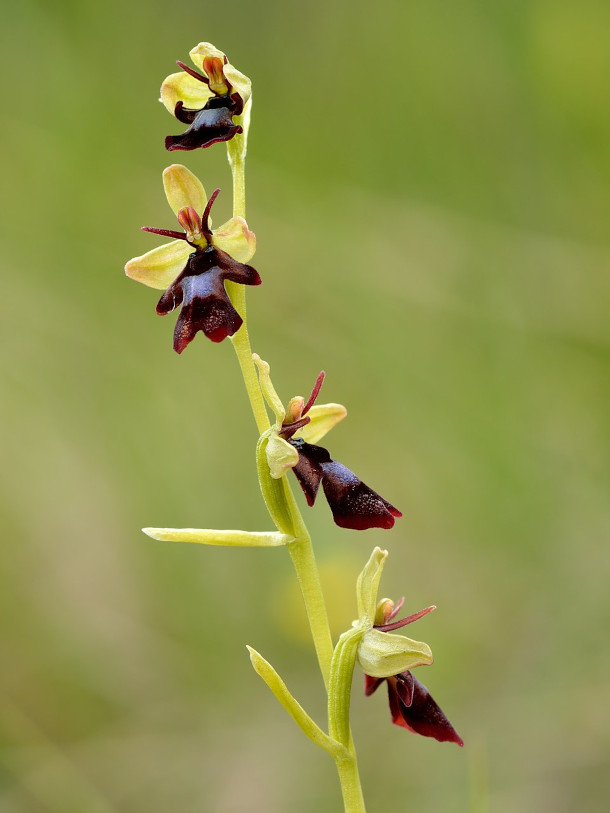
Fly orchids are sexual deceivers. They evolved to look like female wasps so that male wasps will land on them and spread their pollen. (Photo: Ivar Leidus, Wikimedia Commons, CC BY-SA 4.0)
CURWOOD: So, you spent a fair amount of your time talking about magnolias in this book. What's so instructive about the magnolia?
HASKELL: So, I start with the magnolia plant, and part of the reason for that, indeed, they're beautiful. I just love their aroma. It's like diving into a different sort of mental space to smell the magnolia flower, but magnolias also are portals into deep time, because their overall structure, a bowl of petals with both male and female sexual parts within it, welcoming all kinds of different pollinators, is very little change in nearly 100 million years. So they're biologically bisexual in the same flower, which is very efficient, because then any little insect that arrives can both bring pollen and take pollen away. And to this day 90% of flowers still keep with that old formula for success of having male and female in the same bloom.
CURWOOD: So at one point in your book, you call out Henry David Thoreau, saying that his call for self-reliance is, well, it's rather problematic in the case of flowers. What do you mean?
HASKELL: Yeah, so I mean, of course, he was a beautiful writer and had lots of great, insightful things to say, but his call to sort of go it alone, to go out into the cabin and live by the labor of his hands alone, A: was a lie, because his sisters and his mother were cooking for him and doing his laundry, and so forth. So it was a sort of fiction that he was spinning there in his writing. And B: in terms of biology, it really doesn't work. There is no species that has been able to go it alone and succeed, and what flowering plants do is give us a time-tested example over 100 million years of success through cooperation, success through building new relationships, primarily with pollinators and fruit disperses, but also below ground with fungi and microbes, extending those pre-existing partnerships. So the Thoreau way of thinking, this sort of notion that the self is the fundamental unit of innovation and of progress, I think doesn't really hold up in biology, and flowers are an extraordinary example of that.
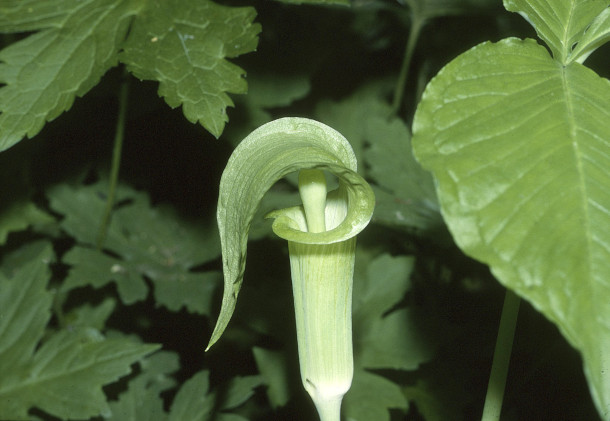
Another deceiving flower is Jack-in-the-pulpit, or Arisaema triphyllum, which traps and kills its pollinator. (Photo: Robert H. Mohlenbrock, Wikimedia Commons, Public Domain)
CURWOOD: So these plants aren't always nice to the rest of the ecosphere, I mean, what about deception and trickery by plants that are seeking pollination and the substrate that they sometimes use?
HASKELL: Absolutely, so I've emphasized cooperation, and indeed, most interactions between flowers and their pollinators are cooperative. They both, the pollinator gets some nectar and pollen to eat, and the plant gets pollinated. But there are delicious dark threads running through this, and as is true in all sorts of stories of evolution, conflict and cooperation are in creative tension with one another, and orchids are great examples of this. So many orchids pretend that they have food to provide nectar and pollen to feed the insects, but really they have none. The storefront says we're full, but once the insect goes into the store, there's no reward there. So the insect is being duped. But it gets worse, because some orchids are sexual deceivers. They look and smell just like female wasps, and so the male wasps embrace the orchid flower, thinking that they're going to mate with a female of their own species, but they're just wasting their time. Instead, they get a dab of orchid pollen on the back of their head, and they fly on into another flower. And then others, like Jack and Jill-in-the-pulpit, a common plant in much of the eastern United States, actually kills its pollinator. There are male flowers that flies fly into it and pick up pollen, but when they enter a female flower, there's no exit hole, and the little flies die inside the plant. So, this, for me, is a suggestion that we should put the brakes on allegorizing nature too much. Nature is not a moral guide, or if we want it to be, we're going to be finding a sort of Baskin-Robbins of different flavors to choose from.
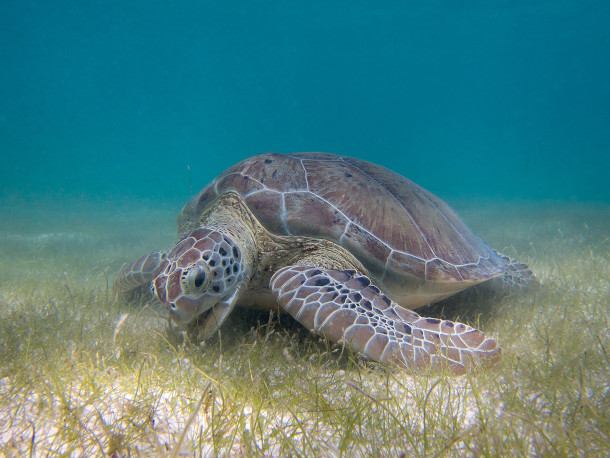
Many organisms depend on flowering plants to survive, such as the green sea turtle, which grazes primarily on sea grass. (Photo: P. Lindgren Wikimedia Commons, CC BY-SA 3.0)
CURWOOD: So we as humans, you say, owe our very existence to the evolution of one family of flowering plants. Tell me, what is so powerful about grasses?
HASKELL: Yes, I mean, many of us don't even think of grasses as flowers, but if you've got allergies, you know very well that grasses do indeed produce flowers. And grasses are a fairly late arrival on the scene. They evolved after many other groups of flowering plants, and what they did was create new habitats like savannas and prairies and the steppes, very productive habitats. They did so mostly by encouraging fire and later grazing animals. And our ancestors, say 10 million years ago, were happy primates living up in the trees of tropical forests, and then I don't know why some of them had this idea of leaving that quite pleasant life, but they moved out of the forests into grasslands to become bipedal primates, walking on two legs, either eating grasses or eating animals, like wildebeest, that were eating the grasses. So, without grasslands, our ancestors would still be up in the trees, as most other of our primate cousins are. So, both millions of years ago, in the evolution of our pre-human ancestors, grasslands were critically important, and, in fact, the main catalytic stimulus for the evolution of our species, and then in the present day, wheat, maize, and rice form two thirds of the calories we eat. So even today, we are grass apes, and we should be putting grasses on the altars of our places of worship to thank our original ecological creators. I mean, I'd encourage listeners actually to use the zoom on your cell phone camera to look at some of the native grasses that we have here in North America and around the world. And when you look close, the flowers are incredibly beautiful, particularly when they set seed, they're like these architectures made out of silvery strands and all kinds of different shades of brown. It's just absolutely gorgeous.
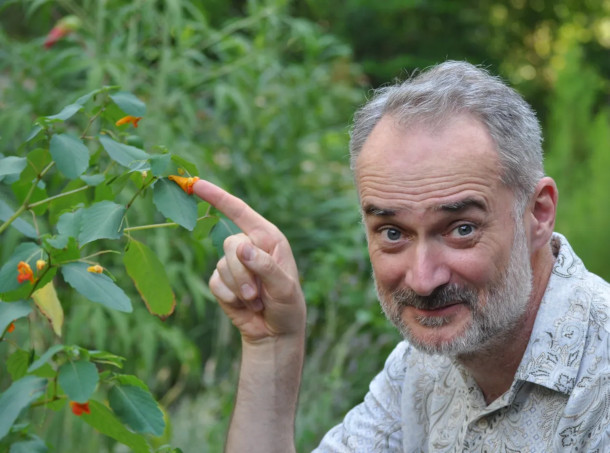
Author David George Haskell (above) invites listeners to dive into the world of flowers by observing them through all the senses. (Photo: Katherine Lehman)
CURWOOD: By the way, speaking of grasses, I was somewhat startled by your section about sea grasses, and your assertion that they're so extremely important and really not understood. So, why are they so important?
HASKELL: So, sea grass is a kind of flowering plant that blooms underwater, extraordinary creatures, right? And they have special pollen grains that are designed to catch the ocean currents and spin back down into the sea grass meadow. Sea grasses grow wherever there is mud or sand extending out into the shallows of the ocean, so they ring many continents. They form the nurseries for many fish and shellfish and invertebrates, so they're really important for biodiversity. They're also incredible storehouses for carbon. A seagrass meadow can store per acre, per year, more carbon than the richest forest on earth, sometimes 30 to 50 times more carbon. So they're great climate champions, they're biodiversity champions, but you know they don't look particularly impressive, right? They don't look as impressive as an old growth forest or a rain forest, and yet they're a vital part of the ecosystem. In the 20th century, they declined by up to 7% per year globally, and the good thing is now there are some incredibly successful restoration projects that are bringing back these seagrass meadows back to some of their former glory, and also weaving awareness of even the existence of sea grass back into human consciousness, and also it's a reminder that the revolutionary power of flowers wasn't just limited to the terrestrial world, they also revolutionized the oceans. Green sea turtles, for example, feed mostly on seagrass meadows. So, without seagrass, there'd be no charismatic marine reptiles swimming around, let alone all the fish and other creatures that depend on them.
CURWOOD: Much of the operation of flowers is done with aroma, with fragrance. What do you suppose that says about us as a species, and how important smell is, even for humans, let alone the animals that can smell flowers as part of their quest for pollination?
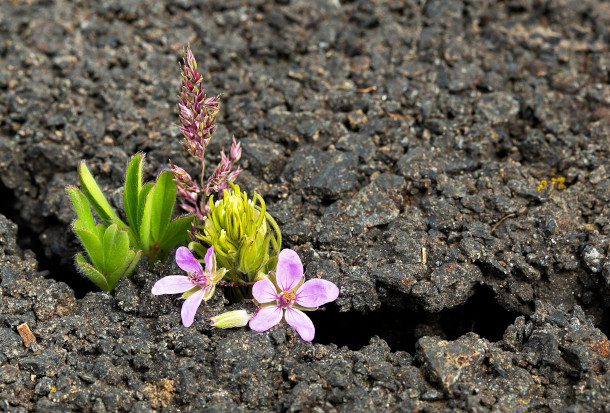
Haskell says his favorite flowers are the ones that grow in the cracks of his driveway. (Photo: Sheila Sund, Wikimedia Commons, CC BY 2.0)
HASKELL: Well, I think smell is one of the most important senses in humans, and the sense of smell goes directly to the parts of our brain associated with memory and emotion, so smell is this way of connecting in a deeply emotional way to the living world, which I think is why we like floral aftershave, perfumes, floral scented candles, is that it's a way of becoming chimeric beings. I express my individuality myself paradoxically by hybridizing my aroma with that of a flower, which to me is a beautiful enactment of what flowers do for the rest of the ecosystem, which is draw unlikely species together into partnerships. So, in my book, I repeatedly emphasize the aromas of flowers, because it's a delight that we can find in just in the middle of the city, smelling flowers that are growing in parks or in department stores through floral perfumes. And reconnecting with aroma brings us back to our senses and brings us back to the present moment, because it's an experience of the moment that you hold onto in memory, but you can't carry with you, say, the way you take a photograph with it with your cell phone. So ephemerality is especially precious to me.
CURWOOD: You invited us to play with flowers at the end of your book. What's one way to play with them?
HASKELL: So the end of the book, I really wanted to encourage people to get hands on and senses on with flowers. It's wonderful to read about flowers, and I hope people find some interesting florid tales in the book, but the book ends deliberately with flowers' power to draw us out of ourselves into relationships, so making floral perfume in your own kitchen. The simplest is just to sit with a flower and use your imagination and senses to get into the flower's world. To whom is the flower speaking? What aromas is this flower producing? How did the flower get here? What role do humans have in this flower's well-being? This is essentially a floral meditation, and we all need a little bit more flower power in our lives right now. And so I'd encourage listeners just to take 15 minutes this week to sit with a flower, open your curiosity, unself yourself into the flower's world and see where that curiosity and sensory connection will lead you.
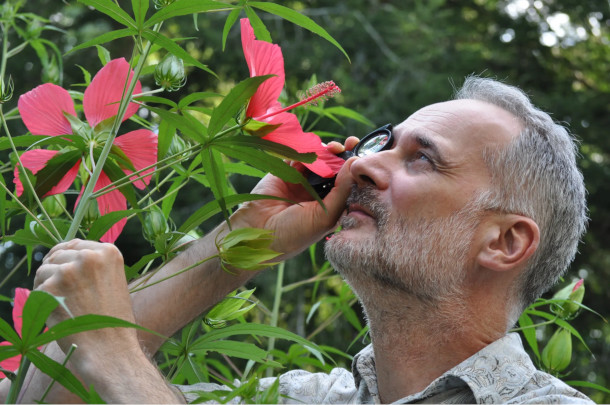
David George Haskell is an Atlanta-based author and biologist. (Photo: Katherine Lehman)
CURWOOD: Probably the first thing I'll do is sneeze, and then, right?
HASKELL: [LAUGHS] the sneezing is part of the sensory connection.
CURWOOD: David, why are flowers so important to humans in your view? Maybe you would read a section from your book about that.
HASKELL: Yeah, so I can read from page 255, this is the afterward on floral beauty and joy. When we take pleasure in a flower, we reclaim our inheritance as animals in a world made by flowers. Sensual indulgence and enjoyment of floral beauty are not frivolities, flowers give us embodied experiences of the creativity and vitality that drive the grand narrative of life on earth. Floral delight is deep, earthy beauty.
CURWOOD: Before we go, David, you can tell me. What's your favorite flower?
HASKELL: My favorite flower are the tiny little weeds that grow up in the cracks in my driveway. I've got a very old cracked driveway in Atlanta, and there are a dozen different species of weed that grow from all around the world, and I admire and love those plants so much for their resilience and for the way that they launch beauty out of these unexpected places, and to me that's embodied hope. Given half a chance, the floral world can remake the world, and we can cooperate with them. And so, in the springtime, I literally lie down in my driveway with a little hand lens and look at these tiny little blooms that we often dismiss as mere weeds. But in fact, these are our kin, and they're our creators, and I really, they lift my spirits, and I look forward to their emergence in the cracks in the driveway every single year.
DOERING: David George Haskell is a writer, biologist, and adjunct professor at Emory University in Atlanta. His book is called How Flowers Made Our World: The Story of Nature's Revolutionaries, and he spoke with Living on Earth’s Steve Curwood.
Links
Purchase How Flowers Made Our World and support Living on Earth and independent booksellers
Living on Earth wants to hear from you!
Living on Earth
62 Calef Highway, Suite 212
Lee, NH 03861
Telephone: 617-287-4121
E-mail: comments@loe.org
Newsletter [Click here]
Donate to Living on Earth!
Living on Earth is an independent media program and relies entirely on contributions from listeners and institutions supporting public service. Please donate now to preserve an independent environmental voice.
NewsletterLiving on Earth offers a weekly delivery of the show's rundown to your mailbox. Sign up for our newsletter today!
 Sailors For The Sea: Be the change you want to sea.
 The Grantham Foundation for the Protection of the Environment: Committed to protecting and improving the health of the global environment.
 Contribute to Living on Earth and receive, as our gift to you, an archival print of one of Mark Seth Lender's extraordinary wildlife photographs. Follow the link to see Mark's current collection of photographs.
 Buy a signed copy of Mark Seth Lender's book Smeagull the Seagull & support Living on Earth
© Copyright World Media Foundation. All Rights Reserved
Home | Contact | RSS | Donate | Newsletter