

A Cemetery Buzzing with Bees
Air Date: Week of June 19, 2026
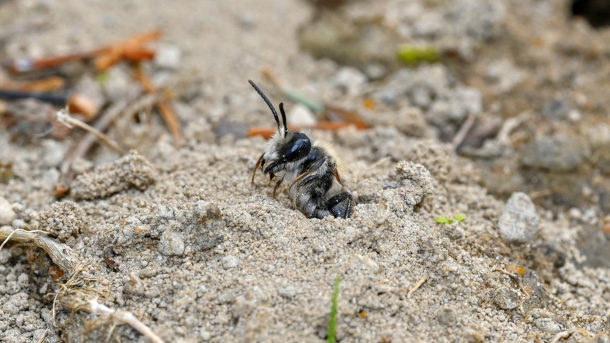
Though many of us might assume that bees always live in hives, most species of bees are solitary, and many of those live underground. Above is Adrena regularis, also known as the regular mining bee. Bryan Danforth and his team at Cornell studied a large aggregation of these solitary bees at a local cemetery. (Photo: Bryan Danforth)
While honeybees get most of the buzz, most bees don’t produce honey, and most don’t even live in colonies. Instead, they’re solitary bees who build individual nests. These are the type of bees that Bryan Danforth studies as a professor of entomology at Cornell University. He speaks with Host Paloma Beltran about his recent paper detailing an astonishing finding of several million solitary bees in a cemetery in Ithaca, New York.
Transcript
BELTRAN: Many of us know the famous image of Winnie the Pooh holding onto a balloon, reaching his paw into a hive full of honeybees. But most bees don’t produce honey, and most don’t even live in colonies. Instead, they’re solitary bees who build individual nests. These are the type of bees that Bryan Danforth studies as a professor of entomology at Cornell University. His most recent paper details an astonishing finding of several million solitary bees in a cemetery in Ithaca, New York. Bryan Danforth joins me now to discuss -- Welcome to Living on Earth!
DANFORTH: Thanks very much, Paloma.
BELTRAN: So, when I picture bees, the first thing that comes to mind is a buzzing hive. But you study solitary bees. How common are these solitary bees compared to social bees?
DANFORTH: Yeah, that is the image I think many people have of a bee. You imagine a colony, you imagine a honey bee, or a bumblebee, a queen, thousands of workers, aggressive stinging. The bees that I work on, the solitary bees, are much more docile. These are bees in which each female builds her own nest, provisions her brood cells with pollen and nectar, lays her own eggs, defends her nest from enemies, parasites, and predators, and then leaves her offspring to the next generation. So, the image of a social bee is quite different from the kind of solitary bees that we work on. So, we know that there are 21,000 described bee species on Earth, and that's probably an underestimate. You know, there may be 30,000 bees total. Of those 21,000 described bee species, 77% of them are solitary, 13% of them are brood parasites of those solitary bees, and then about 10% are social. So the social bees comprise a pretty small slice of that 21,000 total species. The vast majority are these solitary bees.
BELTRAN: And you note in your study that solitary bees are important for pollination, but just how important are they?
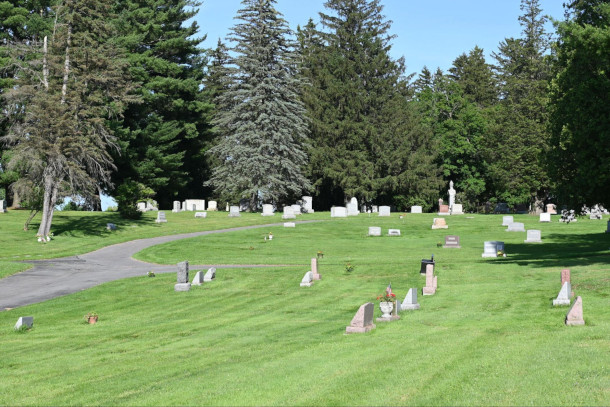
Bryan Danforth’s study took place at East Lawn Cemetery, located in Ithaca, NY. Danforth suspects that cemeteries serve as biodiversity hotspots for ground nesting bees. (Photo: Bryan Danforth)
DANFORTH: It really depends on the crop. I'll give you a few examples. So, in squash and pumpkin, for example, there is a single solitary bee species called Peponapis pruinosa, which is a narrow host plant specialist on squash and pumpkin, and those are very effective pollinators. They are early morning bees, so they get out before any of the other wild or managed bees, visit squash and pumpkin, and they're doing most of the squash and pumpkin pollination. We did a lot of work on the role of wild bees as apple pollinators in New York because New York is a big producer of apples. It's... we're the second largest producer of apples in the country, and for about a decade my lab studied the role of wild bees as crop pollinators and apples. So this is something I know really well, and we were able to document 120 wild bee species visiting apples in New York state, that's about a quarter of the total number of bees in New York state, so a big slice of New York pollinators are actually visiting apple, and through the work of Mia Park, a graduate student at the time, we determined that the solitary bees are actually more effective on a per visit basis as pollinators. So, when they visit a flower, they deposit more pollen grains, and they're also more abundant in many apple orchards. So, for the apples that I worked on, the wild bees are actually more important than honey bees, but there are certain crops that are really highly dependent on managed pollinators. So, I would say the answer to your question is, it really depends on the crop, but for the crops that I have worked on, the wild bees are very, very important, and they're doing all this work for free, by the way. These are not bees that you have to manage or you have to pay for. They're just out there in the environment doing their job.
BELTRAN: Wow, amazing. So your study was conducted at a cemetery in Ithaca, New York. How did your team choose this location for your research?
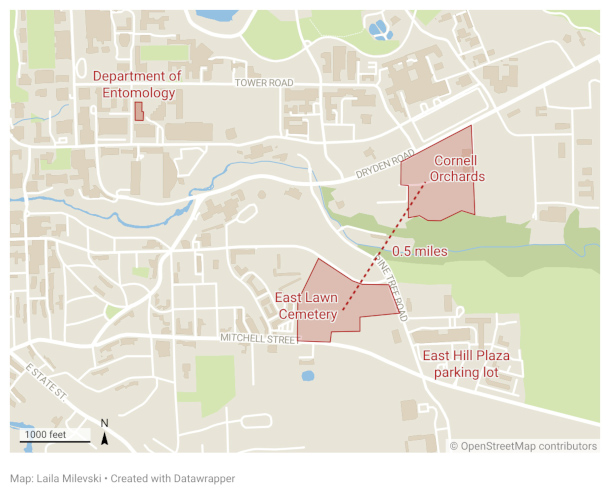
The team decided to study the bees in the cemetery when a colleague happened to see a cloud of them as she was walking from the East Hill Plaza parking lot to campus. (Image: Lalia Milevski, Created with Datawrapper)
DANFORTH: So, it turns out that the cemetery is just right off the edge of the Cornell campus, so we don't have to go very far to study these bees. But it really was just a random event. My technician at the time had the habit of parking her car at East Hill Plaza, the shopping center out there on the east side of campus, and on her way into work, she walked through the East Lawn Cemetery. And she did this in the spring of, I think it was 2022, and discovered that there were tons of bees over the lawn, clouds of bees flying over the surface of the cemetery. And she collected a few of these bees, brought them into the lab, and we immediately identified them as Andrena regularis, a solitary bee that we'd studied as an apple pollinator. We knew it was a fairly common bee in New York, but we didn't really know where it nested, and we certainly didn't know how large the nesting aggregations were. So this discovery allowed us then to dig into, no pun intended, dig into the biology of this bee. So we then did a follow-up study in 2023 where we used emergence traps to capture bees emerging from the soil at the very start of the season, and that allowed us to track the number of bees emerging over time, the sex ratio of the bees, the parasites emerging along with the host, and we were able to come up with this population estimate of 5.6 million bees.
BELTRAN: Wow, that's a huge number. How surprising was that number to you?
DANFORTH: So it was very surprising to me, although I will say that I would not at all be surprised if there were larger bee aggregations out there. It just turns out that this is the largest one that's ever been reported in the literature. And I'll put that number in perspective. So, what does 5.6 million bees look like? It looks like 270 honey bee colonies. Imagine what that looks like, a whole lot of white boxes scattered across the landscape. It's also equivalent to four times the population of Manhattan, the human population of Manhattan.
BELTRAN: Wow.
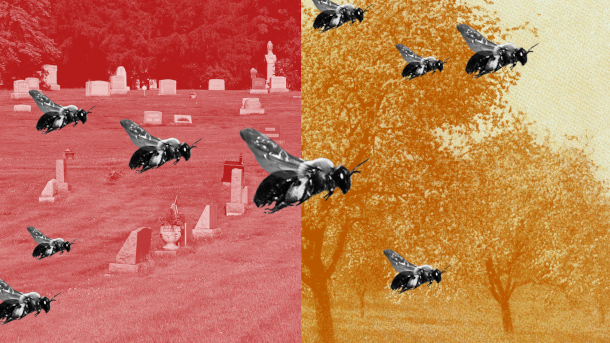
Solitary bees are crucial to the pollination of many crops, including the species of apples that grow in New York. (Photo: Lalia Milevski)
DANFORTH: It's a large number. Yes, there are a lot of bees.
BELTRAN: What were the conditions in this cemetery that led to such a high concentration of bees?
DANFORTH: We think that it's related to the soil texture. Ground nesting bees, just like humans, like to dig in soil that's kind of maintains its consistency, so the cemetery soil is what's called sandy loam. It's a very nice soil texture for digging, and we think that that's one of the reasons that these bees are particularly abundant at that site. And many cemeteries across the landscape in the eastern United States were sited on these sandy loam soils because you could dig a six foot deep hole with a shovel in sandy loam soil, and this was before the advent of the backhoe. So, we think that there is really something unique about that sort of soil texture, and now we're expanding our studies to look at other cemeteries around New York and see whether they have that kind of soil and whether they also host large numbers of solitary bees.
BELTRAN: And part of your study analyzed parasite rates among bees. Talk to me about the parasites. What do they look like, and how do they affect the bees?
DANFORTH: Yeah, so we focused on the most common parasite of Andrena regularis, which just turns out to be another bee. It's called Nomada imbricata. It's the nomad bee. We call them brood parasites, or you could call them cuckoo bees. They are very adept at sneaking into the nest of their host, laying an egg in the brood cell, and hiding that egg in the wall of the brood cell, and then leaving, so the adult would leave. Meanwhile, the host bee continues to provision her brood cell, she lays her own egg, she closes up the brood cell, and then she's done with that brood cell. She will never go back into that brood cell. Meanwhile, the nomad bee egg hatches. It crawls across the pollen provisions. It kills the host egg or larva, and then it consumes the pollen and nectar that was gathered by the host, so it's a very devious strategy. It's very much like a cuckoo bird. It's a very common strategy in bees. As I said, about 13% of bee species are brood parasites, and they specialize on individual species or individual groups of bees as their particular host. And I should point out that these brood parasitic bees are really quite different looking from your normal bee. They're not hairy. They are very wasp-like. They're yellow and black. They're heavily armored. They live their life kind of just skulking around the nest site, you know, because they don't actually build a nest. They don't need to collect pollen and nectar for their offspring, so they're kind of drifters around the nest site. And then when they see the opportunity, they dive into a nest. So, if you see wasp-like creatures flying low over the ground in an area where there are bees nesting, those might be brood parasites.
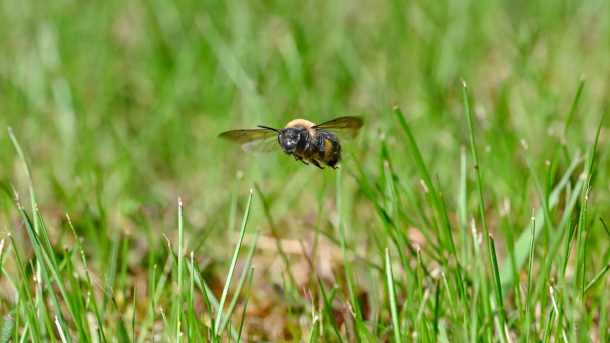
Adrena regularis is far less aggressive than many species of social bees. Each mother lays her own eggs underground and provides them with pollen. (Photo: Bryan Danforth)
BELTRAN: So, you ended your study by discussing how cemeteries could be important for preserving biodiversity. Why do you think that is?
DANFORTH: It turns out that there's a reasonable literature on this. A number of studies have been done in Europe, looking at the fauna and flora of older inner-city cemeteries in cities like Berlin, and it turns out that these cemeteries can host rare plants. They can host rare birds, rare salamanders, so cemeteries, I think, turn out to be these underappreciated biodiversity preserves, and that's because they're undisturbed. So, once the cemetery is established, and most cemeteries are at least 200 to 300 years old, even in the eastern US, so these sites become preserves. They're no longer undergoing change. There's no building. There's no construction going on. And then, in addition, there's low pesticide use in those cemeteries. So, I really think that our study, but also some previous work done in Europe, suggests that cemeteries are these underappreciated refuges for biodiversity.
BELTRAN: You know, what are the broader implications of your research in the cemetery regarding bees?
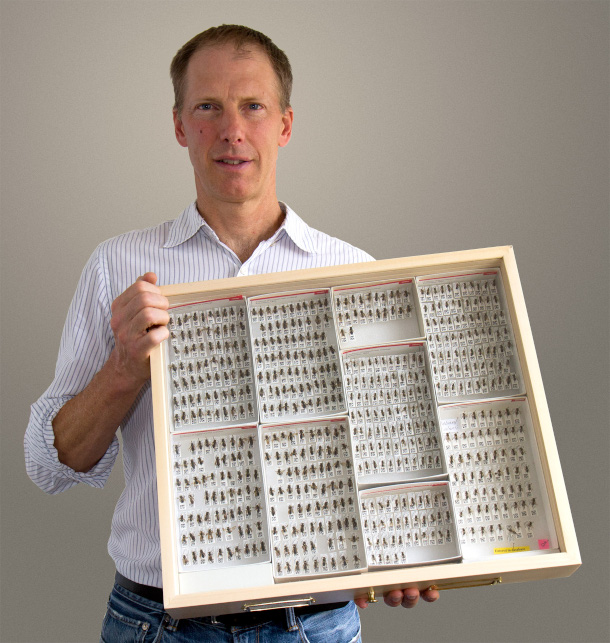
Bryan Danforth is a professor of entomology at Cornell University. (Photo: Courtesy of Cornell Media Relations)
DANFORTH: So, I think the real take home from our study at the East Lawn Cemetery is that nest sites are incredibly important conservation priorities, and that we need to be identifying these nest sites, protecting them, and educating people about their value. So, as a result of that, we started a project called Project GNB, or Project Ground Nesting Bee. It's a community science project. We run it through the iNaturalist platform. And we would like backyard naturalists, birders, people out for a walk with their dog to upload observations of nesting sites, if they see them, of these bees, so that we can map across the landscape where these nesting aggregations occur, and therefore protect them. That's, I think, the main take home from our study.
BELTRAN: Bryan Danforth is a professor of entomology at Cornell University. Bryan, thank you so much for joining us.
DANFORTH: Thanks very much, Paloma. It's been a pleasure.
Links
Read Bryan Danforth’s original research paper
Living on Earth wants to hear from you!
Living on Earth
62 Calef Highway, Suite 212
Lee, NH 03861
Telephone: 617-287-4121
E-mail: comments@loe.org
Newsletter [Click here]
Donate to Living on Earth!
Living on Earth is an independent media program and relies entirely on contributions from listeners and institutions supporting public service. Please donate now to preserve an independent environmental voice.
NewsletterLiving on Earth offers a weekly delivery of the show's rundown to your mailbox. Sign up for our newsletter today!
 Sailors For The Sea: Be the change you want to sea.
 The Grantham Foundation for the Protection of the Environment: Committed to protecting and improving the health of the global environment.
 Contribute to Living on Earth and receive, as our gift to you, an archival print of one of Mark Seth Lender's extraordinary wildlife photographs. Follow the link to see Mark's current collection of photographs.
 Buy a signed copy of Mark Seth Lender's book Smeagull the Seagull & support Living on Earth
© Copyright World Media Foundation. All Rights Reserved
Home | Contact | RSS | Donate | Newsletter