

Note on Emerging Science: Long-Lived Greenland Sharks
Air Date: Week of June 19, 2026
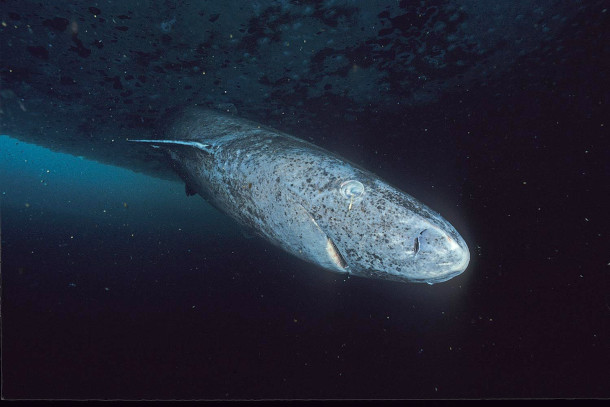
A Greenland shark spotted at the edge of Admiralty Inlet, Nunavut, Canada. (Photo: Hemming1952, Wikimedia Commons, CC BY-SA 4.0)
With a lifespan of several hundred years, Greenland sharks may be the longest living vertebrates on Earth and are estimated to reach sexual maturity at about 150 years old. Living on Earth’s Don Lyman reports in this note on emerging science about how enhanced activity of DNA repair genes may help Greenland sharks’ eyes avoid the usual degradation of aging.
Transcript
DOERING: In a moment, how cemeteries can be safe havens for bees. But first, this note on emerging science from Living on Earth’s Don Lyman.
[SCIENCE NOTE THEME]
LYMAN: The Latin name for the Greenland shark, Somniosus microcephalus, translates to “small-headed sleeper”, but these sluggish giants, which grow to 21 feet-long and can weigh over a ton, are the longest living vertebrates on earth. Scientists say these inhabitants of the cold waters of the North Atlantic and Arctic Oceans, can live to be hundreds of years old. Radiocarbon dating of eye lens tissue of Greenland sharks that died when accidentally caught in fishing nets revealed one specimen that was estimated to be around 400 years old. Scientists also estimated that Greenland sharks grow very slowly, approximately 1 cm (0.4 inches) per year, and don’t reach sexual maturity until they’re about 150 years old.
Biologist Lily Fogg, and her research team at the University of Basel in Switzerland, are trying to figure out how Greenland sharks live so long. To do so, they studied the sharks’ eyes. It wasn’t known if the sharks had much vision, and it was assumed that the sharks might be severely visually impaired. Fogg and her colleagues analyzed the eye tissue from 10 Greenland sharks, some of which were about 150 years old. They found that the cellular and molecular components of their eyes, that the sharks used to see in the dim light of the deep ocean were intact, probably due to enhanced activity of DNA repair genes, which likely keep tissues healthy over the long-term. The tissue in the eyes also looked like it avoided the degradation of aging.
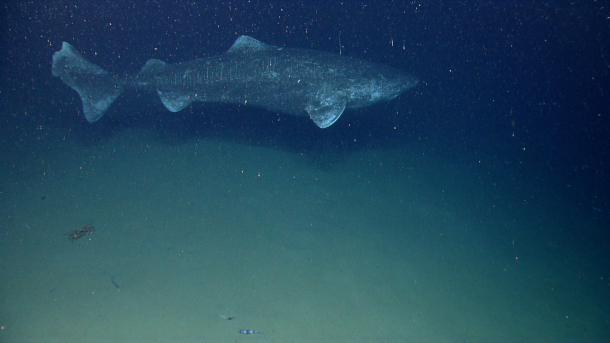
Above is a NOAA photograph showing a Greenland shark, seen during the 2013 Northeast U.S. Canyons Expedition. (Photo: NOAA Photo Library, NOAA OKEANOS Explorer Program, 2013 Northeast U. S. Canyons Expedition, Flickr, CC BY 2.0)
Fogg said that figuring out how Greenland sharks live longer than other vertebrates could possibly help to treat failing organs in aging people someday. That’s this week’s note on emerging science. I’m Don Lyman.
Links
Learn more at Lily Fogg’s article about the Greenland shark in Nature
Living on Earth wants to hear from you!
Living on Earth
62 Calef Highway, Suite 212
Lee, NH 03861
Telephone: 617-287-4121
E-mail: comments@loe.org
Newsletter [Click here]
Donate to Living on Earth!
Living on Earth is an independent media program and relies entirely on contributions from listeners and institutions supporting public service. Please donate now to preserve an independent environmental voice.
NewsletterLiving on Earth offers a weekly delivery of the show's rundown to your mailbox. Sign up for our newsletter today!
 Sailors For The Sea: Be the change you want to sea.
 The Grantham Foundation for the Protection of the Environment: Committed to protecting and improving the health of the global environment.
 Contribute to Living on Earth and receive, as our gift to you, an archival print of one of Mark Seth Lender's extraordinary wildlife photographs. Follow the link to see Mark's current collection of photographs.
 Buy a signed copy of Mark Seth Lender's book Smeagull the Seagull & support Living on Earth
© Copyright World Media Foundation. All Rights Reserved
Home | Contact | RSS | Donate | Newsletter