

When Trees Testify: Science, Wisdom, History and America's Black Botanical Legacy
Air Date: Week of June 12, 2026
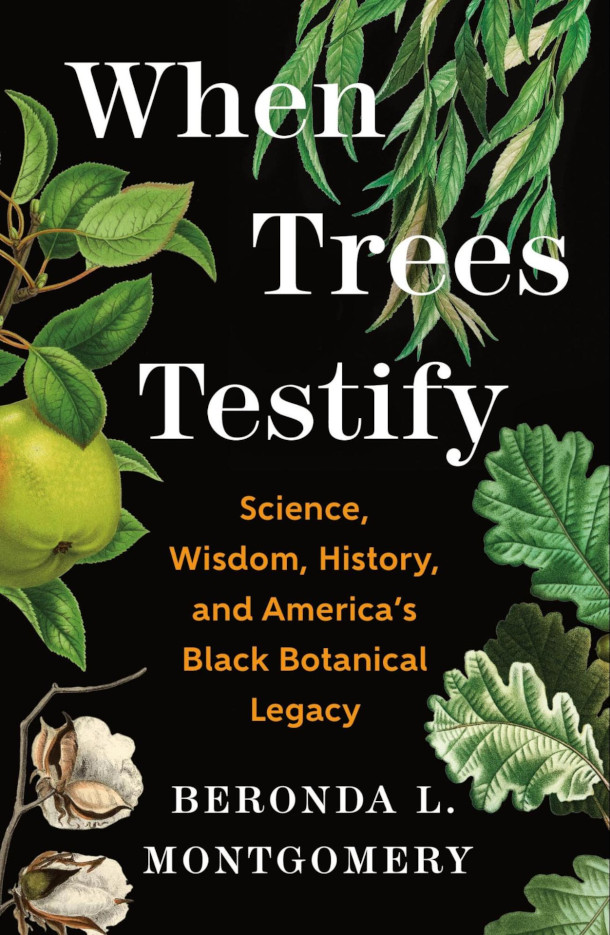
Beronda L. Montgomery’s latest book, When Trees Testify: Science, Wisdom, History, and America’s Black Botanical Legacy. (Photo: Courtesy of Beronda Montgomery)
When plant biologist Beronda Montgomery sat down to write what became a personal memoir mixed with a botanical history of African Americans, she found her research as a PhD lab scientist had brought her squarely into the world of social science as well. From her studies of how plants respond to light during photosynthesis, she started shining a light on the history of extensive plant cultivation by African Americans, including those who endured forced labor. Beronda Montgomery joins Host Steve Curwood to discuss her book, When Trees Testify: Science, Wisdom, History and America’s Black Botanical Legacy.
Transcript
CURWOOD: It’s the Living on Earth Juneteenth special; I’m Steve Curwood.
When plant biologist Beronda Montgomery sat down to write what became a personal memoir mixed with a botanical history of African Americans, she found her research as a PhD lab scientist had brought her squarely into the world of social science as well. From her studies of how plants respond to light during photosynthesis she started shining a light on the history of extensive plant cultivation by African Americans, including those who endured forced labor. And it illuminated a brilliant array of green knowledge among black and brown people worth celebrating. Beronda Montgomery is the author of When Trees Testify: Science, Wisdom, History And America’s Black Botanical Legacy. So, for Juneteenth, Welcome to Living on Earth, Dr. Montgomery!
MONTGOMERY: Thank you so much. It's a real honor to be here.
CURWOOD: Our pleasure to have you. When Trees Testify tells African American history of enslavement through the lens of trees, what do we see?
MONTGOMERY: I think we see that African Americans' experience in the U.S. has been tied up with trees from the beginning, in terms of having to pull them up to make land, and also the ways in which trees are a part of their life, whether that was going through them, navigating through them, or sometimes the very harsh reality of lynching.
CURWOOD: So trees are, of course, very important to the health of the environment, and they are key agents in the fight against climate disruption, for example. Now you are a plant scientist, a botanist, but your book is well, can I call it a history book, maybe a memoir as well? What's this nexus between science and history, and both public history and personal history, in telling these stories?
MONTGOMERY: You know, I think for me it came to reality that there was a very strong nexus there when I was visiting the former site of a plantation, and saw a tree that was estimated to be 600 years old, and realized that that tree would have been standing there when people were enslaved on the land. That my understanding of the science of it gave me some insights into what that meant, the relationship, and also thinking about my own family's history in the South, so that one tree kind of brought together those areas for me.
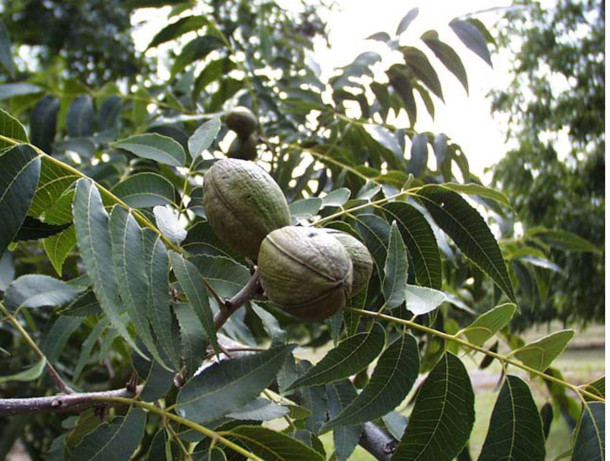
Our guest, Beronda Montgomery, says pecans were a big part of her childhood and hold sentimental value for her. Above, a pecan tree in Washington, D.C. (Photo: Katja Schulz from Washington, D. C., USA, Wikimedia Commons, CC BY 2.0)
CURWOOD: So let's talk a bit about the science that you talk about in here. So there's a 600-year-old tree, actually only would have needed to be 300 years to have been around during slavery. How did this tree capture the experience of slavery that occurred around it?
MONTGOMERY: Well, the tree was standing on the land, and I thought, how beautiful it was that something could live long enough that those enslaved people, and me and my family, who were visiting there, could have been with the same being. That was the first thing, the long-lived nature. But then I also thought about one of the things I study as a scientist, is photosynthesis, and how carbon dioxide and water are combined with the energy of sunlight to make sugars, and those sugars are ultimately used to make the compounds of wood. And so, what occurred to me in that moment, and I shared with my sister and son that the ancestors' breath, that had it been exhaled while they were living with the tree, would be in the wood of that tree; their breath was captured in the tree, and that now we're standing there with that same tree, our breath had a chance to be captured together on a kind of, what I thought about as a recorded carbon archive. And so these long lasting beings gave us a physical connection with them, but also literally our breath was joined together in there with theirs in the wood of the tree.
CURWOOD: So what did your creative scientific mind think about this notion that hey, some of the carbon that's in this tree must have passed through some of my enslaved people who were here before? How did that make you feel?
MONTGOMERY: Initially, I shared it as just a fact of plants, and my sister and son were so in awe of it, it really took me back to think how deeply impactful it was to be able to stand with these beings that the historian Tiya Miles has talked about trees as material witnesses, but it was really in that moment that I understood the materialness of the material witness and how the breath was actually captured there. So I found that very fascinating, and these oak trees have been talked about as witness trees, and it gave that a different meaning for me, that they weren't just witnessing in terms of standing there and observing, but they were carrying forward part of the essence of those people's lives.
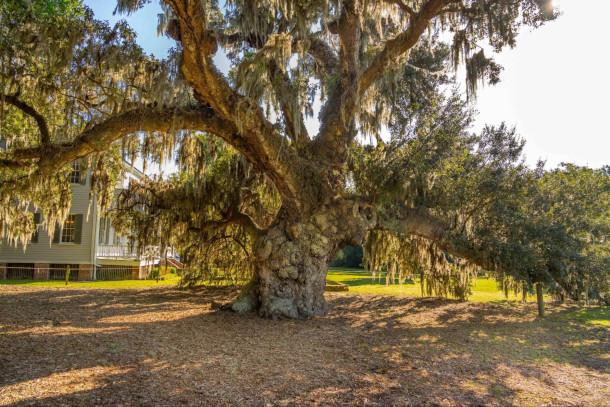
While visiting the McLeod Plantation Historic Site in Charleston, Montgomery was struck by the majesty of the McLeod Oak, which is believed to be more than 300 years old. Established in 1851, McLeod Plantation Historic Site is a 37-acre Gullah Geechee heritage site that reflects some of the most significant chapters in American history. Once sustained by sea island cotton and the labor of enslaved people, the plantation now stands as a place of remembrance and learning, honoring the lives, resilience, and lasting cultural influence of those who lived and worked here. (Photo: Courtesy of Charleston Parks and Recreation)
CURWOOD: Sort of a personal question. I live in a farmhouse in New Hampshire that was built in 1755 and there's trees in front of this house that are maples that are probably 270 or more years old, and we know from the history of this house that a slave lived here, his name was Caesar, and he was bequeathed tools by his master, who also went off to the Revolutionary War. How might Caesar's legacy be in the trees, these old, old maple trees that are here?
MONTGOMERY: Yeah, you know, I think, particularly for trees that we know live towards the farthest edge of their life cycle, they have been well cared for, and so I like to think that, you know, people who were on the land were not only living with the trees, their breath was not only captured in the wood, but there was some care that was taken of those trees, so the legacy is there of living together with, but also sustaining the life of those trees, and many instances you find that some of the wood in the house may have even been harvested by some of the enslaved people and used to build it, so their fingerprints are also on the buildings that are there standing together with those trees.
CURWOOD: So, let's take an excursion a little bit deeper into your scientific background, and talk about epigenetics, that is how environmental circumstances tend to affect how genes get expressed. To what extent, if any, do you think that that big tree in that state, in that former plantation in South Carolina, or in fact the one in our front yard here in New Hampshire? To what extent do you think the experience of slavery might have affected how that tree was able to express its own growth and development, if any?
MONTGOMERY: Yeah, you know, I think that there certainly are likely markers that would have been impressed upon the trees from their living together with people who were enslaved. I mentioned in the book the idea of the fact that if there was a tree that was a hanging tree, that it remembered the weight of those bodies. We know in horticulture that if a branch is bent, that can induce flowering, that can induce differences in the way the branches grow. And I think a lot of times that we think that it's outside the realm of possibility that a hanging tree would remember its strange fruit is because we haven't had scientists who think about those parallels and imagine that the biology is there. I also think about the fact I happened to be visiting the Equal Justice Initiative in Montgomery, and there were some trees where the trees had the roots had been soaked with blood several times, and you imagine that that also changes the soil and the ways that the roots of those trees grow, and so often those kind of changes in an environment are marked in the epigenetics of a tree, and I just wonder, as a plant scientist who is thinking about this through a lens of being the descendant of enslaved people, if there are markers of epigenetic memory that trees would have had living with the enslaved in America.
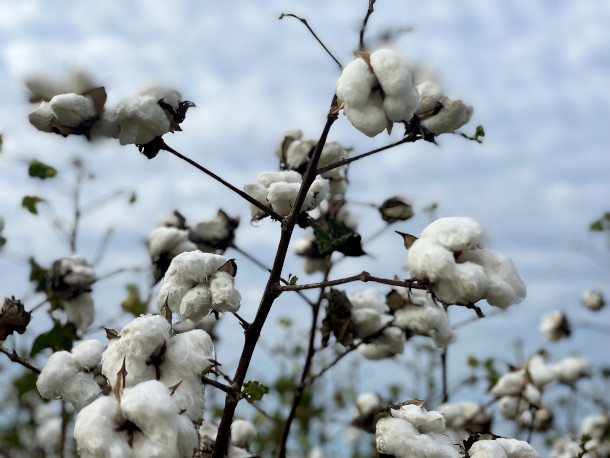
Upon seeing a cotton plant in a greenhouse, Beronda’s mother was transported back to a traumatic time when she had to pick cotton as a child. Above, a cotton plant in Louisiana. (Photo: TealPeacock, Wikimedia Commons, CC BY-SA 4.0)
[MUSIC: Billie Holiday, Ray Ellis And His Orchestra “When It’s Sleepy Time Down South” on Jazz Masters 47: Billie Holiday Sings Standards, A Verve Label Group, UMG Recordings]
CURWOOD: Now, you describe your book as a memoir and a celebration of your family history, growing up in Little Rock, Arkansas, and spending a lot of time with your grandparents out in the countryside of rural Arkansas. Talk to me about your family's history with trees.
MONTGOMERY: So, my, both of my parents, my parents are the children of two women who were best friends, so my maternal and paternal grandmother were best friends, and so my dad and mom grew up in the same area, and both of their lives were really embedded in a rural part of Arkansas, where pecan trees were a huge part of the life. There were wooded areas near where my grandparents lived, and by the time I came along, my paternal grandfather was the caretaker for the trees in the local cemetery. And so trees were a part of my parents' life growing up, but all the way into my grandfather's older age, trees were just a seminal part of our surroundings, but also a part of our cultural and social gatherings, in terms of pecans being ever present in many different dishes as well.
CURWOOD: Let's talk about pecans for a moment here. How much do you like pecans?
MONTGOMER: I love pecans. You know, I love a lot of nuts, but I think pecans do have this kind of sentimentality. In Little Rock, and my aunts and uncles who lived in Chicago, every Christmas, Grandma sent us boxes of pecans. So pecans have this real deep personal connection to my grandmother and my family, but I do love them.
CURWOOD: You have spoken, though, about your mom being affected by dementia, losing her memory, forgetting things. But trees do remember. How can trees be reservoirs of our collective memories, do you think?
MONTGOMERY: You know, I think what's been so lovely, whenever you release a book, you get people who start sharing stories with you, and one of the things that I've been really enriched by is so many people have memories of a childhood tree, or a tree they planted with their grandfather, a tree they climbed, and so I think trees are literal places where so many of us have memories, and some of those are fond memories, and in other cases they're memories of trauma, and I tried to go the full gamut in the book. But I think, you know, one of the things that I've been, as I've been watching my mother's memory be erased, I think one of the things that I tried to do in When Trees Testify is to explore Black histories connected to trees, because as I watch biology erase our memory, I'm living in a country that is trying to intentionally erase the memory of some of us, and those juxtapositions are quite strong for me, and so I think trees become, because they are so long lived, give us these long lasting connections to memories throughout our lifetime.
CURWOOD: It's hard sometimes for people to understand the intergenerational aspects of social trauma - how you carry these things. Tell me the story of what happened when you took your mother on tour of a botanical area you had when you were teaching in Indiana, I believe, and she sees a plant.
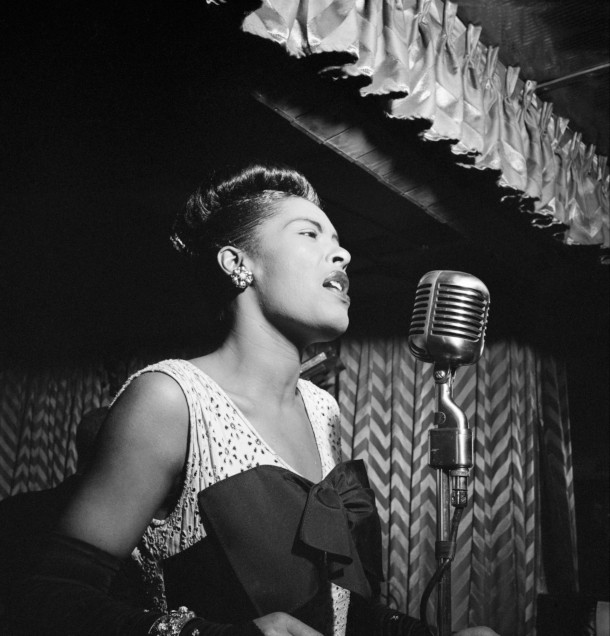
Billie Holiday performs at the Downbeat jazz club in New York City, 1947. In 1939, she released a song based on a poem by Abel Meeropol, “Strange Fruit,” describing the lynchings of African Americans. (Photo: William P. Gottlieb, Wikimedia Commons, public domain)
MONTGOMERY: Yeah, so I was so excited. I had my first professional job after finishing my PhD, and my parents had come to visit. The building that I worked in had an attached greenhouse, and both my parents love plants. My mother loves indoor plants and outdoor; my dad loves outdoor gardening, but they both love plants. So I was eager to take them on a tour of the greenhouse, and we were really enjoying it, you know. We went through the cactus room, my dad loves to be warm, we went and he saw a pineapple that had never grown, and then we got halfway through it, and my mother, who's very gregarious, became very sullen, and her body kind of froze, and when I asked her what was happening, she pointed over her shoulder and said, I never need to see that again. And when I looked, it was a cotton plant in full bloom, and I remember she was rubbing her hands together, and that took me back to the ways that she would talk about when she had to harvest cotton as a youth, she would get scars on her hand. And so both my parents, born in the early 40s in Arkansas, grew up in the Jim Crow time in the Delta region, and so they annually had to be pulled out of school to work in the cotton fields with their parents as day laborers. And so that interrupted my mom's education, and she had a great love for education; she should have been a professor before I. And so the way that just seeing that plant transformed her and took her back to a time of life where she wasn't as free and didn't have as much agency just struck me quite deeply that just the mere sight of something could trigger and pull up all of those memories for her.
[MUSIC: Billie Holiday, “Strange Fruit” on Compilation Billie Holiday, A Verve Label Group release, UMG Recordings]
CURWOOD: So you have a chapter titled Strange Fruit. Thanks to Billie Holiday, the images of lynchings are burned into our memory. Describe the impact of seeing the effigy burning when you were in high school in Little Rock.
MONTGOMERY: Yeah, you know, I think sometimes it is a disappointed but not surprised moment in this country to be continuously confronted with such things, but on that day, which was really about a joy, it was about a football game to see that, and then for it to be set on fire, and it to cause this kind of racial tension was quite disappointing. I think even more than seeing that was the conversations that we had after it that were disappointing, in that even in the 1980s my colleagues and my fellow students and I were still having to explain to some white students and white faculty why that was so hurtful for us to see.
CURWOOD: So, as I understand it, your grandfather was five years old in the town of Elaine, Arkansas, when there was what's known as the Elaine Massacre. Hundreds of Black people killed by a white mob over a period of time that I believe took place in 1919. So, in 2019 there was a tree planted to memorialize that. Tell me the story of that tree, and how that tree tells the story in some respects doesn't.
MONTGOMERY: So, in 2019 a willow tree, a memorial willow tree, was planted in Elaine, Arkansas, to commemorate the 100th year passing of that massacre that had happened in 1919. And they had planted a willow tree, because it had been shared with many Black families that after the massacre in 1919 there was a willow tree near where many of the Black people who had been killed were buried, and so this memorial tree was planted with a placard, and some months later the tree was cut down, and the placard was removed, and that was really a symbol that the area was still struggling with wanting to recognize and acknowledge that this event had happened. What was quite fascinating is that I was living in Michigan at the time, working at Michigan State University, when I saw this story, and I saw willow tree in Arkansas, and was immediately intrigued by the story, and in fact, my family had not known about this massacre, wasn't taught about in the public school, me and all my siblings went to public school, and so it was that hearing of the story in 2019 where we were able to say, wait a minute, my grandfather Hosea was alive and well in 1919, five years old, still living in Elaine. He had passed away by 2019, of course, but it made us understand a connection to this family history, and a connection to this Arkansas history that had not been well known, and I still wonder if I hadn't have, by chance, heard that story, how long it would have taken for us to connect our family's history to this massacre that happened in 1919 and to think about the many ways in which, even though he dealt with it quietly, that impacted my grandfather, and then impacted the rest of us in the family as well.
CURWOOD: What happened during the massacre as far as you understand?
MONTGOMERY: So the massacre started on September 30 in 1919. It was largely associated with the fact that Black farmers, led by Robert Hill, had unionized to demand fair prices for their cotton. September is peak cotton season, and so this would have been the time that it was time for them to get these fair prices. And there was a meeting of the union at a church there near Elaine, Arkansas, and some white Arkansans heard about this, showed up, and there was an exchange of gunfire, and that was translated into there being a Black uprising against white people, and ultimately white Arkansans, white people from Mississippi and other states came, and it resulted in the death of believed to be as many as 800 Black Arkansans and three to five white Arkansans. And so it really was about Black people having the agency and demanding fair prices for cotton that led to this massacre, and it was believed that the farmers, the white farmers, then stole the cotton from the fields, as well as took land. And so it really did affect multiple generations, in addition to those who were killed in the massacre in 1919.
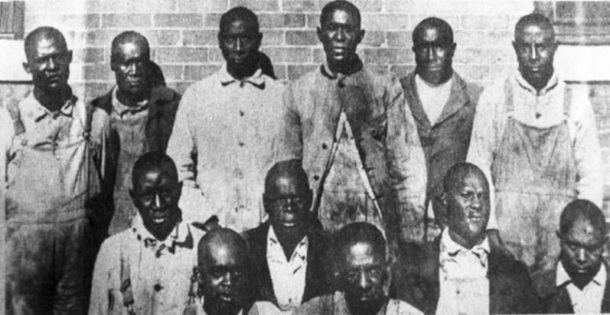
In the aftermath of the Elaine Massacre, 12 Black men were arrested and tried for murder. Six who became known as the Moore defendants and six who became known as the Ware defendants—were found guilty of murder and sentenced to death. The six Ware defendants were freed by the Arkansas Supreme Court. After almost five and a half years and numerous legal efforts by the NAACP and others, the six Moore defendants were released from prison. (Photo: From the Black history photograph collection (BC.PHO.4), courtesy of the Butler Center for Arkansas Studies, Central Arkansas Library System)
CURWOOD: How did you feel when you learned that close to 1,000 Black people were killed by an angry mob just searching for their rights to sell their crops at a fair price?
MONTGOMERY: You know, it was quite infuriating, and you know, when you think about it in the context of 1919 as a whole, where that summer there were massacres across the U.S. Many people are familiar with other towns like Tulsa. This was a period in the U.S. where this was happening, and so in some ways it's not surprising that it happened in Arkansas, but it does really hit close to home when you realize your five-year-old grandfather, you know, you just think about an innocent five year old living through that, and my grandmother, his wife, she and a twin sister were born in August of 1919. So they would have been one month old, and even though they wouldn't have memories of it like my grandfather would have, they were nursed by a stressed mother, and that could have developmental effects. And so, it was just interesting to think about this history that was deep in our family that we were unaware of.
CURWOOD: And to what extent was any justice brought to this situation?
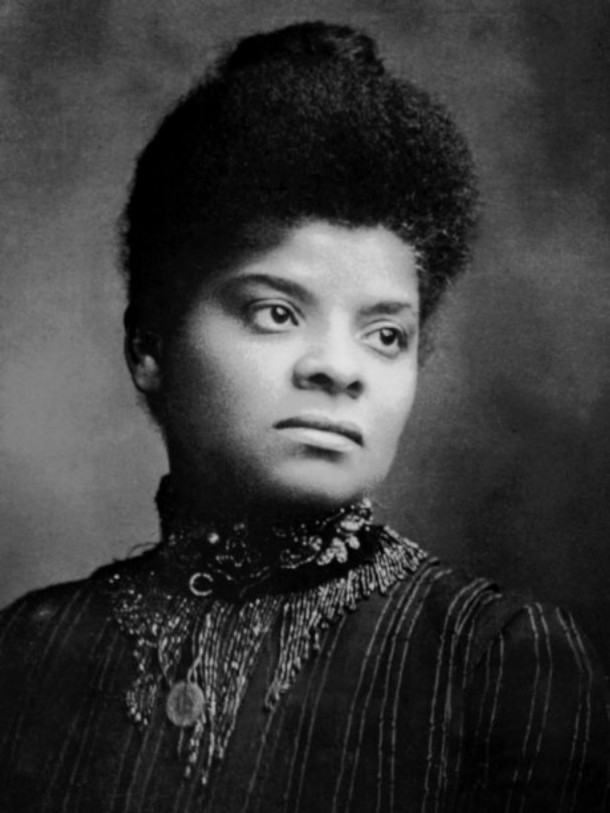
Journalist, sociologist, and early civil rights leader Ida B. Wells wrote about the 1919 Elaine Massacre in Arkansas, when as many as 800 Black people were killed. (Photo: Barnett, Public Domain, via Wikimedia Commons)
MONTGOMERY: So, there were initially as many as 100 Black Arkansans that were arrested, 12 Black men were sentenced to death, and it really became public when Ida B. Wells came to Arkansas, wrote about it, wrote a pamphlet about it, and some famous Black Arkansan legal scholars, like Scipio Jones and others, got involved, and these Black men ultimately were not sentenced to death. And so there was some justice in that regard, but there has continued to be a hesitance to really name and deal with the history in terms of acknowledging it in history books and teaching it to kids in Arkansas. Oh, that's getting better, but it's been a long-term struggle.
CURWOOD: And what about today? What's going on with the willow tree to memorialize this place?
MONTGOMERY: So, there was a second willow tree that was planted, it was poisoned, and so they have considered planting another one, but I think they've been quieter about it, because they have fears. In the time since this has been going on, a public memorial to the Elaine Massacre has been put installed. It is not in Elaine, it's in nearby Helena, West Helena, but there is now a memorial massacre site that you can go and visit, but still dealing with the outcome of people not wanting the memorial there, even as a living willow tree.
Links
The McLeod Plantation Historic Site
The Elaine Massacre Exhibit at the UA Little Rock Center for Arkansas History and Culture
Harvard Radcliffe Institute | Learn more about Beronda Montgomery
Oprah Daily | “The Traditional Foods of Juneteenth Carry a Rich History”
Living on Earth wants to hear from you!
Living on Earth
62 Calef Highway, Suite 212
Lee, NH 03861
Telephone: 617-287-4121
E-mail: comments@loe.org
Newsletter [Click here]
Donate to Living on Earth!
Living on Earth is an independent media program and relies entirely on contributions from listeners and institutions supporting public service. Please donate now to preserve an independent environmental voice.
NewsletterLiving on Earth offers a weekly delivery of the show's rundown to your mailbox. Sign up for our newsletter today!
 Sailors For The Sea: Be the change you want to sea.
 The Grantham Foundation for the Protection of the Environment: Committed to protecting and improving the health of the global environment.
 Contribute to Living on Earth and receive, as our gift to you, an archival print of one of Mark Seth Lender's extraordinary wildlife photographs. Follow the link to see Mark's current collection of photographs.
 Buy a signed copy of Mark Seth Lender's book Smeagull the Seagull & support Living on Earth
© Copyright World Media Foundation. All Rights Reserved
Home | Contact | RSS | Donate | Newsletter