
Terry Tempest Williams on 'The Glorians'
Air Date: Week of May 29, 2026

Bison graze on Antelope Island, a small island located within the Great Salt Lake in Utah. (Photo: Matthew Dillon, Wikimedia Commons, CC BY 2.0)
The Utah desert with its raw beauty has long been a muse for writer Terry Tempest Williams. In her 2026 book, The Glorians: Visitations from the Holy Ordinary, she explores miraculous moments of grace that call for our attention, even in spaces that may at first seem unremarkable. Terry Tempest Williams joined Hosts Steve Curwood and Jenni Doering for an online Living on Earth Book Club event.
Transcript
[DESERT SOUNDS]
DOERING: At first glance, a desert may appear barren. But it’s actually a place teeming with life. There are coyotes –
https://freesound.org/people/Marnie.Devereux/sounds/398600/
DOERING: Wind in the cottonwood trees…
https://freesound.org/people/Danjocross/sounds/579250/
DOERING: ….a never ending night sky, and once in a while, water comes and goes with a ferocity.
https://freesound.org/people/foosiemac/sounds/95130/
DOERING: The Utah desert with its raw beauty has long been a muse for writer Terry Tempest Williams, who lives in Castle Valley. Her environmental classic Refuge: An Unnatural History of Family and Place interwove a story of environmental crisis with her mother’s battle with cancer.
CURWOOD: In her 2026 book, The Glorians: Visitations from the Holy Ordinary, Terry explores miraculous moments of grace that call for our attention, even in spaces that may at first seem unremarkable. She told us her book came to her in a dream in 2020 during the pandemic. And Terry Tempest Williams joined us for an online Living on Earth Book Club event. We asked her to start off by reading from a passage near the beginning of her book, one of her first encounters with a “Glorian.”

The night sky glitters through Turret Arch, a popular hiking milestone in Arches National Park, Utah. (Photo: Arches National Park, Wikimedia Commons, CC BY 2.0)
WILLIAMS: In late spring, fierce winds converge in our valley in the Red Rock Desert, a reliable occurrence that has shaped this erosional landscape. The winds are particularly strong one morning in May. I am outside admiring the coyote willow draped in magenta flowers, each one resembling a snapdragon blossom, only larger the length of my index finger. Suddenly, in a swoop of wind, our stone patio is strewn with flowers. They are too lovely to let lie. So I decide to gather them and bring them inside. I get a basket from the kitchen. When I return to the patio, the wind has blown most of them away. I bend down to pick one up, only to see it move. Not only does it move, it has legs. I realize the blossom is being transported by an ant. This wee little being appears as a small black boat with a large pink sail above its six-legged body, I follow it. for close to half an hour I walk behind the ant as it carries a petal clutched in its mandibles and moves across the patio at a quick and steady pace. It continues down the stone path from our porch, then sets off across the red sand, where I can see in the distance a thriving ant colony emerging from the desert floor like a raised fist. Each time a breeze comes up, threatening to blow the tiny ant over. A pair of attending ants appear to hold the ant steady, then disappear. Each time the ant is about to cross a perilous path, facing cracks between stones, again a pair of ants appear to ferry the ant across the chasm, and again disappear. The ant continues on its mission, projecting its strange shadow ahead as it approaches a wide patch of prickly pear. I think surely this will be its demise. The flower impaled by a spine, and then miraculously three ants appear to help lift the blossom above, around and over the cacti, and once on open ground, vanish. When the ant finally arrives at the ant colony I watch it slowly climb up the hill with the magnificent blossom intact. The ant reaches its destination, pauses, then lays the flower down at the entrance of its home, where it is instantly met by dozens of workers, who, in a frenzy of purpose, cut the flower into tiny pieces, each one carrying a part of the pink blossom down into their chambers, where I imagine they are lining a pathway to the queen. This is a glorian, the ant carrying the coyote blossom across the desert is a glorian, and a glorian is an encounter, a glorian in is a meeting with Elon Vital, a glorian in is a moment of grace.

The Great Salt Lake is the largest freshwater lake in the Western Hemisphere, and provides a habitat for millions of native creatures including the bison, which are being reintroduced to the state in an effort to replenish the population. (Photo: Harrison Steen, Unsplash, Unsplash license)
CURWOOD: Thank you. I mean, you see why we have Terry with us with this book now, and why we are so lucky to have you with us, and be able to read this volume. You know, Terry, the last time we talked to you, we discussed your book, Erosion, and it was our last big live event before the pandemic.
WILLIAMS: I remember that.
CURWOOD: At the Cambridge Public Library. So, what's happened in your life since then?
WILLIAMS: You know, it's really bookhanded by you. I have to say, it's so interesting how life holds itself. What's happened to me? We weathered the pandemic. We now have a million citizens that we lost. All of us know someone that passed during this time. I've been teaching at the Harvard Divinity School, and we've been able to bring 20 students to Great Salt Lake as it's retreating, and that was so meaningful to see these students from Cambridge literally have 10 days in the wild where they could enter sun tunnels by Nancy Holt, that land art, or walk through Robert Smithson's Spiral Jetty, but most importantly, into the waters and feel the power of Great Salt Lake as our sacred mother, which our brothers and sisters in the Ute Nation have admonished us to call her that. We've also been through a lot together. We have a president that is beyond politics, and I think what we've seen is that alongside extraordinary cruelty we have seen extraordinary compassion, and I feel that at this moment of uncertainty, where there's so much beauty that remains, this is a place where we can stand steady.

The Glorians: Visitations from the Holy Ordinary by Terry Tempest Williams was published in March 2026 by Grove Atlantic Publisher. (Cover: Courtesy of Grove Press)
CURWOOD: Thank you. This is not an easy place, though, to stand steady, is it?
WILLIAMS: No, it isn't, and change is all around us. Again, I think living in an erosional landscape where we are shaped by wind, water, and time, there's no expectation that things aren't going to change, and that might make it a little bit easier.
DOERING: Well, Terry, I wonder if one of the ways that you ground yourself in this time of uncertainty and change, you write about these night walks that you take in the desert, and you have this wonderful passage on page 31 You write, "deserts are nocturnal landscapes alive with creatures aligned with darkness, I move among them." What is it about this walking at night practice that really captivates you?

A female Wilson’s Phalarope sports brightly-colored breeding plumage. A reversal of typical avian sex roles, female Wilson Phalaropes are larger with more exuberant coloring than the males. (Photo: Dominic Sherony, Wikimedia Commons, CC BY 2.0)
WILLIAMS: You know, it really was out of necessity, because during the pandemic in the summer it was so hot. I think we had 52 days of blistering heat, over 100 it got as high as 116 and you can't walk in the day when it's that hot, and so I thought I can walk at night, and what I learned is that our eyes adapt to darkness, and especially in the light of full moon, the red rocks become blue, you see the eye shine of deer, if you're lucky enough, you see the eye shine of coyote red and the eye shine of a jackrabbit that is red like flames, and you become so familiar with the changing sky, depending on the time of night that you go, that you begin to feel very comfortable orienting around a rotating sky, even the Milky Way rotates, and I had never experienced before, and I think it was about my eyes adjusting to the dark, how the Milky Way becomes dimensional. It wasn't just a smudge of stars, but actually you could almost pull it out into a third, fourth dimension. It was very wild, and I had a partner, Bianca, who she was 30 at the time, I was in my early 60s, and she was in Vermont, I was in Utah, and we ended up doing night walks together and writing letters to one another, audio letters, and I could hardly wait till the next morning to find out what my companion, my night walk companion saw where I was seeing deer, she was seeing cows where I was seeing the Milky Way, she was imagining it. So I think we found our people, whether they were the pods within us in proximity or our night walking companions.
DOERING: It's a lovely idea, the audio letters.
WILLIAMS: Yes, and I felt like I knew her so well that when we did a moon cycle from full moon to full moon, and when it was over, I think both of us grieved that intimacy of not only walking at night, knowing the other was walking too, but recording the letters, and then receiving them, and I have to say, I can only speak for myself, but there were times where I think I lost my mind. At one point, I pulled up a chair to a sacred datura, it's called a moon flower in some places, and you watch that flower unfurl, and every so often it'll just go poof and go a little further, and then it'll keep turning, and it'll go poof. If your nose happens to be where that poof is, you receive this powerful aroma. And I didn't realize how hallucinatory it was. And I hope I never hear the letter that I sent to Bianca, where I think that I was absolutely under the spell of sacred datura.
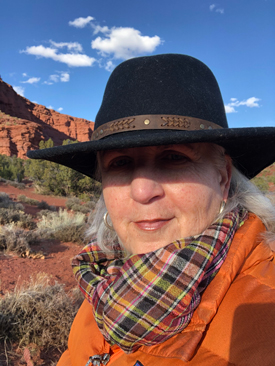
Terry Tempest Williams, author of The Glorians, at her home in Castle Valley, Utah. (Photo: Courtesy of Terry Tempest Williams)
[MUSIC: David and Steve Gordon with Sequoia Artists, First Chakra Muladhara]
CURWOOD: We’re speaking with nature writer Terry Tempest Williams about her 2026 book The Glorians: Visitations from the Holy Ordinary. We’ll be right back after the break. Keep listening to Living on Earth!
ANNOUNCER: Support for Living on Earth comes from the estate of Rosamund Stone Zander - celebrated painter, environmentalist, and author of The Art of Possibility – who inspired others to see the profound interconnectedness of all living things, and to act with courage and creativity on behalf of our planet. Support also comes from Sailors for the Sea and Oceana. Helping boaters race clean, sail green and protect the seas they love. More information @sailorsforthesea.org.
[CUTAWAY MUSIC: Dieter Huber, “Leben” single, Chill Pal]
CURWOOD: It’s Living on Earth, I’m Steve Curwood.
DOERING: And I’m Jenni Doering.
Let’s get back to our conversation with author Terry Tempest Williams, writer in residence at Harvard Divinity School, whose 2026 book is The Glorians: Visitations from the Holy Ordinary.
CURWOOD: One of the things that, as you were mentioning, that walking outside at night, you're so lucky and careful both where you live, because you have a truly dark sky out there in, in the desert, you mentioned that your friend in Vermont was sort of imagining the Milky Way, but when you're, when you're out there, I've spent a little time out there, like near Capitol Reef, and such, you have a really dark sky, it's so beautiful, huh?
WILLIAMS: We qualify as one of the 52 dark sky communities around the world, and that is a commitment. And we have a community that is very diverse in terms of ideologies. This is the one thing we agree on: a night sky of stars. And we don't have street lights; we have dirt roads, and all of us turn off our lights at night, and it is really a gift. What I didn't realize is that much of the Colorado Plateau, particularly in southeastern Utah, is one of the largest conglomerates of dark skies in the world, and I think if anyone wants to really experience that, you know, go to natural bridges, you can hardly see your hand in front of you.
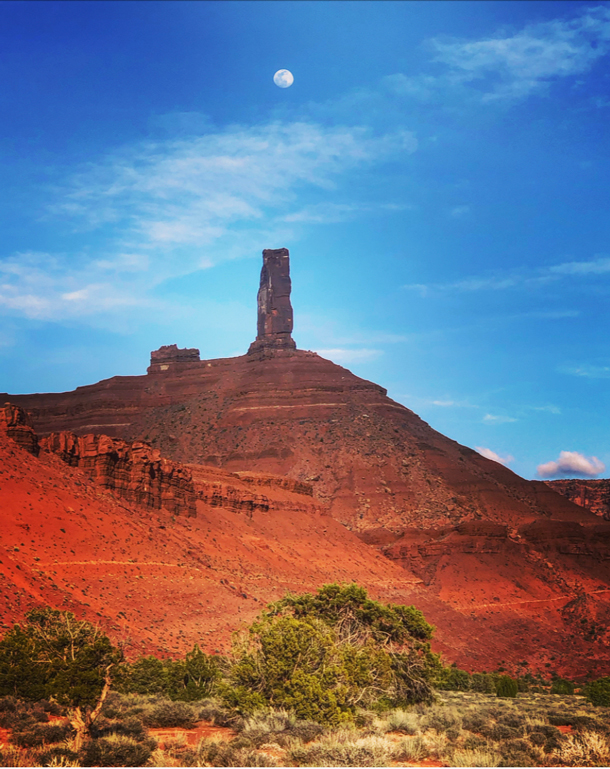
The Castleton Tower red rock formation, as seen near Terry Tempest William’s home in Castle Valley. (Photo: Courtesy of Terry Tempest Williams)
CURWOOD: So, speaking of the desert, there's a couple of lines in your book that prompt this question. At one point, you say it's a choice to live in the outback of rural Utah, where you understand your neighbor, who says, "If you're not my friend, you're my target" and means it, right? Other words, "if you're not sitting at the table, you're on the menu," right? But you live there anyway, because confronting differences and accepting them means you expand with the territory, regardless of the species, regardless of the political persuasion. You can appreciate dark skies, and then you quote Albert Camus, you say "the only way to deal with an unfree world is to become so absolutely free that your very existence is an act of rebellion". And then you write, "I like living near roosters who mark the morning of sunrise each day, we love, we live by the clock of crowing, that is our rebellion".
WILLIAMS: I do love living here, and I love my neighbors, and we've lived here now 30 years, and our differences seem less than when we first moved here, and I think that has to do with fire and flood and heat. We need each other. You don't have the luxury of not getting along. Our neighbors, the Williams, devout Mormons, they have a beautiful garden. And when we had those five flash floods in 2024, we relied on each other. I'm not sure what I gave them. I know they brought me beats. I think we were together, and I could watch clouds, and we alerted each other, and also another neighbor, very close, they are devout MAGA supporters. That disappears when you're all in danger of losing your homes, and for a good week we couldn't get out, the road was a river, and you rely on each other, and every time we see each other, that bond deepens. I remember we had a dinner party for some new neighbors that moved in where our other neighbors left right after these flash floods, and we wanted to welcome them and to let them know who the neighbors are, so that again we can create those bonds so that they're tight when necessary. It was so moving. We had Mormons around the table, we had Trump supporters around the table, we had government workers, we had a flint napper, we had radical environmentalists that made me look like Nancy Reagan.

Captured by the Moderate Resolution Imaging Spectroradiometer (MODIS) on NASA’s Terra satellite, this image of The Great Salt Lake reveals the Bonneville Salt Flats to the west of the lake. The Great Salt Lake is a remnant of Lake Bonneville, a large pluvial lake from the late Pleistocene era, that covered most of current-day Utah. (Photo: MODIS Land Rapid Response Team, NASA GSFC via Wikimedia Commons, public domain)
Everyone was there. I was nervous. My partner, husband Brooke was nervous, and when they came in, I had a basket of stone hearts I had collected through the years, and when each person came in, they took a heart. We sat down in the living room, and we talked about, for our neighbors' sake, one thing that we loved about Castle Valley: it took an hour. It was a night sky of stars, it was coyotes howling. It was solitude, it was sage. And by the time we got to the table, we were in a state of tenderness, and origin stories began how we came to this valley, where we came from, and then it was Richard Williams, the patriarch in the Mormon Church, who said, I have a question for the table, where does the water want to go? And suddenly everything shifted, the table was cleared, maps came out, each person brought their expertise, and what evolved in that evening of very different-minded people was, what if we held an event for the community? We have about 250 people that live here, called Walking the Path of Water. And that's what we organized together, and we found where the old creek went, we saw where the flood came, and we put posters up. We thought maybe we'll get 12 people. Close to 60 or 70 came, and for three hours we walked that path of water and talked to each other and learned from each other. We had a hydrologist amongst us, we had a geologist amongst us, and it took us three hours. It was rigorous, and when we got to the town square, so to speak, we had a potluck, and nobody wanted to leave. And these are the kinds of things that I think bring us together and remind us what we share rather than what tears us apart.

“Spiral Jetty” work of land art by artist Robert Smithson, located at Rozel Point of The Great Salt Lake. (Photo: Netherzone, Wikimedia Commons, CC BY-SA 4.0)
DOERING: That's such a different way of looking at the world, too. Asking where the water wants to go, as opposed to, you know, prescribing where we want it to go.
WILLIAMS: That's right and so this community is growing together as we face climate change, as we face floods, as we face this 2500 year mega drought.
CURWOOD: So you're married to a man with the name Williams. You said the patriarch of the Mormon Church in that area is a Williams. Your family, I have the impression, came out to the Great Salt Lake. Your ancestors came out to this area, the Great Salt Lake, which I guess these days a little bit less of it seems to be less and less of the Great Salt Lake, and talk to us about the bison herd that's on what's now become a peninsula there at the Great Salt Lake, and for that matter, say more about what's important about this lake.
WILLIAMS: Well, Great Salt Lake right now is, I want to say a puddle by its own standards, and I've lived long enough to have seen it at its highest elevation, when it was the fullest, when it was flooding at 4,211.85 and now it's around 4,198 I think, or less. 4,188 is the lowest in 2023 It's probably 4,189 or 90. I didn't check recently, but there's a thousand square miles exposed. It's hard to imagine Grace Salt Lake is enormous. It's a remnant of Lake Bonneville, and it's a Pleistocene. It's a remnant of a Pleistocene lake, and we're worried those exposed playas now are laced with arsenic and cadmium and all sorts of toxins that, as these dust devils whip up, they are going right across the Wasatch Front, Salt Lake City with 2.5 million people. So we're in an environmental crisis. The bison remains steady on Antelope Island, and I'm smiling because I love them. I think they remind us about survival, I think they remind us about resiliency, I think they remind us about community, how they take care of each other, how they put the young bison in the center if there's danger, how they maneuver their bodies through deep, deep snow and survive. I can tell you a story.
DOERING: Yes
WILLIAMS: I love this
CURWOOD: Please do.
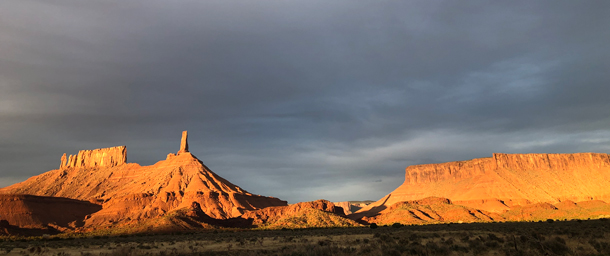
Terry Tempest Williams lives in Castle Valley, as pictured here, with a glimpse of the Castleton Tower formation. (Photo: Courtesy of Terry Tempest Williams)
WILLIAMS: When we had this, when we had the students on Great Salt Lake, that's where we were staying for those days. We had one of the, we called them one of the czars of Great Salt Lake, one of the public servants that was charged with figuring out how do we bring water to Great Salt Lake, so that it can literally survive. And we had the Deputy Czar of Great Salt Lake there. We had our chairs outside around the fire, it was cold. It was morning. There was snow, and this was late March. And one of the students asked the deputy, "How do you feel about the Endangered Species Act?" because we were about to petition the Fish and Wildlife Service to protect the Wilson's phalarope, it's a small little shorebird that spins and creates a column of brine shrimp that then it can survive and eat. And he said "The endangered species has never saved a species", and right then we heard this rumbling, and we felt the ground moving beneath our feet. We all stood up, and there on the horizon were 600 bison stampeding our direction, and even the deputy said, "I stand corrected", and the irony was not lost on him. But it's that kind of magic that I think occurs when we are present, and I think when we are present we know what to do. When we are present we can say "I stand corrected," because we were met with another presence greater than our own, the Glorians, in this instance, 600 bison on Antelope Island in a retreating Great Salt Lake.
CURWOOD: Well how fair is it to say that you find glorians everywhere, or that we can find them everywhere?
WILLIAMS: I think they are everywhere, if we are present, if we slow down enough to see, if we favor our senses, and if we recognize the yearning that we have for other, other people, other species, moments of grief, and moments of compassion, the full range, I think, is there for us. This is a book where I didn't hold back, because I think we're in a time where we cannot afford to. This is a book where I took risks that in other books I have not, because I think that's what this moment warrants. You know, I talk about a global prayer that was offered, and I remember calling Jonah Yellowman, who is a medicine person in Monument Valley, Dine, Navajo, and I said, Jonah, do you want to join me? There is this global prayer that's happening, and he said yes, and it happened at 11 o'clock on a Sunday. As I was walking out where I say my prayers on our porch, I faced South Round Mountain, which is an igneous volcanic plug, and I had just, I think, for comfort and solidarity with my grandmother, whom I love, who taught me about dreams, I held this amethyst crystal in my hand as the prayer was internal. You know, it was just that people would stand in prayer around the world at this moment for those in the pandemic, and those who had this virus. All of a sudden my eyes were closed. I felt this fire burning inside Round Mountain, and in my mind's eye, I could see a small flame coming toward me. And would you believe me if I told you it entered my heart, and all of a sudden my entire body felt like it was on fire, my hands were so hot that I opened my eyes and I opened my hand where my grandmother's hand stone, that's what she called it, I could see where that crystal had been burned. Now that is not a story I would normally tell, except for to those closest to me, that is a story that normally I never would have written, but I trust that now, because I think we are evolving as a species to where we realize these issues that are so confounding, and that we are confronting, be it climate, be it ice in our neighborhoods, or be it a pandemic, fire, or floods, we do have the capacity to create a new way of being, to create a new way of seeing, and to me this collective evolution that we are seeing of consciousness is also a glorian. It is a moment where our focus, our collective focus, can change everything. And I'm not talking about hope, I think there's something deeper than hope, and for me that is engagement, again, being present wherever we call home, then we will know what to do.

An aerial shot of “Four Corners, USA” from the NASA Terra satellite. "Four Corners" is the precise location where Utah, Colorado, Arizona, and New Mexico meet. Living on Earth has added a red circle at the approximate location of the Four Corners monument on top of the satellite photo. (Photo: NASA, nasa.gov, public domain)
[SFX: BIRD CALL Randolph Little; Cornell Lab of Ornithology | Macaulay Library]
DOERING: And this is the call of that spinning bird of salt lakes, the Wilson’s Phalarope.
[SFX: BIRD CALL Randolph Little; Cornell Lab of Ornithology | Macaulay Library]
CURWOOD: Terry, it’s amazing how you always bring us to the nature around us.
DOERING: It’s true, going back to the environmental classic Refuge, and
in this wonderful 2026 book, The Glorians: Visitations from the Holy Ordinary.
CURWOOD: Terry Tempest Williams, it’s been so great to sit with you and celebrate nature in this world. Thank you.
WILLIAMS: Jenni, Steve, I cannot thank you enough, and to your listeners: we are all in this together. Thank you.
Links
Find out more about Terry Tempest Williams
More on the Wilson's Phalarope from the Cornell Lab of Ornithology
Living on Earth wants to hear from you!
Living on Earth
62 Calef Highway, Suite 212
Lee, NH 03861
Telephone: 617-287-4121
E-mail: comments@loe.org
Newsletter [Click here]
Donate to Living on Earth!
Living on Earth is an independent media program and relies entirely on contributions from listeners and institutions supporting public service. Please donate now to preserve an independent environmental voice.
NewsletterLiving on Earth offers a weekly delivery of the show's rundown to your mailbox. Sign up for our newsletter today!
 Sailors For The Sea: Be the change you want to sea.
 The Grantham Foundation for the Protection of the Environment: Committed to protecting and improving the health of the global environment.
 Contribute to Living on Earth and receive, as our gift to you, an archival print of one of Mark Seth Lender's extraordinary wildlife photographs. Follow the link to see Mark's current collection of photographs.
 Buy a signed copy of Mark Seth Lender's book Smeagull the Seagull & support Living on Earth
© Copyright World Media Foundation. All Rights Reserved
Home | Contact | RSS | Donate | Newsletter