
Indigenous Wisdom in Science
Air Date: Week of May 22, 2026
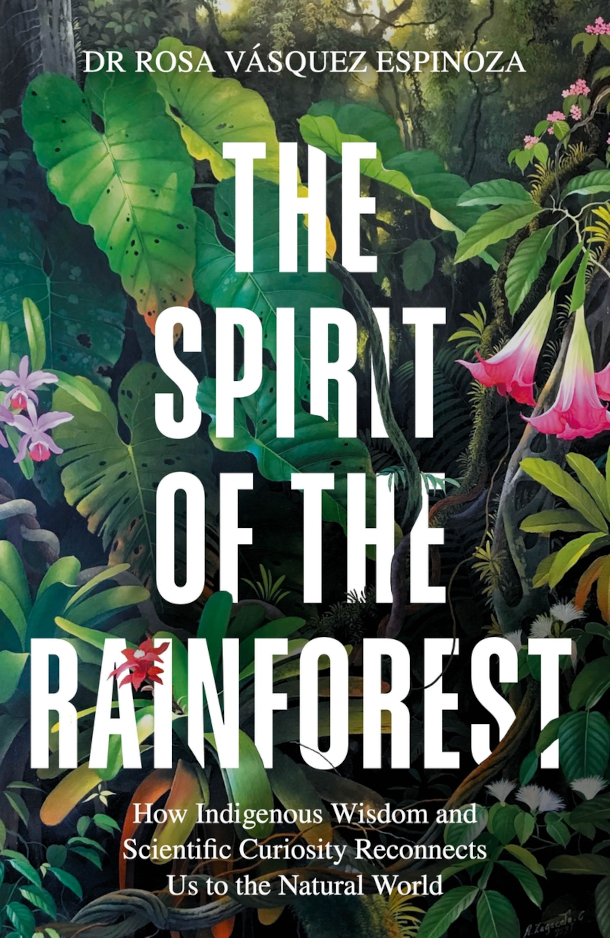
Dr. Rosa Espinoza’s book, The Spirit of the Rainforest: How Indigenous Wisdom and Scientific Curiosity Reconnects Us to the Natural World, chronicles her experiences in the Peruvian Amazon, studying the natural world alongside her indigenous colleagues. (Cover: Alfredo Zagaceta, Courtesy of Octopus Publishing Group)
In accounts of scientific expeditions into the remotest parts of our world, indigenous people can often be depicted as mere backdrop—part of a quote “exotic” landscape, or at best, helpful sidekicks. But for Dr. Rosa Espinoza, a Peruvian chemical biologist and conservationist, the traditional knowledge and worldviews of indigenous people could be the key to unlocking some of nature’s greatest mysteries, if scientists are willing to listen—and collaborate. Host Aynsley O’Neill and Dr. Espinoza talk about her 2025 book, The Spirit of the Rainforest: How Indigenous Wisdom and Scientific Curiosity Reconnects Us to the Natural World.
Transcript
CURWOOD: It’s Living on Earth, I’m Steve Curwood
O’NEILL: And I’m Aynsley O’Neill. In Western accounts of scientific expeditions into the remotest parts of our world, indigenous people can often be depicted as mere backdrop—part of a quote “exotic” landscape, or at best, helpful sidekicks. But for Dr. Rosa Espinoza, a Peruvian chemical biologist and conservationist, the traditional knowledge and worldviews of indigenous people could be the key to unlocking some of nature’s greatest mysteries, if western scientists are willing to listen—and collaborate.
Dr. Espinoza’s 2025 book is called, The Spirit of the Rainforest: How Indigenous Wisdom and Scientific Curiosity Reconnects Us to the Natural World, and she joins me now. Welcome to Living on Earth, Rosa!
ESPINOZA: Thank you so much for having me. It's such an honor.
O'NEILL: So, Rosa, please tell us a bit about how you grew up in Peru. What was your connection to both the rainforest there as well as the indigenous cultures there?
ESPINOZA: Yeah, absolutely. I had a unique upbringing. I was born and raised in the city of Lima, which is the capital of Peru, like any other busy city, New York or Buenos Aires, is just a bustling city without necessarily that much access to nature, but my grandmother made sure that she made a small natural pharmacy, a small garden that really reflected the nature she grew up with in the Andes, but also our Amazonian ancestry. Since I was a little girl, I would go visit my family members and spend summers in either the high Andes, the mountains of Peru, or the deep Amazonian forests. So, I had this very, like, yeah, triple cultural experience growing up with such depth perspectives on indigenous worldviews from my own family, and that really has allowed me to kind of see the world through these two eyes as I've delved into science.
O'NEILL: Well, because you did eventually go on to study chemical biology in a Western science tradition here in the US. How difficult was it for you to balance those two worldviews, the sort of Western worldview and your indigenous background?
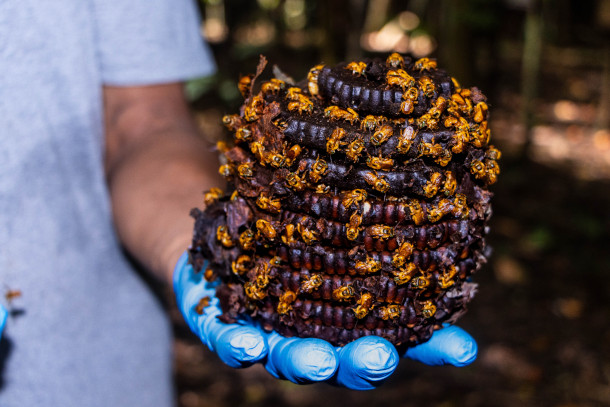
Heriberto Vela, of the Kukama Kukamiria indigenous culture, holding a colony of stingless bees. (Photo: Luis Garcia Solsol)
ESPINOZA: Yeah, that's exactly right. So, I think this indigenous connection made me have just a fascination for the natural world. While I was still in high school in Peru, I was really eager to get this additional lens on how to see nature, not just through the indigenous perspective, but through the scientific ones. So, I went on to do my undergrad and PhD in chemistry with a focus on chemical biology, and I think there are many difficulties when one tries to merge these two knowledge systems. First of all, that the indigenous worldviews have not really been considered scientific and are nowhere to be found, really, in the educational systems. So, it definitely felt conflicted, because to me, my grandmother, although she doesn't have formal education, was the first doctor I met, was the first chemist I met. I saw her apply such a method to her ways of learning and discovering and applying and reiterating, which was similar to what I was learning to do in the laboratory with these incredible academics, except that she just didn't have it in writing. So I think seeing the lack of representation was definitely something that felt heavy, and it just made me sad and a little frustrated because the farther I dove in Western science and realized that one in three medicines derive from nature and have had actually the discoveries made thanks to traditional knowledge, the fact that that still was not reason enough for us to find a stronger way to incorporate indigenous knowledge, it just made no sense, and I think that sense of injustice and awareness of lack of integration, it's definitely a big component why I decided to do what I do today.
O'NEILL: And in your book, you talk a lot about this "cosmovision," as you put it. Can you tell us what exactly is this cosmovision, and what inspired you or compelled you to incorporate it into your own personal perspective on the world?
ESPINOZA: Yeah, so indigenous worldviews, the other word we use for it is cosmovision, the vision of the world. I have actually have noticed that what I'm about to share, although I learn it through my Amazonian Andean heritage, you find similarities across indigenous groups around the world, which is in a way really beautiful, and I think reflective of a larger sense of humanity that we all share and just have forgotten about. So, the Amazonian and Andean indigenous worldviews share multiple truths. One is that nature is alive beyond just the biological definitions that we have for how nature could be alive, in the sense that a mountain is a life as well, and a tree is not just a biological resource but rather a grandfather. And so, this larger definition of life and the idea that we exist because nature exists and nature exists because we exist. This sense of continuity without any barriers to differentiate nature as separate, and so this sense of extension of self into nature plays such a key role into decision making afterwards. I think those are kind of the more comprehensive worldviews. There is another one from our Quechua heritage that I particularly love, and it's called the concept of ayni, which is, "today for you and tomorrow for me," and it actually derives from harvesting potatoes, meaning that you cannot do it alone, you need to have your whole community. So today you guys are going to help me harvest potatoes in my land, tomorrow will help you. So, it's a sense of reciprocity, that is not just practice within human forms, but also within non-human life.
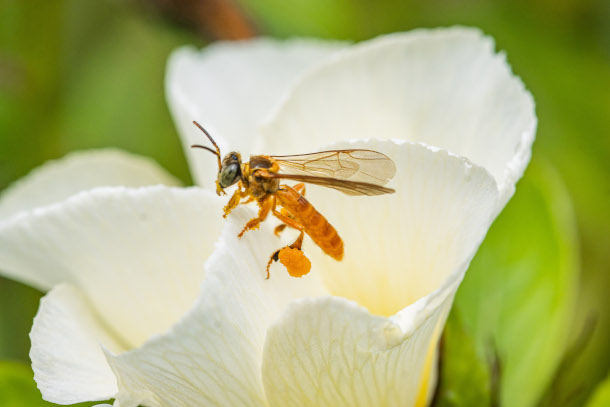
Angelita bee collecting pollen. (Photo: Luis Garcia Solsol)
O'NEILL: Well, and so there's the central perspective, essentially, that spirituality and science, they don't need to be separated when we consider the world, and in fact, we can learn so much more when we think of them jointly. What are some of the spiritual beliefs or practices that you feel can really help guide our scientific discovery?
ESPINOZA: That's a beautiful question, and that's exactly right. I think, in a way, the Western scientific world, or modern science in general, has relied on traditional knowledge for a long time. I mean, I'll give you a key example: the 2012 Nobel Prize in medicine, where it was awarded to Tu Youyou, a Chinese scientist who had discovered a drug to treat malaria that saved millions of lives back in the day when it was discovered, and the only reason why it was discovered is because these scientists went back to old Chinese traditional medicine and written records that the culture has, and from there they unlocked one single detail that their ancestors had managed to use to extract the active components from a plant. So, we have already used it, we just haven't had a system of acknowledging it. So I think to me it's a no-brainer that if we find a way to walk away from extractivism and instead work together equitably, we can not only do better by the discoveries that are already happening, but we can actually discover more, we can refine more solutions for medicine, for agriculture, for materials, for technology, for systems in general, in a way that I think if we only pursue one way of knowledge, we wouldn't arrive to those solutions, but the way I see it is that there is this new wave of explorers and scientists that, similar to me, have indigenous ancestry, can basically navigate both worlds and are facilitating this new way of conducting scientific work that actually honors both knowledge systems.
O'NEILL: What are you currently studying yourself, and in what ways has indigenous knowledge or practice influenced your current approach?
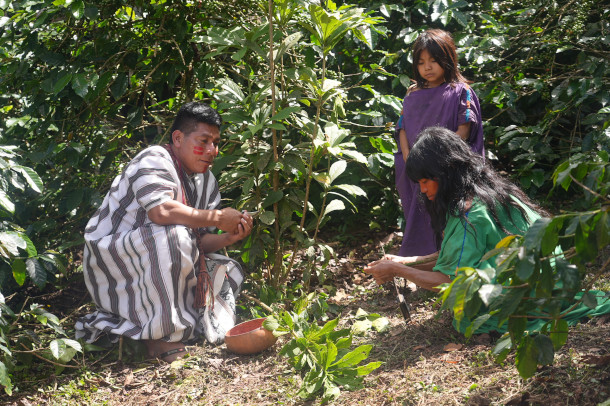
Ashaninka scientist Richar (left) with local citizen scientists, documenting medicinal flora. (Photo: Rosa V. Espinoza)
ESPINOZA: So our current main focuses for science, we have one aspect that studies stingless bees, which are the indigenous bees of the Amazon, and we are actually creating the first map as to where they exist in nature through the Amazon, and the only reason why that project is even possible is by the merging of knowledge, and by that I mean identifying these bees in the wild is really difficult. The genetic work is not quite ready yet to make it possible, and the indigenous people have their own indigenous taxonomy, which we learned early on that it matched the accuracy of insect taxonomy, and that is why we've been able to do this work. We have another program on medicinal gardens, and it's focused on creating the first compendium of scientific and cultural information on key natural medicines in indigenous languages, because traditionally that's just been done in foreign languages and not really even shared back with a community.
O'NEILL: And now in The Spirit of the Rainforest, you detail a number of these trips into the Amazon, many of which involve events that to an outsider might seem sort of larger-than-life. One that really stood out to me is this concept of the “boiling river,” which is something that I had never conceptualized before. Tell me a little bit about that.
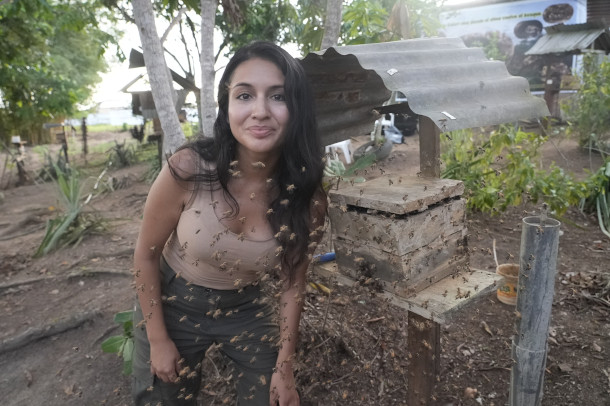
Dr. Rosa Vasquez Espinoza posing with thousands of stingless bees. (Photo: Myrian Delgado)
ESPINOZA: The boiling river, it's a place that really, I think, blows anyone's mind. So, people worldwide may be familiarized with other thermal systems, like Yellowstone National Park is such a famous one. There are some thermal springs in Iceland, Ethiopia, Japan, and others. These exist, and we know about, but now imagine that extended into a whole river that is so hot it's actively boiling, you hear the bubbles busting, and then the vapor raises so strongly that it is this constant sauna, and this happens to exist in the hearts of our planet, and unlike the Yellowstones or other thermal springs, the flora and the fauna somehow in the Amazon have managed a way to uniquely adapt, so that they grow literally right next to this extreme ecosystem that usually wouldn't accommodate any other forms of life, and it was part of my PhD work. I became fascinated with it, because it basically kind of creates this natural laboratory to start understanding climate change, and what are the life forms that can live in such an extreme place that reaches 99 Celsius, which is 200 Fahrenheit? Only microbes, a special kind of microbes. So that was part of what we did, and we actually managed to discover new species that were new to science too.
O'NEILL: And there's also a part of this story that I was truly on the edge of my seat for, that's a metaphor, usually, but I really was. It's when one of your travel companions burned his feet in scalding mud. Can you tell me a little bit more about that story?
ESPINOZA: Yeah, so you know, doing field work is dangerous and risky in general, and safety is definitely top of our priority. That doesn't mean one is free of accidents sometimes, and this was one of those that nobody could have ever predicted. And we happened to be in an area that had suffered from earthquakes over the last few years, which means the whole system had been rearranged, and part of the river was buried under thick layers of mud that, in theory, you could walk on top of, but they just happened to be this section that was a lot more fragile than any of us knew about, and one of our colleagues accidentally put both of his feet in boiling mud. I mean, he screamed immediately, it was absolutely terrifying. It also happened to be towards the end of the day, none of us had expected to stay beyond daylight. We were not really prepared for it, and we happened to be in an area where we had to open a path to enter, which means to get out, you don't have an open road to walk in, no, you are really struggling across the jungle, and it just became this unexpected, terrifying adventure and experience that, in a way, I think solidify our team effort so strongly, and reminded me that without a team we are nothing in the field.
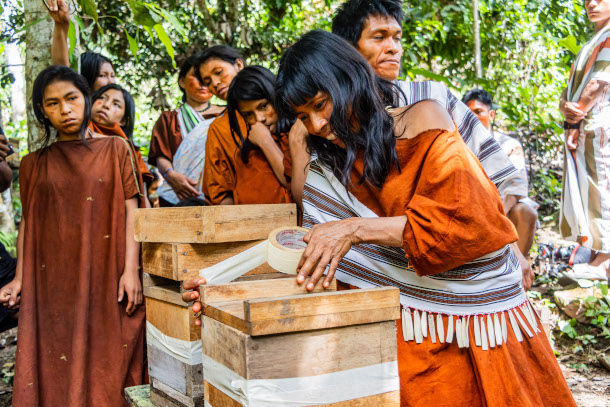
Here, a group of Ashaninka locals learn about sustainable stingless beekeeping. (Photo: Luis Garcia Solsol)
O'NEILL: I mean, and you're talking about the importance of the team. Part of that team was the local people who, in under an hour, you said built a bridge across another section of the river in order to help your teammate get the treatment that he would need. I feel like this really exemplifies the importance of this indigenous knowledge. I'm not sure that a lot of Westerners could build a bridge in under an hour in order to help somebody out.
ESPINOZA: But that's exactly my point. I think without indigenous knowledge and collaborations, there is only so far one can go. And this has been in history, it's just that it's never been acknowledged as co-authors, you know, co-authors of discoveries, of explorations. It's always been relegated to, oh, somebody help me, maybe I'll give them an acknowledgement, and in this case, I think the reason why our work is having the impact that it is having and is having this resonance with the rest of the world is because we've just simply shifted that dynamic, where now, instead of being bystanders or like mere contributors, they're co-authors of everything, you know?
O'NEILL: Well, then you, I believe, I think pioneered sort of the concept of listing your indigenous collaborators as co-authors on your published research, right?
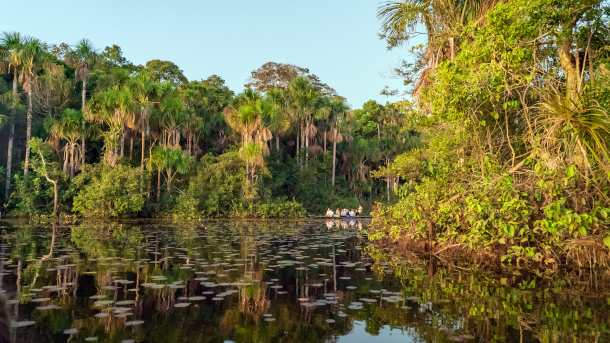
The Amazon Rainforest is one of the most biodiverse-rich places on the planet, such that it is difficult for scientists to accurately quantify. Some estimates suggest there are 3 million distinct species throughout the region. (Photo: Christopher Perry)
ESPINOZA: We definitely have one of the, I believe, the first case in Peru when a scientific article has an Asháninka community member and park ranger as the first author. We believe from what we've been able to find that he is the very first published a Asháninka scientist, which is outstanding, and I think part of that is to acknowledge that we did all the work behind the scenes for a few years to ensure he had the training needed to, you know, be in that position to be first author, although he may not have quote unquote, formal university scientific training, and yeah, I think it definitely ruffled some feathers, which we knew was going to do, because it's something new, and that is just bound to happen. I think some people were really excited to see this shift, some perhaps felt threatened or looked down upon it, but ultimately, I think it is opening these larger conversations, what you're saying. We've needed a better system. Clearly, something that we're doing collective, as you know, human society is not working for nature, because things are not necessarily getting better. So, why not let's try a better approach? And why not let's give power to those that are living in the most biodiverse areas of our planet that are suffering the worst consequences of climate change, although they have been the least ones to contribute to it?
O'NEILL: And now another thing you talk about is the idea of keeping an open mind to things that might seem fantastical or even impossible at first glance. Can you tell me about one of these phenomena that you yourself might have thought was impossible at first?
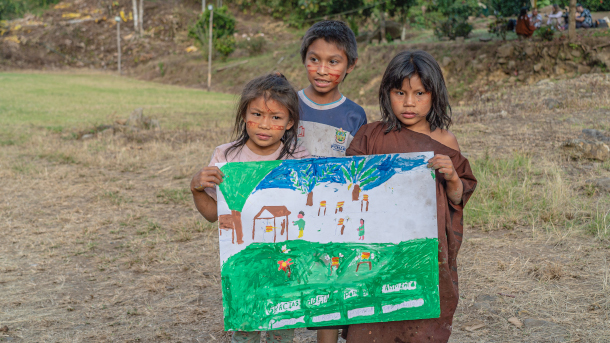
A group of Ashaninka children hold up a poster about beekeeping. (Photo: Luis Garcia Solsol)
ESPINOZA: Yeah, you know, in Western science we like to kind of boil things down to things we can measure and monitor, and it makes sense, and it is part of what we need, absolutely. At the same time, many of the discoveries we've got to, since the beginning of modern science, it's really through opening the door for a space of wonder. This is what we are missing right now. And one experience, particularly for me, was, so ayahuasca is considered a natural medicine in the Amazon. For those who have never heard about it, it is a combination of plans that shamans and elders make to be able to cure, to diagnose disease, and they drink it, and then go through this experience. Now, for many of the elders and masters that we connect with, I had heard so many times that they acquire knowledge through ayahuasca, which is a concept that I found it really hard to even just kind of conceptualize in my head. You acquire knowledge through a dream and acquire knowledge in the sense of seeing what plant to use for what disease, although nobody has ever told them that knowledge, even if sometimes being completely new plant that they have no scientific name for, and I kept an open mind in the sense of I was trying to understand what they meant and also trying to imagine what that would look like and not being able to get there and then I had an experience myself in an ayahuasca session where that happened to me. And I became a jaguar in this dream, and it sounds so bizarre to say it out loud, but in the process, I could smell medicinal plants, and what I came out from that in my own interpretation was, can animals smell medicine? It was a concept in science that I had never thought of. It made sense when you think about pheromones and other types of processes, but then that led me to an area of science that existed, which I had never heard of or knew nothing about, and it actually led to now one of the coolest new projects that we have. We've partnered with Dr. Elodie Freeman, who's an expert in an area of science called zoopharmacognosy. It's an emerging field. It's the study of how animals self-medicate, but none of this work has ever been done in the Amazon, and so, yeah, we are conducting this very cool set of experiments right now, and I think as we progress, we dream that it could guide us in understanding what medicinal flora is vital for people, yes, but also for animals.
O'NEILL: And that's just one of your many examples of how all of these scientific processes and scientific inquiries can be inspired by and considered in conjunction with something like the Ayahuasca dreams, this traditional way of knowledge acquisition. It's really incredible to see all of these get incorporated like this.

Rosa Espinoza Ph.D. is a chemical biologist, conservationist, and author of the book, The Spirit of the Rainforest: How Indigenous Wisdom and Scientific Curiosity Reconnects Us to the Natural World. (Photo: Stephanie King)
ESPINOZA: Thank you. I think, again, perhaps if someone you know keeps a closed mind and not even at least is open to have a dialogue, then we just close the doors to all of this, what may sound fantastical at first, and then we realize actually our natural world is fantastical. If we look at the details of the chemical and physical processes, many of those we couldn't have explained, you know, before we had the scientific tools we do now. And back in the day, previous cultures used to explain it, like witches, and you know, magic, and now we have some science to prove that. Have we actually discovered all the scientific tools to measure absolutely everything? I will argue no, just only, you know, in 1960s by that time, we didn't even have this thing called PCR. We thought DNA couldn't survive above 50 Celsius, and now people will laugh at the idea that that was a truth at some point. So, I think it's just kind of taking a look a little bit at the past and ourselves, and knowing that although our human minds are so extraordinary, the natural world has been here for much, much, much longer than any of us and evolved in so many deeper ways, and one way to listen to it differently, it's by looking at these ancestral civilizations that are still alive today.
O'NEILL: Dr. Rosa Espinoza is a chemical biologist, conservationist, and author of the book, The Spirit of the Rainforest: How Indigenous Wisdom and Scientific Curiosity Reconnects Us to the Natural World. Rosa, thank you so much for joining me today.
ESPINOZA: Thank you so much. It's been such a wonderful conversation, and I'm so excited to see more of the world getting to learn about this whole other reality that the Amazon is.
Links
Living on Earth wants to hear from you!
Living on Earth
62 Calef Highway, Suite 212
Lee, NH 03861
Telephone: 617-287-4121
E-mail: comments@loe.org
Newsletter [Click here]
Donate to Living on Earth!
Living on Earth is an independent media program and relies entirely on contributions from listeners and institutions supporting public service. Please donate now to preserve an independent environmental voice.
NewsletterLiving on Earth offers a weekly delivery of the show's rundown to your mailbox. Sign up for our newsletter today!
 Sailors For The Sea: Be the change you want to sea.
 The Grantham Foundation for the Protection of the Environment: Committed to protecting and improving the health of the global environment.
 Contribute to Living on Earth and receive, as our gift to you, an archival print of one of Mark Seth Lender's extraordinary wildlife photographs. Follow the link to see Mark's current collection of photographs.
 Buy a signed copy of Mark Seth Lender's book Smeagull the Seagull & support Living on Earth
© Copyright World Media Foundation. All Rights Reserved
Home | Contact | RSS | Donate | Newsletter