

Spring "Bursts" Forth
Air Date: Week of May 22, 2026
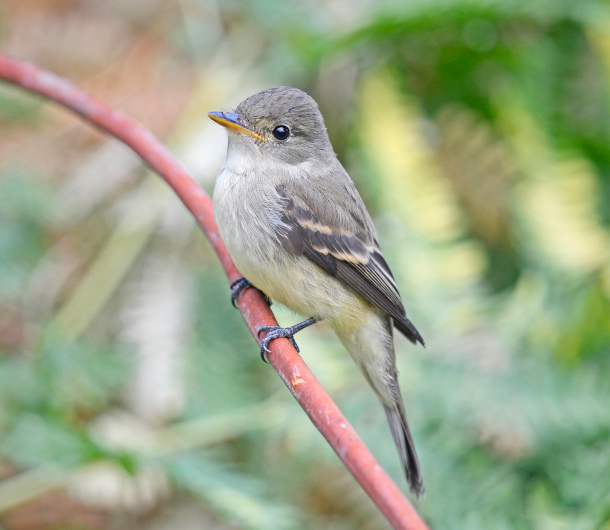
Willow Flycatchers are among the latecomers of migratory songbirds in North America, arriving as late as June. (Photo: VJAnderson, Wikimedia Commons, CC BY-SA 4.0)
Springtime in the northern hemisphere brings many migrating birds returning from their winter havens, in a series of slowly breaking waves that sweep up from the south to the north. BirdNote’s Mary McCann reports.
Transcript
CURWOOD: Springtime in the northern hemisphere brings many migrating birds returning from their winter havens. BirdNote’s Mary McCann reports.
BirdNote®
Spring Bursts Forth
Written by Bob Sundstrom
McCANN: We often hear it said that spring “bursts” forth. As if winter’s leafless trees suddenly shimmer with green. Flowers pop. Birds start singing with all their hearts.
[Northern Cardinal song, http://macaulaylibrary.org/audio/176244, 0.06-.10.]
But this seasonal change isn't instantaneous. It's a series of waves, slowly breaking waves that sweep up from the south to the north right over the continent.
[American Robin http://macaulaylibrary.org/audio/168300] ]
Early spring migrants like robins and bluebirds return north in March, some even in February. Across the whole of April week after week, new songbird migrants work north from the tropics adding bit by bit to spring’s ever-growing soundtrack.
[Intermixed songs of Black-headed Grosbeak, http://macaulaylibrary.org/audio/106598, 0.07-.10; House Wren, http://macaulaylibrary.org/audio/144011, 0.10-.12; Chipping Sparrow, http://macaulaylibrary.org/audio/191234, 0.11-.13]
By May, birds continue flooding into northerly states and Canada. And even as late as June, birds like Willow Flycatchers [song of Willow Flycatcher, http://macaulaylibrary.org/audio/106793] and Mourning Warblers are just completing the trek to northern breeding sites from South America. [Mourning Warbler, http://macaulaylibrary.org/audio/191054, 0.15-.17]
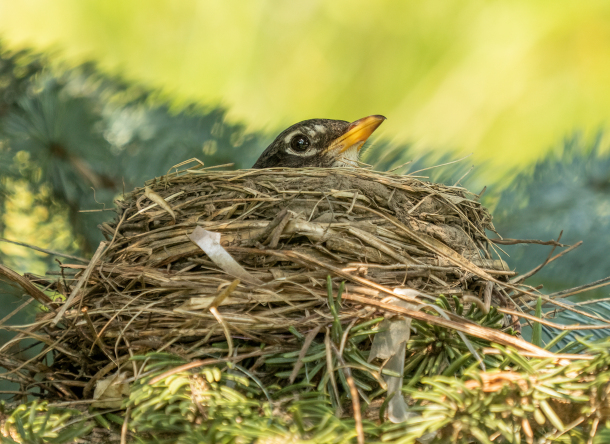
Robins, on the other hand, return north in March and may be feeding their second brood by midsummer. (Photo: Rhododendrites, Wikimedia Commons, CC BY-SA 4.0)
By this time, those early robins… [American Robin song, http://macaulaylibrary.org/audio/168300, 0.7-.11]
…may already be hard at work feeding their second brood. For them, spring has been bursting for over three months.
I’m Mary McCann.
###
Bird sounds provided by The Macaulay Library of Natural Sounds at the Cornell Lab of Ornithology, Ithaca, New York. Northern Cardinal [168300] recorded by G A Keller; American Robin [168300] Chipping Sparrow [191234] and Eastern Bluebird [107204] recorded by W L Hershberger.
Black-Headed Grosbeak [106598] House Wren [144011] and Willow Flycatcher [106793] recorded by R S Little. Mourning Warbler [191054] recorded by Jay W McGowan.
BirdNote’s theme music was composed and played by Nancy Rumbel and John Kessler.
Producer: John Kessler
Executive Producer: Dominic Black
© 2015 Tune In to Nature.org June 2015 March 2023 /2025
Narrator: Mary McCann
ID# spring-13-2015-6-3 spring-13
CURWOOD: For pictures, fly on over to the Living on Earth website, LoE.org.
Links
Living on Earth wants to hear from you!
Living on Earth
62 Calef Highway, Suite 212
Lee, NH 03861
Telephone: 617-287-4121
E-mail: comments@loe.org
Newsletter [Click here]
Donate to Living on Earth!
Living on Earth is an independent media program and relies entirely on contributions from listeners and institutions supporting public service. Please donate now to preserve an independent environmental voice.
NewsletterLiving on Earth offers a weekly delivery of the show's rundown to your mailbox. Sign up for our newsletter today!
 Sailors For The Sea: Be the change you want to sea.
 The Grantham Foundation for the Protection of the Environment: Committed to protecting and improving the health of the global environment.
 Contribute to Living on Earth and receive, as our gift to you, an archival print of one of Mark Seth Lender's extraordinary wildlife photographs. Follow the link to see Mark's current collection of photographs.
 Buy a signed copy of Mark Seth Lender's book Smeagull the Seagull & support Living on Earth
© Copyright World Media Foundation. All Rights Reserved
Home | Contact | RSS | Donate | Newsletter