

The Quest for Green Steel
Air Date: Week of May 15, 2026
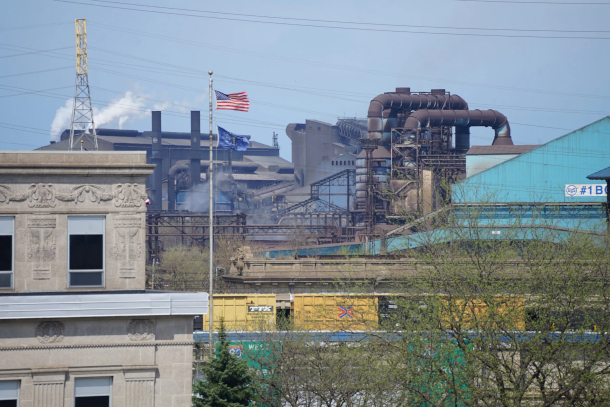
Shown above is US Steel's Gary Works, the largest steel mill in the United States, located in Gary, Indiana. (Photo: Reid Frazier / The Allegheny Front)
Just outside of Chicago, the country’s largest complex of steel mills faces an uncertain future. Air pollution, climate change and the preservation of union jobs are affecting the industry, as are the Trump administration’s stances on coal, steel, and tariffs. The Allegheny Front’s Reid Frazier reports on efforts to get big steelmakers in the region to switch from coal to natural gas or hydrogen, but overhauling existing infrastructure isn’t easy or cheap.
Transcript
O’NEILL: It’s Living on Earth, I’m Aynsley O’Neill.
CURWOOD: And I’m Steve Curwood.
Just outside of Chicago, the country’s largest complex of steel mills faces an uncertain future. air pollution, climate change and the preservation of union jobs are affecting the industry, as are the Trump administration’s stances on coal, steel, and tariffs. The Allegheny Front’s Reid Frazier recently got a tour of the area while attending this year’s conference of the Society of Environmental Journalists.
FRAZIER: On the shores of Lake Michigan, Megan Robertson stands in front of a group of journalists at a park in Whiting, Indiana. To the north, is Chicago.
ROBERTSON: You look over here and you've got this beautiful shoreline, you've got nature, you see Chicago. It's great. People are walking around, going on trails. And then you look over here.
FRAZIER: Robertson gestures over her other shoulder, toward a hulking mass of industrial buildings and smokestacks. This is Indiana Harbor, a massive tangle of steel mills and other industrial plants.
ROBERTSON: And I grew up here. It still shocks me when I drive through.
FRAZIER: Robertson’s grandfather worked in the steel mills here. She’s now head of Indiana Conservation Voters, and she’s come to talk about the future of this place. Robertson says these mills are still an important source of union jobs.
ROBERTSON: You can make a really good living for your family, but there's also physical and environmental sacrifices that come with that.
FRAZIER: Those sacrifices are largely due to the coal-based steelmaking process these plants are based on. For US STEEL’s Gary Works nearby, the process begins in Western Pennsylvania. The company processes coal at its Clairton plant near Pittsburgh into a refined product called coke. The coke is shipped by rail to Gary, where it’s put in a blast furnace and eventually becomes steel. This process creates several thousand tons of local air pollution; and makes Gary Works, Indiana’s top greenhouse gas polluter. That’s a problem, Robertson says.
ROBERTSON: We don't want people going without jobs. We don't what things shut down, but we have to start the transition eventually.
FRAZIER: Terry Steagall says Nippon Steel, US Steel’s new owner, should start that transition now. Steagall is a retired steelworker from the area and member of the group–Gary Advocates for Responsible Development.
STEAGALL: I've seen the history of the industry. And I want this industry to continue for future generations. And I also want the industry to clean up its act as far as environmentally. These things are important.
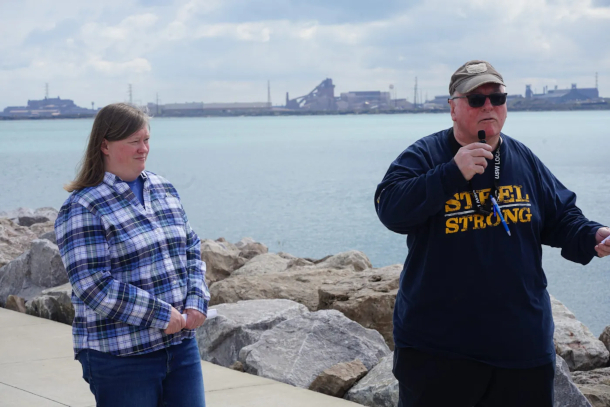
Megan Robertson (left), of Indiana Conservation Voters, and former union steelworker Terry Steagall (right), in front of the Cleveland-Cliffs’ Indiana Harbor steel mill. The two spoke against the environmental impacts of the steel industry at the annual meeting of the Society of Environmental Journalists in Chicago. (Photo: Reid Frazier / The Allegheny Front)
FRAZIER: The best way to clean up, Steagall says, is to adopt a process called direct reduction of iron–-or D-R-I. This uses natural gas or hydrogen instead of coal to turn iron ore into steel. It’s a lot cleaner, with much less carbon pollution. The company is putting DRI in at its newest plant in Arkansas. But the company said this would require a major overhaul to do at Gary Works, which has been in operation for over a century. US Steel has said this changeover to DRI would result in job losses and be “financially disastrous” for the company. Steagall says cost shouldn’t be a problem. Nippon has promised to invest $11 billion in US Steel’s plants, including $4 billion in Gary. The company said in an email those investments will help the plant make steel cleaner, more efficiently, and with less coke, but Steagall wants them to go further.
STEAGALL: We've been advocating for the DRI at Gary Works because they have the technology and they have the money, and that's the key. In the past, the industry would try to say, well, we don't have the technologies, we don't have the money. Well, U.S. Steel and Nippon don't have that excuse.
FRAZIER: But will Nippon Steel do it? As we get on a bus to continue our tour, Roger Smith of the environmental group, Steel Watch, addresses the question. Smith has studied Nippon –the world’s fourth biggest steelmaker–for years.
SMITH: This is a company that has built its global success on coal, on blast furnaces, and it's very reluctant to change course. So despite the fact that we're in a new era of decarbonization, Nippon Steel is actually acquiring coal mines around the world.
FRAZIER: The company has said it wants to ensure access to coal as countries move away from it as they address climate change. The company’s own climate goals call for “carbon neutrality” by 2050. As we pull into the city of Gary, Indiana, the plant comes into view.
SMITH: if you start looking to the left through the graffiti, that is the front gate, the main gate of Gary Works. You're gonna see the blast furnaces. You're going to see smoke coming out of it. If you come back at night, it's very lit up and pretty surreal.
FRAZIER: A few blocks away, we go to the roof of a nearby garage to get a better look. The plant has massive blue-walled industrial buildings. Smoke and steam waft out of smokestacks. Kianna Grant, Air Quality Control Manager for the City of Gary is on the roof with us. Her office is across the street from Gary Works, where she keeps a watchful eye on the plant’s emissions.
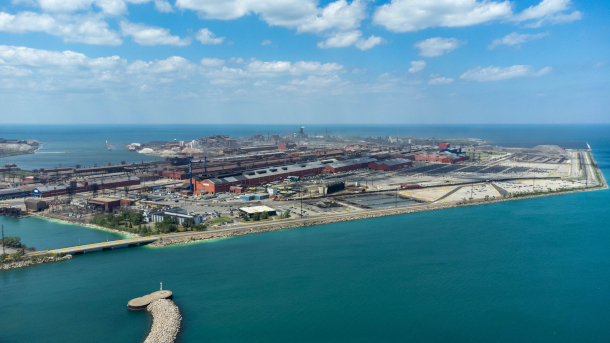
Cleveland-Cliffs’ Harbor Works in East Chicago, Indiana, surrounded by Lake Michigan. (Photo: Sea Cow, Wikimedia Commons, CC BY-SA 4.0)
GRANT: We're in communication with them very often about what they do to make sure that there's transparency.
FRAZIER: The company announced it would spend $350 million to refurbish one of the blast furnaces here–that would extend the life of its coal-based process another 15-20 years. The company says this will make the plant more energy efficient–and lower its carbon dioxide emissions–the main cause of global warming. Grant thinks the company will eventually have to decide whether the plant will switch to cleaner processes.
GRANT: I would love for our community to thrive in, you know, health and to thrive in economy. And so I think there might be a good balance of both. You’ll always have a fight between economy and public health, but I think there could be a healthy dose of both.
FRAZIER: The tour winds down and the group heads back to the bus. For now, people in Gary and other towns in Indiana wait to see what Nippon and other steel companies decide to do with the mills along their shore. For Living on Earth, I’m Reid Frazier.
CURWOOD: That story comes to us from the Allegheny Front.
Links
The Allegheny Front | “Activists Want Mills Along Lake Michigan to Invest in Clean Steel”
Living on Earth wants to hear from you!
Living on Earth
62 Calef Highway, Suite 212
Lee, NH 03861
Telephone: 617-287-4121
E-mail: comments@loe.org
Newsletter [Click here]
Donate to Living on Earth!
Living on Earth is an independent media program and relies entirely on contributions from listeners and institutions supporting public service. Please donate now to preserve an independent environmental voice.
NewsletterLiving on Earth offers a weekly delivery of the show's rundown to your mailbox. Sign up for our newsletter today!
 Sailors For The Sea: Be the change you want to sea.
 The Grantham Foundation for the Protection of the Environment: Committed to protecting and improving the health of the global environment.
 Contribute to Living on Earth and receive, as our gift to you, an archival print of one of Mark Seth Lender's extraordinary wildlife photographs. Follow the link to see Mark's current collection of photographs.
 Buy a signed copy of Mark Seth Lender's book Smeagull the Seagull & support Living on Earth
© Copyright World Media Foundation. All Rights Reserved
Home | Contact | RSS | Donate | Newsletter