

Artemis II Launch Party
Air Date: Week of April 3, 2026
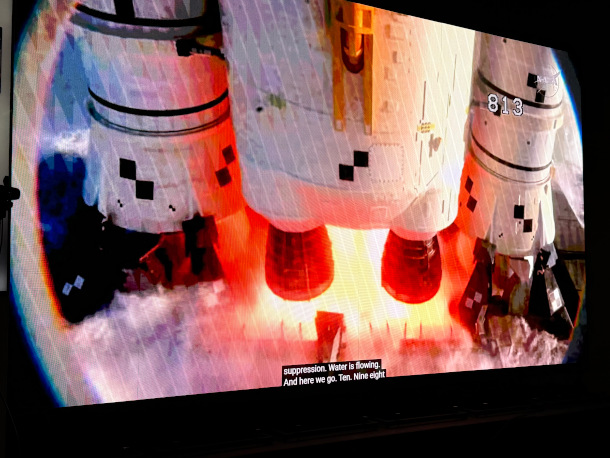
The Artemis II launch as seen on screen at the watch party. (Photo: Jennifer Stevens-Curwood)
As the Artemis II launch counted down, folks of all ages gathered excitedly to watch the livestream at the McAuliffe–Shepard Discovery Center in New Hampshire, named for two prominent astronauts from the state. Living on Earth’s Steve Curwood was there and caught up with members of the University of New Hampshire Astronomy Club and others to get their reactions and hear their hopes for the mission and the future of space exploration.
Transcript
DOERING: More than 100 people gathered in front of a big screen at the McAuliffe-Shepard planetarium and Discovery Center in Concord, New Hampshire to see the giant Artemis rocket light up and fly. And Living on Earth’s Steve Curwood was there.
[CROWD SFX]
CURWOOD: As a big digital clock counted down, ripples of anticipation coursed through
this all-age crowd including one six-year-old, who could not stay in his seat. Why was
he here?
SIX-YEAR-OLD: I came tonight because I haven't seen a rocket launch and I really like
space and I've never seen a rocket launch. It'd be cool to see one.
CURWOOD: A man named Sam also paced around:
SAM: It's the core of human beings, to be curious, to want to explore, to get to what's
next, and this is that first step for our next journey. We're going back to the moon, and
we're going to set up a station on the moon, and we will have things going on there
where there will be humans occupying the moon as their residence in the future. And
that's just, you know, this is the first step for it. And I just think that that's so incredibly
exciting.
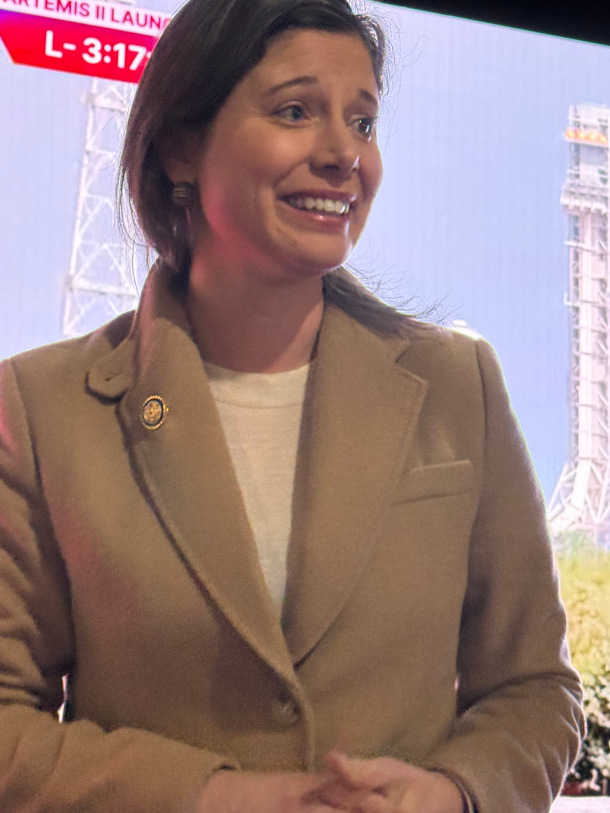
Congresswoman Maggie Goodlander (D-NH) at the Artemis II launch party. (Photo: Jennifer Stevens-Curwood)
CURWOOD: The McAuliffe-Shepard Discovery Center honors two famous New
Hampshire astronauts. Alan Shepard was the first American in space and later the first
to hit a golf ball on the moon. And while he made it home safely, Concord High School
teacher and Astronaut Christa McAuliffe did not. The ill-fated Challenger Shuttle rocket
exploded 73 seconds after liftoff. Both astronauts came from towns presently
represented by Democratic Congresswoman Maggie Goodlander.
GOODLANDER: This is the most extraordinary moment that we could ask for as
Americans, coming together to celebrate the end of an incredible process that led us to
this night and to all that lies ahead, which is the future, which is innovation, which is
space, and all of the discovery that comes with it.
NASA LIVESTREAM: And here we go. 10, 9…
CROWD CHANTING: … 8, 7, 6, 5, 4, 3, 2, 1!
[CROWD CHEERS, CLAPS]
GOLUBIEWSKI: It was really amazing to watch. It was an incredible experience. And I've
been waiting to see this my whole life. So being here has been amazing so far. [LAUGHS]
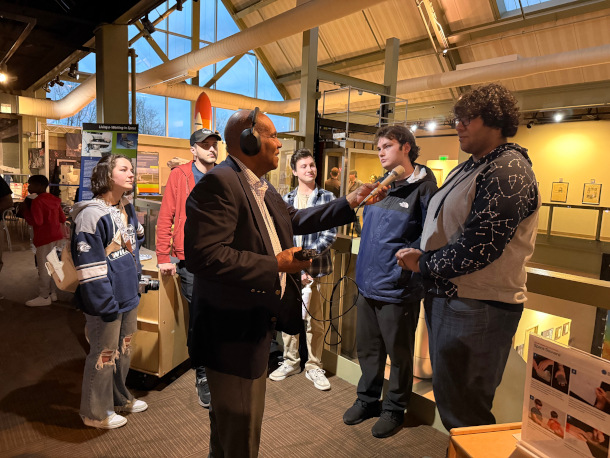
Living on Earth host Steve Curwood interviews the UNH Astronomy club. (Photo: Jennifer Stevens-Curwood)
CURWOOD: University of New Hampshire astronomy club member and student Rachel
Golubiewski.
GOLUBIEWSKI: It's like a once in a lifetime experience. We're making history now.
OUHHABI: It's felt unreal, out of this world, really. Our generation has never had
something like this. Older folks all talk about seeing the first moon landing and how
unreal that is, and we finally got something like that. That feeling, that's, I don't know –
rush, that's excitement. It's all so unreal.
CURWOOD: Like Rachel, Ryad Ouhhabi also studies at UNH and is part of the same
Club.
NASA LIVESTREAM: Confirm separation. Main engine…
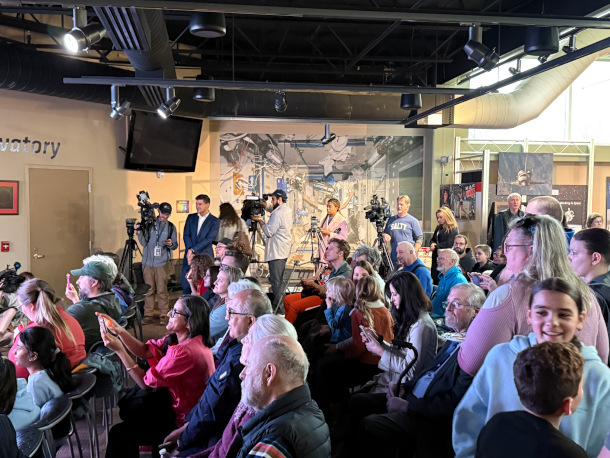
The audience at the Artemis II launch party on April 1, 2026. (Photo: Jennifer Stevens-Curwood)
[CROWD CHEERS]
CURWOOD: I asked another astronomy club member, Liam Pearl, to say what he
thinks the Artemis Moon Mission means.
PEARL: Well, I hope it means that we're going to be able to have a permanent presence
off the earth for good. So, yeah, I hope so. Yeah.
CURWOOD: So what, civilization, humanity is never going back. We'll always be more
than just on the earth?
PEARL: Well, I hope so. I mean, I hope we would go back to Earth, but, like, not
exclusively on the earth, you know, to avoid extinction and all that.
CURWOOD: As the big screen showed the Orion spacecraft going faster and faster to
reach 18,000 miles an hour to get into Earth orbit, Rachel touched on the risks ahead
on the even higher velocity voyage to the moon. The odds are daunting, knowing that
while they took many trips, two of the five operational space shuttles eventually came to
fiery and fatal ends.
GOLUBIEWSKI: I think in some ways it's a bit scary, especially for the people and families
who are involved with this. But at the same time, there is a lot of risk involved in learning
something new, and especially with the past missions, although there have been risks,
we wouldn't have been able to make a lot of the discoveries that we have now because of that. So I mean, I think they've done as much as they can to make sure this is safe, and we're hoping and praying that it will be and yeah, I mean, I guess all we can do is really learn from our mistakes, and hopefully this one will go well.
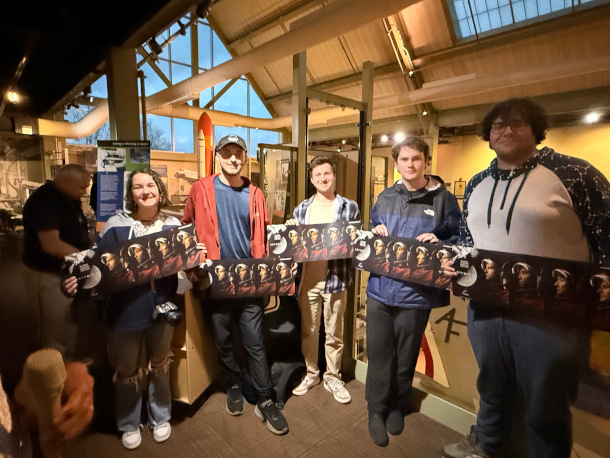
The University of New Hampshire Astronomy club, from left to right: Rachel Golubiewski, Joey Arena, Matthew Anderson, Liam Pearl, Ryad Ouhhabi. (Photo: Jennifer Stevens-Curwood)
CURWOOD: And I asked Rachel and the others from the astronomy club including
Matthew Anderson and Joey Arena what they might tell the astronauts right now, if they
could.
ANDERSON: When astronauts are far enough away from Earth and they look back on
it, it's almost spiritual how their perspective shifts. And in the modern day, with all of
what's been going on, I want to know how their modern perspective changes when they
see the earth, how it is now in its entirety, from their little ship going to the moon.
CURWOOD: What would you tell them, if you could?
ARENA: I'd tell them that they're the real life Fantastic Four. And I hope that they get
superpowers out there.
CURWOOD: And you, what would you tell them?
GOLUBIEWSKI: I would tell them that their bravery and courage is so admirable, and a lot
of people are willing to, I don't know, do some things with, you know, the things that
they're passionate about, but nobody is really willing to die for what they're passionate
about. And obviously, we hope that's not the case, but the fact that they're putting their
lives out there, and, you know, really just committing their life to this, I think, is an
incredible quality that we all should have for whatever we're passionate about and
courageous about.
DOERING: UNH astronomy students and others speaking with Living on Earth’s Steve Curwood, from the Artemis II launch party at the McAuliffe-Shepard Discovery Center in Concord, New Hampshire.
Links
About the McAuliffe-Shepard Discovery Center
Living on Earth wants to hear from you!
Living on Earth
62 Calef Highway, Suite 212
Lee, NH 03861
Telephone: 617-287-4121
E-mail: comments@loe.org
Newsletter [Click here]
Donate to Living on Earth!
Living on Earth is an independent media program and relies entirely on contributions from listeners and institutions supporting public service. Please donate now to preserve an independent environmental voice.
NewsletterLiving on Earth offers a weekly delivery of the show's rundown to your mailbox. Sign up for our newsletter today!
 Sailors For The Sea: Be the change you want to sea.
 The Grantham Foundation for the Protection of the Environment: Committed to protecting and improving the health of the global environment.
 Contribute to Living on Earth and receive, as our gift to you, an archival print of one of Mark Seth Lender's extraordinary wildlife photographs. Follow the link to see Mark's current collection of photographs.
 Buy a signed copy of Mark Seth Lender's book Smeagull the Seagull & support Living on Earth
© Copyright World Media Foundation. All Rights Reserved
Home | Contact | RSS | Donate | Newsletter