
Wastewater to Wealth
Air Date: Week of February 27, 2026
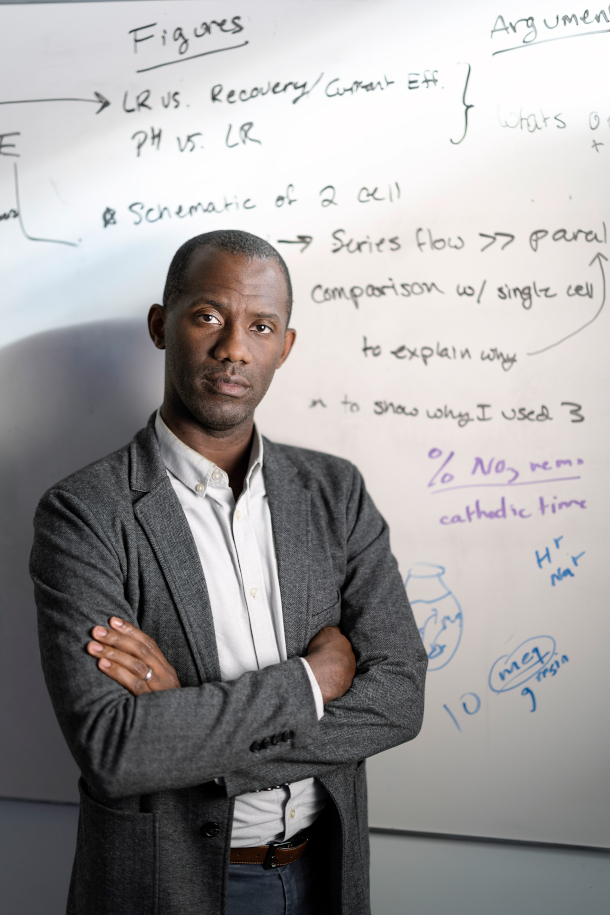
William Tarpeh is a 2025 MacArthur Fellow and a Stanford University Assistant Profesor. He’s a chemical engineer whose work centers on pulling useful chemicals from various kinds of wastewater. (Photo: Christopher Michel, Courtesy of Will Tarpeh)
Urine is packed with nutrients such as phosphorus and nitrogen, which can be pollutants when they enter the environment unchecked. But these can also be turned into vital fertilizer to nourish our crops, and 2025 MacArthur Fellow William Tarpeh, an Assistant Professor of Chemical Engineering at Stanford University, is developing methods for “refining” wastewater. He discusses with Host Steve Curwood how we can turn wastewater into wealth.
Transcript
BELTRAN: It’s Living on Earth, I’m Paloma Beltran
CURWOOD: And I’m Steve Curwood.
When nature calls and we flush, most of the time we don’t give a second thought to where our waste goes. But 2025 MacArthur Fellow William Tarpeh thinks a whole lot about wastewater and how it can be put to good use. Will uses his skills as an engineer to develop ways of pulling nutrients, such as phosphorus and nitrogen, from wastewater. Though these chemicals can be pollutants when they enter the environment unchecked, they can be made into vital fertilizer to nourish our crops. William Tarpeh is an Assistant Professor of Chemical Engineering at Stanford University and joins us now to discuss how we can turn wastewater into wealth. Hi Will congratulations and welcome to Living on Earth!
TARPEH: Thanks a lot. It's great to be here.
CURWOOD: So, your research works on ways to remove waste from wastewater treatment plants and turn what you remove into useful products. But let's get back to the basics here. In your mind, what is waste?
TARPEH: To me, waste is something that we've all sort of agreed on. We've agreed that something is waste based on where it is and how much of it there is. So for example, things we put in the trash can we call waste because we're not sure what else to do with them, but some of us have decided that we should recycle some of those things. And so waste is in some ways quite a social construct, if you will, but it has to do with what we deem as not valuable anymore, and that's some of the things that we try to change in my research group.
CURWOOD: It's kind of like the gardening saying that a weed is only a plant that's in a place we don't like it.
TARPEH: Yeah, that's a great analogy. Yes, we say the same thing, but just about chemical compounds. It's only a waste if it's in a place that we don't like it.
CURWOOD: So what you're doing with wastewater sounds a lot like what, let's face it, oil companies do with crude oil. Talk to me about that.
TARPEH: We use the term wastewater refining, and that's something we devised on purpose to sort of evoke what oil and gas companies do, but with a different type of feedstock, a different type of input. At an oil and gas refinery, a company takes in crude oil and then they have a bunch of processes to make a bunch of products. We immediately think of like gas that goes in our cars, but we can think of other fuels -- jet fuel, rocket fuel, plastics, lots of components of different things we use around the house all the time. We think about the same approach, but the input is wastewater. And so we need to design the next generation of processes that can help us turn wastewater into a lot of different products. Think fertilizers, fuels as well actually, commodity chemicals, things we use in our house all the time.
CURWOOD: I understand that one of your main focuses is actually human urine. And I'm reminded from working with people who are doing composting human "waste." Some of those efforts separate urine from the feces. Most of us don't think of urine as a so-called pollutant, because, well, it's natural. So what's your take on that?
TARPEH: Yeah, I think that's a fantastic take. I always say that people have recycled excreta, including urine, for millennia, right? This isn't a new idea. I think the new challenge in the 21st century is that people are more concentrated than ever. So we've got mega cities of over 10 million people, and we have dozens of those popping up in the world now. And so the question was, how can I recycle like my own urine or my family's urine on our household farm? That is a more feasible question than what do I do with 10 million people's urine if I'm miles and miles away from the nearest farm? And so that's what we think about, on how to concentrate what you want out of the urine, so that you're not carting around loads and loads of urine.
CURWOOD: I mean, yeah, 10 million people's pee. That's, that is a lot, isn't it?
TARPEH: It is. Fun fact, each of us pees around one liter per day. So that's like 10 million liters of pee per day.
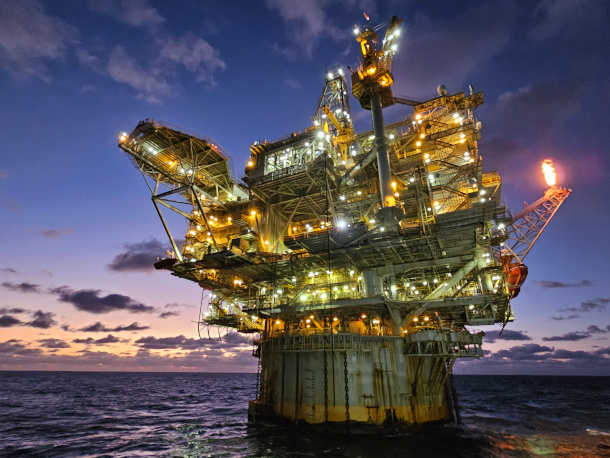
Much of Tarpeh’s work aims to treat wastewater the way that oil companies (like the one that runs this oil rig off the Gulf of Mexico) treat crude oil: he pulls the useful chemicals out of the original liquid and turns them into products. That’s why his team refers to the work as “wastewater refining.” (Photo: GuavaTrain, Wikimedia Commons, CC0)
CURWOOD: Okay well, why, of all things, study pee?
TARPEH: That's the question that my family continues to ask me, or they say, are you still studying that pee stuff? And I'm like, Yes. I started off with urine. The realization for me was that, like you mentioned, when people are using composting toilets, they usually separate the feces and the urine. And that most of the time, historically, has been for the benefit of the feces, if you will. If you want to make compost, or you want to make briquettes or charcoal, you want to dry out your feces. And so one of the best ways to do that is to collect the urine separately. So if you do that, then you've got this urine, and you have to do something with it. And so that was the realization I had early in my PhD and said, Okay, what are we going to do with this urine? It turns out that urine contains the majority of nitrogen, phosphorus and potassium that we excrete, and those are the three main nutrients that you purchase fertilizers based off of --- The NPK ratio is nitrogen, phosphorus, potassium. So if you want to go after those nutrients in wastewater, urine is the place that they're naturally separated or concentrated higher.
CURWOOD: And when it's not separated, when it's just plain pee or urine, it's rather polluting, isn't it?
TARPEH: Yes, exactly. And that's where we come back to the concept of waste like nitrogen and phosphorus, particularly as ammonia and phosphate. Those are fertilizer ingredients, but they can also over fertilize algae and water, and that can lead to these harmful algal blooms that some of us have seen. If you've seen green, kind of slimy water, that can be the product of having too much nitrogen or too much phosphorus in that bay, or that stream, or that river, that lake. These are problems that are growing exponentially decade over decade. And so we can stop some of those by removing the nitrogen and phosphorus. And while we're at it, why not make something valuable?
CURWOOD: Yeah, so how valuable is that nitrogen? How valuable is that phosphorus?
TARPEH: Yeah, it really depends where you are and what you make. So at the base level, with the fertilizers --- think like fertilizer you could purchase at the store, something like that --- it's around like $1 per kilogram. So these aren't very expensive components. And part of that is because fertilizer is very cheap and subsidized in the US. However, we've shown that in places like Kenya, where I've done some of my field work, making fertilizer from urine is actually one of the cheapest ways to do it because it's locally produced. There, ertilizer is produced outside of the country, by and large, and then it's imported into the country. And so there are huge markups every time the fertilizer changes hands. So one of the huge benefits of our approach, that honestly, I didn't anticipate, was simply that it's locally derived fertilizer. Where there are people, there's urine, and therefore we can make fertilizer. And it was about 40% cheaper than imported fertilizers.
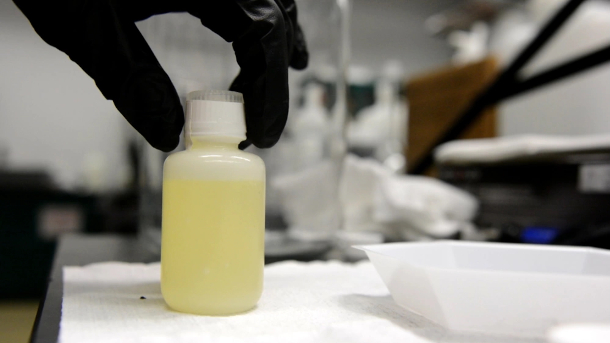
William Tarpeh researches how to pull chemicals used in fertilizer from human urine because it contains high concentrations of phosphorus, nitrogen, and potassium, the key ingredients in many fertilizers. This is a sample from a U.S. Army laboratory in Maryland. The appearance of U.S. Department of Defense (DoW) visual information does not imply or constitute DoW endorsement. (Photo: David McNally, Army Research Laboratory, dvidshub.net)
CURWOOD: So there's a problem in our oceans with too much nitrogen, and that comes from fertilizer runoff from people who use commercial nitrogen as part of fertilizer. To what extent does your work give us some insights as to how we might be able to shift from this sort of chemical burden of using nitrogen-based fertilizer to recycling and having more of a virtuous circle there?
TARPEH: Absolutely, yeah, most of the work we do is motivated by, like you said, a virtuous circle or a vision of a circular economy. Let's take waste that is causing a problem and bend it from a line, a linear economy, like a take-make-waste economy and turn it into a circle where you can have nitrogen that's been used six or seven times. So when it comes to the ocean, a lot of our wastewater treatment plants, at least in coastal places, are on the bay. Like here in San Francisco, several of our 30 plus treatment plants discharge directly to the ocean or to the bay. And what that means is that we get harmful algal blooms. So we got one a few years ago for the first time in several years, and it killed thousands of fish in Oakland. It was a huge eyesore. There were lots of challenges for recreation and tourism. A big contributor to that is our wastewater treatment plants, because at the time, they were not removing much nitrogen. So now there's a bunch of effort to do that. If we look across the country, somewhere like the Chesapeake Bay near where I grew up, there have been limitations on nitrogen and phosphorus for decades, like since the late 1990s for the same reason. But if we are able to recover valuable products, what we can do is doubly incentivize their removal. We're preventing pollution and making something valuable that people need. And in the meantime, since we're making those fertilizers in the green or circular way, we're reducing some of the greenhouse gas emissions associated with traditional fertilizer production.
CURWOOD: So talk to me about these various projects you've done. You mentioned that, in Kenya, locally produced urine is actually a pretty good source of fertilizer for folks who don't have a lot of money. What about here in the United States, say, California, the farmlands and elsewhere. Where does your work translate into giving people a ecological advantage?
TARPEH: Yeah, so we've started some work on farm in Salinas, California, a little bit south of us. And it's in partnership with the US Department of Agriculture, and we've managed to measure different nitrogen forms in runoff at that farm. And so things like nitrate, which is another form of nitrogen --- that actually can cause forms of thyroid cancer, also can cause several disorders for infants --- that nitrate just goes into the water and eventually makes its way to streams, rivers, lakes, et cetera. What we've done is developed a way to capture that nitrate and convert it, at least partially, into ammonia, so that it can be a product that you use on site. So there we're making a small circle, if you will, on the farm, so that the nitrate that would leave the farm gets trapped, converted to ammonia that we can then use on the farm, and again, avoid the energy and emissions of the farm that would have been not importing but transporting fertilizers for use.
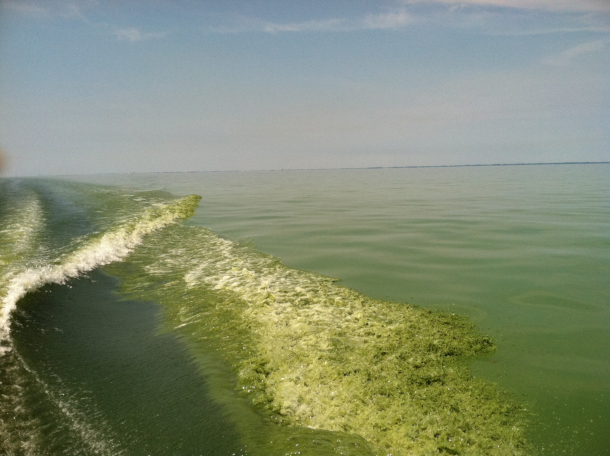
The buildup of phosphorus and nitrogen in natural bodies of water can lead to harmful algal blooms, like this one in Lake Erie. (Photo: NOAA Great Lakes Environmental Research Laboratory, Wikimedia Commons, CC BY-SA 2.0)
CURWOOD: So we've been talking predominantly about fertilizer, urine, but what other products do you envision coming from wastewater?
TARPEH: Yeah, so in my group, really the vision is we are thinking about wastewater as really broadly defined. Like you said, going from the definition of what is a waste and what is a wastewater, to what pollutants are there and what products can be generated. So we started with nitrogen and phosphorus, because that was where some of the work made the most sense. Around 2019, 2020, we started to expand our portfolio, if you will, of pollutants and products we were interested in. Now we're thinking a lot, in addition to those nitrogen phosphorus cases, about things like sulfur, lithium, nickel, cobalt, and getting into some of these higher value products, if you will. So people may have heard the term critical minerals. If you've looked at, I don't know, Department of Energy things, there's a lot of that in the news, in the science news, let's be clear. But these critical minerals are ones where the domestic supply is somehow vulnerable, and so then recycling them becomes very important.
CURWOOD: So you're suggesting that we could get the minerals we might need for smartphones or batteries from sewage?
TARPEH: Yeah. So rather than sewage there, because those are in low concentrations, we instead go to, actually, industrial water. So one of the things we do is look at when batteries are recycled, we can actually leach the old batteries. By that, I mean put them in acid and get the ions out, and then make new batteries. So we can make a circular economy out of batteries. We can also do that with waste electronics. Think some of the circuit boards and other things that get wasted. They often get leached, and then we can make pure forms of each metal that you need, so that you can go back to the front end of the factory.

Not only does Tarpeh research how to utilize chemicals from sewage, but his team also explores how to pull critical minerals, such as lithium, from industrial wastewater. Those minerals could then be used to make smartphones, like those pictured. (Photo: Ka Kit Pang, Wikimedia Commons, CC BY-SA 4.0)
CURWOOD: So how does environmental justice fit into the work you're doing?
TARPEH: Yeah, it's a great question. We are constantly thinking in my group and challenging ourselves to think about, to think big, right? We think very small, and think about, how do you separate one molecule from another? But when I say think big, what I mean is, we think, if lots of people in the world adopted this technology, what would be the benefits and what are the risks? And some of those risks tie into environmental justice. Where does the factory, the refinery, go? Who's around that refinery, and to what extent do they have a say in it? Another thing we've been doing is thinking a lot about how recovering value from people's waste, so going back to the municipal wastewater case, can be a way to improve economic outcomes in rural and low-income communities. So we've had a project actually co-led by another MacArthur Fellow, Catherine Coleman Flowers, 2020, that focuses on septic tanks in Lowndes County, which is between Montgomery and Selma, Alabama. And that's a predominantly Black, low-income rural community, and they have experienced septic tank failures for several years. And so we've been documenting those septic tank failures and then thinking of ways with the community to generate value from septage such that there might be a way to reduce the costs of septic tanks and improve the performance.

Will Tarpeh is excited to see his team expand the number of chemicals they can pull from various types of wastewaters as they continue their research. (Photo: Christopher Michel, Courtesy of Will Tarpeh)
CURWOOD: Okay, tell me, how are you going to do that? What are the most promising paths?
TARPEH: Yeah, so the promising paths here are really embedded in the communities. We've been doing a lot of focus groups and workshops and surveys, but from a scientific perspective, the septic tank is beautiful because it captures the waste. So we have devices that are pretty small, and they can just attach to the septic tank, basically, and recover nitrogen in a fairly passive way. And then you can imagine, potentially, a micro enterprise or a small company that goes around and collects that valuable nitrogen, sells it for revenue, and then invests that back into improving the septic tanks. And in the meantime, you're getting someone to check your septic tank more often, because there's an incentive to make sure products are being produced.
CURWOOD: What's next for you?
TARPEH: I'm at a fun time in my career. I've been at Stanford about seven and a half years, so I am in academia. We call it. I'm currently up for tenure, and so it's a natural time to think what's next. These days, I'm thinking about both translating what we do out of the lab, like we've talked about a little bit today, and also expanding to higher and higher value products. So some of the things on the nitrogen side, I said we'd make fertilizers, but we're continuing to say --- business, I don't know, maxim is like a diverse portfolio is a productive portfolio, right? And so we're applying that to the products we make. Can we make fuels like hydrazine, like literal rocket fuel from urine? Or can we make hydroxylamine, which is a precursor to a lot of pharmaceuticals? Or just what else can we make? And we're thinking, can we tune what we make? Like it's one thing to have a device that makes one product. It's another to have a device that can make 10 products, and you can choose which one you want it to make. So that tuneability is something we're really excited about.
CURWOOD: William Tarpeh is an Assistant Professor of Chemical Engineering at Stanford University and a 2025 MacArthur Fellow. Thanks so much Will for taking the time with us today.
TARPEH: Thanks for having me.
Links
Learn more about William Tarpeh’s MacArthur fellowship here.
Living on Earth wants to hear from you!
Living on Earth
62 Calef Highway, Suite 212
Lee, NH 03861
Telephone: 617-287-4121
E-mail: comments@loe.org
Newsletter [Click here]
Donate to Living on Earth!
Living on Earth is an independent media program and relies entirely on contributions from listeners and institutions supporting public service. Please donate now to preserve an independent environmental voice.
NewsletterLiving on Earth offers a weekly delivery of the show's rundown to your mailbox. Sign up for our newsletter today!
 Sailors For The Sea: Be the change you want to sea.
 The Grantham Foundation for the Protection of the Environment: Committed to protecting and improving the health of the global environment.
 Contribute to Living on Earth and receive, as our gift to you, an archival print of one of Mark Seth Lender's extraordinary wildlife photographs. Follow the link to see Mark's current collection of photographs.
 Buy a signed copy of Mark Seth Lender's book Smeagull the Seagull & support Living on Earth
© Copyright World Media Foundation. All Rights Reserved
Home | Contact | RSS | Donate | Newsletter